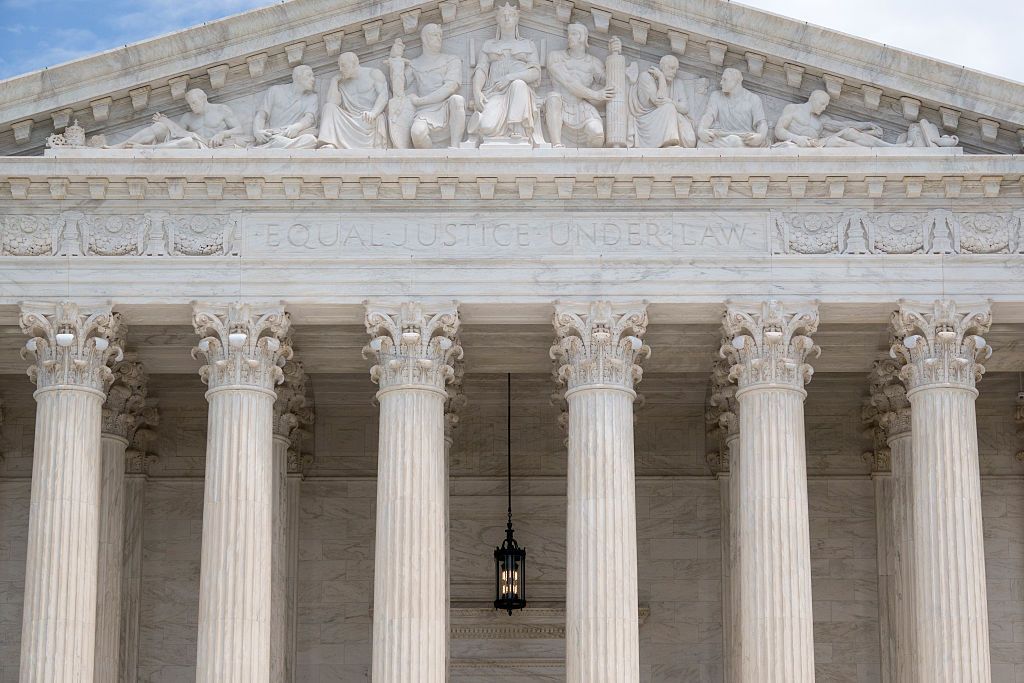









Just as the 2026-27 term was getting underway, the Supreme Court once more sided with the Trump administration with a stay order in what has been variously called the emergency, shadow, interim, or equity docket. The case, Department of Homeland Security v. D.V.D., involved the government’s plan to deport undocumented persons without a hearing to third countries where they might be subject to torture or other persecution.
Though the stay generated some publicity, the court permitting a Trump policy plausibly seen as violating fundamental rights pending further review is, by now, hardly news. Yet the D.V.D. order is newsworthy in another regard. It brings together the court’s now familiar emergency docket leanings with another tendency – its increasing disregard, if not antipathy, to international human rights law. That combination is not only news. It’s news that spells trouble for anyone concerned with immigrant rights and the rule of international law. Still less does any of this bode well given that the court has now granted cert to consider the merits.
***
D.V.D. involves a class action on behalf of undocumented aliens subject to a February 2025 Department of Homeland Security policy mandating immediate removal from the United States to a third country. Immediate means just that. Those subject to the new initiative would have no opportunity to argue that they have a valid fear of torture or other forms of mistreatment to the new destination, so long as DHS received “credible,” non-individualized “diplomatic assurances that [any person being deported] will not be persecuted or tortured.” For all other countries the detainee would have 24 hours to demonstrate that it would be “more likely than not” that she or he would be subject to persecution or torture. If so, the case would be referred to an immigration judge. If not, Immigration and Customs Enforcement must “consider” filing a motion to reconsider or select another country.
The named plaintiffs demonstrate the dangers the third-country policy poses. Each one goes by only initials. D.V.D. is a Cuban national with severe mental illness who is afraid of deportation to a country where he will be deprived of psychiatric treatment and be imprisoned on arrival. O.C.G is a gay man from Guatemala who already “has faced multiple death threats on account of his sexual orientation" in his home country and “was kidnapped and raped” in Mexico. M.M., a citizen from Honduras, had been severely beaten by her husband and dreads him finding her in a “third country,” as he already did once. As members of a certified class, they, by definition, share common questions of law and fact with countless others.
The key common question of law and fact for the current stay centers on whether DHS must provide persons it intends to remove to a third country: 1) notice of which third country to which it intends to remove the individual; as well as 2) a meaningful opportunity to show the basis for a fear of likely being subject to torture or persecution.
Those challenging the DHS policy rely on two federal statutes. In particular, section 241(b)(3)(A) of the Immigration and Nationality Act, codified as 8 U.S.C. section 1231(b)(3)(A), provides that “the Attorney General may not remove [a noncitizen] to a [third-country] if the Attorney General decides that the [noncitizen’s] life or freedom would be threatened in that country because of the [non-citizen’s] race, religion, nationality, membership in a particular social group, or political opinion.” Likewise, section 2242(a) of the Foreign Affairs Reform and Restructuring Act, codified as a statutory note to 8 U.S.C. section 1231, states that that it shall be the policy of the United States “not to expel, extradite, or otherwise effect the involuntary return of any person to a country in which there are substantial grounds for believing the person would be in danger of being subjected to torture, regardless of whether the person is physically present in the United States.” The regulation implementing this policy provides that “f the immigration judge determines that the alien is more likely than not to be tortured in the proposed country of removal, the alien is entitled to protection under the Convention Against Torture.”
Neither statute expressly requires notice and an opportunity to be heard. Nor do the related regulations to implement the statutes, which provide for individualized consideration of persecution and torture claims, but do not expressly prescribe prior notice nor an opportunity of such.The U.S. District Court for the District of Massachusetts and the U.S. Court of Appeals for the 1st Circuit nonetheless held that they are best read as implicitly requiring those protections. These holdings asserted that the two laws, together with associated regulations, are most sensibly read to require procedural protections giving a person notice of which third country to which they will be removed and an opportunity to demonstrate that they would face torture or persecution there. Bolstering these interpretations was the venerable cannon of constitutional avoidance: Not to require notice and an opportunity would risk interpreting the two statutes in a way that would violate procedural due process under the Fifth Amendment. As Justice Louis Brandeis perhaps most famously articulated the canon, “it is a cardinal principal that the Court will first ascertain whether a construction of [a] statute is fairly possible by which the question [of its constitutionality] may be avoided.”
The Supreme Court subsequently granted a stay on the ground that the government would likely succeed on the merits. The court’s lack of any substantive explanation for its ruling, which has become commonplace on the emergency docket, was troubling enough. But even more disturbing was any apparent engagement with international law, much less international human rights. Even as background, that body of law would appear to be relevant to a situation involving one country detaining asylum speakers claiming to escape severe persecution from their nation, only to send them to another potentially authoritarian state without any opportunity to demonstrate that their removal would subject them to the same type of mistreatment that caused them to flee their home country to begin with. As it happens, this case invites and even compels consideration of international law as a matter of well-settled U.S. legal doctrine.
***
A cornerstone of both international refugee and human rights law goes under the French term, non-refoulment. Under this doctrine, a nation may not oblige a person to return – refoule – to a territory where “where his life or freedom would be threatened on account of his race, religion, nationality, membership of a particular social group or political opinion." This prohibition appears in several landmark treaties, including the 1951 Refugee Convention, its 1967 Protocol, and the 1987 Convention Against Torture and Other Cruel, Inhuman or Degrading Treatment or Punishment. It is also widely accepted that the principle of non-refoulment has attained the binding status of customary international law. Through both its treaties and international custom, this obligation applies to the United States.
International non-refoulement also implicates corollaries directly relevant to the Supreme Court’s consideration. The UN Committee Against Torture, which implements CAT, has stated that diplomatic assurances from a state are not sufficient to justify refouling an individual where there is clear evidence that the receiving state would engage in torture or other mistreatment. More generally, the Executive Committee of the UN Office of High Commissioner for Refugees has set out extensive procedural protections to enable a person to argue against deportation to a state likely to engage in persecution, including some, like the right to consult a UNHCR representative, that go well beyond the opportunity sought by the asylum seekers in D.V.D. These bodies, like the district court and 1st Circuit on domestic grounds, concluded that the right against non-refoulement would mean little unless the person facing persecution had some opportunity to contest the removing government’s say-so.
How a nation’s international law obligations do or do not come down into its domestic legal system could well fill up a year of columns. Suffice is to say in the present case several well-settled American legal doctrines invite, if not mandate, their application.
The most obvious route involves FARRA and congressional intent. In 1988 President Ronald Reagan, with the advice and consent of two-thirds of the Senate two years later, made the U.S. a party to CAT. Congress enacted FARRA in particular to incorporate CAT’s provisions with respect to non-refoulement. Indeed, the statute tracks CAT’s language closely, making it the policy of the United States “not to expel, extradite, or otherwise effect the involuntary return of any person to a country in which there are substantial grounds for believing the person would be in danger of being subjected to torture, regardless of whether the person is physically present in the United States.”
Both the lower federal courts in D.V.D. noted FARRA’s general purpose to incorporate CAT’s non-refoulement prohibition en route to holding that the substantive limit on removal would have little practical meaning without the procedural protection of a deportee’s opportunity to be heard. They could have gone even further. A more powerful argument would have been to emphasize Congress’ intent to bring the U.S. in line with not just CAT, but with the global legal commitment to non-refoulment – a commitment at least worth a mention by name.
Then there is the Charming Betsy. In that celebrated 1804 case, Chief Justice John Marshall proclaimed that “an act of congress ought never to be construed to violate the law of nations, if any other possible construction remains.” Applying the Charming Betsy canon, any ambiguities in the INA, which is not directly tied to CAT, or for that matter FARRA itself, should be interpreted in a way that avoids placing the U.S. at risk of violating evolving customary international law. Among other things, that means not naively relying on a state’s diplomatic representations that it is not repressive. No less importantly, it also confirms that argument that the right not to be refouled means little without an opportunity to contest the refoulement.
Finally, there is the federal court’s authority to effectively fashion national common law rules to draw upon even those international standards that have yet to achieve the near universal status of international custom. Here the precedent is the court’s landmark 1964 decision in Banco Nacional de Cuba v. Sabbatino. In that case, the court applied that act of state doctrine, which holds that the courts of one nation state will accept the official acts of another undertaken within its own borders, to side with a Cuban state bank over a U.S. corporation. This it did even though the majority held that the doctrine had not achieved the status of binding customary international law. But the court applied the doctrine in any event using its Article III judicial power to fashion rules out of respect for international comity and widespread practice.
So too with D.V.D. Even if one views the procedural protections against non-refoulement as not quite a matter of binding international custom, Sabbatino affords the federal courts a rationale to mandate them nonetheless. Doing so, moreover, would have the further basis of the well-established power of the federal courts to fashion common law rules to fill, in the words of Judge Henry Friendly, the “interstices” of federal statutes.
In its holding in D.V.D., the Supreme Court did no such thing, ignoring the requirements of international law altogether. Sadly, this is nothing new from the court, which – in its present incarnation in particular – has grown hostile to this body of law. The justices would do well to recall the words of the first chief justice, John Jay, who wrote, “We had become a nation. As such we were responsible to others for the observance of the Laws of Nations; and as our national concerns were to be regulated by national laws, national tribunals became necessary for the interpretation and execution of them both.”
Continue reading...
[ H/T SCOTUSblog ]