






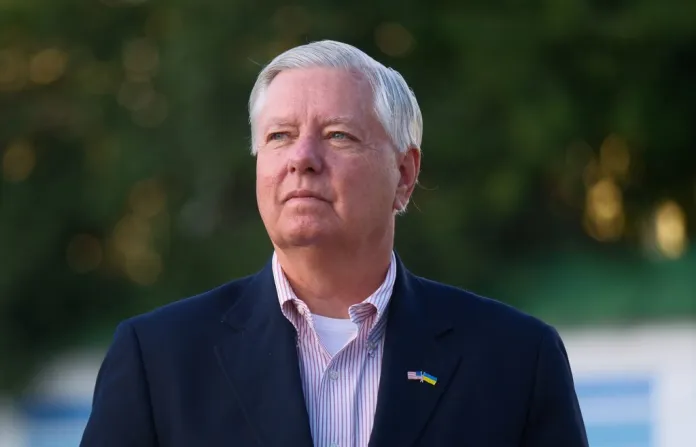
As chance would have it, I happened to be roaming the halls of the Russell Senate Office Building just a few weeks ago when I bumped into — almost literally — Sen. Lindsey Graham. I had met him briefly on two different occasions years ago, each time at one of those functions where you briefly meet such figures, but couldn’t say I knew him; he was busy, I was busy, and in any case he was not on my list of people I needed to speak with, so it was a fleeting encounter with no words passed, the type that happens a dozen or more times every day.
Had I known he was to pass away less than a month later, I should like to think that I would have taken a second to interrupt his movements long enough to simply tell him “thank you.” I didn’t know, of course, no one did, and life doesn’t work that way in any event. Nevertheless, his was a life of service worthy of a measure of gratitude, however belated.
You wouldn’t get that from reading some of the eulogies. As our post-modern political culture no longer seems to suffer any moral limits, there is no shortage of vitriol among the hard Left, vilifying the man’s memory as they vilified the man himself. The more polite ones tend to go along the lines of lamenting that he may have been an all right guy at one point, but sadly sold his soul to the devil — President Donald Trump — in his misbegotten latter years.
One can find examples in the opposite direction from a few on the Right as well. There are certainly plenty of MAGA-types who, like their brethren on the Left, have never forgiven him for being a hawkish “neocon,” nor for his close friendship with the late Sen. John McCain.
It’s impossible — let alone ungrateful and deceiving — to distill a public career such as Graham’s into such a reductionist sound bite. His conservatism did not always follow a strictly orthodox playbook (does such a thing exist?), and it is pro forma, I suppose, to declare the obvious — that every now and then he made decisions or supported policies with which I disagreed.
But he was nonetheless a principled conservative, politically, practically, and temperamentally. One of his greatest moments, frequently replayed on social media over the past week, was his blistering rebuke of his Democratic colleagues during Brett Kavanaugh’s Supreme Court confirmation hearing, whose behavior was disgraceful enough to supplant the term “borking” from the political lexicon. One got the sense, listening to him, that his disgust and outrage were catalyzed as much by the insult to the process as by the insult to the man. Process and institution — “establishment”, one might say, tongue-in-cheek — were important to Graham as a conservative, evidenced by his refusal to stoop to such depths during the appointments of justices with whom he was philosophically unaligned, but who met the necessary requirements as established by the Constitution.
He was, of course, best known for his clarity regarding foreign policy and America’s unique role in the world. He was a “hawk”, yes, but not blindly or reflexively so. His championship of American power abroad was rooted in a clear-eyed appraisal of the world, America’s interests in it, and who posed a threat to them. This was not a general position unique to Graham — in fact, until fairly recently, it was the entire basis of the conservative Republican approach to foreign policy — but he understood and crystallized the issues better than many of his colleagues.
And what of the Trump factor? Like many conservatives, Graham had little use for Trump in the lead-up to 2016 and was repulsed by the puerile actions of Trump and his acolytes in the aftermath of the 2020 election. But his sense of political reality was as keen as his sense of international reality; he knew Trump was at the helm, and he knew Trump didn’t countenance opposition, and he knew that his perspectives on foreign policy were too important to sacrifice on an altar of obdurance. His pivot to support Trump was neither an act of shallow political opportunism nor an abandonment of principle, but a shrewd recognition of how best to keep those principles front and center.
OPINION: LINDSEY GRAHAM IS GONE. HIS MIDDLE EAST PLAN DOESN’T HAVE TO DIE WITH HIM
And thank God for that prescience. Graham’s unique role was to keep Trump as grounded as he could in international reality, against a rising cadre of populist, neo-isolationist voices gaining the upper hand. The Republican Party is at a crossroads, a tug of war between populism and conservatism, and Graham sought to be both a bridge and an anchor.
It is tempting to mark the passing of great men as a sort of generational terminus, that they were the last of their kind, that their passing represents the end of an epoch, like George H.W. Bush or Henry Kissinger, for instance. With Graham, his death coming as untimely as it did, the sense was less generational than political; he did, indeed, represent one of the last stalwarts of traditional conservatism in the Republican Party. There will be immediate, practical, political impacts stemming from his family’s loss, certainly; the far greater impacts for a free world, and for the country which he loved and served so well, will depend a great deal on whether the courage remains to carry on his legacy.
Kelly Sloan (@KVSloan25) is a Denver-based public affairs consultant and columnist.
Continue reading...
[ H/T Washington Examiner ]