







Guest Post by Alex Berenson
Christopher Hoyt doesn’t have super-fancy insurance coverage.
He, his wife, and his 21-year-old son live in an upscale suburb of Birmingham, Alabama. They’re both 57. After Covid, he left his job to work for himself as a health and well-being coach.
Since then Hoyt has insured himself and his family through BlueCross BlueShield of Alabama — like almost everyone else in the state. BlueCross holds a near-monopoly on Alabama’s private health insurance market, with an 84 percent share, according to the American Medical Association. That is the tightest hold any insurer has on any state by far. In only one other state, Kentucky, does any single company have over 65 percent of the market.
In 2025, Hoyt paid BlueCross BlueShield just under $2,487 a month for insurance for his family — just under $30,000. For 2026, the company raised his rates almost 30 percent, to $3,156 a month — almost $38,000.
Again, his plan is far from fancy. This year it included a $10,000 per-person in-network maximum for out-of-pocket costs.
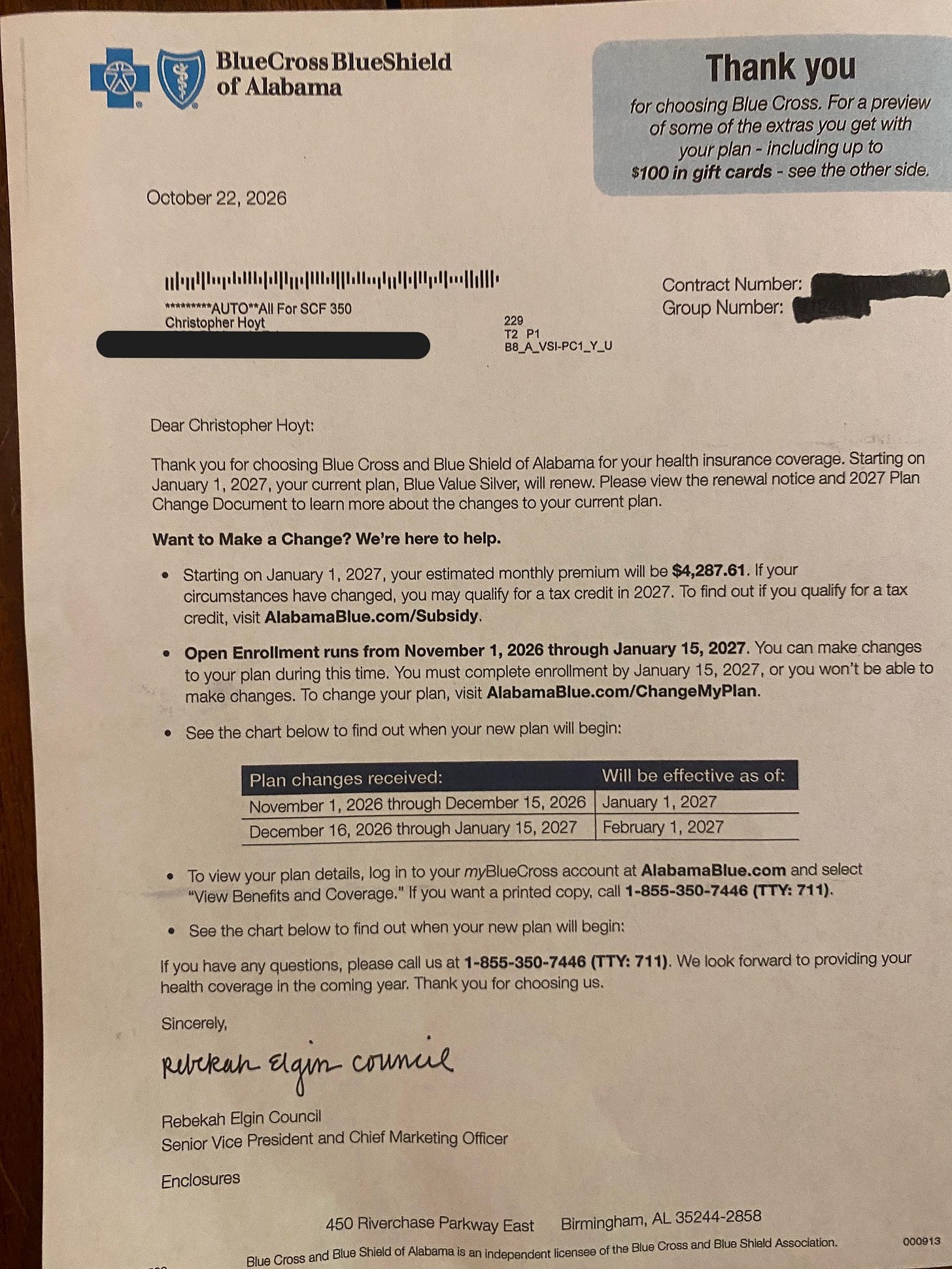
Last week, BlueCross BlueShield sent Hoyt a renewal notice for his family plan for 2027.
Next year’s monthly premium?
$4,287.61.
That’s an increase of almost 36 percent compared to this year, and about double the average American monthly mortgage.
Oh, and his in-network maximum will rise to $12,000.
Oh, and he can no longer use doctors or hospitals outside Alabama at all, except for “accidental injury or medical emergency.”
All this for the low, low price of $51,451.32 for 2027.
Yes, $51,451.32.
—
(See for yourself)
—
I asked Hoyt whether he had had some extraordinary medical expense this year that might help explain the increase. His answer, unedited:
Regarding my health, neither my wife (57), son (21), or I (57) have had a health care incident that required a large outlay by the insurance company. For transparency sake, I had a calcium CT test earlier this year that triggered a series of additional heart and cardiovascular tests. My cardiologist put me on a statin and told me to modify my diet. Beyond that, he did not appear terribly concerned. Also, an old athletic injury caught up to me and it will require shoulder replacement surgery (severe arthritis). As I have seen a cardiologist and orthopedist in 2026, BC/BS is aware of these issues. Below is a picture taken this summer of my wife and me with our children. I think it will show that we are generally happy, healthy people.
(Note: It did.)
Shoulder replacement surgery isn’t cheap. But Hoyt and his previous employer have faithfully paid premiums for many years; the point of insurance is (or should be) to cover unexpected and large expenses.
If BlueCross BlueShield of Alabama is demanding this increase to punish Hoyt for the shoulder operation, it is undercutting its own reason to exist. If it is raising prices like this — over 70 percent in two years — for a broad swath of private individual customers, the system is even closer to collapse than we know.
Unreported Truths readers know that I often regard health insurance companies as unfairly tarred, at least compared to big hospital systems that have merged to acquire near-monopoly power in many cities and states.
But BlueCross BlueShield of Alabama — which, like most of those hospital systems, is technically a nonprofit — shows that when insurers have market power, they too will use it.
Last month, AL.com (essentially, the successor to the Birmingham News), published an investigation into the company that focused on its aggressive negotiating tactics and care denials. In one case, BlueCross had refused to pay for advanced rehabilitation treatment for a 23-year-old who had suffered a brain bleed. (The company reversed the decision after the article.)
By the way, if you want to know what BlueCross’s executives make, you can’t. In 2015, Alabama passed a law hiding their salaries from the public, even though BlueCross BlueShield is a nonprofit. (Because of another loophole, it also does not file Form 990s with the Internal Revenue Service.)
—
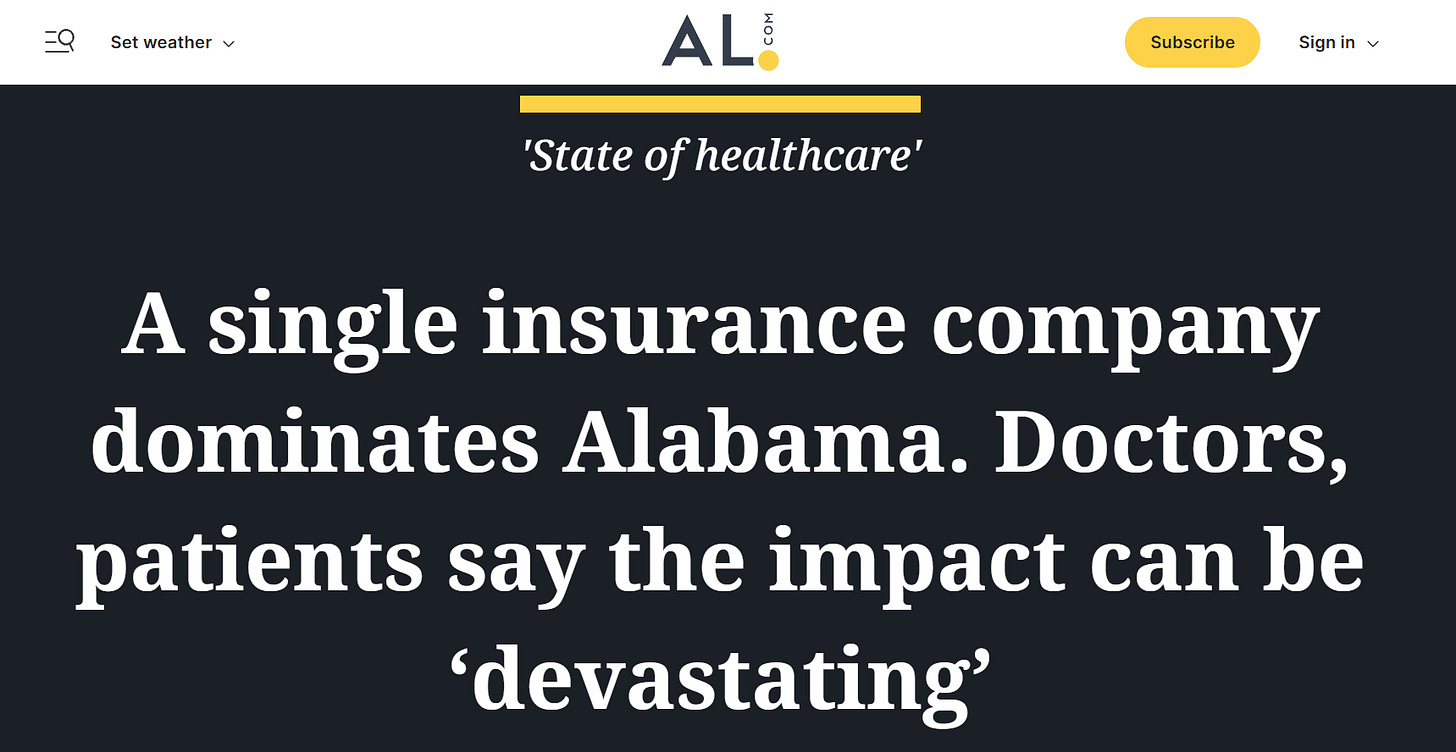
(SOURCE)
—
As we discussed his situation, Hoyt told me he wanted to be clear — he and his wife have a stake in a successful family business and will be able to pay this increase. He is not pleading poverty.
But, of course, a $50,000 a year health insurance bill for a family of three is both unaffordable without massive subsidies for most Americans — and unsustainable societally.
As Hoyt wrote: Whether I can afford to pay the increase or not, I still believe the system is extraordinarily broken and benefits hospitals, insurance companies, and drug companies.
Amen.
Tweet
Continue reading...
[ H/T The Burning Platform ]
A UT reader just shared his 2027 renewal offer from Blue Cross/Blue Shield. $4,287.61 a month – with a $7,000 in-network deductible and minimal out-of-state coverage. Medicine is eating itself.
Christopher Hoyt doesn’t have super-fancy insurance coverage.
He, his wife, and his 21-year-old son live in an upscale suburb of Birmingham, Alabama. They’re both 57. After Covid, he left his job to work for himself as a health and well-being coach.
Since then Hoyt has insured himself and his family through BlueCross BlueShield of Alabama — like almost everyone else in the state. BlueCross holds a near-monopoly on Alabama’s private health insurance market, with an 84 percent share, according to the American Medical Association. That is the tightest hold any insurer has on any state by far. In only one other state, Kentucky, does any single company have over 65 percent of the market.
In 2025, Hoyt paid BlueCross BlueShield just under $2,487 a month for insurance for his family — just under $30,000. For 2026, the company raised his rates almost 30 percent, to $3,156 a month — almost $38,000.
Again, his plan is far from fancy. This year it included a $10,000 per-person in-network maximum for out-of-pocket costs.
Last week, BlueCross BlueShield sent Hoyt a renewal notice for his family plan for 2027.
Next year’s monthly premium?
$4,287.61.
That’s an increase of almost 36 percent compared to this year, and about double the average American monthly mortgage.
Oh, and his in-network maximum will rise to $12,000.
Oh, and he can no longer use doctors or hospitals outside Alabama at all, except for “accidental injury or medical emergency.”
All this for the low, low price of $51,451.32 for 2027.
Yes, $51,451.32.
—
(See for yourself)
—
I asked Hoyt whether he had had some extraordinary medical expense this year that might help explain the increase. His answer, unedited:
Regarding my health, neither my wife (57), son (21), or I (57) have had a health care incident that required a large outlay by the insurance company. For transparency sake, I had a calcium CT test earlier this year that triggered a series of additional heart and cardiovascular tests. My cardiologist put me on a statin and told me to modify my diet. Beyond that, he did not appear terribly concerned. Also, an old athletic injury caught up to me and it will require shoulder replacement surgery (severe arthritis). As I have seen a cardiologist and orthopedist in 2026, BC/BS is aware of these issues. Below is a picture taken this summer of my wife and me with our children. I think it will show that we are generally happy, healthy people.
(Note: It did.)
Shoulder replacement surgery isn’t cheap. But Hoyt and his previous employer have faithfully paid premiums for many years; the point of insurance is (or should be) to cover unexpected and large expenses.
If BlueCross BlueShield of Alabama is demanding this increase to punish Hoyt for the shoulder operation, it is undercutting its own reason to exist. If it is raising prices like this — over 70 percent in two years — for a broad swath of private individual customers, the system is even closer to collapse than we know.
Unreported Truths readers know that I often regard health insurance companies as unfairly tarred, at least compared to big hospital systems that have merged to acquire near-monopoly power in many cities and states.
But BlueCross BlueShield of Alabama — which, like most of those hospital systems, is technically a nonprofit — shows that when insurers have market power, they too will use it.
Last month, AL.com (essentially, the successor to the Birmingham News), published an investigation into the company that focused on its aggressive negotiating tactics and care denials. In one case, BlueCross had refused to pay for advanced rehabilitation treatment for a 23-year-old who had suffered a brain bleed. (The company reversed the decision after the article.)
By the way, if you want to know what BlueCross’s executives make, you can’t. In 2015, Alabama passed a law hiding their salaries from the public, even though BlueCross BlueShield is a nonprofit. (Because of another loophole, it also does not file Form 990s with the Internal Revenue Service.)
—
(SOURCE)
—
As we discussed his situation, Hoyt told me he wanted to be clear — he and his wife have a stake in a successful family business and will be able to pay this increase. He is not pleading poverty.
But, of course, a $50,000 a year health insurance bill for a family of three is both unaffordable without massive subsidies for most Americans — and unsustainable societally.
As Hoyt wrote: Whether I can afford to pay the increase or not, I still believe the system is extraordinarily broken and benefits hospitals, insurance companies, and drug companies.
Amen.
Tweet
Continue reading...
[ H/T The Burning Platform ]