





The biggest spy scandal of the 21st century might be unfolding. And it offers important clues about how the Chinese Communist Party operates.
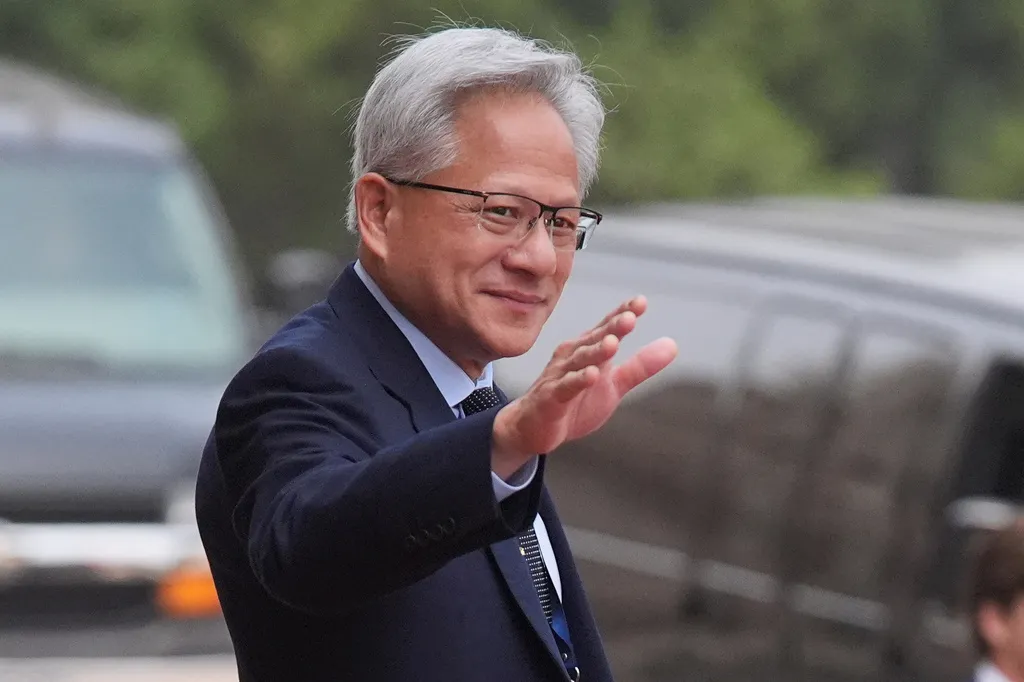
Nvidia CEO Jensen Huang has resigned after confessing to adultery. Huang, the co-founder of a company at the forefront of America’s AI arms race with China, is accused of having multiple affairs, including with a woman, Alice Huang, with deep ties to the CCP.
Alice Huang is a Chinese national and executive at Megaspeed, a Singapore-based company. According to the New York Times, Megaspeed has been “under scrutiny for possibly steering advanced Nvidia A.I. chips to China.” Worse still, the newspaper reported that “American officials had concluded that” Alice Huang “was a Chinese intelligence asset, funneling information to Beijing.”
President Donald Trump was reportedly briefed about the findings a year ago. Several U.S. lawmakers have called for investigations. Sen. Tim Scott (R-SC), the current chairman of the U.S. Senate Committee on Banking, Housing, and Urban Affairs, has requested that Huang appear before his committee for a public hearing.
The emerging scandal has attracted bipartisan concern and considerable media attention. This is unsurprising. The Nvidia story, with its unimaginable wealth, sex, and the fate of nations hanging in the balance, is ready-made for a Netflix documentary.
The full details of what transpired have yet to be revealed. But even now, important lessons can be learned.
For many years, the CCP was widely considered to be amateurish in its approach to influence and espionage operations. Many Western analysts believed that China used what was called a “thousand grains of sand” approach to intelligence gathering.
As Alex Joske noted in his 2022 book, Spies and Lies: How China’s Covert Operations Fooled the World, this was the belief that China relied on “ad-hoc masses of ethnic Chinese amateurs to steal huge amounts of low-grade information, with relatively little involvement by professional spies and intelligence agencies.”
For years, the “grain of sand” concept dominated Western assumptions about how the CCP conducts espionage. China’s intelligence capabilities were held in low regard for much of the Cold War and well into the early 2000s.
But the assumption that China almost exclusively recruits from ethnic Chinese communities is outdated, if it was ever true. And the idea that the CCP was a neophyte at spying runs counter to the history of the CCP itself.
The CCP’s rise to power is inseparable from its prowess at intelligence and influence operations. Communist China has long been exceptional at making friends and influencing people.
The CCP’s first spy service, then called the Central Committee Special Branch, was set up in Shanghai on Nov. 11, 1927. This was a full two decades before the Chinese Communist victory in China’s on-again, off-again, decadeslong victory in the Chinese Civil War. And it was long before the founder of that communist regime, Mao Zedong, gained full and total control of the CCP.
Fittingly, no less a figure than Zhou Enlai, Mao’s future right-hand man, was its creator. Zhou had connections to the Comintern, the entity set up by the nascent Soviet Union to export communism abroad. The connections may have dated back to his time as a student in Germany in the early 1920s.
A cunning interlocutor, Zhou charmed countless Westerners, from gullible journalists such as Edgar Snow to cold-blooded defense strategists like Henry Kissinger. He put a human face on a regime responsible for murdering tens of millions of its own people. As Robert Kaplan recounts in his new book China Whisperers, Zhou had “an elegant exterior but a completely ruthless interior.”
When Snow went to visit Chinese Communist encampments in the summer of 1936, both Zhou and Mao put on a show for the journalist. Snow’s subsequent reports and book, Red Star Over China, presented a sugarcoated view of the CCP. Those in turn influenced scores of Western diplomats, many of whom argued for the West to abandon its support of Mao’s opponents, the Chinese Nationalists, in favor of Mao’s CCP.
The CCP built fake, Potemkin villages for show, staged plays, and feted the journalist with long, one-on-one talks. As Snow’s biographer John Maxwell Hamilton observed, “there was no doubt of the importance Mao attached to the interviews.”
Snow proclaimed that Mao was “in no sense a dictator” and even compared him to Abraham Lincoln. “The people I met” in the Chinese Communist encampment “seemed the freest and happiest Chinese I had known,” he naively observed. Less than two decades later, Mao would launch the Great Leap Forward, which murdered an estimated 45 million Chinese in a mere four-year span.
MAO’S ‘MAGIC WEAPON’: HEGSETH JUST EXPOSED 80 REBRANDED CHINESE CELLS ON CAMPUS
Long before the CCP controlled China, it was adept at finding and cultivating influential and important Westerners and subtly guiding them to adopt its preferred narratives and policies — and often with ruinous effect.
The CCP’s rise is inseparable from influence and espionage. It would be worse than foolish to assume that Communist China won’t rely on these skills to gain AI dominance over America. The time for underestimating Chinese intelligence prowess is over, and the West must do more to guard against Beijing and its spies.
Sean Durns is the director of the Counter Extremism Research Center at Capital Research Center.
Continue reading...
[ H/T Washington Examiner ]