



Watch: MIT Nuclear Expert Warns Of One Nightmare Scenario For Iran
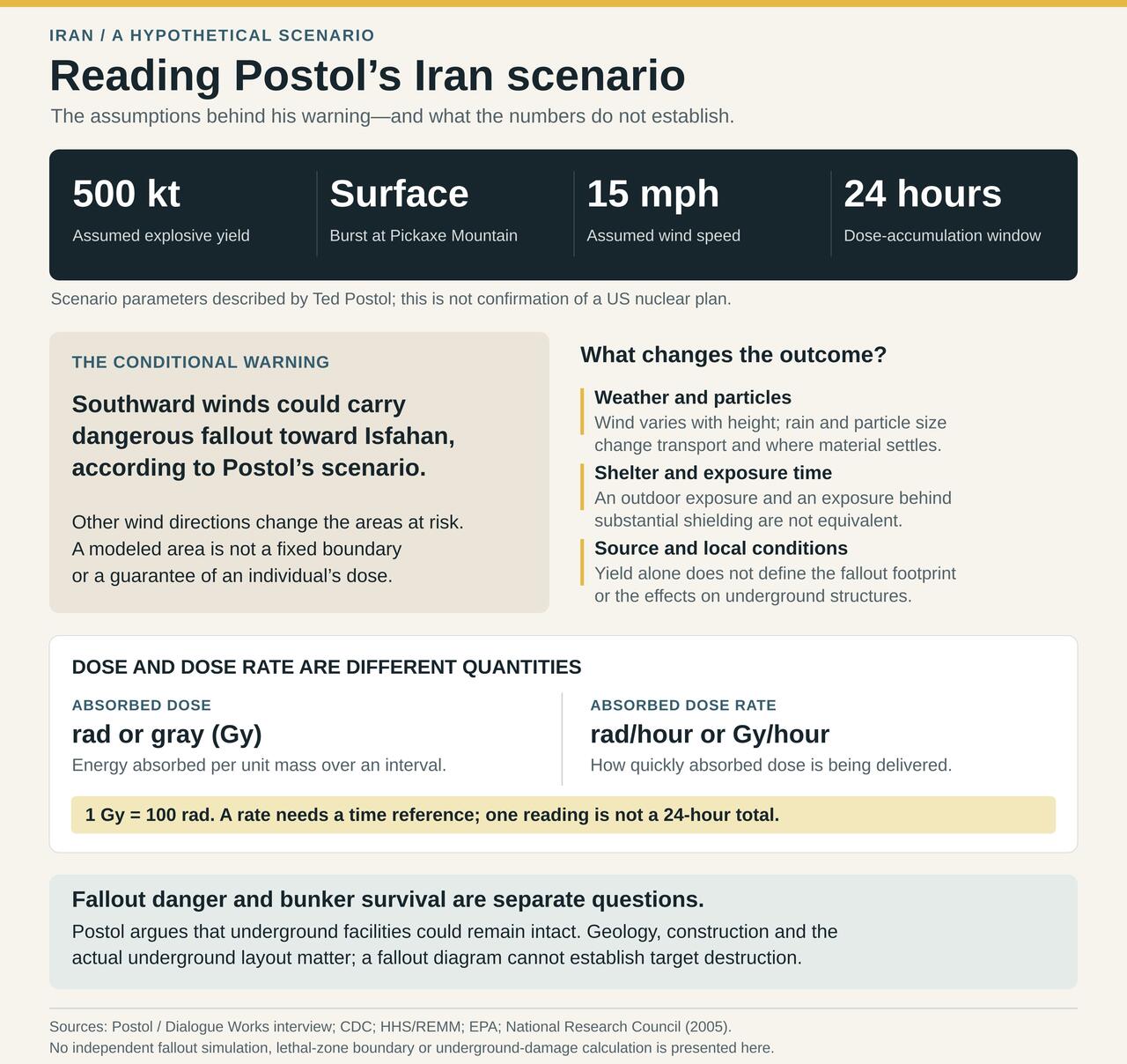
If the US used a 500-kiloton nuclear weapon on Iran's Pickaxe Mountain and the wind blew south, anyone in a band that takes in Isfahan who stayed put would take "roughly twice a lethal dose of radiation" within 24 hours, according to MIT physicist Ted Postol, who mapped the fallout on slides he showed Dialogue Works host Nima Alkhorshid on Friday. And by his account, the tunnels the bomb would be aimed at would probably come through intact.
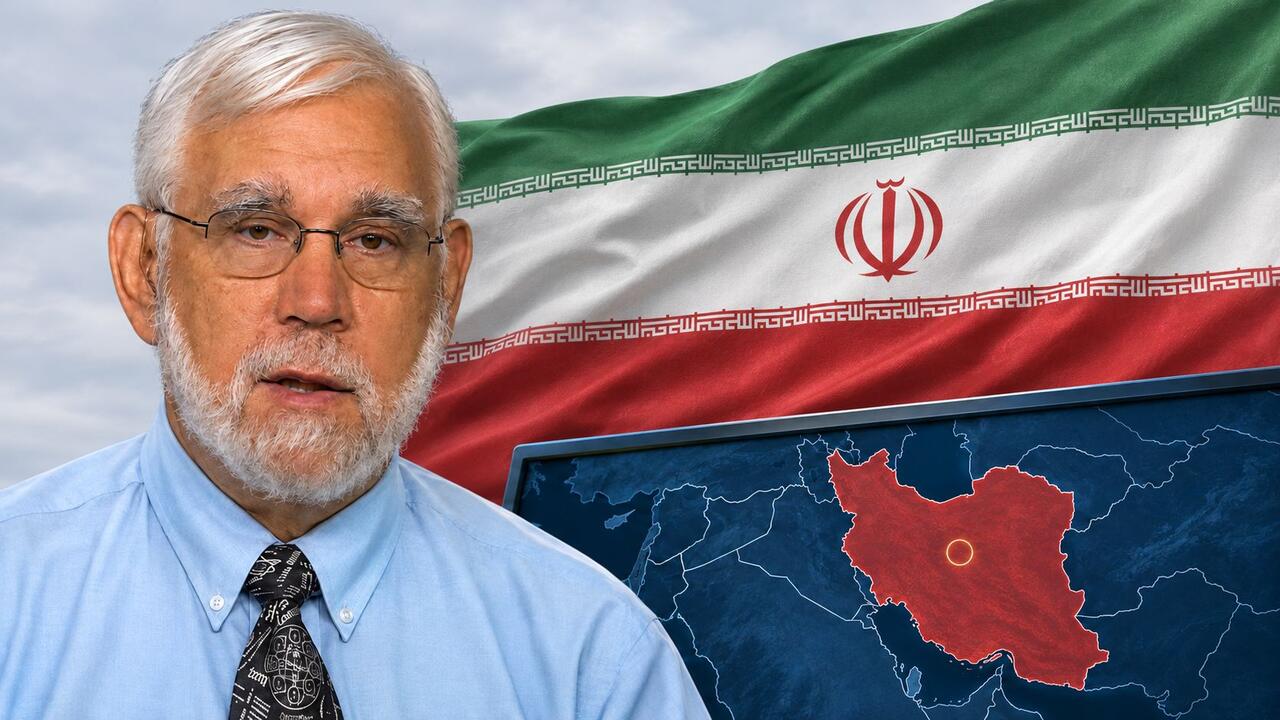
Postol, a professor emeritus of science, technology and national security policy at MIT and a former scientific adviser to the Chief of Naval Operations, made the case as the White House weighs a days-long strike campaign against Iran, and after one of Wall Street's top defense analysts said US nuclear use in Iran "cannot be 100% ruled out," as we reported last week. Over an hour he also dismissed Israel's latest air-defense upgrade as "total nonsense" and laid out how he expects Iran to answer a renewed US attack: on Israel, and on the Gulf's oil.
Postol's map put the burst on Pickaxe Mountain, the tunnel complex Iran has been digging about 2 kilometers south of the Natanz enrichment site, with the wind carrying the debris south. The innermost red contour, he said, is a zone where "anybody in that zone who didn't get out of it" would have received "roughly twice a lethal dose of radiation" within 24 hours. "That would include Isfahan incidentally," he said.
The next band out marks 300 rads accumulated over the same day: "you'd be sick enough to require hospitalization," Postol said, across a whole population at once. Beyond that, a fainter contour marks 100 rads per hour.
The calculations assume an average wind of 15 miles per hour. At 25 or 30 miles per hour, he said, the heavier contours would reach as far as the lighter ones do now. Turn the wind around, and the capital is in the path: "So you could have very large parts of Tehran, if the wind conditions were right, subjected to near lethal doses of radiation." He added: "Very large parts of the population could be sick, sick enough to die from radiation exposure."
A 500-kiloton crater, Postol said, could wreck shelters down to perhaps 500 or 600 meters, "unless they were very, very, very well designed." But Iran doesn't have to rely on a mountain. Tunnels 50 or 100 meters down could be destroyed by a 50-kiloton weapon on the ground, he said, but only if the US knows where they run. "So you know where the entrance is, but you don't know where the facilities are in the tunnel," he said.
"You're going to drop 50 kiloton warheads on it?" he asked. "You're going to cover Iran with 50 kiloton warheads? The amount of radiation you'd produce would fall at lethal levels in Pakistan if the wind was going east." It would be, he said, "a human catastrophe on a scale we haven't seen since the Mongols swept across Europe."
"And incidentally, the underground shelters would not be destroyed," Postol said: the people inside them would still have the centrifuges, the plants that convert uranium hexafluoride to metal and machine it into bombs, and the lines still building drones and ballistic missiles that could carry them. "All of that would still be intact."
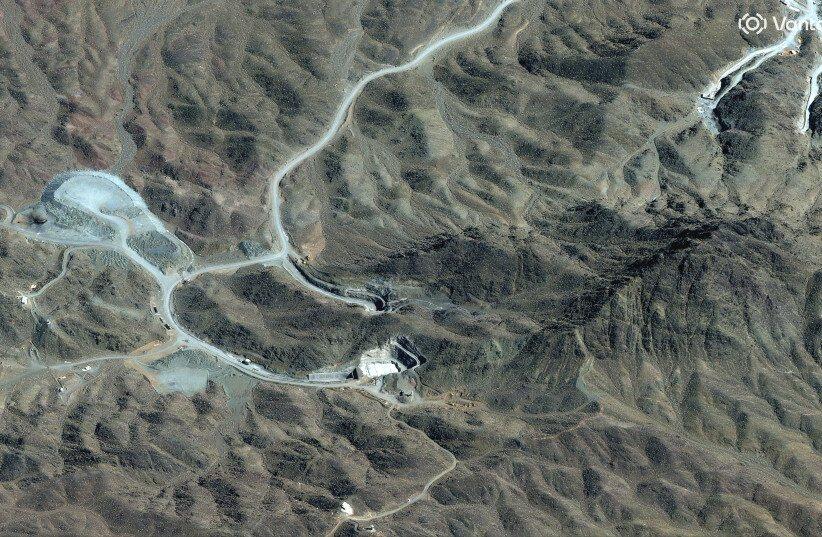
A satellite image shows an overview of the Pickaxe Mountain tunnel complex in Natanz, Iran, March 7, 2026. (credit: VANTOR/HANDOUT VIA REUTERS)
The fallout follows from how a bunker gets attacked. "If you detonate a nuclear weapon to destroy an underground structure, you have to detonate the nuclear weapon on the ground," Postol said, and that changes what the weapon does to the earth around it.
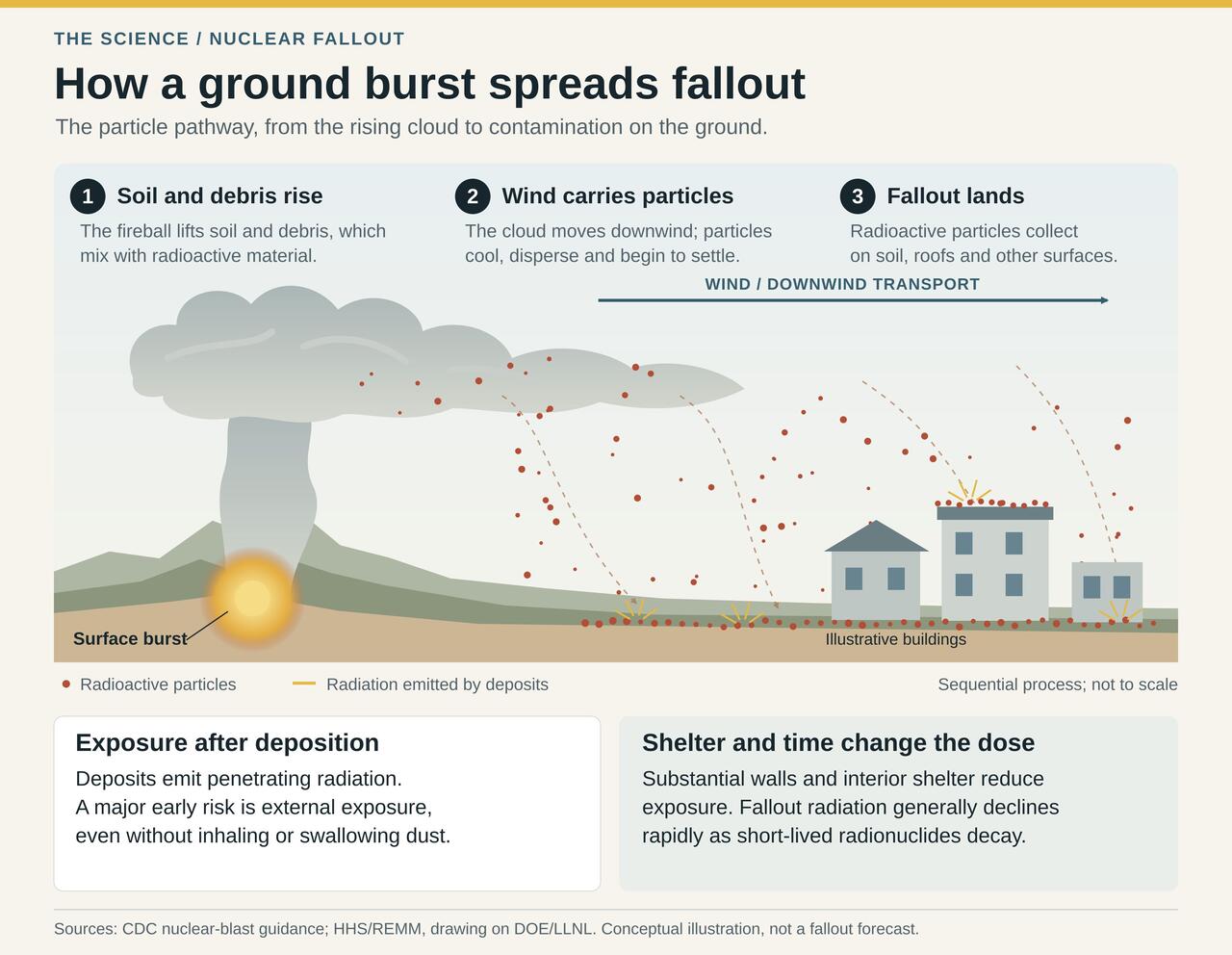
Unlike an artillery shell throwing up dirt, "When a nuclear weapon detonates, it evaporates the ground," he said. "It's made into a superheated gas, which expands violently," and the shockwave comes from that gas, while "a very large part of the excavation is done by evaporation." The vaporized ground rises in the fireball, the fission products condense onto particles, and "those particles then get lifted to high altitudes and they float downwind." By his slides, a 500-kiloton cloud climbs 10 or 11 miles.
Postol used the same slides to take apart this month's anonymous-intelligence reports that Iran was weighing a dirty bomb or a chemical weapon against senior officials in Washington, reports Tehran called fabricated and blamed on Israel. A dirty bomb's source, he said, would be thousands of curies, lethal to anyone who handled it unshielded and easy for radiation sensors to detect in transit, and spread by a conventional blast it would leave fractions of a rad per hour over a fraction of a square mile. The press, he said, is "illiterate, technically."
Then he put up a one-kiloton nuclear burst, a fraction of the Hiroshima bomb, with a cloud about a mile tall. "And the inner contour is a thousand rads per hour. I mean, you're going to get a lethal dose if you're in the wind pattern," he said. "So this would be a catastrophe on a very large scale."
Which is why, he argued, no rational Iranian leadership would try either on an American city, since it would "guarantee a nuclear strike, a nuclear retaliation from the United States against Iran." "So for rational reasons of deterrence, you would never do this."
Alkhorshid raised a Bloomberg report that Israel had upgraded its David's Sling air-defense system to intercept a wider range of Iranian ballistic missiles at lower cost. Postol, who made his name in 1991 showing how little the Patriot hit, wasn't buying it. "You couldn't upgrade a system on such a short timeline," he said, putting real testing and new hardware at a year or two even on a crash program.
David's Sling works too high up for video to show what it hits, he said, so he argued by inference from the systems that can be checked. On the Patriots, "they've been claiming 90% intercept rates," and "the evidence that the lower tier, the Patriots are working, indicates that it's not working at all," while Iron Dome "has also been a total failure." He allowed that he doesn't "have the data at this point" on David's Sling itself.
The bigger problem, in his telling, is arithmetic and decoys. Israel doesn't have that many interceptors against the missiles Iran can launch, and at the 40 to 60 kilometer altitudes where David's Sling would engage, "relatively modest decoys of the kind we know that are already available" would soak up interceptors. His advice to Israelis was to "make sure you take shelter, because shelter does help a lot." The US has meanwhile sent its Centcom chief to Saudi Arabia to examine why the kingdom's air defenses are failing.
Iran's answer to any new attack would ride on precision it didn't always have. "The cat is out of the bag with regard to very high precision conventional ballistic missiles," Postol said. Iran built its own capability, he said, "but that ability has been enormously enhanced, enormously so, by Russia and China."
By his account, Russia and China are giving Iran "basically real-time reconnaissance data showing where the American assets are being stored," whether in Jordan, at Israeli air bases or at the Persian Gulf bases, which he said have largely been abandoned. Carriers are a harder target, moving and far out, he said, but the bases on the ground and Israel's cities "are highly vulnerable to Iranian counterstrikes."
The Gulf's energy facilities are just as exposed, Postol said. Iran has made clear it will hit the Gulf states' energy facilities if the US hits its own, Postol said, and its record in the war shows it isn't bluffing. "What the Americans should not want, if they're thinking at all, is an Iranian counterstrike that destroys large parts of Saudi Arabian oil" and diesel production, he said, facilities "which can take years to build up again."
Reopening Hormuz in some later deal wouldn't fix that, he said: "there still has to be a source of crude oil available to go through the Straits." With facilities wrecked in Saudi Arabia, Qatar and elsewhere, "the whole global economy and the American economy will suffer greatly," he said, with Europe and Asia hit harder than the US and China, in his view, the one economy that has prepared.
Postol framed Iran's likely response in its leaders' voice. After a new US attack, he expects them to say, in effect, "We're going to have to decimate Israel as best we can. And we can do that. We have the resources to do it." And: "we're going to have to further decimate the oil producing and energy producing facilities in the Gulf States and Saudi Arabia in particular."
The point, as he put it, would be to show "that there's a cost to continuing to kill our people." He credited Tehran with not escalating unnecessarily so far, and said that if Iran strikes back "in a brutal and merciless way, it will not be because they decided to on their own. It will be because the Americans have put them in a position where they will have no choice."
Tyler Durden Thu, 11/26/2026 - 00:00
Continue reading...
[ H/T ZeroHedge ]
If the US used a 500-kiloton nuclear weapon on Iran's Pickaxe Mountain and the wind blew south, anyone in a band that takes in Isfahan who stayed put would take "roughly twice a lethal dose of radiation" within 24 hours, according to MIT physicist Ted Postol, who mapped the fallout on slides he showed Dialogue Works host Nima Alkhorshid on Friday. And by his account, the tunnels the bomb would be aimed at would probably come through intact.
Postol, a professor emeritus of science, technology and national security policy at MIT and a former scientific adviser to the Chief of Naval Operations, made the case as the White House weighs a days-long strike campaign against Iran, and after one of Wall Street's top defense analysts said US nuclear use in Iran "cannot be 100% ruled out," as we reported last week. Over an hour he also dismissed Israel's latest air-defense upgrade as "total nonsense" and laid out how he expects Iran to answer a renewed US attack: on Israel, and on the Gulf's oil.
"Twice A Lethal Dose"
Postol's map put the burst on Pickaxe Mountain, the tunnel complex Iran has been digging about 2 kilometers south of the Natanz enrichment site, with the wind carrying the debris south. The innermost red contour, he said, is a zone where "anybody in that zone who didn't get out of it" would have received "roughly twice a lethal dose of radiation" within 24 hours. "That would include Isfahan incidentally," he said.
The next band out marks 300 rads accumulated over the same day: "you'd be sick enough to require hospitalization," Postol said, across a whole population at once. Beyond that, a fainter contour marks 100 rads per hour.
The calculations assume an average wind of 15 miles per hour. At 25 or 30 miles per hour, he said, the heavier contours would reach as far as the lighter ones do now. Turn the wind around, and the capital is in the path: "So you could have very large parts of Tehran, if the wind conditions were right, subjected to near lethal doses of radiation." He added: "Very large parts of the population could be sick, sick enough to die from radiation exposure."
The Bunkers Come Through
A 500-kiloton crater, Postol said, could wreck shelters down to perhaps 500 or 600 meters, "unless they were very, very, very well designed." But Iran doesn't have to rely on a mountain. Tunnels 50 or 100 meters down could be destroyed by a 50-kiloton weapon on the ground, he said, but only if the US knows where they run. "So you know where the entrance is, but you don't know where the facilities are in the tunnel," he said.
"You're going to drop 50 kiloton warheads on it?" he asked. "You're going to cover Iran with 50 kiloton warheads? The amount of radiation you'd produce would fall at lethal levels in Pakistan if the wind was going east." It would be, he said, "a human catastrophe on a scale we haven't seen since the Mongols swept across Europe."
"And incidentally, the underground shelters would not be destroyed," Postol said: the people inside them would still have the centrifuges, the plants that convert uranium hexafluoride to metal and machine it into bombs, and the lines still building drones and ballistic missiles that could carry them. "All of that would still be intact."
A satellite image shows an overview of the Pickaxe Mountain tunnel complex in Natanz, Iran, March 7, 2026. (credit: VANTOR/HANDOUT VIA REUTERS)
Why Ground Bursts Are So Dirty
The fallout follows from how a bunker gets attacked. "If you detonate a nuclear weapon to destroy an underground structure, you have to detonate the nuclear weapon on the ground," Postol said, and that changes what the weapon does to the earth around it.
Unlike an artillery shell throwing up dirt, "When a nuclear weapon detonates, it evaporates the ground," he said. "It's made into a superheated gas, which expands violently," and the shockwave comes from that gas, while "a very large part of the excavation is done by evaporation." The vaporized ground rises in the fireball, the fission products condense onto particles, and "those particles then get lifted to high altitudes and they float downwind." By his slides, a 500-kiloton cloud climbs 10 or 11 miles.
A Kiloton Versus A Dirty Bomb
Postol used the same slides to take apart this month's anonymous-intelligence reports that Iran was weighing a dirty bomb or a chemical weapon against senior officials in Washington, reports Tehran called fabricated and blamed on Israel. A dirty bomb's source, he said, would be thousands of curies, lethal to anyone who handled it unshielded and easy for radiation sensors to detect in transit, and spread by a conventional blast it would leave fractions of a rad per hour over a fraction of a square mile. The press, he said, is "illiterate, technically."
Then he put up a one-kiloton nuclear burst, a fraction of the Hiroshima bomb, with a cloud about a mile tall. "And the inner contour is a thousand rads per hour. I mean, you're going to get a lethal dose if you're in the wind pattern," he said. "So this would be a catastrophe on a very large scale."
Which is why, he argued, no rational Iranian leadership would try either on an American city, since it would "guarantee a nuclear strike, a nuclear retaliation from the United States against Iran." "So for rational reasons of deterrence, you would never do this."
"Total Nonsense"
Alkhorshid raised a Bloomberg report that Israel had upgraded its David's Sling air-defense system to intercept a wider range of Iranian ballistic missiles at lower cost. Postol, who made his name in 1991 showing how little the Patriot hit, wasn't buying it. "You couldn't upgrade a system on such a short timeline," he said, putting real testing and new hardware at a year or two even on a crash program.
David's Sling works too high up for video to show what it hits, he said, so he argued by inference from the systems that can be checked. On the Patriots, "they've been claiming 90% intercept rates," and "the evidence that the lower tier, the Patriots are working, indicates that it's not working at all," while Iron Dome "has also been a total failure." He allowed that he doesn't "have the data at this point" on David's Sling itself.
The bigger problem, in his telling, is arithmetic and decoys. Israel doesn't have that many interceptors against the missiles Iran can launch, and at the 40 to 60 kilometer altitudes where David's Sling would engage, "relatively modest decoys of the kind we know that are already available" would soak up interceptors. His advice to Israelis was to "make sure you take shelter, because shelter does help a lot." The US has meanwhile sent its Centcom chief to Saudi Arabia to examine why the kingdom's air defenses are failing.
"The Cat Is Out Of The Bag"
Iran's answer to any new attack would ride on precision it didn't always have. "The cat is out of the bag with regard to very high precision conventional ballistic missiles," Postol said. Iran built its own capability, he said, "but that ability has been enormously enhanced, enormously so, by Russia and China."
By his account, Russia and China are giving Iran "basically real-time reconnaissance data showing where the American assets are being stored," whether in Jordan, at Israeli air bases or at the Persian Gulf bases, which he said have largely been abandoned. Carriers are a harder target, moving and far out, he said, but the bases on the ground and Israel's cities "are highly vulnerable to Iranian counterstrikes."
The Gulf's Oil
The Gulf's energy facilities are just as exposed, Postol said. Iran has made clear it will hit the Gulf states' energy facilities if the US hits its own, Postol said, and its record in the war shows it isn't bluffing. "What the Americans should not want, if they're thinking at all, is an Iranian counterstrike that destroys large parts of Saudi Arabian oil" and diesel production, he said, facilities "which can take years to build up again."
Reopening Hormuz in some later deal wouldn't fix that, he said: "there still has to be a source of crude oil available to go through the Straits." With facilities wrecked in Saudi Arabia, Qatar and elsewhere, "the whole global economy and the American economy will suffer greatly," he said, with Europe and Asia hit harder than the US and China, in his view, the one economy that has prepared.
"Decimate Israel"
Postol framed Iran's likely response in its leaders' voice. After a new US attack, he expects them to say, in effect, "We're going to have to decimate Israel as best we can. And we can do that. We have the resources to do it." And: "we're going to have to further decimate the oil producing and energy producing facilities in the Gulf States and Saudi Arabia in particular."
The point, as he put it, would be to show "that there's a cost to continuing to kill our people." He credited Tehran with not escalating unnecessarily so far, and said that if Iran strikes back "in a brutal and merciless way, it will not be because they decided to on their own. It will be because the Americans have put them in a position where they will have no choice."
Tyler Durden Thu, 11/26/2026 - 00:00
Continue reading...
[ H/T ZeroHedge ]