








President Donald Trump has once again found the quickest way to send Canada's political establishment into a fit of national indignation: point out the obvious.
This time, Trump went after the country's immigration policies.
It is an extraordinary thing to hear a Canadian prime minister publicly discuss planning for an invasion by the US.
“Canada is destroying itself by allowing millions and millions of people into the Country, essentially unchecked and unvetted, and who are causing problems that will soon be too big to handle,” Trump wrote on Truth Social last week. “It is a Liberal takeover that will end very badly. Already showing up in their numbers. Big unemployment.”
Fatuous fact-check
Canadian officials and media outlets were quick to push back. CBC pointed out that immigrants and temporary residents are screened and that Canada's unemployment rate, while still 6.4% in August, has fallen half a percentage point since May.
Fair enough. Like many of Trump's pronouncements, “unchecked and unvetted” is an obvious exaggeration. But concentrating on that phrase conveniently allows Canada to avoid the substance of what he said: The country allowed immigration and temporary migration to rise so rapidly that the Liberal government is now scrambling to bring the numbers back down.
As recently as 2021, more than 8.3 million Canadians — 23% of the population — were or had once been landed immigrants or permanent residents, the highest proportion among G7 countries.
And that was before the subsequent explosion in temporary residents. By October 2024, Canada's non-permanent resident population had climbed to nearly 3 million, or 7.2% of the population.
Ottawa is now reversing course. The government has cut its target for new temporary-resident arrivals from 673,650 in 2025 to 385,000 this year — a reduction of about 43% — and says it intends to reduce the temporary-resident population to less than 5% of Canada's population by the end of 2027. The government itself acknowledges that immigration levels must be brought into line with Canada's housing supply, health care system, and labor market.
Justin time
That is quite a retreat from the immigration consensus that prevailed under former Prime Minister Justin Trudeau.
In January 2017, days after Trump's first inauguration, Trudeau responded to Trump's immigration restrictions with a social media invitation heard around the world.
“To those fleeing persecution, terror & war, Canadians will welcome you, regardless of your faith,” Trudeau wrote. “Diversity is our strength. #WelcomeToCanada.”
Nine years later, Ottawa is trying to get the numbers back down.
Statistics Canada reported last week that the number of non-permanent residents fell by nearly 155,000 over the previous year. Yet 2.78 million non-permanent residents still remained in Canada on July 1 — about 6.7% of the population.
You don't have to accept every word of Trump's Truth Social post to notice what happened. Canada dramatically increased immigration and temporary migration. The government that presided over the increase is now cutting it.
Yet Canada's political establishment remains far more comfortable talking about Donald Trump than examining how the country arrived here.
Carney's cosplay
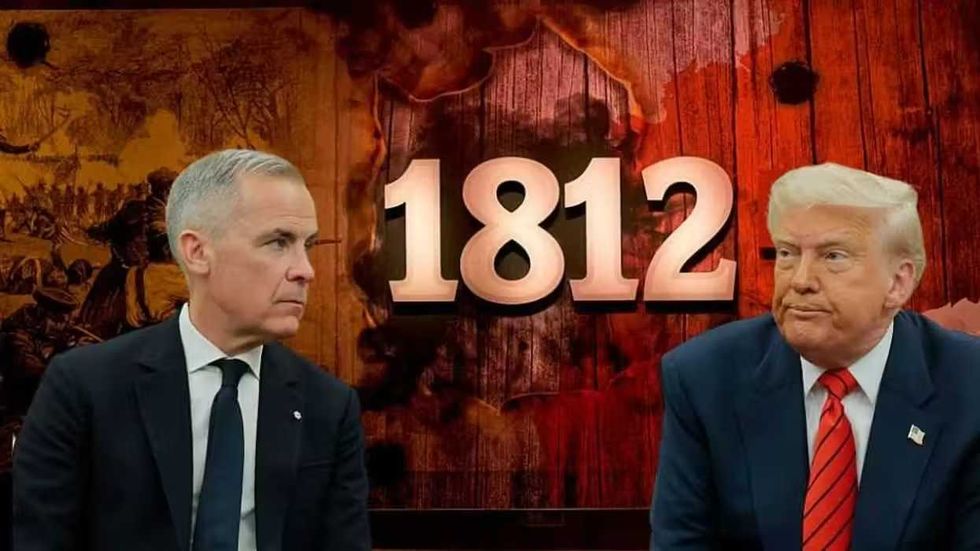
Within days of Trump's latest broadside, Prime Minister Mark Carney was discussing something considerably more dramatic than immigration: the possibility of war with the United States.
Asked by the New York Times whether he had seriously considered the possibility of American military action against Canada, Carney said he had examined the “extreme tail risk.”
“I think you have a responsibility in these roles to look at extreme tail risk,” Carney said. He stressed that an American invasion was “not a base case,” describing the exercise as simple “risk management.”
It is an extraordinary thing to hear a Canadian prime minister publicly discuss planning for an invasion by the U.S. Despite Carney's fond reveries about the War of 1812, when American forces repeatedly invaded British North America, Canada and the United States have spent the past century preparing to fight alongside each other, not against each other.
The two countries were founding members of NATO. They jointly operate NORAD, the world's only binational military command, and maintain a web of bilateral defense agreements and joint military plans for the defense of North America. The U.S. State Department has described America's defense arrangements with Canada as more extensive than those it maintains with any other country.
That cooperation dates back at least to 1940, when Prime Minister Mackenzie King and President Franklin Roosevelt established formal cooperation on continental defense.
Eighty-six years later, Canada's prime minister is publicly acknowledging that his government has considered what happens if the country on the other side of that defense partnership becomes the threat.
The military imbalance makes the hypothetical stranger still. Canada's armed forces are a shadow of the military that fought through two world wars and landed at Juno Beach on D-Day. During World War II, the Royal Canadian Air Force grew into the fourth-largest Allied air force. Today's Canadian military has struggled with recruiting, aging equipment, and years of procurement delays.
RELATED: 'AMERICAN INVASION': Flailing Canada PM Mark Carney invokes historical grudge in latest lob at Trump
Made in Canada
Carney's comments might have remained an odd diplomatic footnote if Donald Trump were not simultaneously becoming the organizing principle of Canadian domestic politics.
In British Columbia, Premier David Eby has just called a provincial election two years ahead of schedule. The timing could hardly be better for Eby. B.C. Conservative leader Kerry-Lynne Findlay had resigned only days earlier after months of turmoil within the opposition party.
But Eby says the election is necessary because British Columbia faces an “existential moment.” The threat comes courtesy of — you guessed it — Donald Trump.
“Donald Trump is attacking our jobs, driving up costs, and threatening our ability to make decisions for ourselves," said Eby in announcing the election.
Obviously, no alliance means that two countries' interests will always align. Canada has benefited enormously from its relationship with the United States, but there have always been disputes over trade, defense, energy, and any number of other issues. Trump's tariffs have hurt Canadian industries, while his repeated talk about Canada becoming the 51st state has understandably irritated Canadians. That is what happens when two sovereign countries pursue their own interests.
But Canadian politicians seem increasingly preoccupied with the points of friction. And Trump has become awfully useful to them.
Meanwhile, many of the problems Trump is talking about were made in Canada.
Trump did not create Canada's housing shortage. He did not create its enormous temporary-resident population or set the immigration targets the Liberal government is now cutting. Those were Canadian decisions, made by Canadian governments.
The immigration reversal should make that particularly difficult to ignore. Ottawa spent years pushing the numbers higher and is now scrambling to bring them down. Correcting Trump's exaggerations does not make that record disappear.
Canadian politicians can continue blaming Trump for what he says about their country. They might spend a little more time explaining what they've done to it.
Continue reading...
[H/T Blaze Media]


