


Editor’s note: This is a lightly edited transcript of today’s video from Daily Signal senior contributor Victor Davis Hanson. Subscribe to our YouTube channel to see more of his videos.
Hello, this is Victor Davis Hanson for the Daily Signal.
What is the Left today? What is the Democratic Party? What term do you use? It’s so strange. It’s so unfamiliar. Let’s try to do a typology of it, and let’s start with the premise that the Democratic Party we knew, some of us of our generation in the 1990s, it was very successful under Bill Clinton.
Not that it ever won 51% of the vote, but it was able to leverage the Ross Perot candidacy and gain control of the presidency and, for a few years, some of Congress as well.
And what did it stand for? Well, we can only determine that by looking at the 1992 platform at the Democratic Convention that nominated Bill Clinton, who was elected, and then his reelection platform in the ’96 Democratic Convention.
And what were they for? They were for closed borders. They were for deportations. They were for protection of American workers. They were for moderate tariffs. They were very suspicious of China. They were for adding 100,000 policemen. They were for trying violent juvenile offenders as adults.
I could go on, but my gosh, you can get the picture.
They even balanced the budget, and they succeeded in that with the help of Newt Gingrich and the Republican opposition for four years: ’98, ’99, 2000, 2001. I think it’s fair to say that that Democratic Party and what I just talked about was mostly the intellectual work of Doug Schoen and Mark Penn, to a lesser extent, James Carville.
Those people are completely gone. I mean, they’re still active, and they comment, and they’re still loyal Democrats for the most part, but they’ve been completely ignored. And that Democratic Party today, today looks like it’s a Republican Party.
They want nothing to do with that legacy. Bill Clinton is not revered, revered as a person that really got the country moving and did a lot of good things.
So who’s left? Well, there’s still some ossified liberals. These are kind of like Clinton, but they were more liberal. I guess this is Chuck Schumer, Nancy Pelosi. These are people who were on the left wing of the Bill Clinton Democratic Party. Left wing. They were a little bit stronger. They wanted universal health care.
They were the Obama progressives. Universal health care. They wanted, you know, Cash for Clunkers. They warred on fossil fuels, but not in an extreme fashion. They kinda, sorta wanted the border open, kinda, sorta, sorta closed. They would say things, “We can’t have illegal aliens, but who’s going to do our wash or, our wash or cook our meals or pick our crops?”
They were liberal on free speech at that time. There was no trans issue. They were anti-pornography, but not to the extent they wanted to ban it. they were kind of Playboy liberals.
Those progressives are not there anymore. I guess you could say that the liberals are ossified and gone, and what replaced them, the progressives, they were kind of like, I don’t know, Elizabeth Warren.
They wanted consumer protection, and they wanted to sue corporations, and they were the Greenpeace people, and they wanted to get a lot more muscular. They were the liberals. I’m trying to perhaps make a distinction that doesn’t really exist between ossified liberals and calcified progressives. But the progressives were a little bit to the left, and Elizabeth Warren, I guess, versus what?
Chuck Schumer. But they were still in the same ballpark. And once in a while, they would work with the Republicans, not like Bill Clinton. But they were big-spending liberals, and they were more socially active on matters of diversity and affirmative action and feminism and gay rights.
They’re pretty much ossified now, too. Chuck Schumer is under enormous attack. Nancy Pelosi is an octogenarian on her way out.
And we now have three different groups that are starting to take over the Democratic Party. One is the DEI people. These are the so-called diversity, equity, and inclusion.
They identify mostly not necessarily as Indian Americans or Arab Americans or Black Americans or Hispanic Americans or Native Americans, but people who are not white. Not white, the victimized class.
And this is not the generation of Charles Rangel or Jim Clyburn, the people who came out of the civil rights movement and were for the melting pot and integration and assimilation and equality of opportunity originally.
The new DEI movement wants equality of result. They want reparations. They feel—They talk nonstop about white supremacy, white privilege, white rage. They want compensatory or reparatory government to start to not ignore race. Their idea is that race is essential, not incidental to who we are. It’s our primary way of identifying.
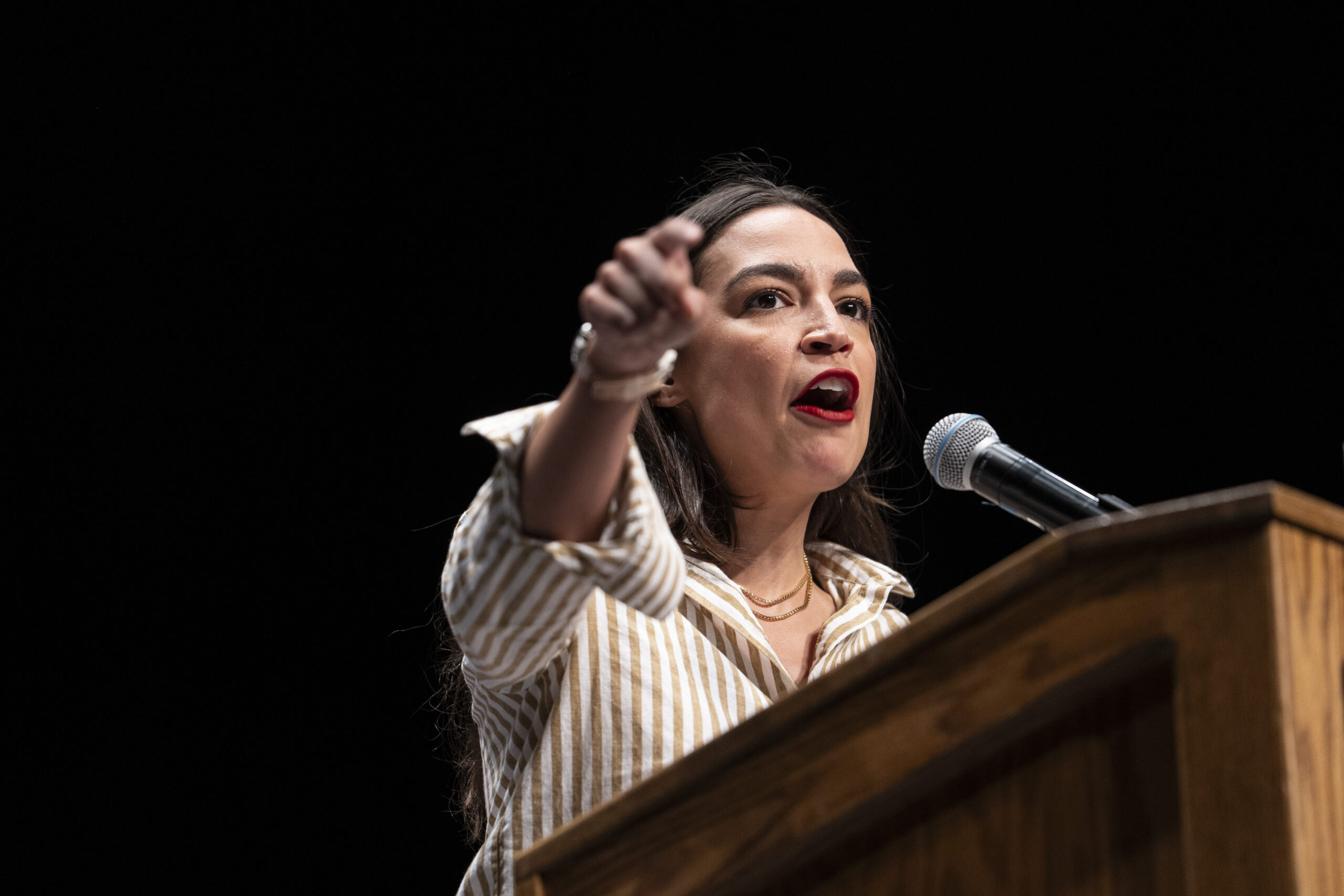
So these people, and the Squad is a good example. The Squad is a good example. Ilhan Omar, [Alexander Ocasio-Cortez], etc. These people now have joined with the other two elements of the new Democratic Party to be the Democratic Party. They were kind of a minority before the DEI people. The liberals and progressives ran the party.
Now the liberals and progressives are on the run. The younger DEI members are ascendant, and they have joined with two groups. The first is the Islamists. The population of people from the Middle East has grown to about 5 million people. But more importantly, they have concentrated on particular areas, Dearborn, Michigan, for example.
And they have been the beneficiaries of multibillion dollars. Fifty, 100 billion dollars have gone to universities in the last 20 years. So when I was a graduate student in the 1970s, the Middle East departments were two or three people, and one was a Jewish historian and one was an Arab historian. Not now.
Due to gifts from Saudi Arabia, Kuwait, Qatar, the Gulf States, they have massive endowments. They have faculties of 10, 20 people. They offer all sorts of degrees, and they are the natural nexus for a huge number. 50, 60,000 students are coming in the United States from the Middle East.
Now, some of you are going to say, “Why would they want to come to America?
They’re so chauvinistic about the Arab world or the Islamic world, and they’re so critical of America because as soon as they come here, they’re overwhelmingly left-wing.
Why would they leave a place and say, “I cannot stand it here in Gaza. I cannot stand it here in the West Bank. I cannot stand it because I have no freedom. I have no economic prosperity. I have no security,” then come over to the place where all their wishes are granted, and they want to change it?
And if they were successful, they would end up changing it in a religious and constitutional or anti-constitutional model to resemble what they fled from. And who are they?
They’re the podcaster Hasan Piker. They’re Ilhan Omar. They’re Mr. Abdul El-Sayed, the new Democratic senator from [Michigan]. They’re [Rep.-elect Alan] Hamawy. He was the one that couldn’t distinguish whether, Israel or Iran was better. They were equivalent, but actually in the way he formulated, he favors Iran, as most of the Islamists do over Israel.
They’re the Zohran Mamdanis, who say he’s going to go after white, richer neighborhoods. So this is a new group. Now, you think that they wouldn’t have a home in the Democratic Party for a variety of reasons. The Islamists have had traditional, friction with the black community, and we’re seeing a little bit of that in Detroit today, where there were some defections of black Democrats because of the El-Sayed candidacy.
But mostly, the Islamists say, “We are victims like you are of white settler colonialism, and therefore we have more in common.” They have a very shaky but still viable coalition between DEI and Islamists.
There’s the final, tessera in this Democratic new mosaic, and that’s the socialists. Now, the Democratic Socialists of America has always been an obscure, irrelevant group.
It’s 85% white. It’s mostly concentrated in Boulder, Colorado, or Brooklyn or Manhattan or Washington, D.C. or San Francisco or Austin or Portland or Seattle. Liberal enclaves of mostly white, college-educated people with high aspirations but are downwardly mobile. Their degrees in political science, in dash studies courses, in sociology, in psychology, in environmental, do not render them the type of income, prestige, and influence that they feel they deserve in these highly expensive urban enclaves.
They rub shoulders with professional lawyers, doctors, finance, Wall Street people, and they say, “He has all this money. She’s a CEO. I can’t buy a apartment. I can’t buy a home.” And they’re very bitter, and they blame their own personal unhappiness on the system. They don’t have the money of their parents.
They have student loans. They went to graduate school in many cases, and yet they’re downwardly mobile. So now they want to destroy capitalism, universal health care for everybody. They want to raise taxes. They want to raise inheritance. They want to tax net worth, not just your income. And they have now joined with the Islamists.
Now, some of you are going to say, “This can’t happen.” The DEI Islamist socialist coalition doesn’t make any sense because socialists are either agnostic or atheist. Islamists are hyper-religious. Socialists say that they’re pan-global, that they feel that, like the old Soviet Union, that they have affinities with anybody, who is a communist or socialist.
The Islamists are ethnocentric and religious-centric. Socialists feel that the gay lifestyle is just an alternate lifestyle, the trans lifestyle. Not Islamists. Those are against the Quran. What do they have in common? What are the ossified liberals, the challenged progressives, the DEI people, the Islamists, the socialists, what holds them together now?
Two things. They despise Donald Trump to such a degree that their hatred of him and their desire to destroy him and the MAGA movement for now overcomes their individual fault lines.
And two, they despise the Jewish state of Israel and its supporters, both Jews and non-Jews. It has become a signature issue in the Democratic Party, a unifying issue.
As far as all of the other issues, they’re pretty much left-wing and in agreement on the border, on crime, on energy. But what really galvanizes these very diverse groups is, let’s put aside our differences because we agree on the two motivating issues. We despise Israel and its supporters, and we hate Donald Trump and want to see him out and the MAGA movement erased.
That’s the new Democratic Party.
We publish a variety of perspectives. Nothing written here is to be construed as representing the views of the Daily Signal.
Continue reading...
[ H/T The Daily Signal ]