


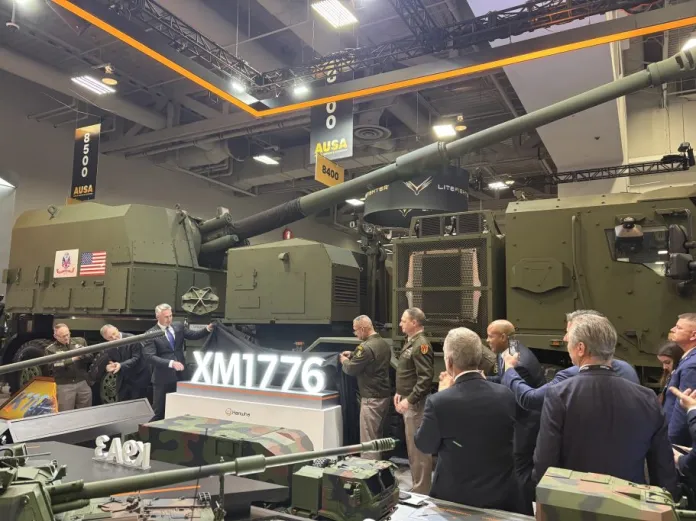
The Army unveiled the name for its new mobile howitzer, the XM1776, in a ceremony at the annual Association of the United States Army expo on Monday.
The XM1776 self-propelled howitzer is the latest weapon to emerge from the flurry of weapons development influenced by lessons from the modern battlefield, primarily the war in Ukraine. The weapon, slated to become one of the workhorses of the U.S. artillery, was developed by the South Korean Hanwha in cooperation with the U.S.
The Army’s new XM1776 self-propelled artillery gun. (Brady Knox/Washington Examiner)
" data-large-file="https://www.washingtonexaminer.com/wp-content/uploads/2026/10/IMG_3524-e1791837977675.jpeg?w=696" src="https://www.washingtonexaminer.com/wp-content/uploads/2026/10/IMG_3524-e1791837977675.jpeg?w=696" alt="XM1776" class="wp-image-4763485" srcset="https://www.washingtonexaminer.com/wp-content/uploads/2026/10/IMG_3524-e1791837977675.jpeg 911w, https://www.washingtonexaminer.com/...0/IMG_3524-e1791837977675.jpeg?resize=300,225 300w, https://www.washingtonexaminer.com/...0/IMG_3524-e1791837977675.jpeg?resize=768,576 768w, https://www.washingtonexaminer.com/...0/IMG_3524-e1791837977675.jpeg?resize=150,112 150w, https://www.washingtonexaminer.com/...0/IMG_3524-e1791837977675.jpeg?resize=696,522 696w" sizes="(max-width: 911px) 100vw, 911px">
The Army’s new XM1776 self-propelled artillery gun. (Brady Knox/Washington Examiner)
Speaking at a ceremony unveiling the weapon’s new name, Hanwha Defense USA President and Chief Operating Officer Michael Smith justified the name by harkening back to a decisive moment during the country’s founding, when the Continental Army rolled in mobile artillery batteries to overlook Boston Harbor in 1776, forcing the British fleet to withdraw. This marked the first strategic victory of what became U.S. forces, beginning a field artillery legacy that led to the XM1776’s unveiling 250 years later.
Smith told the Washington Examiner in an interview that the XM1776 addressed the problems seen in the Army’s primary artillery weapons, the M777 and M109.
The war in Ukraine showed three deficiencies in the M777 howitzer and M109 self-propelled howitzer: range, survivability, and volume of fire. In a battlefield saturated by reconnaissance and strike drones, survivability has become the biggest problem.
“In this battle space, within 30 seconds of first fire, you’re going to have a drone on top of you,” Smith said. “So the need to shoot and scoot, to get in place, fire, displace, within 90 seconds, is a must.”
The XM1776 can get into place and deploy its four stabilizers within about 18 seconds, as shown in tests, then disengage as quickly after firing.
The loading of the cannon is fully automated, allowing a tiny crew of just two people to operate the behemoth. The autoloading also allows a high rate of fire at nine rounds per minute, compared to around four to five per minute max from the M777 and M109. Competitors can manage six to eight rounds per minute.
In terms of range, the 58 caliber barrel can fire rounds “well beyond” 50 miles. From the convention floor in Washington, the weapon could launch a round into Baltimore.
“Not that you’d want to do that,” Smith laughed.
What truly makes the XM1776 unique, he argued, is its high magazine capacity.
“No one has a larger magazine than this vehicle,” Smith said, with each unit carrying 40 on-board shells. It can be supported by the K10 Ammunition Resupply System, which allows automated resupply.
ZELENSKY BASHES TRUMP OVER DIESEL DEAL WITH RUSSIA
So far, the Army has ordered six prototypes of the XM1776.
Smith said Hanwha is aiming to produce 48 vehicles per year, but “the Army would love to see 96 per year,” 48 guns and 48 resupply, “which means a good bit more investment.”
Mike Brest contributed to this report.
Continue reading...
[ H/T Washington Examiner ]