




US Blacklists Sam Altman's Old Y Combinator China Pick Over Startup Built On Stolen Google AI Secrets
Of all the people who could end up on a US sanctions list for bankrolling stolen Google AI technology, a former Microsoft executive hand-picked by Sam Altman to run Y Combinator's China arm was probably not on many bingo cards. And yet here we are.
On Monday, the State Department blacklisted Shanghai Zhisuan Technology, the AI startup founded by convicted ex-Google engineer Linwei Ding, along with MiraclePlus, the Chinese venture firm founded by ex-Microsoft AI scientist Lu Qi, and three MiraclePlus-managed funds, for providing seed financing to Zhisuan. According to Bloomberg, the measures may include freezing US assets and banking restrictions.
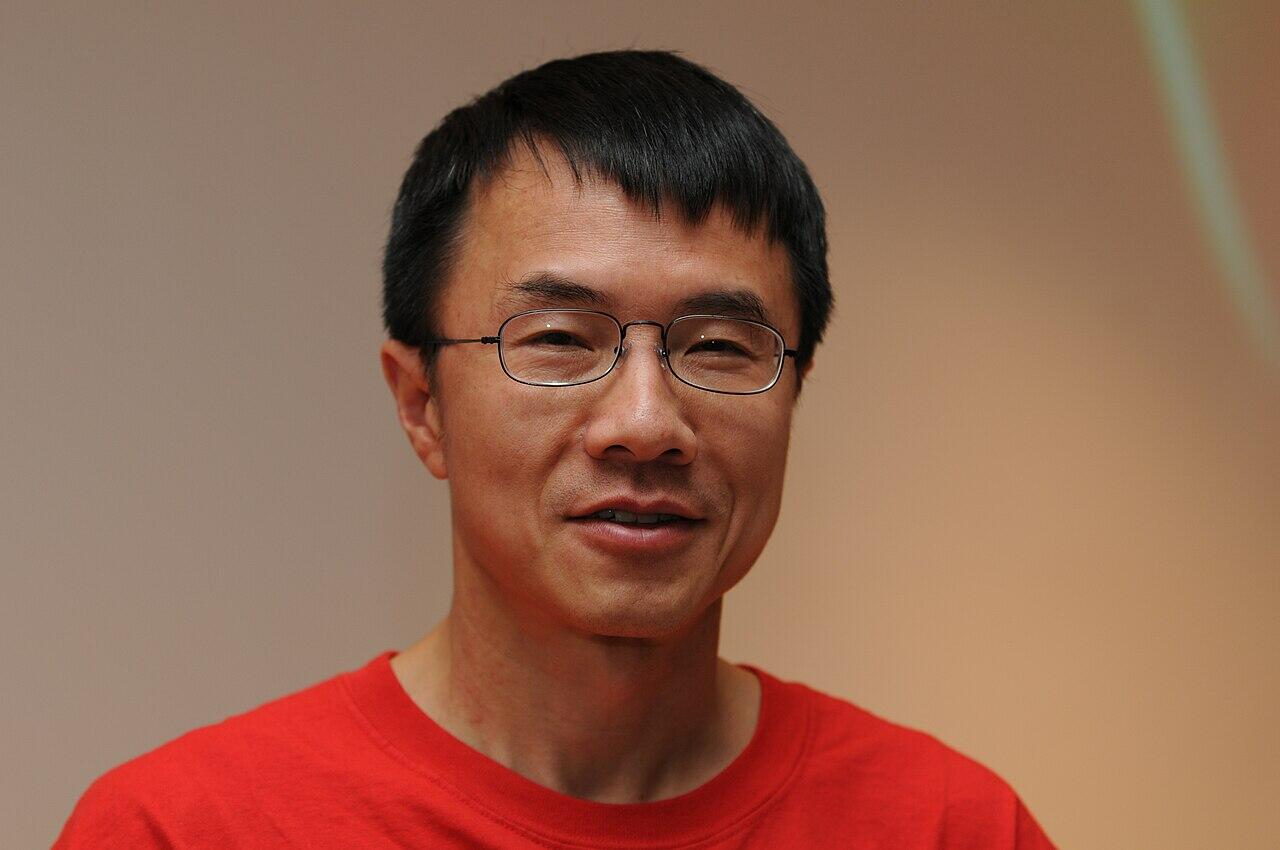
Lu Qi
The best part of the story is Lu's resume, which reads like a tour of every major tech power center of the past 20 years: the stuff corporate espionage movie scripts are made of. Per Bloomberg:
When Y Combinator abandoned the expansion a year later, Lu and his team simply kept going under the MiraclePlus brand. That's the same MiraclePlus that, according to the State Department, gave a Chinese startup seed money in exchange for equity after its founder showed up touting his inside knowledge of Google's AI infrastructure.
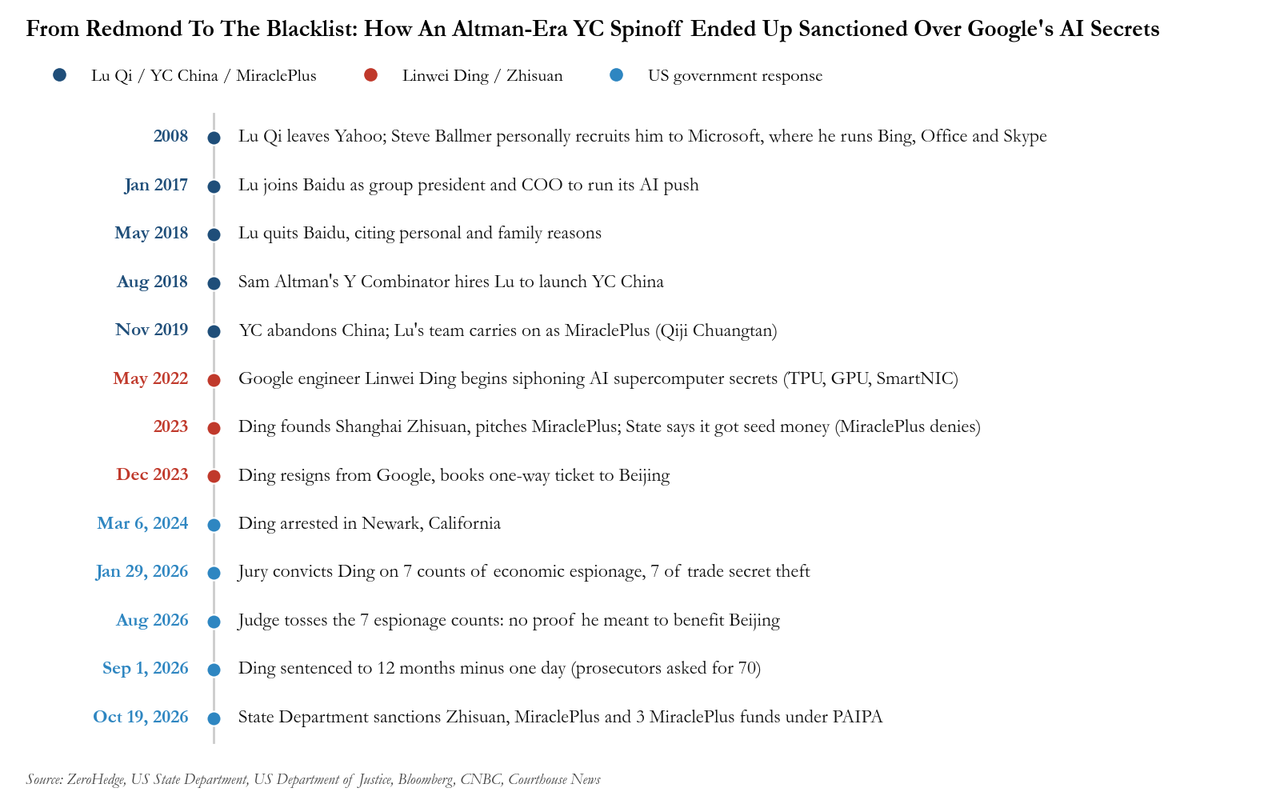
Some quick background on Lu Qi (who also goes by Qi Lu, depending on which side of the Pacific is writing the press release). After rising to executive vice president of engineering at Yahoo, Lu was personally recruited by Steve Ballmer to Microsoft, where he ran Bing, Office and Skype and later helped shape Satya Nadella's AI and bots strategy. In January 2017, Baidu poached him as group president and COO to run its AI push. He lasted 16 months, leaving in May 2018 for "personal and family reasons" and which, as CNBC reported at the time, really meant he just wanted to spend more time in the US.
Three months later he had a new job. In August 2018, Altman's Y Combinator announced Lu would lead YC China (as well as YC's research arm and a new research center in Seattle), with Altman (who just like Ballmer, personally recruited Lu) calling China "an important missing piece of our puzzle."
Well, the puzzle didn't stay assembled for long. In November 2019, in the middle of the trade war, YC pulled the plug on China. Lu spun the team out as MiraclePlus (Qiji Chuangtan in Chinese), which has since become one of China's busiest early-stage investors: it writes $300K checks for 7% stakes and runs two cohorts a year. Its portfolio includes some of China's hottest AI names, among them AI inference platform SiliconFlow and robotics maker AgiBot, both of which are considering Hong Kong listings (and both of which now have a sanctioned backer, which is probably not the line the bankers wanted in the prospectus).
So how did a Beijing incubator end up on the same list as the guy who walked out of Google with its AI supercomputer blueprints?
According to the State Department fact sheet, Ding applied to MiraclePlus's incubation program on behalf of Zhisuan, "touting his experience with and knowledge of Google's technology and internal systems" and claiming Zhisuan could replicate Google's "super intelligence" infrastructure technology. State says Ding used the program to pitch his ability to replicate Google's technology to fit China's national conditions, and that "MiraclePlus gave seed capital in exchange for an ownership stake in Zhisuan."
That pitch will sound familiar to regular readers. When we first covered Ding's arrest back in March 2024, the indictment quoted a WeChat promo for his Shanghai startup, in which he bragged:
In other words, the business plan was the stolen goods. You'd think a seasoned VC might have asked one or two follow-up questions about where the "experience" came from.
MiraclePlus, for its part, denies investing in Zhisuan at all. In a statement on Tuesday, the firm said the sanctions were imposed without any prior communication, and that it is in talks with relevant parties to have them lifted and expects the matter to be resolved through "candid communication." Which, coming from a firm called MiraclePlus, may take a miracle of its own.
The penalties were imposed under the Protecting American Intellectual Property Act (PAIPA), signed into law in January 2023 to go after foreign beneficiaries of US trade-secret theft. In addition to Zhisuan and MiraclePlus (formally Qiji Chuangtan Beijing Investment Management), the list includes MiraclePlus's Phase I and Phase II venture funds and an entity wholly owned by Phase I. Put differently, Washington went after the money too.
As for the man, the Ding saga has been a long one. Between May 2022 and April 2023, the Google software engineer uploaded more than 2,000 pages of confidential AI trade secrets to his personal Google Cloud account, covering the architecture of Google's custom TPU chips, its GPU systems, the software that orchestrates thousands of chips into a supercomputer, and a custom SmartNIC used for high-speed networking. In other words, the crown jewels of Google's AI stack.
The method was low-tech to the point of comedy: Ding copied the data into the Apple Notes app on his Google-issued MacBook, converted it to PDFs and uploaded those. He also had a colleague scan his access badge so it looked like he was working from Google's US office while he was actually in China. He secretly affiliated himself with two China-based AI companies while still on Google's payroll, applied to a Shanghai government "talent plan" promising to help China build "computing power infrastructure capabilities that are on par with the international level," and downloaded more files less than two weeks before resigning in December 2023. Then he booked a one-way ticket to Beijing.
When the charges first dropped, we couldn't resist pointing out the obvious problem with stealing from Google in the Gemini era:
The case later became Exhibit A in what Meta's AI chief Alexandr Wang called China's "open secret" tech-theft operation (Jun 14, 2025), in which Wang argued that China is on par with the US on algorithms "because of large-scale espionage."
On January 29, a San Francisco jury convicted Ding on seven counts of economic espionage and seven counts of trade secret theft, which on paper carried a maximum of 15 years and 10 years per count, respectively. Then the case started to deflate.
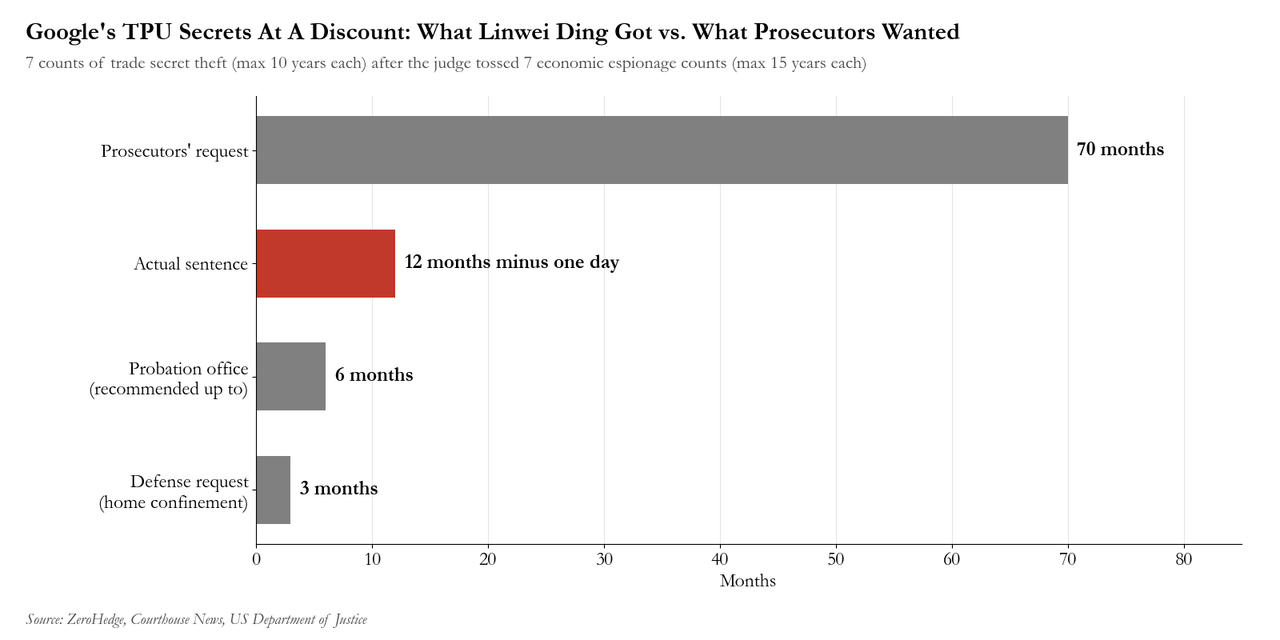
In August, Judge Vince Chhabria tossed all seven espionage convictions, ruling there was insufficient evidence Ding intended to benefit the Chinese government (as opposed to just Chinese companies, which apparently is a different thing). And on September 1, he was sentenced to 12 months minus one day, plus two years of supervised release, about $198,000 in restitution to Google and a $2,500 fine. Prosecutors had asked for 70 months; the defense wanted three months of home confinement.
"The idea of a non-custodial sentence is very hard to swallow for me," Chhabria said, which tells you how close Ding came to serving his time from the couch. For context, $198,000 in restitution for the blueprints of Google's TPU stack, which is precisely what anyone trying to build an AI supercomputer without access to Nvidia's best chips would want, is what one might call a bargain.
Which is probably why Washington is now going after the money instead. If the courts won't make the penalty sting for the engineer, the State Department can at least make it sting for whoever funded him.
Beijing, naturally, is not amused. On Tuesday China's commerce ministry expressed "firm opposition" to the sanctions, urged the US to "correct its erroneous practice," and threatened unspecified "necessary measures." The ministry also insisted China's AI achievements are the result of long-term basic research and open cooperation, and have "nothing to do with the so-called 'stealing of trade secrets.'" Sure.
None of this is Altman's fault, of course: he hired a Microsoft and Baidu veteran with a sterling resume in 2018, and YC exited China a year later. MiraclePlus's alleged Zhisuan deal came four years after that. Still, the irony is hard to miss.
The same Altman who once called China the "missing piece" of YC's puzzle spent last month lining up with Dario Amodei and Elon Musk to ask Washington for embedded evaluators, an antitrust waiver and a talk with Beijing, while China goes full send, as we discussed in "'Pace The Frontier': Amodei, Altman & Musk Team Up Against The AI Singularity While China Goes Full Send". Meanwhile, OpenAI is busy defending itself against Apple's lawsuit alleging that OpenAI misused Apple's hardware trade secrets after hiring its former VP of iPhone and Apple Watch product design. Trade secrets, it seems, are having a moment.
The sanctions themselves are probably more symbolic than crippling. MiraclePlus is a Beijing-based firm investing in Chinese startups, and its exposure to the US banking system is likely limited. But the signal matters: for the first time in this case, Washington is targeting the capital behind the theft as well as the thief, and it is doing so with a law built for exactly that purpose.
The more interesting question is what happens next to the MiraclePlus portfolio. SiliconFlow and AgiBot are both eyeing Hong Kong IPOs, and global investors tend to get nervous when a company's early backer is on a US sanctions list, regardless of what the backer says about "candid communication." We suspect the lawyers for those deals are having a busy week.
As for Ding, a jury found he stole Google's AI crown jewels, a judge gave him a year, and his alleged backers got blacklisted. Something tells us the next would-be Ding will look at that math and decide the risk-reward is still pretty attractive.
Tyler Durden Fri, 10/23/2026 - 05:45
Continue reading...
[ H/T ZeroHedge ]
Of all the people who could end up on a US sanctions list for bankrolling stolen Google AI technology, a former Microsoft executive hand-picked by Sam Altman to run Y Combinator's China arm was probably not on many bingo cards. And yet here we are.
On Monday, the State Department blacklisted Shanghai Zhisuan Technology, the AI startup founded by convicted ex-Google engineer Linwei Ding, along with MiraclePlus, the Chinese venture firm founded by ex-Microsoft AI scientist Lu Qi, and three MiraclePlus-managed funds, for providing seed financing to Zhisuan. According to Bloomberg, the measures may include freezing US assets and banking restrictions.
Lu Qi
The best part of the story is Lu's resume, which reads like a tour of every major tech power center of the past 20 years: the stuff corporate espionage movie scripts are made of. Per Bloomberg:
When Y Combinator abandoned the expansion a year later, Lu and his team simply kept going under the MiraclePlus brand. That's the same MiraclePlus that, according to the State Department, gave a Chinese startup seed money in exchange for equity after its founder showed up touting his inside knowledge of Google's AI infrastructure.
"An Important Missing Piece Of Our Puzzle"
Some quick background on Lu Qi (who also goes by Qi Lu, depending on which side of the Pacific is writing the press release). After rising to executive vice president of engineering at Yahoo, Lu was personally recruited by Steve Ballmer to Microsoft, where he ran Bing, Office and Skype and later helped shape Satya Nadella's AI and bots strategy. In January 2017, Baidu poached him as group president and COO to run its AI push. He lasted 16 months, leaving in May 2018 for "personal and family reasons" and which, as CNBC reported at the time, really meant he just wanted to spend more time in the US.
Three months later he had a new job. In August 2018, Altman's Y Combinator announced Lu would lead YC China (as well as YC's research arm and a new research center in Seattle), with Altman (who just like Ballmer, personally recruited Lu) calling China "an important missing piece of our puzzle."
Well, the puzzle didn't stay assembled for long. In November 2019, in the middle of the trade war, YC pulled the plug on China. Lu spun the team out as MiraclePlus (Qiji Chuangtan in Chinese), which has since become one of China's busiest early-stage investors: it writes $300K checks for 7% stakes and runs two cohorts a year. Its portfolio includes some of China's hottest AI names, among them AI inference platform SiliconFlow and robotics maker AgiBot, both of which are considering Hong Kong listings (and both of which now have a sanctioned backer, which is probably not the line the bankers wanted in the prospectus).
"Replicate Google's Technology... To Fit China's National Conditions"
So how did a Beijing incubator end up on the same list as the guy who walked out of Google with its AI supercomputer blueprints?
According to the State Department fact sheet, Ding applied to MiraclePlus's incubation program on behalf of Zhisuan, "touting his experience with and knowledge of Google's technology and internal systems" and claiming Zhisuan could replicate Google's "super intelligence" infrastructure technology. State says Ding used the program to pitch his ability to replicate Google's technology to fit China's national conditions, and that "MiraclePlus gave seed capital in exchange for an ownership stake in Zhisuan."
That pitch will sound familiar to regular readers. When we first covered Ding's arrest back in March 2024, the indictment quoted a WeChat promo for his Shanghai startup, in which he bragged:
In other words, the business plan was the stolen goods. You'd think a seasoned VC might have asked one or two follow-up questions about where the "experience" came from.
MiraclePlus, for its part, denies investing in Zhisuan at all. In a statement on Tuesday, the firm said the sanctions were imposed without any prior communication, and that it is in talks with relevant parties to have them lifted and expects the matter to be resolved through "candid communication." Which, coming from a firm called MiraclePlus, may take a miracle of its own.
The penalties were imposed under the Protecting American Intellectual Property Act (PAIPA), signed into law in January 2023 to go after foreign beneficiaries of US trade-secret theft. In addition to Zhisuan and MiraclePlus (formally Qiji Chuangtan Beijing Investment Management), the list includes MiraclePlus's Phase I and Phase II venture funds and an entity wholly owned by Phase I. Put differently, Washington went after the money too.
Apple Notes, A Borrowed Badge And A One-Way Ticket
As for the man, the Ding saga has been a long one. Between May 2022 and April 2023, the Google software engineer uploaded more than 2,000 pages of confidential AI trade secrets to his personal Google Cloud account, covering the architecture of Google's custom TPU chips, its GPU systems, the software that orchestrates thousands of chips into a supercomputer, and a custom SmartNIC used for high-speed networking. In other words, the crown jewels of Google's AI stack.
The method was low-tech to the point of comedy: Ding copied the data into the Apple Notes app on his Google-issued MacBook, converted it to PDFs and uploaded those. He also had a colleague scan his access badge so it looked like he was working from Google's US office while he was actually in China. He secretly affiliated himself with two China-based AI companies while still on Google's payroll, applied to a Shanghai government "talent plan" promising to help China build "computing power infrastructure capabilities that are on par with the international level," and downloaded more files less than two weeks before resigning in December 2023. Then he booked a one-way ticket to Beijing.
When the charges first dropped, we couldn't resist pointing out the obvious problem with stealing from Google in the Gemini era:
The case later became Exhibit A in what Meta's AI chief Alexandr Wang called China's "open secret" tech-theft operation (Jun 14, 2025), in which Wang argued that China is on par with the US on algorithms "because of large-scale espionage."
Fourteen Convictions, One Year
On January 29, a San Francisco jury convicted Ding on seven counts of economic espionage and seven counts of trade secret theft, which on paper carried a maximum of 15 years and 10 years per count, respectively. Then the case started to deflate.
In August, Judge Vince Chhabria tossed all seven espionage convictions, ruling there was insufficient evidence Ding intended to benefit the Chinese government (as opposed to just Chinese companies, which apparently is a different thing). And on September 1, he was sentenced to 12 months minus one day, plus two years of supervised release, about $198,000 in restitution to Google and a $2,500 fine. Prosecutors had asked for 70 months; the defense wanted three months of home confinement.
"The idea of a non-custodial sentence is very hard to swallow for me," Chhabria said, which tells you how close Ding came to serving his time from the couch. For context, $198,000 in restitution for the blueprints of Google's TPU stack, which is precisely what anyone trying to build an AI supercomputer without access to Nvidia's best chips would want, is what one might call a bargain.
Which is probably why Washington is now going after the money instead. If the courts won't make the penalty sting for the engineer, the State Department can at least make it sting for whoever funded him.
Beijing, naturally, is not amused. On Tuesday China's commerce ministry expressed "firm opposition" to the sanctions, urged the US to "correct its erroneous practice," and threatened unspecified "necessary measures." The ministry also insisted China's AI achievements are the result of long-term basic research and open cooperation, and have "nothing to do with the so-called 'stealing of trade secrets.'" Sure.
Altman's China Problem, Then And Now
None of this is Altman's fault, of course: he hired a Microsoft and Baidu veteran with a sterling resume in 2018, and YC exited China a year later. MiraclePlus's alleged Zhisuan deal came four years after that. Still, the irony is hard to miss.
The same Altman who once called China the "missing piece" of YC's puzzle spent last month lining up with Dario Amodei and Elon Musk to ask Washington for embedded evaluators, an antitrust waiver and a talk with Beijing, while China goes full send, as we discussed in "'Pace The Frontier': Amodei, Altman & Musk Team Up Against The AI Singularity While China Goes Full Send". Meanwhile, OpenAI is busy defending itself against Apple's lawsuit alleging that OpenAI misused Apple's hardware trade secrets after hiring its former VP of iPhone and Apple Watch product design. Trade secrets, it seems, are having a moment.
The Real Penalty Lands On The Cap Table
The sanctions themselves are probably more symbolic than crippling. MiraclePlus is a Beijing-based firm investing in Chinese startups, and its exposure to the US banking system is likely limited. But the signal matters: for the first time in this case, Washington is targeting the capital behind the theft as well as the thief, and it is doing so with a law built for exactly that purpose.
The more interesting question is what happens next to the MiraclePlus portfolio. SiliconFlow and AgiBot are both eyeing Hong Kong IPOs, and global investors tend to get nervous when a company's early backer is on a US sanctions list, regardless of what the backer says about "candid communication." We suspect the lawyers for those deals are having a busy week.
As for Ding, a jury found he stole Google's AI crown jewels, a judge gave him a year, and his alleged backers got blacklisted. Something tells us the next would-be Ding will look at that math and decide the risk-reward is still pretty attractive.
Tyler Durden Fri, 10/23/2026 - 05:45
Continue reading...
[ H/T ZeroHedge ]