



Unhappiest Place On Wall Street: Disney Readies Thousands Of Layoffs As Managers Told To Slash 20% Of Costs
Three years, two CEOs, at least six rounds of layoffs... and one stock that still can't get off the floor.
On Monday evening, Bloomberg reported that Walt Disney is set to unleash thousands of job cuts, with the entertainment giant asking some managers to target 20% in annual cost savings. Citing "people familiar with the matter", the savings could come from job eliminations as well as other expense reductions, and some of Disney's operations, which range from theme parks to the TV networks and the movie studio, "will be affected disproportionately."
Disney declined to comment, but the timing speaks for itself: the company reports fiscal Q4 results in two weeks (Nov 17), and it has already promised investors double-digit growth in adjusted EPS in the current fiscal year. When the top line won't cooperate, well, there is always the cost line.
Regular readers know this is hardly a new chapter. When Disney picked parks boss Josh D'Amaro to replace Bob Iger back in February, the stock was already locked in a trough that started in 2022, and by April we were writing that there would be "no storybook ending" for the roughly 1,000 marketing staff on D'Amaro's first chopping block. This one is, by all accounts, much bigger.
First, some context on why Disney is reaching for the axe (again). The stock closed Monday at $113.11 (and barely budged after hours, up ~0.3%), which is 44% below its March 2021 record close of $201.91. Over the same period the S&P 500 is up 97%. Put differently, anyone who bought Mickey at the peak has watched the broader market almost double while their position lost nearly half its value. Shares are, more or less, where they traded in early 2019.
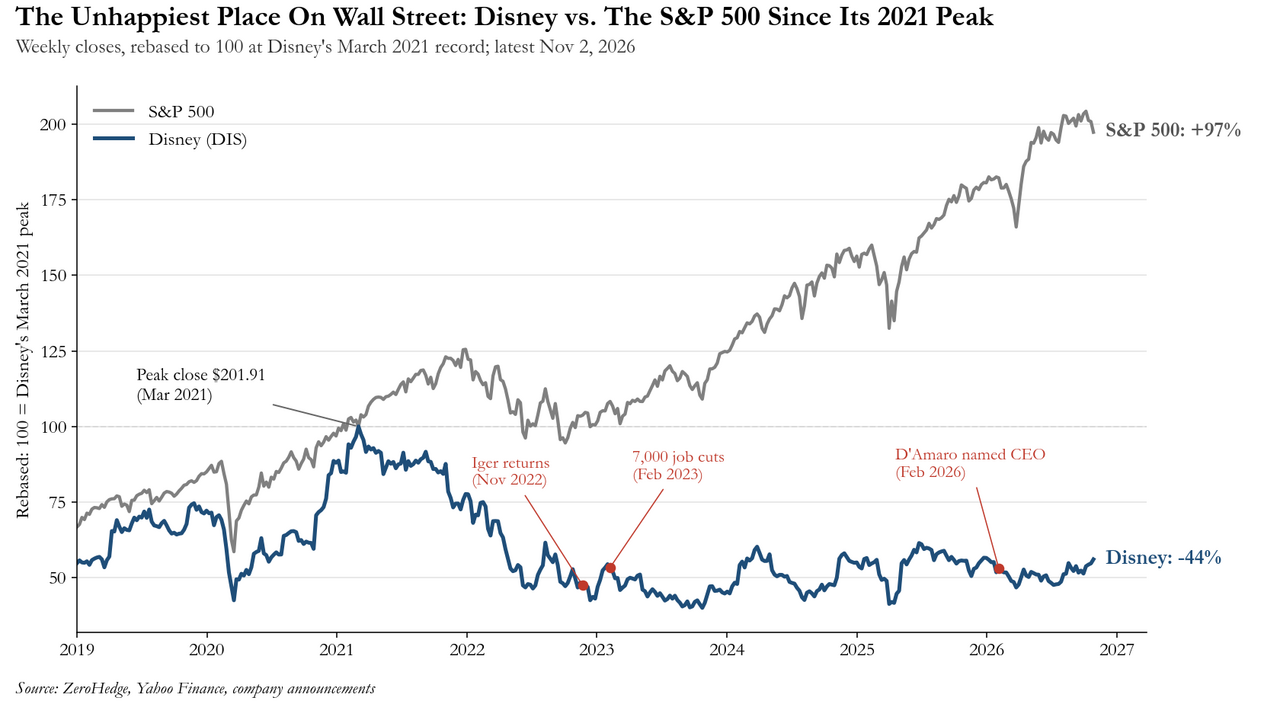
Note the red dots: Iger's return in November 2022, his 7,000-job, $5.5 billion cost-savings plan in early 2023, and D'Amaro's appointment this year. None of them moved the needle for more than a few months. So much for the magic.
Bloomberg notes that Disney has already cut billions of dollars in costs and eliminated thousands of positions in recent years, with reductions hitting every division, including ABC, Pixar, ESPN, the film studio and the experiences unit. Here is the abridged version of what has become a rolling layoff calendar, with the newest entry in red:
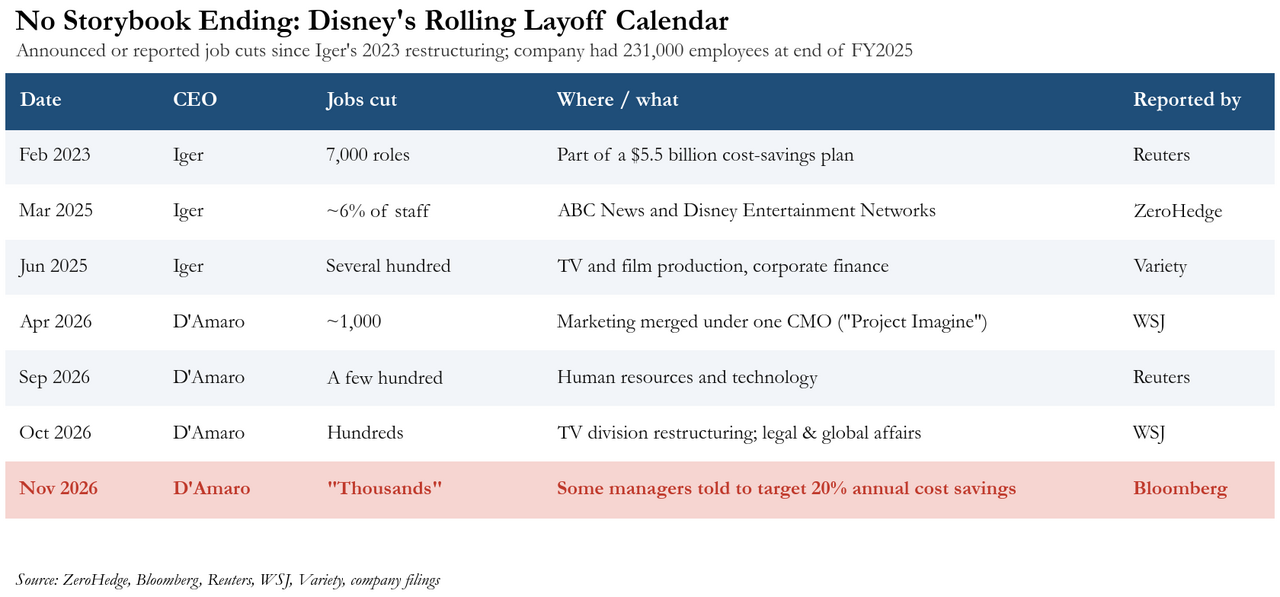
Some of these we covered as they happened: the cuts of 6% of staff at ABC News and Disney Entertainment Networks (Mar 5, 2025), followed by another round in June 2025 as the latest projects bombed at the box office. Then, on Oct 1, the WSJ reported that Disney was planning to restructure its TV division and cut jobs in its legal and global affairs unit:
Back in April, the WSJ also reported that Disney had been working with Bain & Co. consultants on its cost-cutting strategy, which probably makes Burbank the happiest place on earth for at least one group of people.
Today's numbers, though, are on a different scale. Disney had 231,000 employees worldwide at the end of fiscal 2025. This means that even a 2% headcount reduction is roughly 4,600 jobs, which would comfortably qualify as "thousands". And while the 20% savings target applies to "some managers" and includes non-labor expenses, a target of that size in any budget line rarely gets met with paper clips alone.
D'Amaro isn't pocketing all of it. According to Bloomberg, the CEO aims to reinvest a portion of the savings into film and TV programming, technology, and the theme parks and cruise ship businesses, where Disney is already in the middle of a $60 billion, decade-long investment push. That is also more or less the bull case on the Street.
Goldman's Michael Ng, who reiterated his Buy ahead of the print in his latest F4Q26 preview note (available to pro subs), argues that Disney "remains a multi-year earnings compounder driven by ongoing investment in Experiences, cruise expansion, a strong theatrical slate, and Disney+ ecosystem enhancements." Ng is looking for F4Q EPS of $1.73 versus $1.66 consensus, on revenue of $25.4 billion and segment EBIT of $4.93 billion, both above consensus (helped by a 53rd week). He also nudged up his F2027 EPS to $7.56, though mostly on lower taxes rather than better operations.
The fine print is more interesting. Goldman lists the offsets as "SVOD advertising softness, higher content investment and weaker Asian park attendance", and despite the above-consensus numbers, Ng lowered his 12-month price target to $140 from $144. When even the bulls trim their targets into a beat, you know the multiple is doing the heavy lifting.
And the parks, which Disney is now asking to carry the whole kingdom, are showing some cracks. Back in August, D'Amaro told analysts on the fiscal Q3 call (when Disney beat with adjusted EPS of $2.06 vs. $1.86 expected) that domestic parks were fine, with per-capita spending up 4%, while management flagged trouble abroad. As JPMorgan's Market Intelligence desk highlighted in its daily earnings macro read-through (available to pro subs), "the most interesting comments came from DIS":
Closer to home, Goldman's latest Orlando tourism tracker, which the bank uses to gauge intra-quarter demand at Disney and Universal parks, showed Orlando airport arrivals down 7% year-over-year in August. Maybe that's just tough comps against a hot 2025; or maybe even American families have a limit on how many $4.25 bottles of water they are willing to buy.
The other pillar of the bull case, streaming, has a pricing problem of a different kind: Disney keeps raising prices because it can't grow subscribers fast enough to do anything else. A year ago we laughed at the latest Disney+ price hike...
...and exactly one year later, to the day, we got the sequel:
Disney is far from alone. Bloomberg points out that Netflix, Sony Pictures and Skydance's Paramount and Warner Bros. divisions have all cut jobs as revenue from traditional television declines and streaming subscriber growth slows, while viewers drift to social media, online video and the streaming arms of Amazon and Apple. Reuters added AI adoption, a weaker box office and slowing international park attendance to D'Amaro's list of headaches.
Disney President Dana Walden put it rather bluntly at Bloomberg's Screentime conference last month:
Translation: the tech giants are coming for the eyeballs, and Disney's answer is a smaller Disney. Which is a curious pivot for a company that, only last December, invested $1 billion in OpenAI to bring its characters to Sora, before walking away from the deal in March, according to the Hollywood Reporter.
To be fair, the sell-side is not exactly running for the exits. Besides Goldman, Wells Fargo's Steven Cahall recently upgraded the stock to Overweight with a $132 target, and Guggenheim's Michael Morris reiterated a Buy with a $120 target. On Goldman's F2027 EPS estimate, Disney trades at roughly 15x forward earnings (napkin math: $113.11 / $7.56), a steep discount to the market.
The problem is that Disney has looked "cheap" for the better part of four years, and as the chart above shows, it hasn't helped much. Cost cuts can deliver an EPS beat; they can't manufacture revenue growth, and a 20% savings target in a company with 231,000 employees is not what management teams announce when they're confident about the top line.
D'Amaro inherited a company where the parks print money, the linear TV business is in managed decline, streaming leans on ever-higher prices, and the box office remains hit or miss. His answer so far looks a lot like Iger's: cut, consolidate, reinvest in the parks and promise double-digit EPS growth. Maybe it works this time. But with the Asian consumer weakening, Orlando arrivals falling and even Goldman trimming its target, we suspect the next round of savings will be needed sooner rather than later... and the layoff calendar above will need a few more rows.
We'll find out on Nov 17 how much of the 20% is already baked into guidance.
Much more in the full Goldman "F4Q26 preview" note and the bank's Orlando tourism tracker, both available to pro subs.
Tyler Durden Mon, 11/02/2026 - 23:07
Continue reading...
[ H/T ZeroHedge ]
Three years, two CEOs, at least six rounds of layoffs... and one stock that still can't get off the floor.
On Monday evening, Bloomberg reported that Walt Disney is set to unleash thousands of job cuts, with the entertainment giant asking some managers to target 20% in annual cost savings. Citing "people familiar with the matter", the savings could come from job eliminations as well as other expense reductions, and some of Disney's operations, which range from theme parks to the TV networks and the movie studio, "will be affected disproportionately."
Disney declined to comment, but the timing speaks for itself: the company reports fiscal Q4 results in two weeks (Nov 17), and it has already promised investors double-digit growth in adjusted EPS in the current fiscal year. When the top line won't cooperate, well, there is always the cost line.
Regular readers know this is hardly a new chapter. When Disney picked parks boss Josh D'Amaro to replace Bob Iger back in February, the stock was already locked in a trough that started in 2022, and by April we were writing that there would be "no storybook ending" for the roughly 1,000 marketing staff on D'Amaro's first chopping block. This one is, by all accounts, much bigger.
The Unhappiest Place On Wall Street
First, some context on why Disney is reaching for the axe (again). The stock closed Monday at $113.11 (and barely budged after hours, up ~0.3%), which is 44% below its March 2021 record close of $201.91. Over the same period the S&P 500 is up 97%. Put differently, anyone who bought Mickey at the peak has watched the broader market almost double while their position lost nearly half its value. Shares are, more or less, where they traded in early 2019.
Note the red dots: Iger's return in November 2022, his 7,000-job, $5.5 billion cost-savings plan in early 2023, and D'Amaro's appointment this year. None of them moved the needle for more than a few months. So much for the magic.
No Storybook Ending, Part VII
Bloomberg notes that Disney has already cut billions of dollars in costs and eliminated thousands of positions in recent years, with reductions hitting every division, including ABC, Pixar, ESPN, the film studio and the experiences unit. Here is the abridged version of what has become a rolling layoff calendar, with the newest entry in red:
Some of these we covered as they happened: the cuts of 6% of staff at ABC News and Disney Entertainment Networks (Mar 5, 2025), followed by another round in June 2025 as the latest projects bombed at the box office. Then, on Oct 1, the WSJ reported that Disney was planning to restructure its TV division and cut jobs in its legal and global affairs unit:
Back in April, the WSJ also reported that Disney had been working with Bain & Co. consultants on its cost-cutting strategy, which probably makes Burbank the happiest place on earth for at least one group of people.
Today's numbers, though, are on a different scale. Disney had 231,000 employees worldwide at the end of fiscal 2025. This means that even a 2% headcount reduction is roughly 4,600 jobs, which would comfortably qualify as "thousands". And while the 20% savings target applies to "some managers" and includes non-labor expenses, a target of that size in any budget line rarely gets met with paper clips alone.
Cut Here, Spend There
D'Amaro isn't pocketing all of it. According to Bloomberg, the CEO aims to reinvest a portion of the savings into film and TV programming, technology, and the theme parks and cruise ship businesses, where Disney is already in the middle of a $60 billion, decade-long investment push. That is also more or less the bull case on the Street.
Goldman's Michael Ng, who reiterated his Buy ahead of the print in his latest F4Q26 preview note (available to pro subs), argues that Disney "remains a multi-year earnings compounder driven by ongoing investment in Experiences, cruise expansion, a strong theatrical slate, and Disney+ ecosystem enhancements." Ng is looking for F4Q EPS of $1.73 versus $1.66 consensus, on revenue of $25.4 billion and segment EBIT of $4.93 billion, both above consensus (helped by a 53rd week). He also nudged up his F2027 EPS to $7.56, though mostly on lower taxes rather than better operations.
The fine print is more interesting. Goldman lists the offsets as "SVOD advertising softness, higher content investment and weaker Asian park attendance", and despite the above-consensus numbers, Ng lowered his 12-month price target to $140 from $144. When even the bulls trim their targets into a beat, you know the multiple is doing the heavy lifting.
And the parks, which Disney is now asking to carry the whole kingdom, are showing some cracks. Back in August, D'Amaro told analysts on the fiscal Q3 call (when Disney beat with adjusted EPS of $2.06 vs. $1.86 expected) that domestic parks were fine, with per-capita spending up 4%, while management flagged trouble abroad. As JPMorgan's Market Intelligence desk highlighted in its daily earnings macro read-through (available to pro subs), "the most interesting comments came from DIS":
Closer to home, Goldman's latest Orlando tourism tracker, which the bank uses to gauge intra-quarter demand at Disney and Universal parks, showed Orlando airport arrivals down 7% year-over-year in August. Maybe that's just tough comps against a hot 2025; or maybe even American families have a limit on how many $4.25 bottles of water they are willing to buy.
"Technology Set Their Sights On Our Business"
The other pillar of the bull case, streaming, has a pricing problem of a different kind: Disney keeps raising prices because it can't grow subscribers fast enough to do anything else. A year ago we laughed at the latest Disney+ price hike...
...and exactly one year later, to the day, we got the sequel:
Disney is far from alone. Bloomberg points out that Netflix, Sony Pictures and Skydance's Paramount and Warner Bros. divisions have all cut jobs as revenue from traditional television declines and streaming subscriber growth slows, while viewers drift to social media, online video and the streaming arms of Amazon and Apple. Reuters added AI adoption, a weaker box office and slowing international park attendance to D'Amaro's list of headaches.
Disney President Dana Walden put it rather bluntly at Bloomberg's Screentime conference last month:
Translation: the tech giants are coming for the eyeballs, and Disney's answer is a smaller Disney. Which is a curious pivot for a company that, only last December, invested $1 billion in OpenAI to bring its characters to Sora, before walking away from the deal in March, according to the Hollywood Reporter.
Cheap For A Reason?
To be fair, the sell-side is not exactly running for the exits. Besides Goldman, Wells Fargo's Steven Cahall recently upgraded the stock to Overweight with a $132 target, and Guggenheim's Michael Morris reiterated a Buy with a $120 target. On Goldman's F2027 EPS estimate, Disney trades at roughly 15x forward earnings (napkin math: $113.11 / $7.56), a steep discount to the market.
The problem is that Disney has looked "cheap" for the better part of four years, and as the chart above shows, it hasn't helped much. Cost cuts can deliver an EPS beat; they can't manufacture revenue growth, and a 20% savings target in a company with 231,000 employees is not what management teams announce when they're confident about the top line.
Magic Kingdom, Shrinking Kingdom
D'Amaro inherited a company where the parks print money, the linear TV business is in managed decline, streaming leans on ever-higher prices, and the box office remains hit or miss. His answer so far looks a lot like Iger's: cut, consolidate, reinvest in the parks and promise double-digit EPS growth. Maybe it works this time. But with the Asian consumer weakening, Orlando arrivals falling and even Goldman trimming its target, we suspect the next round of savings will be needed sooner rather than later... and the layoff calendar above will need a few more rows.
We'll find out on Nov 17 how much of the 20% is already baked into guidance.
Much more in the full Goldman "F4Q26 preview" note and the bank's Orlando tourism tracker, both available to pro subs.
Tyler Durden Mon, 11/02/2026 - 23:07
Continue reading...
[ H/T ZeroHedge ]