






UK Officials Are Keeping A List Of Brits Who Question Government Policy
Authored by Steve Watson via Modernity.news,
The British state is compiling a list of people who criticise its own counter-terror programme. Ordinary X and Reddit users who questioned Prevent training, flagged a one-sided focus on the "far Right," or simply criticised it have had their posts logged, stored and "investigated" by a Home Office-linked unit most of them have never heard of.
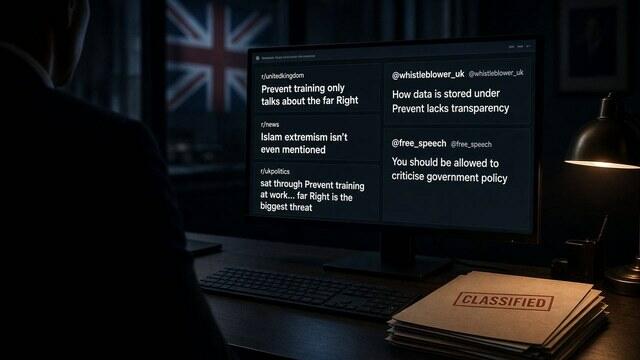
Officials spent more than a year trying to keep that database secret. They only released it after an appeal to the Information Commissioner's Office. The public was never told their feeds were being trawled.
The Standards and Compliance Unit, or StaCU, was set up in February 2024 as an "opaque" body to handle complaints about Prevent, the safeguarding scheme sold as a way to stop people becoming terrorists. Documents obtained by The Metro and released by Rights & Security International show StaCU did more than wait for formal complaints.
Between March 2024 and February 2025 it made 77 "observations" of critical online comments, most of them from X, with others from Reddit and even articles in the Guardian and the Telegraph.
Jacob Smith, Freedom of Expression and Belief Team Leader at Rights & Security International, fought for a year to force the Home Office to publish the material.
"It is shocking that the government has been trawling X and Reddit to find out who has been critiquing Prevent - and then storing that information," he said. "You should be allowed to criticise government policy without being put on a list."
He added: "People should be able to express their views on social media without that being catalogued in government databases."
Many of those logged, he said, had posted without thinking "that the government might be looking at their feed and taking that data. It is in an almost private setting."
His conclusion was blunt: "It's a stark reminder that, in the government's eyes, anything you share online is fair game and could go into a file forever."
A large share of the logged posts accused Prevent training of treating the "far Right" as the main threat while skating over Islamist extremism.
One X user was recorded after calling the training "complete bullshit." They wrote: "Anyone's who done the prevent training knows it only talks about the far Right. Islam extremism isn't even mentioned."
Another poster said they "sat through Prevent training at work ... and the narrative was very much that the far Right is the biggest threat." They added: "I kid you not!"
StaCU says it tries to independently verify claims about Prevent. It managed that for only 10 percent of the posts. The unit's parent body, the Commission for Countering Extremism, sometimes replies in public, inviting the user to submit a formal complaint.
In one case, after a post accused Prevent training of "turning a blind eye to Islam," the Commission wrote: "Hello, we process and investigate complaints about Prevent and are interested in finding out more about the training referenced above. Please feel free to DM us, tweet us back, or make a formal complaint using this link."
What that reply does not say is that the user's post has already been stored in an internal government list.
It was not only anonymous accounts. Open Rights Group had a tweet recorded that said: "How data is managed and stored under the Prevent programme lacks transparency."
Sarah Lasoye, the group's Programme Manager for Pre-Crime, told The Metro: "Prevent has expanded far beyond its stated aim of identifying people considered 'vulnerable to radicalisation', and has increasingly been used to justify extensive surveillance."
She added, "It is deeply concerning to see the Prevent duty being used to enable the monitoring of people and organisations simply because they are critical of the programme. That raises serious questions about freedom of expression and the right to dissent and protest."
"There is also a troubling lack of transparency about what happens to the information gathered through this social media monitoring: how long it is retained, who it is shared with, and ultimately what the Government is using it for," Lasoye urged.
Rights & Security International says organisations including Hope Not Hate and Maslaha also appear in or around the observations. The Campaign Against Antisemitism had a post logged that did not even name Prevent. It criticised police for failing to take a Hezbollah vigil seriously. A spokesperson said: "We aren't sure whether to be flattered or concerned that StaCU has picked up a post of ours."
The group added, "If it's because we've dared to be critical of law enforcement's lax attitude toward Islamist extremism in this country, we stand by what we said and would reiterate it for as long as it takes to bring about change. But if our post was flagged because StaCU agrees with us that police forces have failed to train their officers on what Islamist terrorism looks like and which organisations are banned, we hope that the message is being received and change is coming."
That last point tracks a long-running complaint. Sir William Shawcross, in his 2023 review of Prevent, wrote: "The bar for what RICU includes on Islamism looks to be relatively high, whereas the bar for what is included on the extreme Right-wing is comparably low."
Home Office figures for the year to September 2025 showed 10,293 Prevent referrals. Twenty percent were recorded as extreme right-wing ideology. Eight percent concerned Islamist extremism.
A Home Office spokesperson said: "Prevent does not track people who may have criticised the programme, and nor does it target any particular community." The department added that keeping the public safe is "our number one priority" and that Prevent has "moved more than 6,000 people away from violent ideologies since 2015."
The documents say otherwise on the first claim. StaCU collated the posts as "open-source complaints," stored them internally, and the Home Office refused to release the list until the Information Commissioner forced its hand. Nobody outside the unit can say who else sees the file, how long it is kept, or whether it is shared with police, platforms or other departments.
This is not an isolated compliance desk. It sits inside a growing stack of state machinery built to police speech, "narratives" and online anger.
In June, we laid out how the Home Office's Research, Information and Communications Unit has been used to manage the mass-migration story - briefing police to cast concerned citizens as "unsympathetic thugs," shaping family statements after migrant-linked killings, and running a higher bar for Islamism than for the so-called extreme Right.
The same week, ministers moved to give Ofcom faster powers to block "false information" during so-called crisis events - a phrase wide enough to cover any unrest the government would rather you not describe accurately.
London Mayor Sadiq Khan had already demanded a central government social-media "disinformation" unit, complaining of an "outrage economy" while knife crime, robbery and theft climbed on his watch. "If platforms fail to act, the state must have the tools to make them," he said.
Last week Prime Minister Andy Burnham used his first United Nations speech to announce a National Centre for Information Defence - a new machine to "detect, attribute and disrupt" what ministers call hostile information attacks and to stop a "distorted and untrue narrative about Britain."
He wrapped it in Russia, bots and "community cohesion." Nigel Farage called it a Ministry of Truth. "Never ever trust this authoritarian Government," he said. Defence Secretary Wes Streeting insisted: "We're not interested in policing domestic political dissent." Labour's record is why that promise is already worn thin.
Police have their own version. The National Internet Intelligence Investigations team, stood up after the 2024 Southport riots, has referred more than 100 "suspicious" posts to local forces, including dozens tied to protest-related activity.
Officials describe it as "a dedicated function at a national level for exploiting internet intelligence." Reform UK leader Nigel Farage called it "the beginning of the state controlling free speech."
The arrest figures sit underneath all of it. Between 2021 and 2025 at least 62,199 people were arrested in Britain on suspicion of communications offences - section 127 of the Communications Act 2003, the Malicious Communications Act 1988, and the Online Safety Act's false-communications offence.
That is roughly 34 arrests a day. Big Brother Watch director Silkie Carlo said speech policing is "out of control" and called the result an "Orwellian mess." Lord Toby Young asked why authorities spend so much time "policing our tweets when they could be policing our streets."
Prevent is sold as safeguarding. The logged posts are not bomb plots. They are workers calling official training biased, campaigners asking how data is stored, and a Jewish group complaining that police treat a banned terrorist organisation too lightly.
If that is enough to enter a Home Office database, the category of "acceptable" speech is already whatever officials decide it is on a whim.
Britain does not need another unit to hunt "untrue narratives." It needs a government that can survive being questioned without opening a file on the questioner.
Tyler Durden Fri, 10/02/2026 - 03:30
Continue reading...
[ H/T ZeroHedge ]
Authored by Steve Watson via Modernity.news,
The British state is compiling a list of people who criticise its own counter-terror programme. Ordinary X and Reddit users who questioned Prevent training, flagged a one-sided focus on the "far Right," or simply criticised it have had their posts logged, stored and "investigated" by a Home Office-linked unit most of them have never heard of.
Officials spent more than a year trying to keep that database secret. They only released it after an appeal to the Information Commissioner's Office. The public was never told their feeds were being trawled.
The Standards and Compliance Unit, or StaCU, was set up in February 2024 as an "opaque" body to handle complaints about Prevent, the safeguarding scheme sold as a way to stop people becoming terrorists. Documents obtained by The Metro and released by Rights & Security International show StaCU did more than wait for formal complaints.
Between March 2024 and February 2025 it made 77 "observations" of critical online comments, most of them from X, with others from Reddit and even articles in the Guardian and the Telegraph.
Jacob Smith, Freedom of Expression and Belief Team Leader at Rights & Security International, fought for a year to force the Home Office to publish the material.
"It is shocking that the government has been trawling X and Reddit to find out who has been critiquing Prevent - and then storing that information," he said. "You should be allowed to criticise government policy without being put on a list."
He added: "People should be able to express their views on social media without that being catalogued in government databases."
Many of those logged, he said, had posted without thinking "that the government might be looking at their feed and taking that data. It is in an almost private setting."
His conclusion was blunt: "It's a stark reminder that, in the government's eyes, anything you share online is fair game and could go into a file forever."
A large share of the logged posts accused Prevent training of treating the "far Right" as the main threat while skating over Islamist extremism.
One X user was recorded after calling the training "complete bullshit." They wrote: "Anyone's who done the prevent training knows it only talks about the far Right. Islam extremism isn't even mentioned."
Another poster said they "sat through Prevent training at work ... and the narrative was very much that the far Right is the biggest threat." They added: "I kid you not!"
StaCU says it tries to independently verify claims about Prevent. It managed that for only 10 percent of the posts. The unit's parent body, the Commission for Countering Extremism, sometimes replies in public, inviting the user to submit a formal complaint.
In one case, after a post accused Prevent training of "turning a blind eye to Islam," the Commission wrote: "Hello, we process and investigate complaints about Prevent and are interested in finding out more about the training referenced above. Please feel free to DM us, tweet us back, or make a formal complaint using this link."
What that reply does not say is that the user's post has already been stored in an internal government list.
It was not only anonymous accounts. Open Rights Group had a tweet recorded that said: "How data is managed and stored under the Prevent programme lacks transparency."
Sarah Lasoye, the group's Programme Manager for Pre-Crime, told The Metro: "Prevent has expanded far beyond its stated aim of identifying people considered 'vulnerable to radicalisation', and has increasingly been used to justify extensive surveillance."
She added, "It is deeply concerning to see the Prevent duty being used to enable the monitoring of people and organisations simply because they are critical of the programme. That raises serious questions about freedom of expression and the right to dissent and protest."
"There is also a troubling lack of transparency about what happens to the information gathered through this social media monitoring: how long it is retained, who it is shared with, and ultimately what the Government is using it for," Lasoye urged.
Rights & Security International says organisations including Hope Not Hate and Maslaha also appear in or around the observations. The Campaign Against Antisemitism had a post logged that did not even name Prevent. It criticised police for failing to take a Hezbollah vigil seriously. A spokesperson said: "We aren't sure whether to be flattered or concerned that StaCU has picked up a post of ours."
The group added, "If it's because we've dared to be critical of law enforcement's lax attitude toward Islamist extremism in this country, we stand by what we said and would reiterate it for as long as it takes to bring about change. But if our post was flagged because StaCU agrees with us that police forces have failed to train their officers on what Islamist terrorism looks like and which organisations are banned, we hope that the message is being received and change is coming."
That last point tracks a long-running complaint. Sir William Shawcross, in his 2023 review of Prevent, wrote: "The bar for what RICU includes on Islamism looks to be relatively high, whereas the bar for what is included on the extreme Right-wing is comparably low."
Home Office figures for the year to September 2025 showed 10,293 Prevent referrals. Twenty percent were recorded as extreme right-wing ideology. Eight percent concerned Islamist extremism.
A Home Office spokesperson said: "Prevent does not track people who may have criticised the programme, and nor does it target any particular community." The department added that keeping the public safe is "our number one priority" and that Prevent has "moved more than 6,000 people away from violent ideologies since 2015."
The documents say otherwise on the first claim. StaCU collated the posts as "open-source complaints," stored them internally, and the Home Office refused to release the list until the Information Commissioner forced its hand. Nobody outside the unit can say who else sees the file, how long it is kept, or whether it is shared with police, platforms or other departments.
This is not an isolated compliance desk. It sits inside a growing stack of state machinery built to police speech, "narratives" and online anger.
In June, we laid out how the Home Office's Research, Information and Communications Unit has been used to manage the mass-migration story - briefing police to cast concerned citizens as "unsympathetic thugs," shaping family statements after migrant-linked killings, and running a higher bar for Islamism than for the so-called extreme Right.
The same week, ministers moved to give Ofcom faster powers to block "false information" during so-called crisis events - a phrase wide enough to cover any unrest the government would rather you not describe accurately.
London Mayor Sadiq Khan had already demanded a central government social-media "disinformation" unit, complaining of an "outrage economy" while knife crime, robbery and theft climbed on his watch. "If platforms fail to act, the state must have the tools to make them," he said.
Last week Prime Minister Andy Burnham used his first United Nations speech to announce a National Centre for Information Defence - a new machine to "detect, attribute and disrupt" what ministers call hostile information attacks and to stop a "distorted and untrue narrative about Britain."
He wrapped it in Russia, bots and "community cohesion." Nigel Farage called it a Ministry of Truth. "Never ever trust this authoritarian Government," he said. Defence Secretary Wes Streeting insisted: "We're not interested in policing domestic political dissent." Labour's record is why that promise is already worn thin.
Police have their own version. The National Internet Intelligence Investigations team, stood up after the 2024 Southport riots, has referred more than 100 "suspicious" posts to local forces, including dozens tied to protest-related activity.
Officials describe it as "a dedicated function at a national level for exploiting internet intelligence." Reform UK leader Nigel Farage called it "the beginning of the state controlling free speech."
The arrest figures sit underneath all of it. Between 2021 and 2025 at least 62,199 people were arrested in Britain on suspicion of communications offences - section 127 of the Communications Act 2003, the Malicious Communications Act 1988, and the Online Safety Act's false-communications offence.
That is roughly 34 arrests a day. Big Brother Watch director Silkie Carlo said speech policing is "out of control" and called the result an "Orwellian mess." Lord Toby Young asked why authorities spend so much time "policing our tweets when they could be policing our streets."
Prevent is sold as safeguarding. The logged posts are not bomb plots. They are workers calling official training biased, campaigners asking how data is stored, and a Jewish group complaining that police treat a banned terrorist organisation too lightly.
If that is enough to enter a Home Office database, the category of "acceptable" speech is already whatever officials decide it is on a whim.
Britain does not need another unit to hunt "untrue narratives." It needs a government that can survive being questioned without opening a file on the questioner.
Tyler Durden Fri, 10/02/2026 - 03:30
Continue reading...
[ H/T ZeroHedge ]