



Officials in the United Kingdom are looking to utilize their “Special Relationship” with the United States to get a one-up in a competitive race to score a joint production contract with the U.S. for a new frigate.
In a briefing to reporters at the U.K.’s embassy in Washington, D.C., U.K. Defense Readiness and Industry Minister Luke Pollard outlined his efforts to lobby Washington to begin joint production of an American version of the Arrowhead 140 frigate design. The design is the U.K.’s pick in the crowded field of new frigate designs seeking U.S. patronage, triggered by President Donald Trump’s August memo seeking a partnership with a foreign nation to design and build a new frigate.
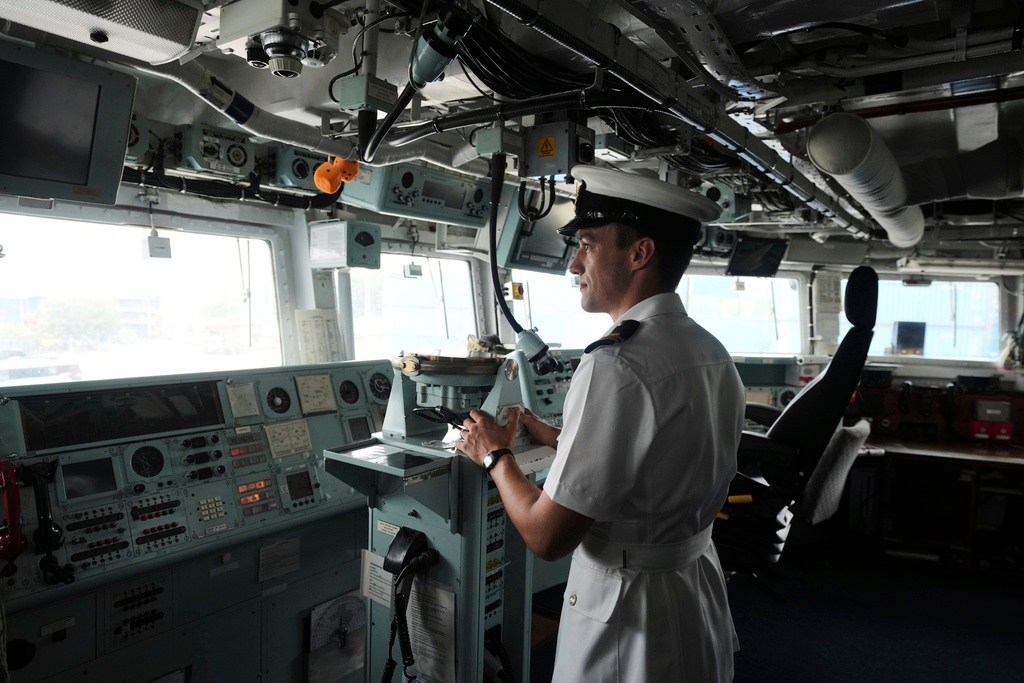
A sailer stands in the bridge of Royal Navy frigate HMS Richmond as it makes a port call at Tanjung Priok Port in Jakarta, Indonesia, Wednesday, June 25, 2025. (AP Photo/Tatan Syuflana)
" data-large-file="https://www.washingtonexaminer.com/wp-content/uploads/2026/11/AP25176261758163.jpg?w=1024" src="https://www.washingtonexaminer.com/wp-content/uploads/2026/11/AP25176261758163.jpg?w=1024" alt="Frigate" class="wp-image-4806302" srcset="https://www.washingtonexaminer.com/wp-content/uploads/2026/11/AP25176261758163.jpg 1024w, https://www.washingtonexaminer.com/wp-content/uploads/2026/11/AP25176261758163.jpg?resize=300,200 300w, https://www.washingtonexaminer.com/wp-content/uploads/2026/11/AP25176261758163.jpg?resize=768,512 768w" sizes="(max-width: 1024px) 100vw, 1024px">
A sailer stands in the bridge of Royal Navy frigate HMS Richmond as it makes a port call at Tanjung Priok Port in Jakarta, Indonesia, Wednesday, June 25, 2025. (AP Photo/Tatan Syuflana)
Trump’s call to scramble for a new frigate came after decades of struggling to find a new design — the Navy’s last frigate, the 1970s-era Oliver Hazard Perry-class, was retired in 2015. Frigates are a step below a destroyer, being less heavily armed but providing a vital support role for larger ships.
Despite the U.S.’s desire for a replacement, efforts have so far been in vain. The consequences have been showcased in recent naval conflicts against the Yemeni Houthis and Iran, as expensive destroyers are routinely forced to use expensive interceptors to counter cheap threats like drones. Smaller and cheaper frigates would be better suited to counter the threat.
The U.K.’s entry into the contest is from the British defense contractor Babcock, whose Arrowhead 140 design spawned the Royal Navy’s Type 31 class. Babcock is going up against five main competitors: the Spanish Navantia’s F-110 design, the Italian Fincantieri’s FREMM EVO design, Turkey’s Istanbul design, South Korea’s Chungnam design, and the Japanese Mitsubishi’s Mogami design.
Pollard appeared confident the U.K.’s design could win out, pitching it as a natural pick given the U.S. and U.K.’s special relationship.
“We don’t view this as a foreign frigate. We view this as a friendly frigate from a friend, because the U.S. and the U.K. naval relationship is so deep that we build each other’s gear already,” Pollard said, also describing the pitch as “working with a friend to have an American-built ship in America.”
The minister made liberal use of “friend” when discussing the U.K.’s view of the U.S., and said that London is eager to share its advanced shipmaking techniques with American shipyards.
“I’m not here saying, ‘Hey, British shipyards are great; you should build our stuff there.’ We’re deliberately saying our shipbuilders are great, but actually, the advanced manufacturing techniques that we use in Britain, we want to be able to support our American friends to increase the productivity and efficiency of U.S. shipbuilding,” he said.
Pollard said the results already speak for themselves. Five Type 31 frigates are under construction in Scottish shipyards, where they were being built “with a greater speed and productivity than some shipyards already.”
Frigates as a group are diverse, covering a wide spectrum of roles, and each frigate design is aimed at covering some part of this spectrum. The roughly 6,000-ton Arrowhead 140 design is on the heavier end of the spectrum, just below a destroyer. Its design is aimed at survivability and pursuing blue-water roles, rather than coastal defense tasks.
The Arrowhead 140 design can be adapted to its various buyers — the U.S. version would carry Mk 41 Vertical Launching System launchers, a U.S. radar system, U.S. command-and-control systems, room for a Seahawk helicopter, and more space for drones and other autonomous systems. Pollard says Babcock is eyeing a partnership with a U.S. shipyard that is yet to be announced.
The minister also joked that the Arrowhead 140 classification, referring to its 140-meter length, would have to be adjusted to the Americans’ preferred measuring system, becoming the Arrowhead 153 for 153 yards.
The design has already been exported to Poland and Indonesia, which are building the vessel with their own tweaks to meet their unique needs.
While the U.S. Arrowhead 140 design would primarily be a blue-water support ship, the U.K. is looking to make it a centerpiece of its navy. Pollard said the Royal Navy is eyeing Type 31s as the “mother ships for the hybrid navy,” the Royal Navy’s grand plan to reclaim its position as a significant naval power by blending crewed and autonomous systems.
“We are deliberately designing this class of vessel in the United Kingdom to be the center of our hybrid navy, which is our crewed, uncrewed, and autonomous navy, all operating together,” he said.
COLOMBIA’S NEW PRESIDENT BRINGS COUNTRY BACK INTO TRUMP’S ORBIT, WITH SOME DIFFICULTIES
With its industrial capacity and massive navy, the U.S. is set to continue relying on its crewed vessels. But each navy has a significant use in mind for the craft.
Whatever the Trump administration decides, the road ahead for the hypothetical U.S. frigate class emerging from the Arrowhead 140 will have to overcome the resistance of Congress, which has been less-than-enthusiastic about turning abroad for help with its frigate problems.
Continue reading...
[ H/T Washington Examiner ]