




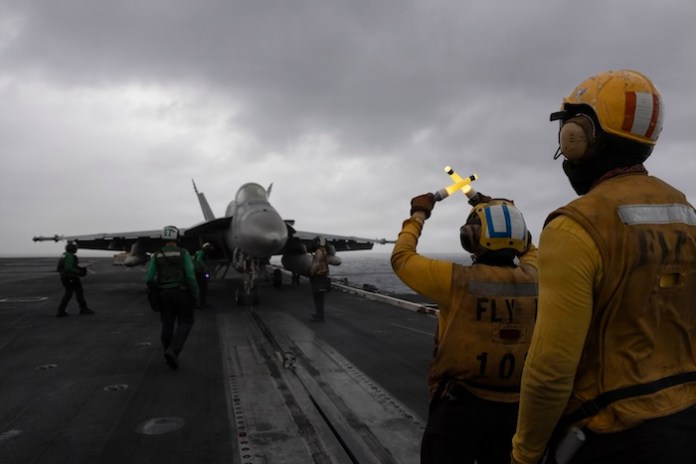
Two weeks after the ceasefire between the United States and Iran dramatically collapsed, U.S. Central Command continues to announce daily bombing attacks designed to target Tehran’s ability to target commercial shipping in the waterways off its coast.
President Donald Trump has continued to talk openly this week about escalating the war by broadening the strikes to hit Iranian infrastructure and suspected nuclear sites, including Pickaxe Mountain. But the escalation comes as concerns grow over transparency over the war, highlighted by a dispute over the number of military service members killed, the scale of damage suffered during Iranian attacks, and the amount of money the war is costing the American taxpayer.
Here’s where things stand
The U.S. military has carried out strikes on Iran for nearly the last two weeks, and they are targeting Iran’s ability to continue threatening ships in the Strait of Hormuz and beyond. Prior to the war, about 20% of the world’s oil transited through the vital waterway, but the threat of being attacked has dissuaded mariners from trying, causing a spike in the economy.
Iran has responded with heavy missile and drone strikes targeting Kuwait, Bahrain, Qatar, the United Arab Emirates, Oman, Jordan, and Saudi Arabia. Iran is responsible for the deaths of three U.S. troops last week in an attack in Jordan.
Trump — who traveled to Dover Air Force Base on Wednesday for the dignified transfer ceremony for four U.S. service members killed last week — has openly discussed escalating the war with attacks on Iranian dual-use infrastructure such as bridges, railroads, roads, and power plants. He also said the U.S. would target one of Iran’s most deeply buried nuclear sites called Pickaxe Mountain, which they didn’t target during last year’s Operation Midnight Hammer.
“From this point forward, any time the Islamic Republic of Iran shoots at a ship in the Strait of Hormuz, whether it be by Missile, Rocket, Drone, or any other device or weapon, the United States will bomb and destroy ONE BRIDGE OR POWER PLANT, including those located next to, or in, the Capital City of Tehran,” he warned on Wednesday.
He told Axios on Thursday, “I am considering a massive attack. Bigger than ever before. I am close to making a decision. We are all set for it.”
While Trump and U.S. Secretary of State Marco Rubio have said this week that Iran has reached out privately to seek a deal to stop the ongoing strikes, Iranian officials have publicly not backed down, and the Islamic Revolutionary Guard Corps continues to carry out retaliatory attacks against Gulf countries.
People stand on a bridge destroyed after a strike in Hormozgan province, southern Iran, Saturday, July 18, 2026. (Amirhosein Khorgooi/Iranian Students’ News Agency via AP)
" data-image-caption="
People stand on a bridge destroyed after a strike in Hormozgan province, southern Iran, Saturday, July 18, 2026. (Amirhosein Khorgooi/Iranian Students’ News Agency via AP)
" data-large-file="https://www.washingtonexaminer.com/wp-content/uploads/2026/07/Iran-bridge.jpg?w=696" src="https://www.washingtonexaminer.com/wp-content/uploads/2026/07/Iran-bridge.jpg?w=696" alt="People stand on a bridge destroyed after a strike in Hormozgan province, southern Iran, Saturday, July 18, 2026. (Amirhosein Khorgooi/Iranian Students' News Agency via AP)" class="wp-image-4662857" srcset="https://www.washingtonexaminer.com/wp-content/uploads/2026/07/Iran-bridge.jpg 700w, https://www.washingtonexaminer.com/wp-content/uploads/2026/07/Iran-bridge.jpg?resize=300,200 300w, https://www.washingtonexaminer.com/wp-content/uploads/2026/07/Iran-bridge.jpg?resize=150,100 150w, https://www.washingtonexaminer.com/wp-content/uploads/2026/07/Iran-bridge.jpg?resize=696,464 696w" sizes="(max-width: 700px) 100vw, 700px">
People stand on a bridge destroyed after a strike in Hormozgan province, southern Iran, Saturday, July 18, 2026. (Amirhosein Khorgooi/Iranian Students’ News Agency via AP)
Pentagon leaders have not held a media press conference since May 5, long before the U.S. returned to daily strikes in mid-July, though they did appear on Capitol Hill Tuesday afternoon.
The Pentagon’s casualty count
The Department of War operates the Defense Casualty Analysis System, which is designed to provide updated information on casualties in current and past conflicts. It garnered attention when the death toll for Operation Epic Fury was not updated after the deaths of four U.S. service members over the last week.
As of Friday afternoon, it currently lists 14 deaths and 420 injuries over the course of the war, stating “as of July 24, 2026.” But that doesn’t account for the four U.S. service members who were killed over the weekend. Three, 1st Lt. Tyler James Feehan, 25; Pvt. Isabella Gonzales, 19; and Sgt. Angel Rampersad, 28, were killed in an Iranian strike on July 17 at Muwaffaq Salti Air Base, a U.S. military base in Jordan. Another service member, Sgt. Michael Emmanuel Swinton, 30, of Fayetteville, North Carolina, was killed during a controlled detonation of a downed Iranian drone on Sunday at Erbil Air Base in Iraq. The database also states that only one U.S. service member, a Navy sailor, was killed in a non-hostile incident in the month of July, which is in reference to Cmdr. Gabriel Edwards, who was announced lost at sea on July 7. It should say five service members have been killed in the month of July.
The database briefly listed the death toll at 18 on Wednesday before it reverted back to 14 shortly thereafter. The New York Times reported that the reduction was made in part because their deaths occurred after Trump declared a ceasefire.
Pentagon spokesman Joel Valdez pushed back on that characterization, instead citing “temporary data disruptions on the Defense Casualty Analysis System (DCAS) website,” in explaining the miscount. “These site anomalies are currently being resolved in coordination with the Military Services.”
Sean Parnell, the Pentagon’s chief spokesman, was even more forceful, calling the New York Times reporting “one of the worst instances of the Fake News media manufacturing lies out of thin air for absolutely no reason at all but to cause distress among the American people.”
The attack on Muwaffaq Salti Air Base represents the third fatal Iranian attack on U.S. forces during the war. Six U.S. service members were killed in an Iranian drone attack in Kuwait, and another U.S. service member died during a March 1 attack on the Prince Sultan Air Base in Saudi Arabia. The four killed over the weekend were returned to the U.S. in the traditional dignified transfer at Dover Air Force Base, which Trump attended. He said on Thursday the death toll was “18.”
Retired Gen. Joseph Votel, a former commander of U.S. Central Command, told the Washington Examiner, “Well, I think this is a good reminder of the ubiquity of these missiles and drones and their ability to really strike wherever they want at almost any particular time, and our defenses have to be right all the time, the Iranians only have to be right one time.”
The Democrats on the Senate Armed Services Committee signed a letter to Secretary of War Pete Hegseth, Chairman of the Joint Chiefs of Staff Gen. Dan Caine, CENTCOM commander Adm. Brad Cooper, and Undersecretary of Defense for Personnel and Readiness Anthony Tata about the inconsistencies with the DCAS.
“We are concerned that DCAS is not being maintained at the granular level and calls into serious question the completeness and reliability of the aggregate totals,” they wrote.
Transparency questions
The Pentagon, like any military, has to balance the goal of transparency without aiding the enemy. Sharing specific details of specific successful attacks can give adversaries advantages, such as which operations were successful and why.
“We always have to be concerned about releasing information that might benefit our adversaries and reinforce things they are doing,” Votel said. “I am certain that is a concern that must be considered.”
Votel oversaw CENTCOM from 2016 to 2019 during both the global war on terror and the defeat ISIS campaign.
“But, when it comes to casualties, we should be very transparent with the American people,” he said. “My experience was that the Department of Defense maintained a website that was updated regularly with the most current casualty information. I am a strong advocate of transparency and I think American citizens should appreciate the risk and the cost of our decisions to go to war.”
The department has not shared details about Iranian strikes on U.S. bases in the Middle East, and the administration has urged satellite imagery companies not to release photos that would show the damage caused in Iranian attacks.
The Senate Armed Services Committee Democrats said in their letter, “From the start of Operation Epic Fury in February 2026, this administration has failed to provide timely updates on the military readiness, personnel, and financial impacts of this war. Delays or inconsistencies in publicly reporting these casualty figures further impede Congress’s ability to conduct oversight and limit the public’s understanding of the operation’s costs. This lack of transparency undermines confidence that military families and the American people are receiving a complete and accurate accounting of the sacrifices made by those serving in uniform.”
Capitol Hill hearing
Hegseth and Caine testified before the Senate Appropriations Committee that the military needs Congress to pass the $87 billion supplemental request, which includes roughly $67 billion for the department, to maintain its pace of operations and readiness.
Hegseth told lawmakers that the newest estimated cost of war is $37.5 billion, though he said that total also includes some additional military pay and operations and maintenance costs they anticipate through the fiscal year. The last estimate the department shared publicly was back in May, when Jay Hurst, the acting Pentagon comptroller, told lawmakers the war had cost $29 billion.
It’s unclear exactly how the department determined the cost of the war, and whether it factored into any of the medium- or longer-term costs associated with it.
President Donald Trump and Defense Secretary Pete Hegseth salute as a U.S. Army carry team moves a transfer case containing the remains of 1st Lt. Tyler James Feehan of Ewa Beach, Hawaii, Wednesday, July 22, 2026, at Dover Air Force Base, Del. (AP Photo/Julia Demaree Nikhinson)
" data-large-file="https://www.washingtonexaminer.com/wp-content/uploads/2026/07/Trump-dignified-transfer.webp?w=696" src="https://www.washingtonexaminer.com/wp-content/uploads/2026/07/Trump-dignified-transfer.webp" alt="President Donald Trump and Defense Secretary Pete Hegseth salute as a U.S. Army carry team moves a transfer case containing the remains of 1st Lt. Tyler James Feehan of Ewa Beach, Hawaii, Wednesday, July 22, 2026, at Dover Air Force Base, Del. (AP Photo/Julia Demaree Nikhinson)" class="wp-image-4663153" srcset="https://www.washingtonexaminer.com/wp-content/uploads/2026/07/Trump-dignified-transfer.webp 700w, https://www.washingtonexaminer.com/.../Trump-dignified-transfer.webp?resize=300,200 300w, https://www.washingtonexaminer.com/.../Trump-dignified-transfer.webp?resize=150,100 150w, https://www.washingtonexaminer.com/.../Trump-dignified-transfer.webp?resize=696,464 696w" sizes="(max-width: 700px) 100vw, 700px">
President Donald Trump and Defense Secretary Pete Hegseth salute as a U.S. Army carry team moves a transfer case containing the remains of 1st Lt. Tyler James Feehan of Ewa Beach, Hawaii, Wednesday, July 22, 2026, at Dover Air Force Base, Del. (AP Photo/Julia Demaree Nikhinson)
“Wars cost more than expected under almost any scenario,” Tressa Guenov, who previously worked in the office of the undersecretary of defense for policy under the Biden administration, told the Washington Examiner. “The United States will continue to rapidly incur additional operational costs with this current ramp up in fighting. These costs come from munitions expenditures, personnel costs such as combat and extended deployment pay, equipment loss, and damage to bases in the region.
“Over the medium and long term, readiness and human costs grow. They include delayed exercises and training for troops, hits to maintenance and sustainment, changes to force posture, accumulated base repairs, and other impacts to force readiness,” she said. “Over time, we can expect costs related to veterans’ healthcare and disability to emerge as a result of the Iran war.“
US SERVICE MEMBERS KILLED IN CONTROLLED DETONATION OF IRANIAN DRONE, CENTCOM SAYS
The current secretary defended the success of the war, and was met with fierce criticism from Democrats who have frequently sparred with him in public hearings.
Sen. Jon Ossoff (D-GA) read comments Hegseth made earlier in the war about the success of the U.S. air campaign and asked if he agreed with those assessments currently.
“You said, ‘Operation Epic Fury was a historic and overwhelming victory.’ You said Iran’s military had been rendered ‘combat-ineffective for years to come,’ and you stated we had ‘achieved every single objective,’” Ossoff told Hegseth. “Were those accurate statements?”
Hegseth defended his prior comments, arguing, “No one ever stated that every single missile was gone. Ultimately, combat-ineffective means they’re not able to dig them out of their UGFs and shoot them,” and adding, “It doesn’t mean they don’t have underground facilities where they put missiles in them and hold on to them because they’re the world’s largest state sponsor of terrorism.”
Continue reading...
[ H/T Washington Examiner ]