

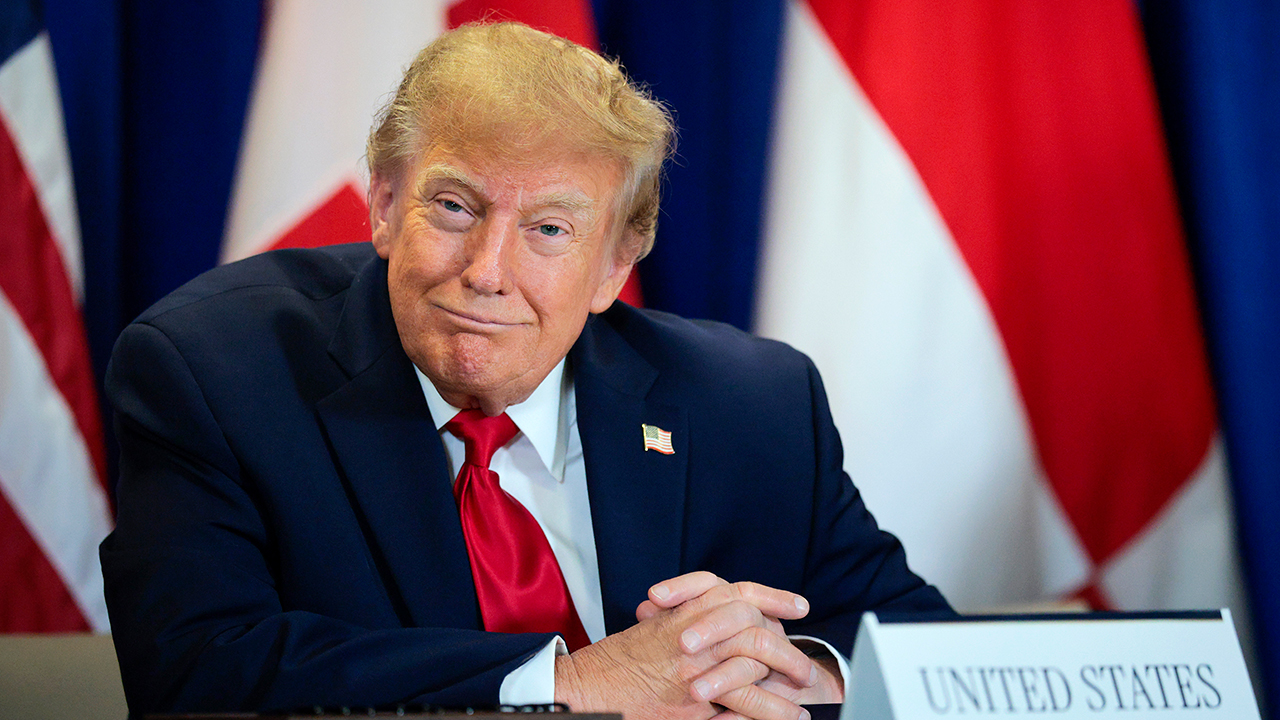
President Donald Trump on Tuesday signed an executive order directing the federal government to replace the term "artificial intelligence" with "Super Intelligence" across the executive branch, cementing a rebranding effort he has championed in recent weeks.
Signed after a White House summit with leading technology executives, the order directs federal agencies to use the terms "Super Intelligence" and "SI" in official correspondence, public communications, websites, reports, policy documents and other non-statutory materials.
The order also directs agencies to "no longer acknowledge" the terms "artificial intelligence" and "AI," according to the White House.
The order further instructs the assistant to the president for science and technology to develop a federal definition of SI and recommend any additional executive actions needed to implement the new terminology.
TRUMP TO MAKE SURPRISE STOP AT TEXAS TRUCK FACTORY TO TOUT MANUFACTURING
Trump argued in the order that AI no longer reflects the technology's rapidly advancing capabilities, saying SI better captures its promise and potential.
"The term 'Super Intelligence' more appropriately captures the promise, potential, and rapidly advancing capabilities of these technologies," Trump wrote.
He also wrote that modern AI systems are increasingly amplifying human ingenuity and unlocking new forms of creativity, arguing they represent the beginning of a new era of SI.
The order follows remarks Trump made at last week's United Nations General Assembly (UNGA), where he publicly called for replacing the term "artificial intelligence" with SI.
TRUMP SAYS HE APPROVED NEW FUEL ECONOMY STANDARDS ENDING BIDEN-ERA ELECTRIC VEHICLE MANDATE
"Whoever wins AI, you have to remember this, and now I say whoever wins SI, whoever wins superintelligence, wins. That's the group that wins," Trump said at the time.
The executive order also comes as governments and technology companies continue debating how rapidly advancing AI systems should be governed.
During a White House roundtable with tech executives, Trump, who has opposed imposing formal guardrails on SI, said participants signed a document at the conclusion of the gathering.
Trump added that the document, dubbed the White House Accord on Super Intelligence, is "morally binding" for the executives who signed it.
"They almost viewed it as a separate kind of constitution," Trump said of the tech leaders. "When they signed that, it meant a lot."
TRUMP REBRANDS AI, REJECTS 'GLOBALIST SCHEME' TO CONTROL TECH
After Tuesday's White House summit, House Speaker Mike Johnson, R-La., said participants focused on striking "the right balance" between "the interests of the American people," advancing technology and maintaining the United States' competitive edge over China.
"This is a statement of principles that you'll see, a statement of standards, commitments that are voluntary on behalf of the industry. It sets forth expectations," Johnson said. "It's, in short, summary, robust internal controls and layers of internal and external review."
Tuesday evening, Meta CEO Mark Zuckerberg wrote on X that he viewed the summit as a "positive step."
"I think it's a significant positive step that the leaders of every major American lab have committed to implementing robust internal controls and multiple layers of audits and reviews," Zuckerberg wrote.
GET FOX BUSINESS ON THE GO BY CLICKING HERE
"This should give people more confidence that the technology each lab is building will work as intended."
FOX Business' Louis Casiano and Eric Revell contributed to this report.
Continue reading...
[ H/T Fox Business ]