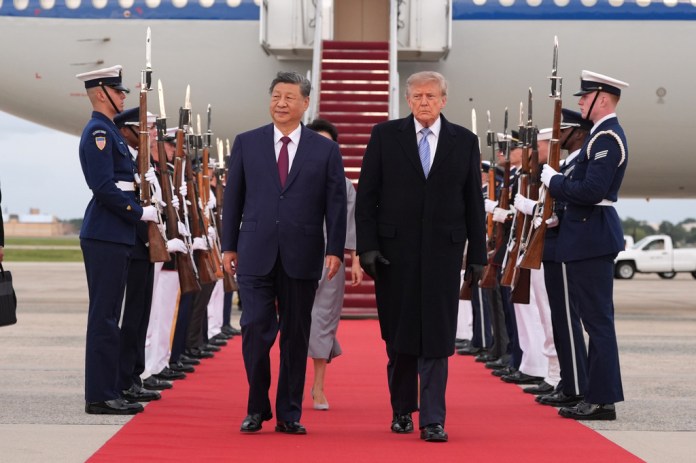


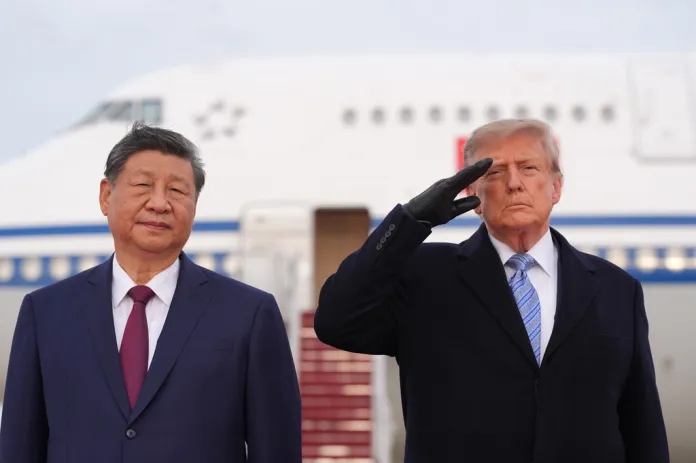
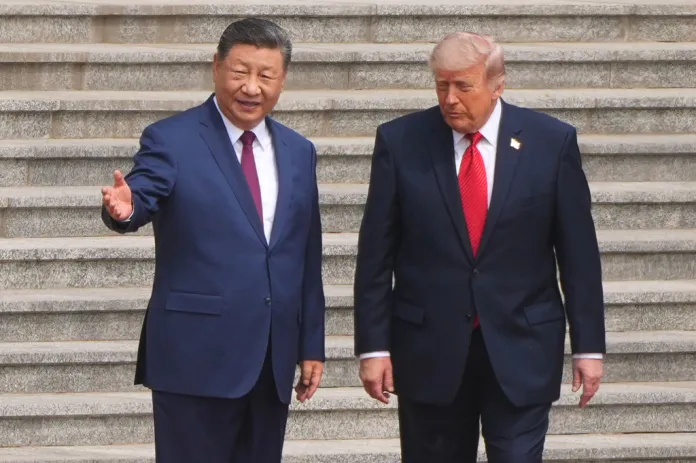
Chinese President Xi Jinping comes to Washington for three days of meetings with President Donald Trump, with the two leaders armed with a different set of priorities for the state visit.
Xi arrived at Joint Base Andrews on Wednesday night, where he was personally greeted by the president and first lady Melania Trump. The White House is describing the pomp and circumstance of the three-day visit, including a military review, formal state dinner, and multiple meetings and sit-downs, as a demonstration of respect. Critics, meanwhile, contend that the display depicts capitulation from Trump to a foreign dignitary apparently impervious to tariffs and other trade threats.
The two leaders last met in May, when Trump took his own state visit to Beijing. That trip was colored by Trump’s trade war. After escalating reciprocal tariffs throughout much of the president’s first year back in office, the U.S. and China reached an initial agreement to lower the temperature in October 2025. The deal included commitments from Beijing to purchase 25 million metric tons of American soybeans, while Washington offered to sell Boeing jets. Neither side was on schedule to meet their respective purchasing quotas before Xi’s trip to Washington.
According to Ker Gibbs, former chairman of the American Chamber of Commerce in Shanghai and author of The Fragile Dragon: Trade, Trump, and China’s Vulnerabilities, Xi’s priorities for the state visit are Taiwan and BYD, the Chinese electric vehicle manufacturer that Trump has previously expressed interest in.
“Taiwan is sort of the uber issue. It’s the one thing that he’ll sacrifice everything for if he thinks he can recover the island, so it’s the one issue that that sort of envelops everything,” Gibbs told the Washington Examiner of Xi, adding that China’s economy isn’t in an “emergency situation” like it was last year when Trump launched his tariff agenda.
The United States is required by law to sell military hardware and munitions to Taiwan, though the Trump administration has slow-rolled the most recent sale. The topic was raised during Trump’s trip to Beijing, and while the president confirmed to reporters that Xi repeatedly brought up the issue, he declined to advance or deny the stalled transfer, saying instead that he preferred to speak with Taiwanese President William Lai before making a formal determination.
But movement on an auto deal could provide a possible political spark for Trump and Republicans.
“The space I’m watching is this whole BYD — ‘BYD is coming. They’re not coming. We’re going to discuss it. We’re not going to discuss it.’ Trump has been pretty clear and consistent on this point that he actually likes the idea of BYD, a Chinese EV manufacturer, setting up in the U.S., and I think that’s very interesting,” Gibbs said. “That would validate his theory of the [tariff] case, and he doesn’t have that yet. I think, though, the more interesting deal would be if he can really achieve a strategic deal there that provides two things: one, technology transfer from China to the U.S. in such a way that it enables a U.S. partner. And second, obviously U.S. jobs, United Auto Workers is going to have a vote in this for sure.”
More generally, a source close to Trump suggested that the president is more interested in promoting another trade agreement before November’s midterm elections and, potentially, some sort of artificial intelligence announcement that addresses voters’ concerns about the technology while maintaining America’s advantage over China in the global AI race.
“President Trump is going to keep conducting his foreign policy in a way that puts the American people in the best strategic position economically and from a security standpoint,” that person told the Washington Examiner. “He says he isn’t letting the elections impact his policy decision, but I think we can all see there’s the opportunity for real political gain here. If the White House makes major announcements here on trade or artificial intelligence, Republicans can turn around and tell voters, ‘See, trust the process. We’ve got everything under control.'”
To that end, Treasury Secretary Scott Bessent last weekend proposed a new AI safety “notification mechanism” between himself and Chinese Vice Premier He Lifeng, establishing an open line of communication between the two men with respect to AI.
The White House declined to outline the specific deliverables or topics that Trump will prioritize while hosting Xi.
During a background briefing call with reporters last week, senior administration officials reiterated that they would prefer not to “get ahead” of Trump when they were pressed on the agenda, including as it pertains to the end of the trade war truce in October.
At the same time, senior administration officials dismissed speculation that Trump and Xi will discuss repealing rare earth export controls in exchange for rescinding certain tariffs and expanding market access.
“There’s not going to be any exchange of export controls to get something that, in our view, we’ve already negotiated for, and that’s the proper flow of rare earths into our and really the global economy,” the source said. “China’s performance in that respect has not been up to par of what we would expect and that I’m sure will be a topic of discussion.”
That person continued, “There has been discussion as some of you, probably most of you, have heard about reducing certain tariffs in non-strategic sectors, a narrow band of goods that would advantage, I guess both sides, goods that are not sensitive and not strategic.”
Officials would also not get ahead of Trump on fentanyl, which triggered the first round of tariffs against China last year.
“It does not appear that China has elevated this issue,” one source said. “But we’d like to see much more systemic change.”
Even if Xi’s trip proves to be more form than function, Lyle Goldstein, the director of the Asia Program at Defense Priorities, argued that getting the pair in the same room is a step in the right direction.
“The challenge of stabilizing U.S.-China relations is always there,” Goldstein told the Washington Examiner. “I do think for the first time, maybe in history, where the two superpowers are on a kind of equal footing, if you will, and at that point maybe real compromises start to come into view. I do absolutely support face-to-face talks here between the superpowers. That’s critically important.”
Trump and Xi will take part in another arrival ceremony at the White House Thursday followed by a Rose Garden military review and their bilateral meeting in the Oval Office as the first lady and Xi’s wife, Peng Liyuan, participate in a separate event.
DOMESTIC POLITICS AND 2026 ELECTIONS CAST SHADOW OVER TRUMP’S RETURN TO THE UN
The couples will reunite later in the day for a state dinner in the East Room, during which both Trump and Xi are expected to speak to a crowd that is anticipated to include Amazon executive chairman Jeff Bezos, Tesla and SpaceX CEO Elon Musk, Google CEO Sundar Pichai, Dell Technologies CEO Michael Dell, Nvidia CEO Jensen Huang, OpenAI CEO Sam Altman, Citi CEO Jane Fraser, and Apple Executive Chairman Tim Cook.
Then on Friday, Xi and Peng will return to the White House for a private tea before departing the complex for a tour of the National Archives to, in the words of a senior administration official, see “some of the United States’ most important founding documents as we celebrate our 250th anniversary.”
Continue reading...
[ H/T Washington Examiner ]