
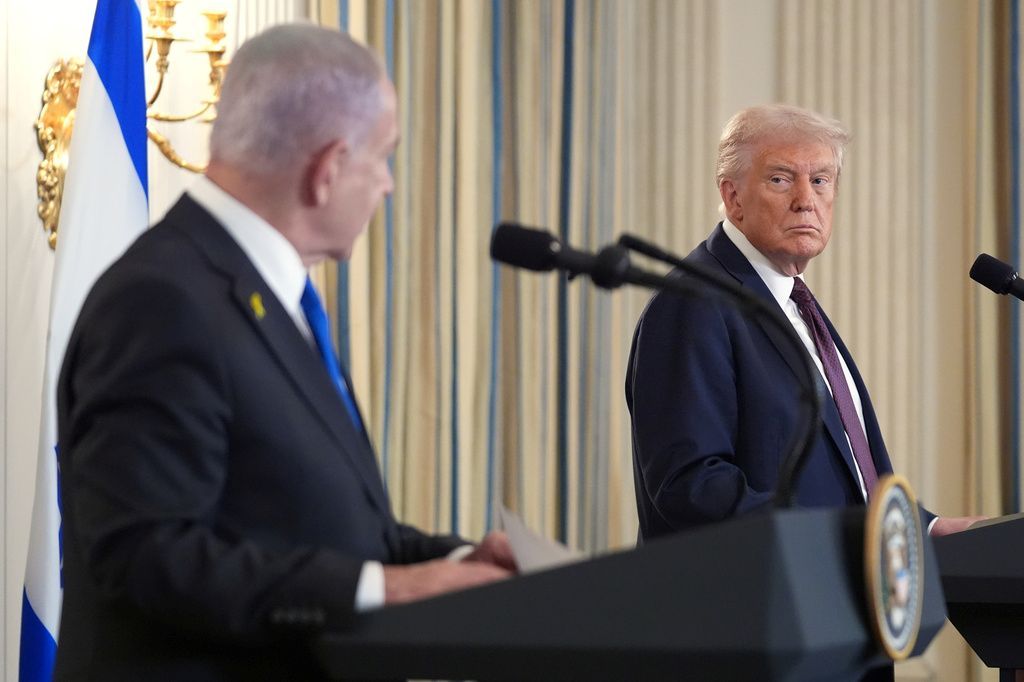
TRUMP AND NETANYAHU, AGAIN. There are reports that President Donald Trump and Israeli Prime Minister Benjamin Netanyahu yelled at each other during a phone conversation about Iran last weekend. The story has been dismissed and downplayed in the last few days, but at the very least the two leaders’ talk was a troubled one at a time of recurring difficulties over the war.
The short version is that Netanyahu is pushing the United States to restart major combat operations, while Trump is taking a more cautious approach, relying on the American blockade and other economic measures to further weaken Iran. It’s a disagreement that has been popping up frequently in the last several months of the war. But the underlying issue dates back farther, to the beginning of the conflict.
The first thing to say is that the decision to take the U.S. to war was Trump’s, and Trump’s alone. That said, there are undoubtedly some hard feelings in some parts of the administration over Netanyahu’s efforts to persuade the U.S. to go to war.
The following is taken from the book Regime Change by New York Times reporters Jonathan Swan and Maggie Haberman. The book describes Netanyahu’s visit to the White House on Feb. 11 of this year. In an extraordinary moment — a foreign leader being allowed into the White House Situation Room — Netanyahu made an extended pitch to the highest U.S. officials, including Trump himself, for the U.S. and Israel to attack Iran. A great success beckoned, he said.
“Over the course of an hour, Netanyahu made a hard sell about how ripe Iran was to be overwhelmed,” the authors wrote, “and how this could finally be the moment for regime change brought about by a joint U.S.-Israeli assault.” The book described Netanyahu showing a video that “included a montage of new leaders who could take over [Iran] if it fell.”
“Netanyahu and his team outlined conditions they portrayed as pointing to near-certain victory,” Swan and Haberman wrote. “Iran’s ballistic missile program could be destroyed within a few weeks; Iran would be so weakened that it could not choke off the Strait of Hormuz; the likelihood that Iran would land blows against U.S. interests in neighboring countries was minimal.” With Israeli spies “helping to foment riots and rebellion … an intense bombing campaign could create the conditions for the Iranian opposition to overthrow the regime.”
Trump said the plan sounded good, according to the book, and several people in the room left with the impression that the president had made up his mind. But the next day, Feb. 12, there was another meeting in the Situation Room, this time without the Israelis. When Trump arrived, he was briefed by CIA Director John Ratcliffe, who gave the president the intelligence community’s assessment of Netanyahu’s case.
“The CIA director used one word to describe the Israeli prime minister’s regime change scenario: ‘farcical,'” the authors wrote. “At that point [Secretary of State Marco] Rubio cut in. ‘In other words, it’s bulls***,’ he said.” After others, including Vice President JD Vance, “expressed strong skepticism” about Netanyahu’s presentation, the book said Trump then turned to Joint Chiefs of Staff Chairman Dan Caine. “Sir, this is, in my experience, standard operating procedure for the Israelis,” Caine said, according to the book. “They oversell and their plans are not always well-developed. They know they need us and that’s why they’re hard selling.”
Trump decided to go ahead anyway, and the war began 16 days later, on Feb. 28. It was the kind of judgment that is a president’s alone to make. It appears Trump made it in part because he was thinking of U.S. forces’ quick success in Venezuela and felt that the Iran operation would be a quick success, too. Plus, the president is an optimistic man. When facing a big problem, he often expresses faith that things will work out, because “they always do.”
But this time things didn’t work out, or at least they haven’t so far in nine months of conflict. Months have gone by with Trump predicting quick resolutions that did not come. Starting in early September, he said the war could end soon after the midterm elections, but that hasn’t happened either.
The elections brought a resounding defeat to Republicans, which Vance attributed solely to the war and which Trump agreed was one of the main factors in the party’s losses. The GOP is facing at least two years of strong Democratic majorities in both the House and Senate. Many lawmakers want the war to end soon, if not immediately.
But Trump still has decisions to make on Iran. Right now there appears to be an intensifying debate between the finish-them-off faction, that is, aides and outsiders who advocate resuming major combat operations to bring an end to the Iranian regime, and the give-it-time faction, who argue that the U.S. blockade and other economic measures are steadily weakening the Iranians and will in the future force the Iranians to give in without any U.S. resumption of major combat operations.
For the moment, Trump is siding with the give-it-time group. Netanyahu, of course, is part of the finish-them-off faction, still pushing for regime change. “Iran is working to renew the nuclear threat,” he told the Knesset this week. “The only way to permanently remove this existential threat is by toppling the ayatollah regime.”
Netanyahu’s words were more proof, as if any more were needed, of the divergence of U.S. and Israeli goals in the war the two nations undertook together. Trump has steadfastly stood behind the war’s initial goal of ensuring that Iran does not obtain a nuclear weapon. The president has not only kept that promise, he has, through U.S. attacks, extended the time during which Iran will be unable to build such a weapon. But one premise of the the way the U.S. has conducted the war is that there is no forever solution to the Iranian nuclear problem; attacks can set the Iranians back for years, but the U.S. or other nations might still have to bomb them again at some point in the future. Netanyahu wants more.
So we don’t really know what the two leaders said to each other on the phone last weekend. But it would not be a total surprise if some yelling was involved.
Continue reading...
[ H/T Washington Examiner ]