






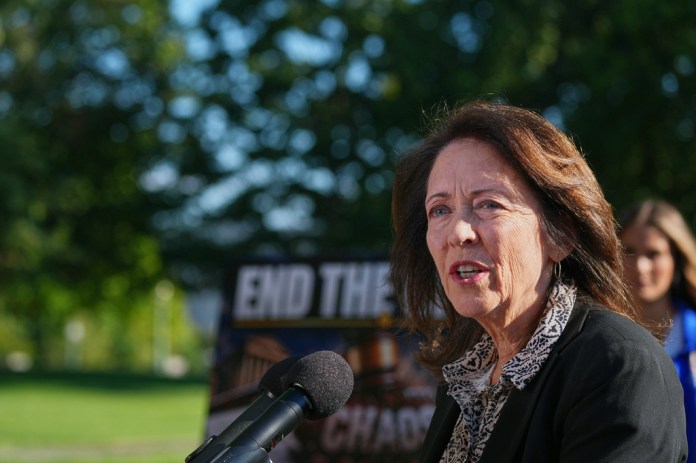
Sen. Maria Cantwell (D-WA), ranking member of the Senate Committee on Commerce, Science, and Transportation, released a six-point framework Wednesday that would provide a basis for any legislation on artificial intelligence.
The AI governance framework pushes for stringent standards as safety concerns about the advanced technology abound. The plan outlines six AI safety principles: enforceable federal safety standards for frontier models, continuous testing, disclosure and oversight, public-private partnerships, protection for children and workers, and global cooperation led by the United States.
CONGRESS IS WRESTLING WITH AI DEVELOPMENT. HERE ARE FIVE BILLS TO WATCH
As the top Senate Commerce Democrat, Cantwell holds extensive congressional oversight and legislative jurisdiction over federal AI policy.
“To manage risks from advanced AI systems we need clear safety standards, continuous testing, and reporting of serious failures,” she said in a statement. “America can lead the world in AI by building systems that are not only more capable, but safer and more secure.”
Cantwell says federal AI safety standards should be established by experts at the National Institute of Standards and Technology in coordination with other federal agencies. She also recommends that frontier models not be released until they have been rigorously tested in an independent audit.
Under the comprehensive framework, NIST would be tasked with developing risk-based standards for AI systems that could pose catastrophic harm. Such risks include AI-enabled cyberattacks, biological or nuclear threats, potential for loss of human control, and rogue agents escaping secure testing environments.
There would also be specialized standards for open-source AI models to reduce the risks of misuse while providing developers with guidance to accelerate U.S. leadership on AI. Additionally, whistleblower protections are in place in case any employee or contractor reports safety concerns regarding the technology.
One of the most notable aspects of the framework is that the U.S. should establish a secure channel with China to address significant AI incidents that could threaten either country or international security more broadly. Both nations are competing in the AI race.
OPENAI CONCEDES ITS RESPONSE TO AUSTRALIAN MEDICARE WEBSITE HACK WAS ‘NOT GOOD ENOUGH’
Cantwell, one of many Democrats pursuing stronger AI regulations, says she has promoted these basic principles for years. But her framework is only gaining traction now amid growing calls from AI leaders to regulate their own products.
If Democrats flip the Senate in the midterm elections this fall, Cantwell would become the Commerce Committee’s chair once again and be able to more easily enforce her own approach to regulating AI. Sen. Ted Cruz (R-TX), who is currently the chair, has repeatedly delayed a planned markup for AI-related bills while senators fail to reach a bipartisan agreement on such legislation.
Continue reading...
[ H/T Washington Examiner ]