




Too Broken For Frontier: Indonesian Markets Suffer Worst Rout Since 1998 As MSCI Threatens The "Argentina Treatment"
Back in January, MSCI fired a warning shot at Jakarta. On Friday it fired the real thing.
Indonesian markets extended their selloff on Monday, with stocks deepening their worst rout in almost 30 years and losses spreading to bonds and the rupiah after MSCI warned the country may face a two-step downgrade: straight from Emerging Market to "Standalone" status, skipping Frontier altogether.
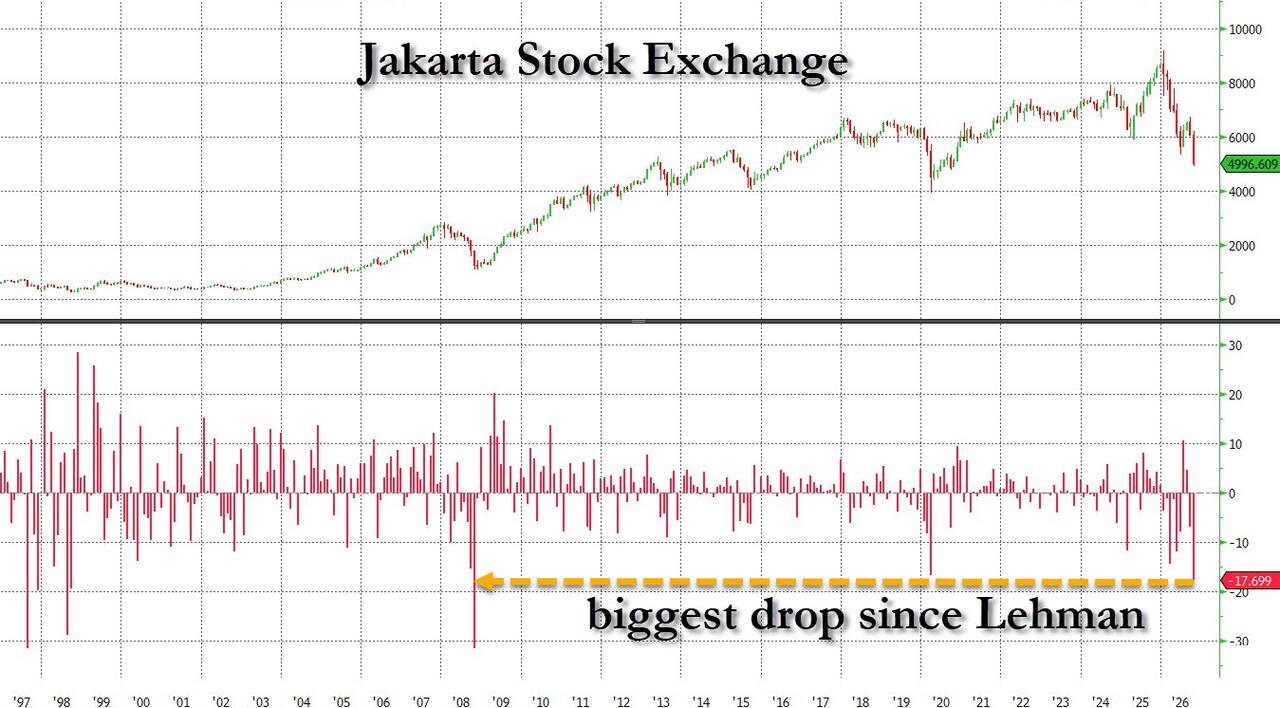
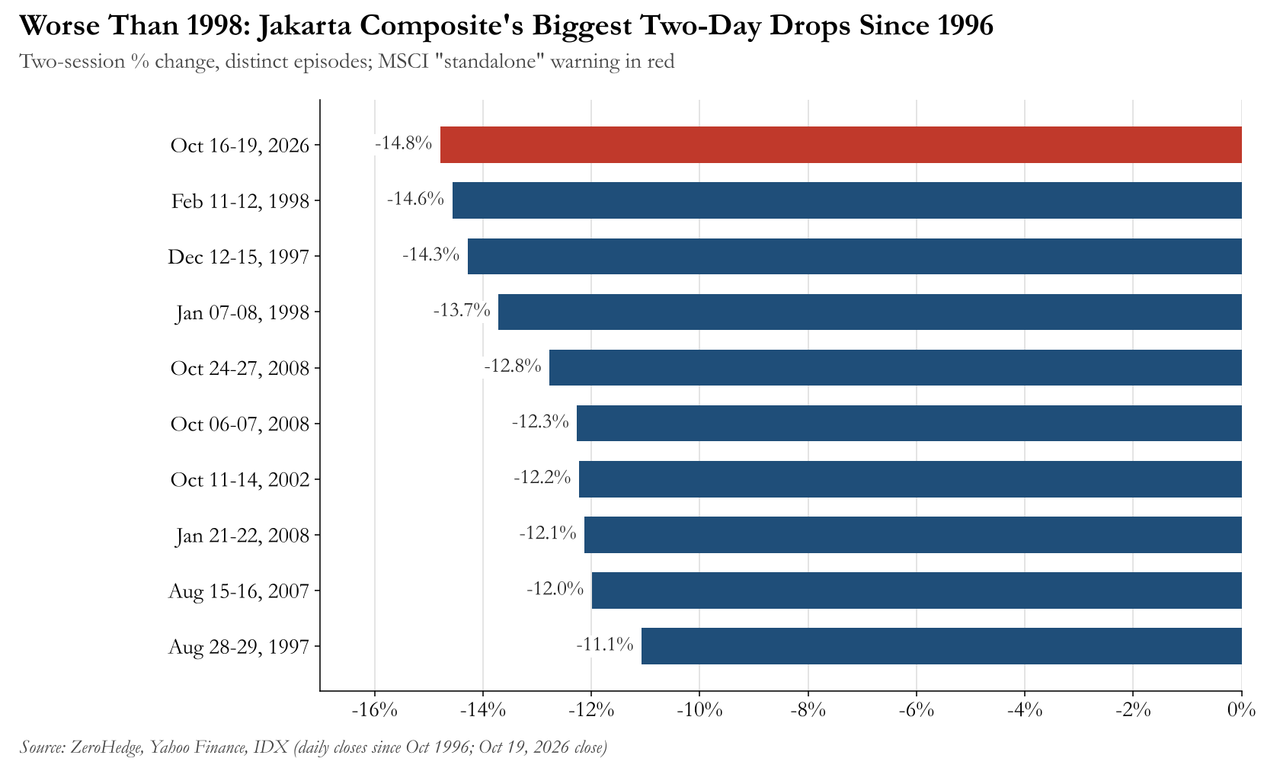
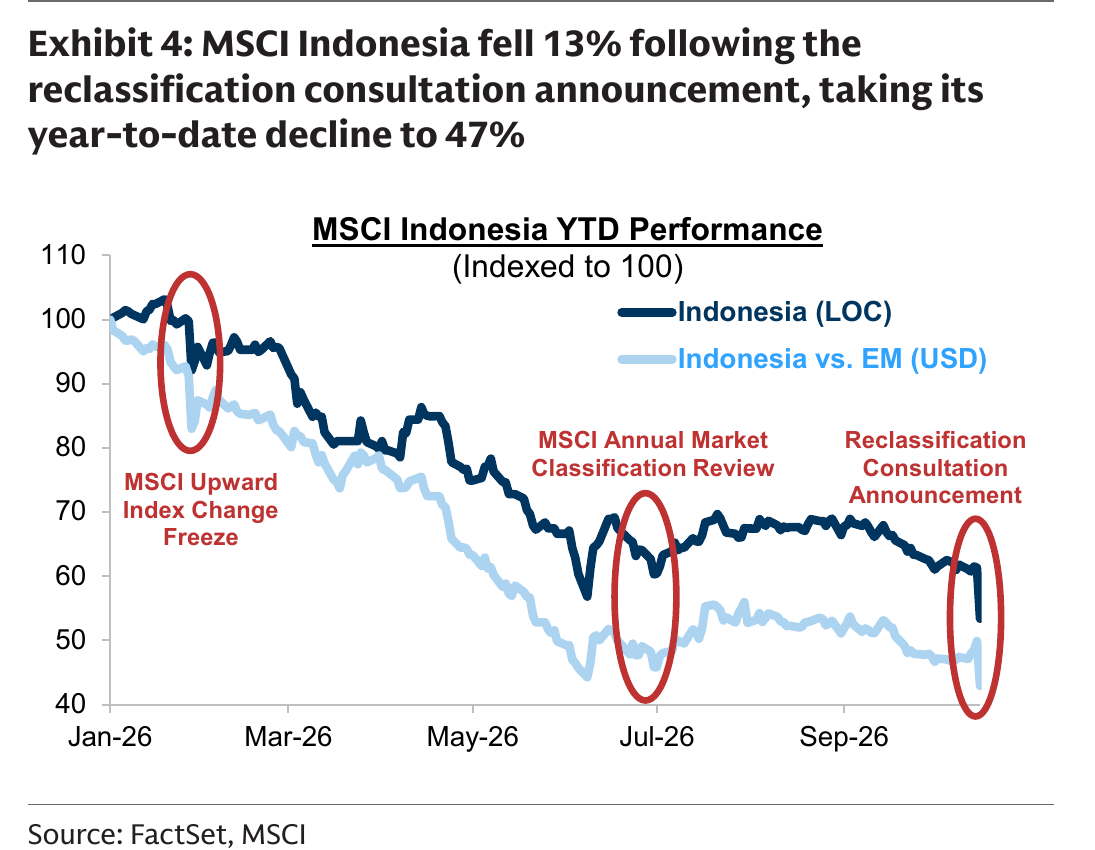
The Jakarta Composite (JCI) closed down 3.6% on Monday after crashing 11.6% on Friday, its biggest one-day drop since January 1998. The combined two-session drop of almost 15% is steeper than any two-day stretch during the 1998 Asian financial crisis, and the index hit a six-year low intraday.
Regular readers will recall that we first flagged this exact risk in January, when Indonesian stocks were halted for 30 minutes after crashing on MSCI "investability" concerns. Back then MSCI merely froze index additions and dangled the threat of a downgrade to frontier status if Jakarta did not clean up its free-float data. The market was halted again the next day...
... and the head of the stock exchange did what heads of stock exchanges do when the market they run gets halted two days in a row:
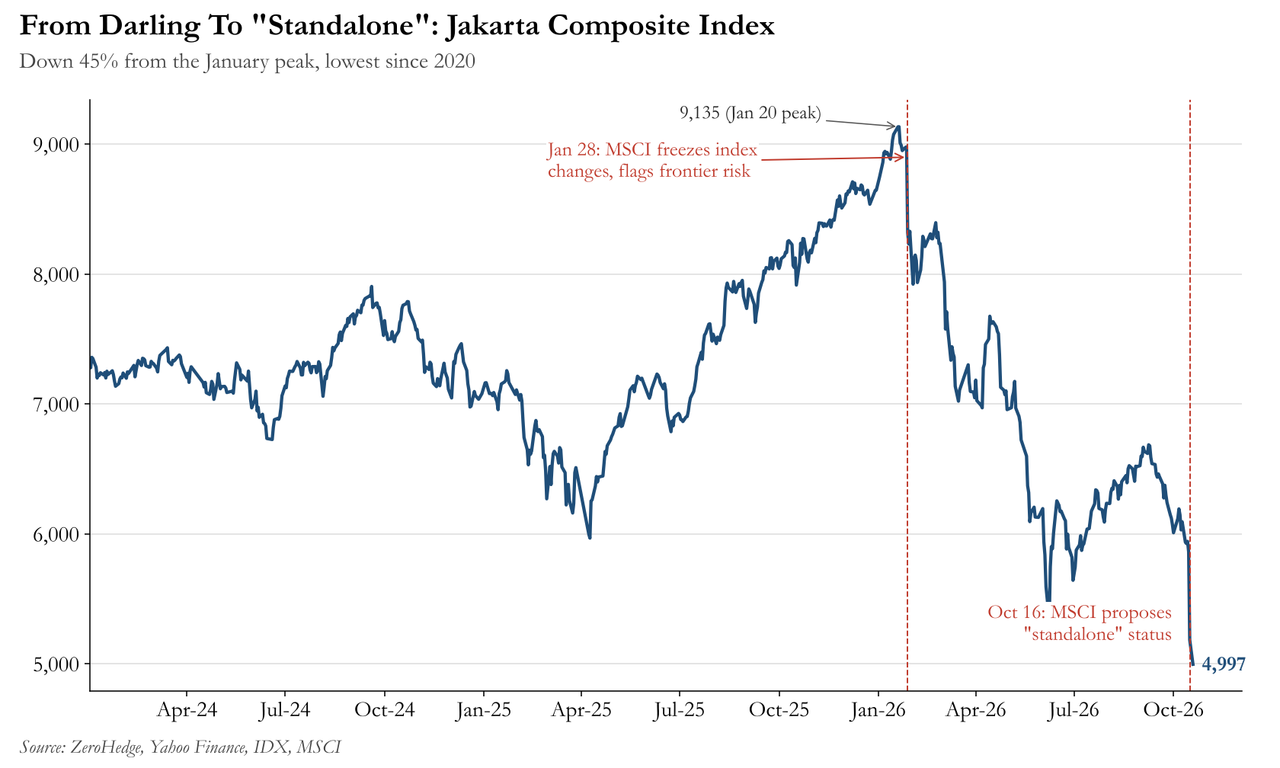
Nine months, a wave of resignations and a pile of failed reforms later, MSCI has concluded that Jakarta's problems are now too deep for frontier status. The damage since January: the JCI is down about 45% from its January 20 peak and some 42% year-to-date, the steepest fall among major indexes anywhere on the planet, with about $350 billion in market value wiped out since January, according to Reuters (some $60 billion of that on Friday alone). Although to be fair, NVDA loses they by breakfast and gains twice that by dinner.
"Foreign capital is staging a full-blown exit from Indonesia's equity market, and now the bond market is feeling the heat," SEB's head of Asia strategy Eugenia Victorino told Bloomberg. "A sliding rupiah is eating real yields. Until the currency finds its footing, global money is content to watch this one safely from the sidelines." The locals aren't stepping in either: "For now, even the locals are not buying. There's too much uncertainty," added ACG Management's Hui Ling Loh.
In its announcement, released a month ahead of its scheduled November review, MSCI said that despite the reforms Jakarta announced, "significant concerns remain around market dysfunction, including continued suspected coordinated trading behavior and lack of evidence of meaningful enforcement." And then came the line that broke the market: feedback from investors suggested that a reclassification to Frontier "would not properly recognize the depth of the market problems."
Translation: Indonesia is too broken even for the frontier bucket, which is traditionally the pinnacle of the banana republic yardstick.
MSCI's original gripes, per Reuters, were i) opaque shareholding structures that obscured how many shares actually trade freely, ii) coordinated trading behavior that undermined "proper price formation," and iii) weak enforcement. In plain English, some Indonesian stock prices were suspected of being artificially propped up by a handful of tightly connected holders. Jakarta's response since January included doubling the minimum free float to 15% from 7.5%, tighter disclosure for anyone holding 1% or more, and a list of stocks with "high shareholder concentration." Not enough, apparently.
The timeline: market feedback is due by April 30, 2027, MSCI will announce its decision by June 30, 2027, and implementation could begin as early as the August 2027 quarterly review. Unless Jakarta can show "clear evidence of material improvements," MSCI "expects to proceed."
Jakarta's response came with all the urgency you'd expect from officials who were, by their own admission, caught completely off guard. "We did not expect there would be such announcement (from MSCI). Such an unexpected statement caused the market to react in panic," said IDX chief Jeffrey Hendrik ahead of a virtual meeting with MSCI on Monday, after which he said he "could not disclose details of the meeting." Which is the kind of non-answer that tends to precede actual answers, or even more non-answers. Within hours of Friday's announcement, regulator OJK slapped 2.1 trillion rupiah ($116 million) in fines on entities tied to manipulation in three stocks, and the police were called in to probe "alleged violations or criminal acts in the capital market." Funny how fast enforcement happens when the index provider stops asking nicely.
The exchange also announced it would exclude stocks with highly concentrated ownership from the JCI and, more to the point, cut the daily down limit to 7% from 15%, meaning sell orders below that level are simply rejected. Because nothing says "orderly market" like making it impossible to sell. Per Goldman's Asia desk, Monday's turnover hit IDR10 trillion by midday, with many stocks quickly hitting the new 7% floor and foreigners dumping another ~IDR1 trillion, led by the banks (BBCA and BBRI among the worst performers).
Corporate Indonesia is also doing its part. Three firms linked to billionaire Prajogo Pangestu announced a combined 2.5 trillion rupiah ($138 million) of buybacks, while Sinar Mas Group's PT Dian Swastatika Sentosa proposed a 1 trillion rupiah buyback of its own. Bloomberg notes the buybacks come days after regulators fined some of these same companies over manipulative market practices, which is probably not the kind of "price support" MSCI had in mind.
For what it's worth, even Goldman wasn't expecting this. As the bank's London FX desk noted on Friday morning, there had been discussion that Indonesia could face frontier status at the next review: "We had put this as somewhere around 15 per cent chance of happening." Standalone, it seems, was not even on the menu.
In a note published Sunday titled "MSCI Market Classification: Indonesia Downgrade Risk Crystallizes" (available to pro subs), Goldman's index strategist Alvin So wrote that the proposal "materially raises the risk of removal from MSCI composite indexes, although it does not trigger immediate passive selling." Then the punchline:
And here is the number every EM PM is now staring at:
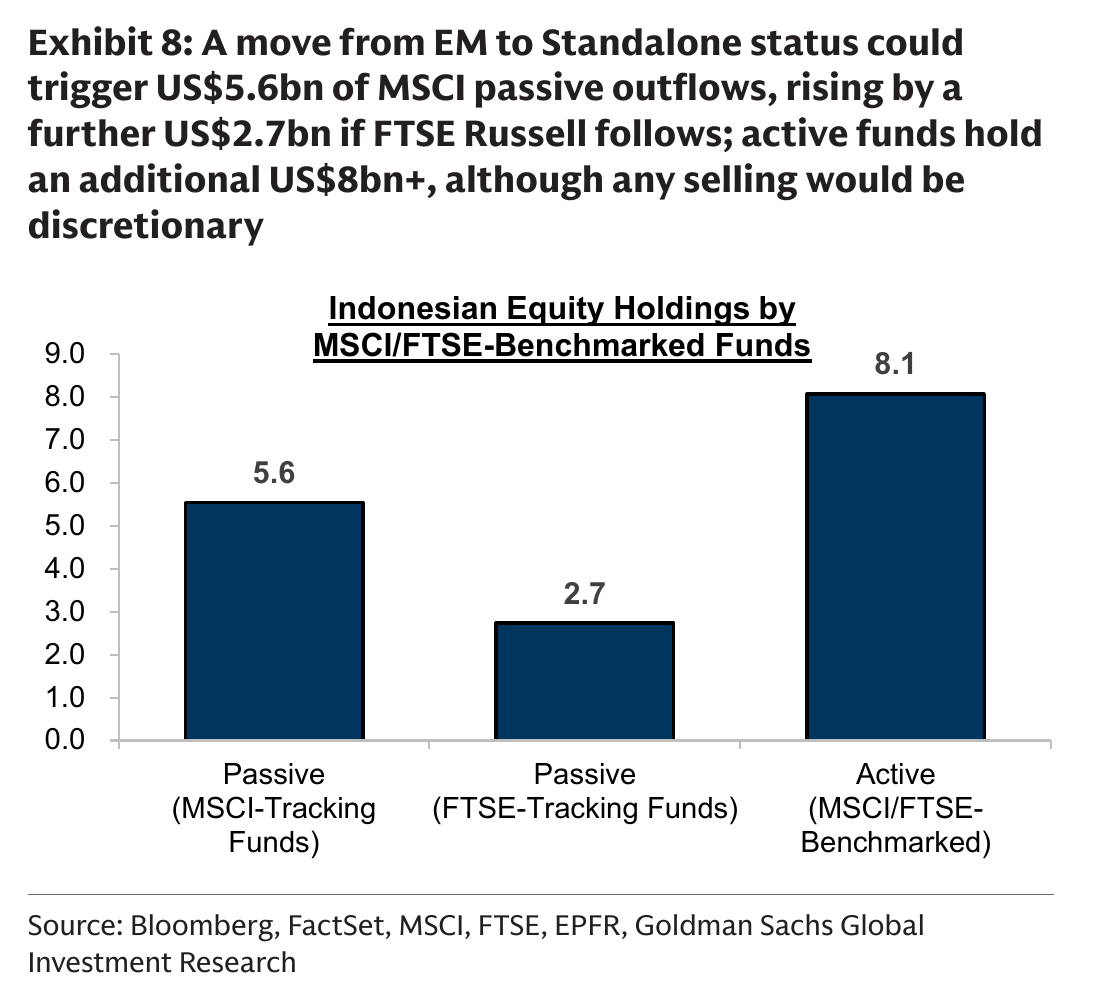
Add it up and you get roughly $16 billion of Indonesian equities held by funds that benchmark to MSCI or FTSE, of which about $8 billion is forced, index-driven selling if both providers pull the plug. FTSE has not gone that far yet (it still classifies Indonesia as Secondary Emerging and hasn't put it on its Watch List, though it too froze positive index changes), so Goldman treats that as a separate downside scenario.
The bank also points out that Standalone is meaningfully worse than Frontier: Frontier status would at least move Indonesia into another composite benchmark with some dedicated demand, while Standalone "would remove it from the major composite indexes without an equivalent destination benchmark." In other words, there is no lifeboat. And roughly $1.4 trillion in funds tracks the MSCI EM index.
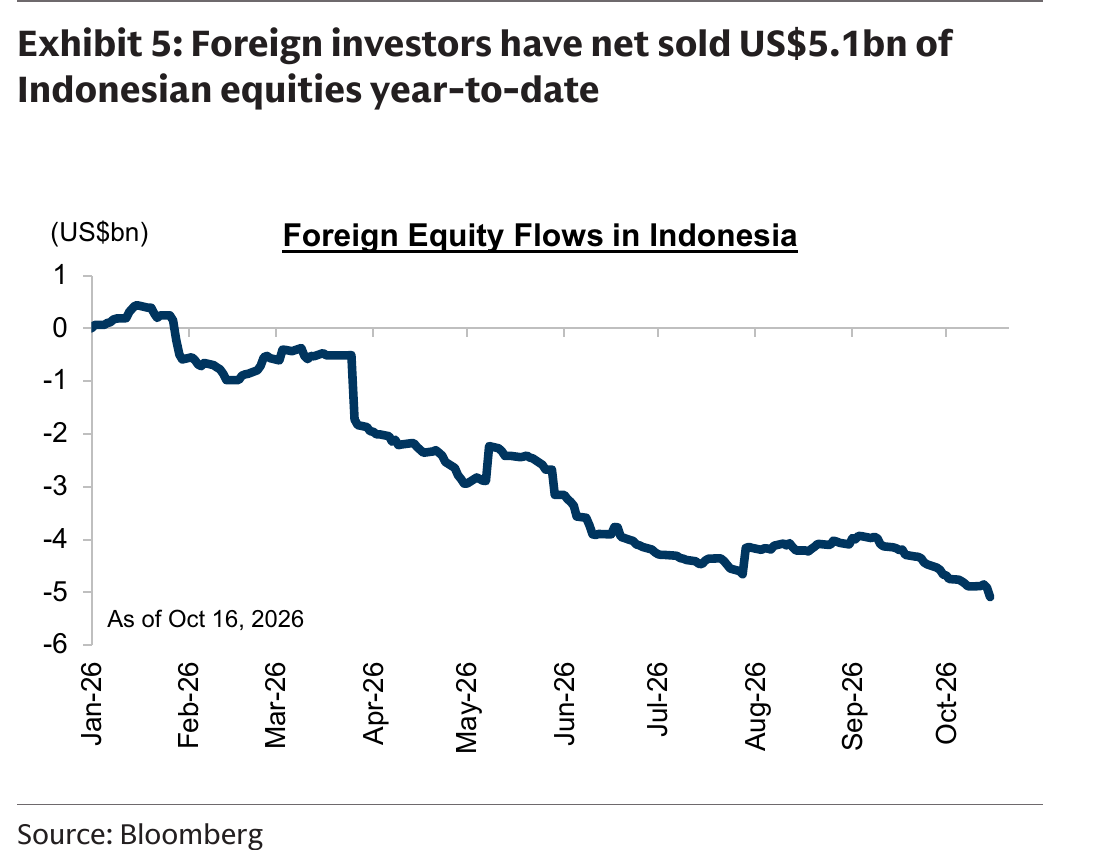
Of course, foreigners didn't wait for MSCI to make it official. Per Goldman, foreign investors have already pulled a net $5.1 billion from Indonesian equities in 2026 (on course for the largest annual outflow on record), and the selling accelerated again into Friday's close:
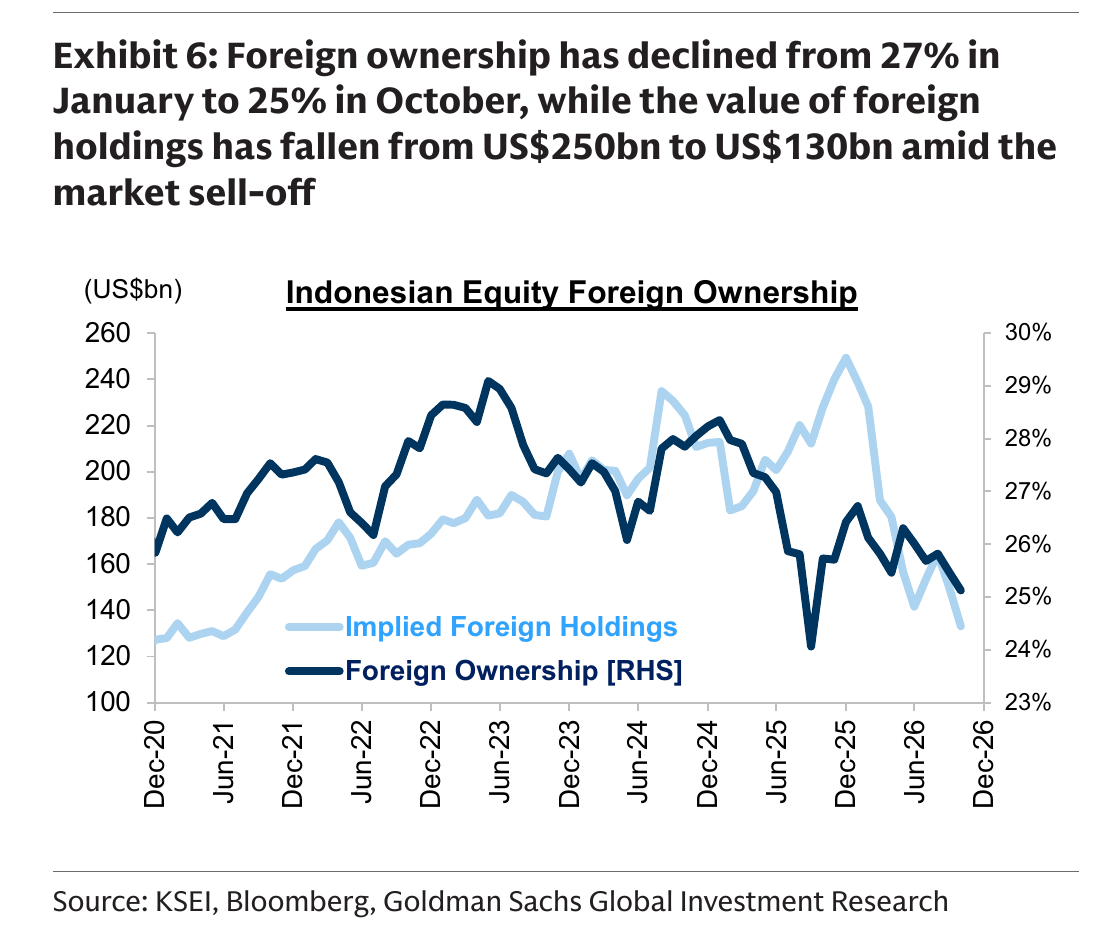
The value of foreign holdings has collapsed from ~$250 billion to ~$130 billion, Indonesia's weight in MSCI EM has shrunk from 1.16% at end-2025 to just 0.39%, and the number of MSCI Standard Index constituents has been cut in half, from 18 to 9, with financials now 72% of what's left. Put differently, by the time MSCI actually hits the button next summer, there may not be all that much left to kick out.
One more thing: active funds are still long. As of September, EM and Asia ex-Japan funds were still ~20bp and ~70bp overweight Indonesia respectively, per Goldman, which means the discretionary selling hasn't really started yet.
The bigger problem for Jakarta is that the selloff refuses to stay inside the equity market. As Goldman's Asia sales trader Peter Sheren wrote on Friday in "Indonesia's Drawdown post the MSCI Reclassification Comments" (available to pro subs), "the MSCI review is increasingly being treated as a country-risk event rather than an equity-specific one." He continued:
Right on cue, the rupiah slid to 18,030 per dollar on Monday, per Reuters, within spitting distance of the record low of 18,190 hit in June, while the 10Y IndoGB yield jumped to 7.4% from 7.169% on Friday.
So how much ammo does Bank Indonesia have to defend the currency? Less than the headline suggests. Gross FX reserves stand near $146 billion, but as Goldman's EM strategists Rishi Radia and Lu Sun point out in "Indonesia: We like paying IDR NDS" (also available to pro subs), BI has been quietly leaning on the forwards market:
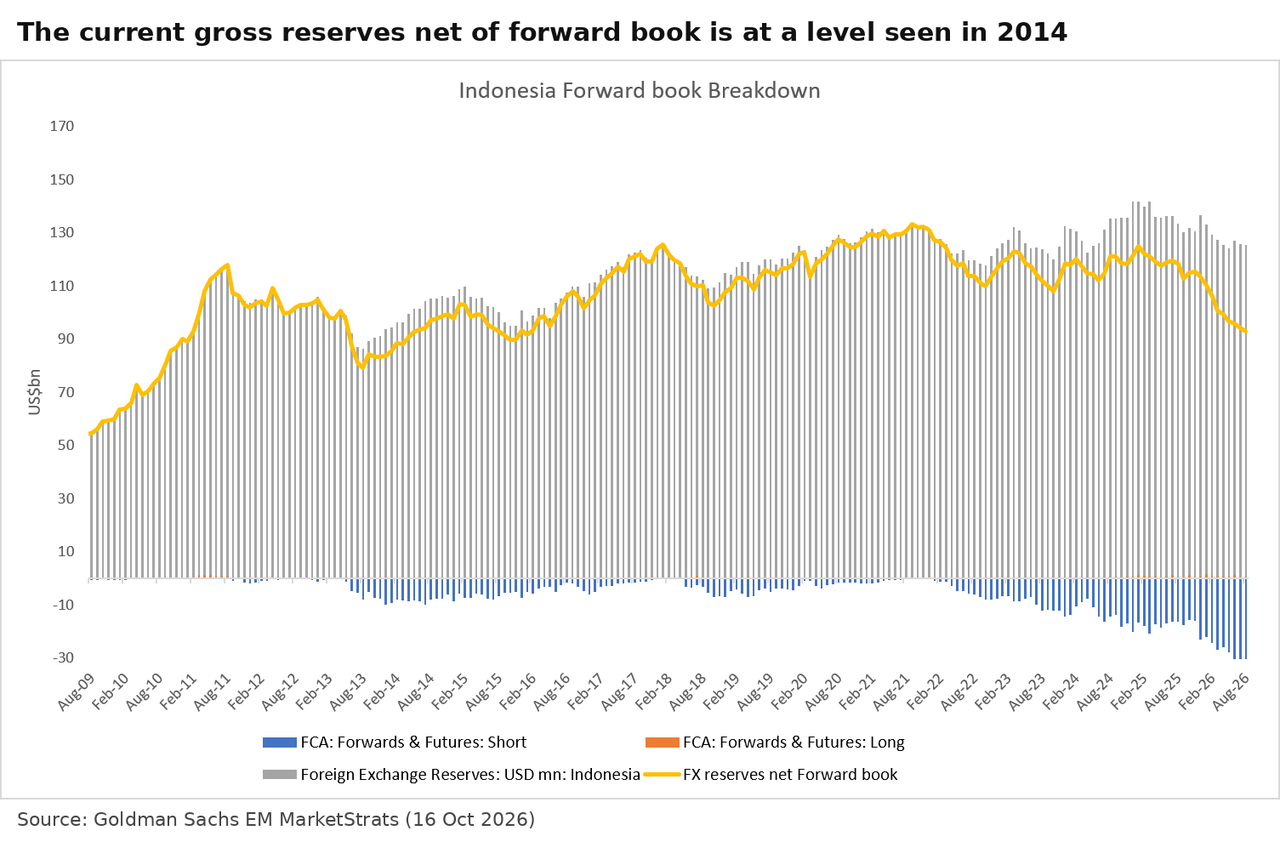
That is why Goldman's EM desk thinks this ends up in front-end rates. Radia and Sun note that GIR's combined $10 billion potential outflow (MSCI plus FTSE, in their earlier math) is "substantial relative to Indonesia's BOP," given that combined current and financial account outflows in all of FY25 were only around $6 billion. Their trade: pay 3Y IDR NDS vs receive 3Y SOFR, entry 215bp, target 290bp, stop at 180bp, because "we expect BI to prioritise FX stability, which may put pressure for front-end rates to go higher."
Goldman EM trader Jake Fox was even more blunt about the setup:
Fox adds that with import coverage down to about three months, Indonesia is moving "towards the convex point," and that since "neither local rates or FX is allowed to adjust... FX implied interest rates have to rise to compensate." In other words, the pressure valve is the forwards market, and it's hissing.
Which brings us to Wednesday's Bank Indonesia meeting. A Reuters poll shows a bare majority (15 of 29) expects BI to hold at 5.75%, but forecasts are flipping fast: Citi now expects a "pre-emptive" 50bp hike and OCBC pulled its December hike forward to this week. Goldman's economists expect two more 25bp hikes, in Q4 2026 and Q1 2027. Higher rates may help the rupiah, but they also hit growth and equity valuations at the worst possible time; so, well, pick your poison. DBS is even more hawkish: a broader correction could push the 10Y toward 7.5% and force BI to hike by another 50 to 100bp, the bank warned.
Bloomberg's Markets Live strategist Mark Cranfield summed it up: "The picture facing investors is a negative feedback loop developing across Indonesian assets, which will likely need local authorities to provide a circuit breaker to create a positive change in sentiment." Judging by the 7% down limit, the authorities took the circuit breaker part a little too literally.
Credit, for now, is the one corner holding up. Goldman's Asia EM credit trader Nitin Pahwa noted that sovereign CDS was only ~3.5bp wider on Friday (at ~97bp) while onshore govies sold off ~30bp, but he wasn't about to fade it: "I just feel the move onshore is ugly, looks like it has legs, and so this small 3-5bp move is just not enough for me to want to fade this as yet." Indonesia's sovereign rating outlooks were already cut to negative by Moody's and Fitch earlier this year, and S&P's sovereign analyst Rain Lin warned on Monday that the "more concerning" risk is "the potential damage to investor confidence and the risk that sentiment weakens more broadly across government bond markets and foreign direct investment."
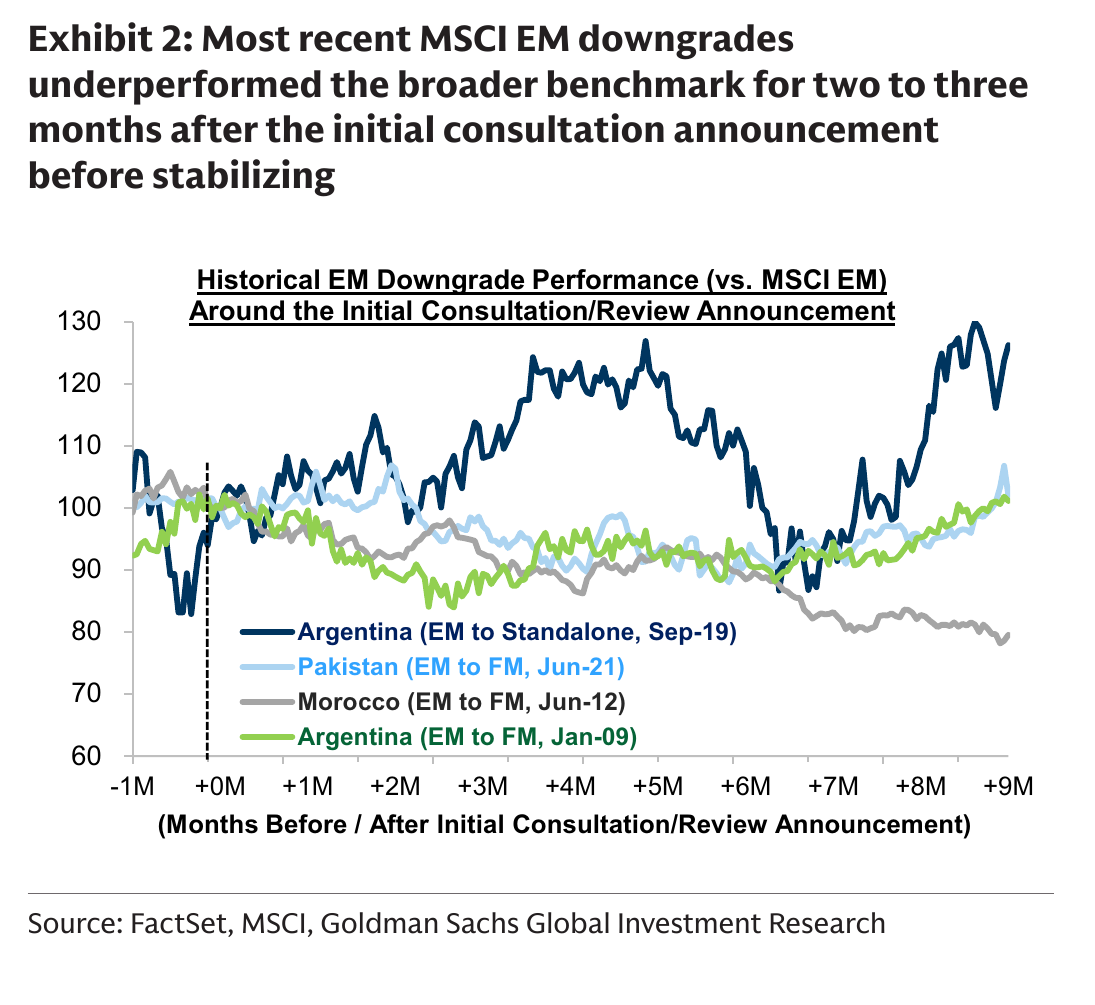
Being booted straight from EM to Standalone puts Indonesia in very exclusive company. Goldman's history of MSCI downgrades shows only a handful of EM-to-Standalone moves: Argentina (2019-21), Russia (2022) and Venezuela (2006). The common thread? Capital controls or outright inaccessibility. As Citi analysts noted (via Breakingviews), this would be the first time a country's stock market is expelled primarily for perceived market integrity failures.
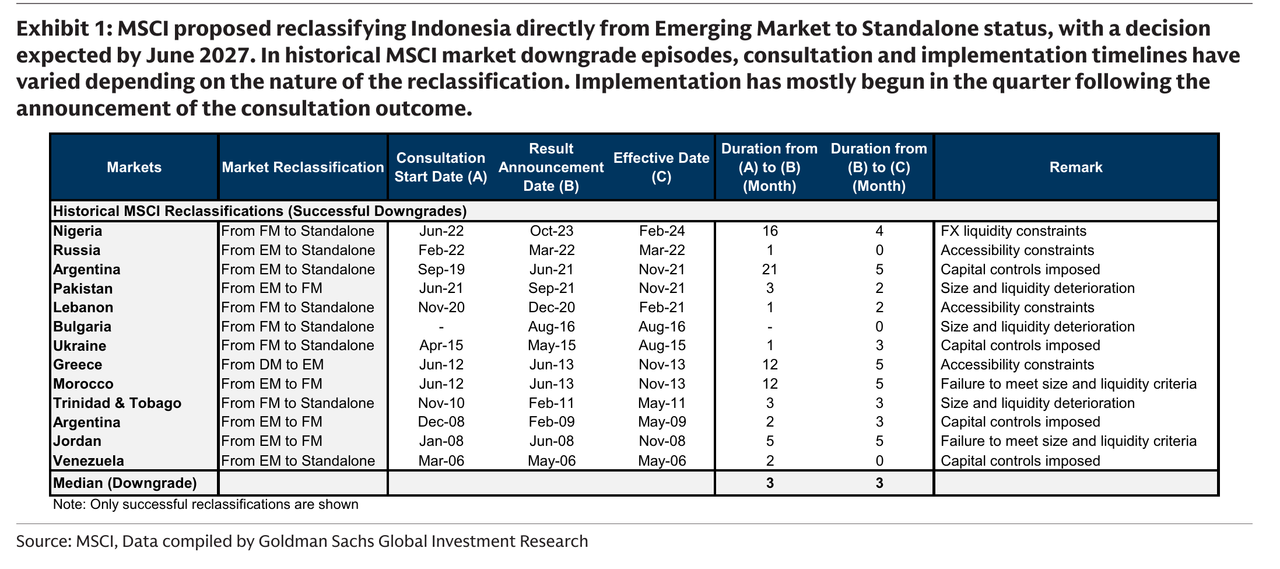
Goldman's Sheren drew the obvious comparison with Argentina, whom MSCI moved from EM directly to Standalone in June 2021, but stressed that "the circumstances were dramatically different": Buenos Aires was mired in capital controls and post-restructuring distress, and MSCI was following an S&P downgrade and a FTSE move. The Argentine downgrade "generated an acute, focused reaction in equities and parallel foreign exchange, but a contained reaction in fixed income." Indonesia, which has none of Argentina's capital controls, is already getting the fixed income reaction.
As for what happens next, history offers a modest silver lining: recent MSCI EM downgrades typically underperformed the broader benchmark for two to three months after the initial consultation announcement before stabilizing. Then again, two to three months from now is Christmas, and the decision isn't due until June.
Meanwhile, the one other market MSCI has put on notice, Türkiye (where MSCI froze positive index changes but has not launched a reclassification consultation), shows how much worse Indonesia's case is, as Emre Akcakmak pointed out:
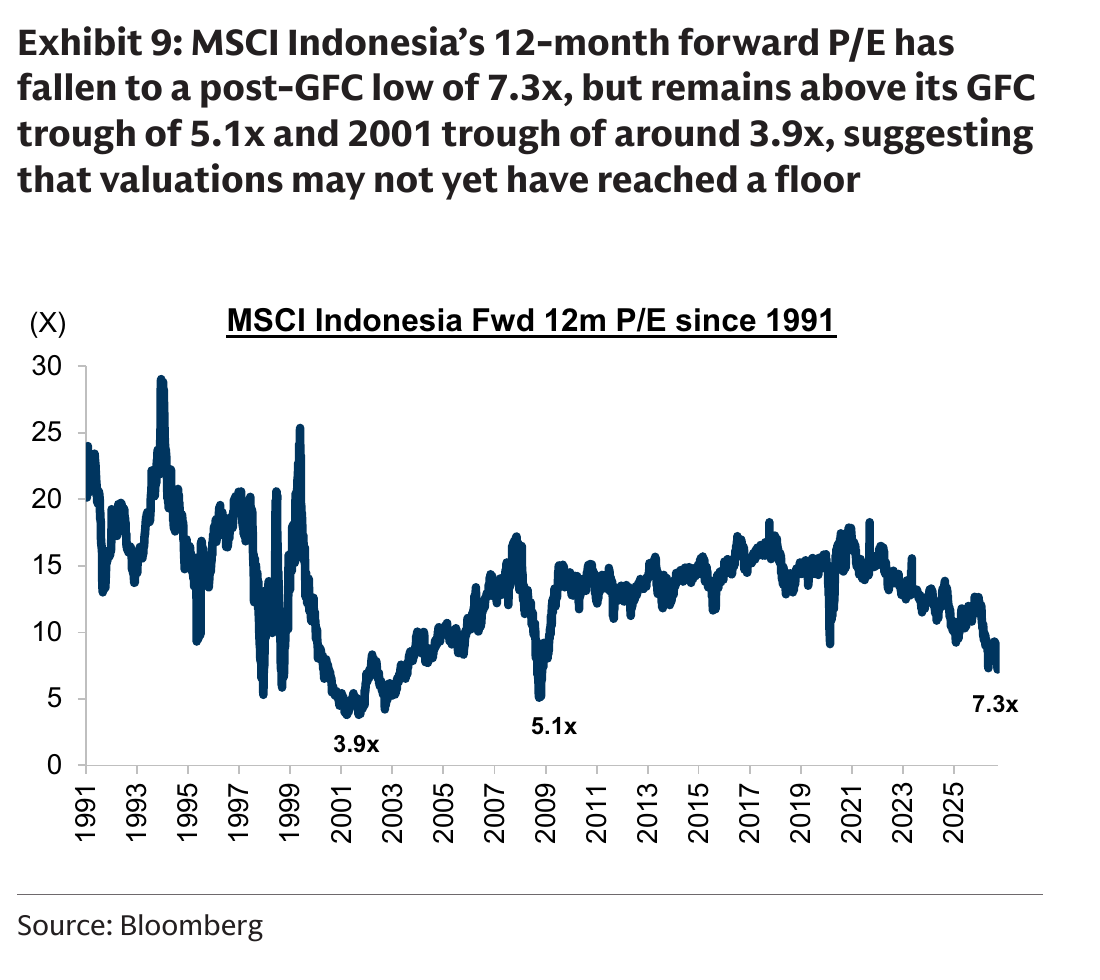
Inevitably, the "too cheap to ignore" crowd has started circling. And yes, after Friday's crash MSCI Indonesia's 12-month forward P/E dropped to a post-GFC low of 7.3x. But Goldman isn't biting: the multiple "remains above the GFC and 2001 troughs of 5.1x and 3.9x, respectively, suggesting valuations may not yet have reached a floor." The bank remains Underweight, citing "the prolonged index overhang, weak earnings, and macro headwinds": consensus 2026 EPS has been cut 3% YTD, household credit growth has slowed to 5% and retail sales growth is stuck near 1%. (And Goldman's bank analyst Melissa Kuang had already downgraded the Indonesian banks a few weeks ago, cutting BMRI to Sell, which matters when financials are now 72% of the MSCI index.)
To be fair, the bulls have a few talking points: hedge funds "generally continue to view Indonesia as tradable" according to Goldman's desk, domestic institutions have been absorbing foreign selling all year, and Breakingviews argues MSCI "unnecessarily" threw Indonesia into a panic by blindsiding local officials. Maybe. But the real shock came from MSCI looking at nine months of Jakarta's reforms and deciding that frontier status was too generous.
We think the overhang wins. Jakarta now has until April 30 to prove a negative (that coordinated trading has stopped) to an index provider that has already said it "expects to proceed," while the rupiah sits less than 1% from its record low, reserves net of forwards are at 2014 levels, and the central bank must choose between defending the currency and defending growth. Goldman's own history shows these downgrades tend to grind lower for months, and with active funds still overweight, the discretionary selling probably hasn't even started. Which is why for Indonesia, the problem is quickly morphing from "where is the bottom in stocks" into "how much does it cost to defend the rupiah", the same question that marked the start of the last Asian crisis. Let's hope this time it doesn't take a 1998-style answer.
Much more in the full Goldman "MSCI Market Classification: Indonesia Downgrade Risk Crystallizes" and the "Indonesia: We like paying IDR NDS" notes, both available to pro subs.
Tyler Durden Mon, 10/19/2026 - 21:45
Continue reading...
[ H/T ZeroHedge ]
Back in January, MSCI fired a warning shot at Jakarta. On Friday it fired the real thing.
Indonesian markets extended their selloff on Monday, with stocks deepening their worst rout in almost 30 years and losses spreading to bonds and the rupiah after MSCI warned the country may face a two-step downgrade: straight from Emerging Market to "Standalone" status, skipping Frontier altogether.
The Jakarta Composite (JCI) closed down 3.6% on Monday after crashing 11.6% on Friday, its biggest one-day drop since January 1998. The combined two-session drop of almost 15% is steeper than any two-day stretch during the 1998 Asian financial crisis, and the index hit a six-year low intraday.
Regular readers will recall that we first flagged this exact risk in January, when Indonesian stocks were halted for 30 minutes after crashing on MSCI "investability" concerns. Back then MSCI merely froze index additions and dangled the threat of a downgrade to frontier status if Jakarta did not clean up its free-float data. The market was halted again the next day...
... and the head of the stock exchange did what heads of stock exchanges do when the market they run gets halted two days in a row:
Nine months, a wave of resignations and a pile of failed reforms later, MSCI has concluded that Jakarta's problems are now too deep for frontier status. The damage since January: the JCI is down about 45% from its January 20 peak and some 42% year-to-date, the steepest fall among major indexes anywhere on the planet, with about $350 billion in market value wiped out since January, according to Reuters (some $60 billion of that on Friday alone). Although to be fair, NVDA loses they by breakfast and gains twice that by dinner.
"Foreign capital is staging a full-blown exit from Indonesia's equity market, and now the bond market is feeling the heat," SEB's head of Asia strategy Eugenia Victorino told Bloomberg. "A sliding rupiah is eating real yields. Until the currency finds its footing, global money is content to watch this one safely from the sidelines." The locals aren't stepping in either: "For now, even the locals are not buying. There's too much uncertainty," added ACG Management's Hui Ling Loh.
"Frontier Would Not Properly Recognize The Depth Of The Market Problems"
In its announcement, released a month ahead of its scheduled November review, MSCI said that despite the reforms Jakarta announced, "significant concerns remain around market dysfunction, including continued suspected coordinated trading behavior and lack of evidence of meaningful enforcement." And then came the line that broke the market: feedback from investors suggested that a reclassification to Frontier "would not properly recognize the depth of the market problems."
Translation: Indonesia is too broken even for the frontier bucket, which is traditionally the pinnacle of the banana republic yardstick.
MSCI's original gripes, per Reuters, were i) opaque shareholding structures that obscured how many shares actually trade freely, ii) coordinated trading behavior that undermined "proper price formation," and iii) weak enforcement. In plain English, some Indonesian stock prices were suspected of being artificially propped up by a handful of tightly connected holders. Jakarta's response since January included doubling the minimum free float to 15% from 7.5%, tighter disclosure for anyone holding 1% or more, and a list of stocks with "high shareholder concentration." Not enough, apparently.
The timeline: market feedback is due by April 30, 2027, MSCI will announce its decision by June 30, 2027, and implementation could begin as early as the August 2027 quarterly review. Unless Jakarta can show "clear evidence of material improvements," MSCI "expects to proceed."
Jakarta's response came with all the urgency you'd expect from officials who were, by their own admission, caught completely off guard. "We did not expect there would be such announcement (from MSCI). Such an unexpected statement caused the market to react in panic," said IDX chief Jeffrey Hendrik ahead of a virtual meeting with MSCI on Monday, after which he said he "could not disclose details of the meeting." Which is the kind of non-answer that tends to precede actual answers, or even more non-answers. Within hours of Friday's announcement, regulator OJK slapped 2.1 trillion rupiah ($116 million) in fines on entities tied to manipulation in three stocks, and the police were called in to probe "alleged violations or criminal acts in the capital market." Funny how fast enforcement happens when the index provider stops asking nicely.
The exchange also announced it would exclude stocks with highly concentrated ownership from the JCI and, more to the point, cut the daily down limit to 7% from 15%, meaning sell orders below that level are simply rejected. Because nothing says "orderly market" like making it impossible to sell. Per Goldman's Asia desk, Monday's turnover hit IDR10 trillion by midday, with many stocks quickly hitting the new 7% floor and foreigners dumping another ~IDR1 trillion, led by the banks (BBCA and BBRI among the worst performers).
Corporate Indonesia is also doing its part. Three firms linked to billionaire Prajogo Pangestu announced a combined 2.5 trillion rupiah ($138 million) of buybacks, while Sinar Mas Group's PT Dian Swastatika Sentosa proposed a 1 trillion rupiah buyback of its own. Bloomberg notes the buybacks come days after regulators fined some of these same companies over manipulative market practices, which is probably not the kind of "price support" MSCI had in mind.
For what it's worth, even Goldman wasn't expecting this. As the bank's London FX desk noted on Friday morning, there had been discussion that Indonesia could face frontier status at the next review: "We had put this as somewhere around 15 per cent chance of happening." Standalone, it seems, was not even on the menu.
Goldman: "The Burden Of Proof Has Shifted"
In a note published Sunday titled "MSCI Market Classification: Indonesia Downgrade Risk Crystallizes" (available to pro subs), Goldman's index strategist Alvin So wrote that the proposal "materially raises the risk of removal from MSCI composite indexes, although it does not trigger immediate passive selling." Then the punchline:
And here is the number every EM PM is now staring at:
Add it up and you get roughly $16 billion of Indonesian equities held by funds that benchmark to MSCI or FTSE, of which about $8 billion is forced, index-driven selling if both providers pull the plug. FTSE has not gone that far yet (it still classifies Indonesia as Secondary Emerging and hasn't put it on its Watch List, though it too froze positive index changes), so Goldman treats that as a separate downside scenario.
The bank also points out that Standalone is meaningfully worse than Frontier: Frontier status would at least move Indonesia into another composite benchmark with some dedicated demand, while Standalone "would remove it from the major composite indexes without an equivalent destination benchmark." In other words, there is no lifeboat. And roughly $1.4 trillion in funds tracks the MSCI EM index.
Of course, foreigners didn't wait for MSCI to make it official. Per Goldman, foreign investors have already pulled a net $5.1 billion from Indonesian equities in 2026 (on course for the largest annual outflow on record), and the selling accelerated again into Friday's close:
The value of foreign holdings has collapsed from ~$250 billion to ~$130 billion, Indonesia's weight in MSCI EM has shrunk from 1.16% at end-2025 to just 0.39%, and the number of MSCI Standard Index constituents has been cut in half, from 18 to 9, with financials now 72% of what's left. Put differently, by the time MSCI actually hits the button next summer, there may not be all that much left to kick out.
One more thing: active funds are still long. As of September, EM and Asia ex-Japan funds were still ~20bp and ~70bp overweight Indonesia respectively, per Goldman, which means the discretionary selling hasn't really started yet.
"As Much An FX And Rates Story As An Equity One"
The bigger problem for Jakarta is that the selloff refuses to stay inside the equity market. As Goldman's Asia sales trader Peter Sheren wrote on Friday in "Indonesia's Drawdown post the MSCI Reclassification Comments" (available to pro subs), "the MSCI review is increasingly being treated as a country-risk event rather than an equity-specific one." He continued:
Right on cue, the rupiah slid to 18,030 per dollar on Monday, per Reuters, within spitting distance of the record low of 18,190 hit in June, while the 10Y IndoGB yield jumped to 7.4% from 7.169% on Friday.
So how much ammo does Bank Indonesia have to defend the currency? Less than the headline suggests. Gross FX reserves stand near $146 billion, but as Goldman's EM strategists Rishi Radia and Lu Sun point out in "Indonesia: We like paying IDR NDS" (also available to pro subs), BI has been quietly leaning on the forwards market:
That is why Goldman's EM desk thinks this ends up in front-end rates. Radia and Sun note that GIR's combined $10 billion potential outflow (MSCI plus FTSE, in their earlier math) is "substantial relative to Indonesia's BOP," given that combined current and financial account outflows in all of FY25 were only around $6 billion. Their trade: pay 3Y IDR NDS vs receive 3Y SOFR, entry 215bp, target 290bp, stop at 180bp, because "we expect BI to prioritise FX stability, which may put pressure for front-end rates to go higher."
Goldman EM trader Jake Fox was even more blunt about the setup:
Fox adds that with import coverage down to about three months, Indonesia is moving "towards the convex point," and that since "neither local rates or FX is allowed to adjust... FX implied interest rates have to rise to compensate." In other words, the pressure valve is the forwards market, and it's hissing.
Which brings us to Wednesday's Bank Indonesia meeting. A Reuters poll shows a bare majority (15 of 29) expects BI to hold at 5.75%, but forecasts are flipping fast: Citi now expects a "pre-emptive" 50bp hike and OCBC pulled its December hike forward to this week. Goldman's economists expect two more 25bp hikes, in Q4 2026 and Q1 2027. Higher rates may help the rupiah, but they also hit growth and equity valuations at the worst possible time; so, well, pick your poison. DBS is even more hawkish: a broader correction could push the 10Y toward 7.5% and force BI to hike by another 50 to 100bp, the bank warned.
Bloomberg's Markets Live strategist Mark Cranfield summed it up: "The picture facing investors is a negative feedback loop developing across Indonesian assets, which will likely need local authorities to provide a circuit breaker to create a positive change in sentiment." Judging by the 7% down limit, the authorities took the circuit breaker part a little too literally.
Credit, for now, is the one corner holding up. Goldman's Asia EM credit trader Nitin Pahwa noted that sovereign CDS was only ~3.5bp wider on Friday (at ~97bp) while onshore govies sold off ~30bp, but he wasn't about to fade it: "I just feel the move onshore is ugly, looks like it has legs, and so this small 3-5bp move is just not enough for me to want to fade this as yet." Indonesia's sovereign rating outlooks were already cut to negative by Moody's and Fitch earlier this year, and S&P's sovereign analyst Rain Lin warned on Monday that the "more concerning" risk is "the potential damage to investor confidence and the risk that sentiment weakens more broadly across government bond markets and foreign direct investment."
Welcome To The Club: Argentina, Russia, Venezuela... Indonesia?
Being booted straight from EM to Standalone puts Indonesia in very exclusive company. Goldman's history of MSCI downgrades shows only a handful of EM-to-Standalone moves: Argentina (2019-21), Russia (2022) and Venezuela (2006). The common thread? Capital controls or outright inaccessibility. As Citi analysts noted (via Breakingviews), this would be the first time a country's stock market is expelled primarily for perceived market integrity failures.
Goldman's Sheren drew the obvious comparison with Argentina, whom MSCI moved from EM directly to Standalone in June 2021, but stressed that "the circumstances were dramatically different": Buenos Aires was mired in capital controls and post-restructuring distress, and MSCI was following an S&P downgrade and a FTSE move. The Argentine downgrade "generated an acute, focused reaction in equities and parallel foreign exchange, but a contained reaction in fixed income." Indonesia, which has none of Argentina's capital controls, is already getting the fixed income reaction.
As for what happens next, history offers a modest silver lining: recent MSCI EM downgrades typically underperformed the broader benchmark for two to three months after the initial consultation announcement before stabilizing. Then again, two to three months from now is Christmas, and the decision isn't due until June.
Meanwhile, the one other market MSCI has put on notice, Türkiye (where MSCI froze positive index changes but has not launched a reclassification consultation), shows how much worse Indonesia's case is, as Emre Akcakmak pointed out:
Market performance since the first serious MSCI warning for a downgrade,Indonesia -46%
Turkey -21% https://t.co/J3KWDU34aP
— Emre Akcakmak (@akcakmak) October 19, 2026
Cheap Is Not The Same As The Bottom
Inevitably, the "too cheap to ignore" crowd has started circling. And yes, after Friday's crash MSCI Indonesia's 12-month forward P/E dropped to a post-GFC low of 7.3x. But Goldman isn't biting: the multiple "remains above the GFC and 2001 troughs of 5.1x and 3.9x, respectively, suggesting valuations may not yet have reached a floor." The bank remains Underweight, citing "the prolonged index overhang, weak earnings, and macro headwinds": consensus 2026 EPS has been cut 3% YTD, household credit growth has slowed to 5% and retail sales growth is stuck near 1%. (And Goldman's bank analyst Melissa Kuang had already downgraded the Indonesian banks a few weeks ago, cutting BMRI to Sell, which matters when financials are now 72% of the MSCI index.)
To be fair, the bulls have a few talking points: hedge funds "generally continue to view Indonesia as tradable" according to Goldman's desk, domestic institutions have been absorbing foreign selling all year, and Breakingviews argues MSCI "unnecessarily" threw Indonesia into a panic by blindsiding local officials. Maybe. But the real shock came from MSCI looking at nine months of Jakarta's reforms and deciding that frontier status was too generous.
We think the overhang wins. Jakarta now has until April 30 to prove a negative (that coordinated trading has stopped) to an index provider that has already said it "expects to proceed," while the rupiah sits less than 1% from its record low, reserves net of forwards are at 2014 levels, and the central bank must choose between defending the currency and defending growth. Goldman's own history shows these downgrades tend to grind lower for months, and with active funds still overweight, the discretionary selling probably hasn't even started. Which is why for Indonesia, the problem is quickly morphing from "where is the bottom in stocks" into "how much does it cost to defend the rupiah", the same question that marked the start of the last Asian crisis. Let's hope this time it doesn't take a 1998-style answer.
Much more in the full Goldman "MSCI Market Classification: Indonesia Downgrade Risk Crystallizes" and the "Indonesia: We like paying IDR NDS" notes, both available to pro subs.
Tyler Durden Mon, 10/19/2026 - 21:45
Continue reading...
[ H/T ZeroHedge ]