


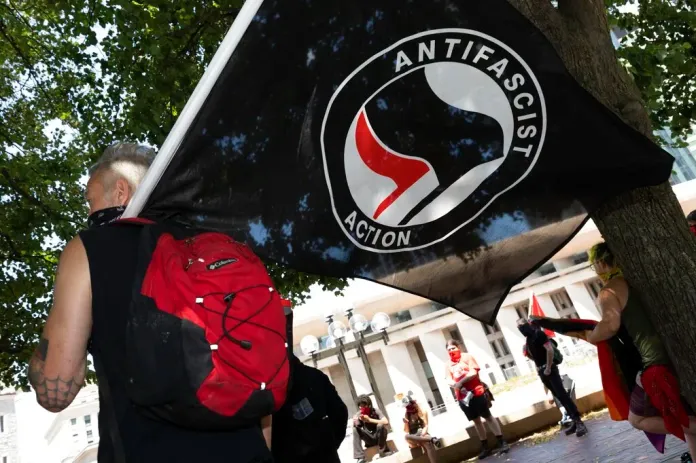
Washington finally started following the money behind political violence. Conservatives cheering the crackdown should make sure it stays aimed at conduct, not politics.
A handful of Italian hackers spent two decades building free encrypted email for anarchist and antifascist groups. On Aug. 26, they landed on the same U.S. terrorism list as Hezbollah’s paymasters. The State Department and Treasury designated Autistici/Inventati, the Bologna-based “A/I Collective,” a specially designated global terrorist, alleging its encrypted hosting and chat tools armed violent far-left cells across the United States and Europe.
I’ve spent a lifetime watching regulators trace dirty money through shell entities, and the lesson never changes: intent lives in the paper trail, not the press release. Follow the wire transfers and server logs and you find out who built the operation. That raises a question every American ought to consider. How far can the government go in dismantling the infrastructure of political violence before it starts dismantling the First Amendment along with it?
The legal framework isn’t new. Under the U.S. Code, providing “material support” to a designated terrorist organization is a federal crime carrying up to 20 years. The Supreme Court upheld that statute against a First Amendment challenge in Holder v. Humanitarian Law Project: coordinated speech loses its constitutional shield once it becomes a service to the organization. Encrypted hosting for a cell claiming credit for pipeline sabotage is a service, and the same principle explains a second case getting less attention. In April, a federal grand jury in Alabama indicted the Southern Poverty Law Center on 11 counts, including wire fraud and money laundering conspiracy, alleging it secretly funneled more than $3 million to individuals tied to the Ku Klux Klan and the National Socialist Movement while fundraising off the claim it was the nation’s premier bulwark against those groups. An entity providing money or infrastructure to violent extremists doesn’t get to hide behind a mission statement any more than a hacker collective hides behind a manifesto about free communication.
Here’s where I part ways with some fellow travelers on the Right. President Donald Trump’s September 2025 executive order designated antifa a domestic terrorist organization, and Attorney General Pam Bondi’s December memorandum ordered the FBI to build a running list of groups “engaged in acts that may constitute domestic terrorism,” updated every 30 days. The memo notes that protected activity alone shouldn’t trigger an investigation, but ask any defense lawyer how much daylight that footnote creates once an agent has a quota to fill. A watch list built on “extreme viewpoints” rather than criminal conduct cuts both ways, and administrations change. A conservative who can’t imagine a future attorney general turning the same authority against pro-life groups, gun clubs, or a men’s Bible study hasn’t been paying attention to how bureaucracies behave once Congress hands them a new toy.
Nobody has a First Amendment right to bankroll a bombing manual or run encrypted communications for a cell that just took down a pipeline, and Humanitarian Law Project settles that question. Where critics have a point is on process. A statute-based prosecution like the SPLC indictment runs through a grand jury and a judge. A watch list compiled inside the FBI with no judicial checkpoint is a different animal, and it deserves more skepticism from people who otherwise trust law enforcement.
I coached high school sports, and you learn fast that the rules matter more when your own child is losing than when he’s winning. If material support laws are legitimate tools against antifa-adjacent hacker collectives and grift artists hiding behind a civil rights brand, they’re legitimate tools, full stop: a fixed evidentiary standard, and a sunset clause forcing Congress to reauthorize the architecture instead of letting it calcify into a permanent bureaucracy.
FROM ‘KILL HER’ CHANTS TO BROKEN RIBS: AUSTRALIA’S TRUMP MOMENT IS HERE
Congress should codify what “material support” means domestically the way it already has abroad, with criminal conduct, not ideology, driving any listing decision, and make clear that hosting a blog or holding unpopular opinions about immigration or gender ideology is never, on its own, material support for anything.
The A/I Collective and SPLC cases prove the system can catch real bad actors when investigators follow actual conduct and actual money. That’s a win. But winning the fight against political violence and preserving the right to disagree with your government aren’t competing goals. They’re the same goal: Know exactly who the enemy is, hit only the target you can prove, and never let the weapon outlive the war.
Jay Rogers is a financial professional with more than 30 years of experience in private equity, private credit, hedge funds, and wealth management. He has a Bachelor of Science in criminal justice from Northeastern University and has completed postgraduate studies at UCLA, the University of Pennsylvania, and Harvard. He writes about issues in finance, constitutional law, national security, human nature, and public policy.
Continue reading...
[ H/T Washington Examiner ]