


Via History.com
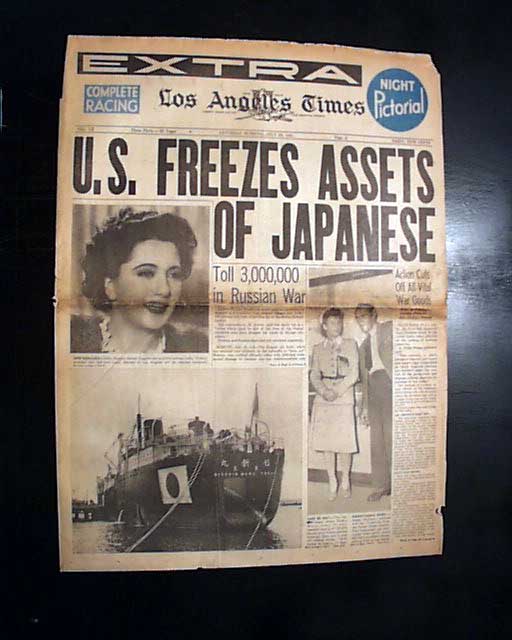
On July 26, 1941, President Franklin Roosevelt seizes all Japanese assets in the United States in retaliation for the Japanese occupation of French Indo-China.
On July 24, Tokyo decided to strengthen its position in terms of its invasion of China by moving through Southeast Asia. Given that France had long occupied parts of the region, and Germany, a Japanese ally, now controlled most of France through Petain’s puppet government, France “agreed” to the occupation of its Indo-China colonies. Japan followed up by occupying Cam Ranh naval base, 800 miles from the Philippines, where Americans had troops, and the British base at Singapore.
President Roosevelt swung into action by freezing all Japanese assets in America. Britain and the Dutch East Indies followed suit. The result: Japan lost access to three-fourths of its overseas trade and 88 percent of its imported oil. Japan’s oil reserves were only sufficient to last three years, and only half that time if it went to war and consumed fuel at a more frenzied pace. Japan’s immediate response was to occupy Saigon, again with Vichy France’s acquiescence.
If Japan could gain control of Southeast Asia, including Malaya, it could also control the region’s rubber and tin production—a serious blow to the West, which imported such materials from the East. Japan was now faced with a dilemma: back off of its occupation of Southeast Asia and hope the oil embargo would be eased—or seize the oil and further antagonize the West, even into war.
Tweet
Continue reading...
[ H/T The Burning Platform ]
On July 26, 1941, President Franklin Roosevelt seizes all Japanese assets in the United States in retaliation for the Japanese occupation of French Indo-China.
On July 24, Tokyo decided to strengthen its position in terms of its invasion of China by moving through Southeast Asia. Given that France had long occupied parts of the region, and Germany, a Japanese ally, now controlled most of France through Petain’s puppet government, France “agreed” to the occupation of its Indo-China colonies. Japan followed up by occupying Cam Ranh naval base, 800 miles from the Philippines, where Americans had troops, and the British base at Singapore.
President Roosevelt swung into action by freezing all Japanese assets in America. Britain and the Dutch East Indies followed suit. The result: Japan lost access to three-fourths of its overseas trade and 88 percent of its imported oil. Japan’s oil reserves were only sufficient to last three years, and only half that time if it went to war and consumed fuel at a more frenzied pace. Japan’s immediate response was to occupy Saigon, again with Vichy France’s acquiescence.
If Japan could gain control of Southeast Asia, including Malaya, it could also control the region’s rubber and tin production—a serious blow to the West, which imported such materials from the East. Japan was now faced with a dilemma: back off of its occupation of Southeast Asia and hope the oil embargo would be eased—or seize the oil and further antagonize the West, even into war.
Tweet
Continue reading...
[ H/T The Burning Platform ]