








Thomas Jefferson is either the most prolific, hypocritical liar in American history or the victim of the most profane defamation of character allegation in 250 years. There is no gauzy middle ground in this historical tableau. Now, with a new book, History by a Hair: Thomas Jefferson, Sally Hemings & Solving a 200-Year-Old Mystery, and a DNA study alleging a further genetic match to Jefferson’s “clipped” hair, the debate has reignited.
It has been said that journalism “is the first rough draft of history.” Some truth lies in this statement. Unfortunately, this standard has been misapplied to the current controversy: whether Jefferson had an affair with his 14-year-old slave, Sally Hemings. The debate has now dissolved into a second and third draft of a politicized novel. Jefferson is, as Pulitzer Prize-winning historian Virginius Dabney once wrote, “one of the principal historical victims of the current orgy of debunking” our heroes.
A small universe of historians contends that whether the consanguinatory allegations are true is a peripheral issue, because Jefferson’s renown as a votary of liberty is so monumental that nothing can affect it. Perhaps. Yet the “Sally” sexual allegations have permeated the national consciousness and remain a demonizing blot on Jefferson’s character. In the interest of fairness and historical accuracy, the scientific and historical allegations need to be appraised, and, if proven false, vigorously refuted.
No other person in the public domain has been studied, debated, and written about more than the man who penned the charter of American independence. Of all the Founding Fathers, Jefferson, statesman, diplomat, naturalist, apostle of freedom, has fared the worst at the hands of barbed revisionists. In fact, Jefferson’s personal reputation has been all but assassinated for the last 20 years, since the 1998 DNA match. The face on Mount Rushmore has been vilified as a slave-owning hypocrite, misogynist, and racist.
It is beyond the scope of this article to address the major problems with the new scientific conclusions, but serious problems remain. For example, the strength of the new DNA study depends on several separate links in an evidentiary chain. Is the hair unquestionably Jefferson’s? The new study describes hair that was “clipped” from Jefferson shortly after his death, placed in paper, and preserved for 250 years. That alone presents monumental problems with what, in the law, is called “chain of custody”: Who handled the hair over nearly two centuries? Was every transfer documented? Were other Jefferson family hairs stored nearby? Was there any independent genetic method for establishing that the particular hairs tested actually belonged to Thomas Jefferson rather than another family member? That distinction is colossal. Moreover, ancient hair DNA presents enormous scientific problems.
A “cut” hair normally contains little or no intact nuclear tissue compared with a freshly “plucked” hair containing root material. With material approximately two centuries old, degradation, fragmentation, and environmental contamination become major concerns. The question then becomes not merely “Was DNA detected?” but “How much authentic endogenous DNA was recovered, at what coverage, and how confidently can contaminating DNA be excluded?” And finally, a reconstructed genome — the genome consists of 23 pairs of chromosomes located in the cell’s nucleus — is not necessarily equivalent to sequencing pristine DNA from Jefferson himself. There was no reconstructed genome from other more likely paternity candidates, such as Jefferson’s younger, unknown brother, Randolph Jefferson, and Jefferson’s lascivious nephew, Peter Carr, who admitted to having an affair with Hemings. In fact, Jefferson’s overseer at Monticello, Edmund Bacon, specifically stated that he saw another man, not Jefferson, coming out of Hemings’s cabin “many a morning,” implying Carr.
Finally, one Hemings relative who participated in the new DNA research for the book proclaims that the scientists lost her trust, prompting her to remove her DNA from the study. Mary Brady-Atkins, Hemings’s 98-year-old great-great-great-granddaughter, cited serious concerns that the book is being published hastily, before its conclusions could be vetted by any peer-reviewed journal.
“It is with regret that I write to withdraw my consent to participate in the above study, effective immediately,” she wrote to the lead researchers on Aug. 24.
I have long questioned whether the case against Jefferson has been stated with more certainty than the evidence permits. In my view, the misleading science ignores all of the other overwhelming historical facts and evidence that directly point to two other more probable candidates for the sexual affair with Hemings: Randolph Jefferson and Carr. In fact, the Hemings “story” can be made authentic only by an incredible suspension of disbelief. The allegation consists of a mixture of gossip, hearsay, and speculation, bordering on willful opacity. One would have to assume Jefferson transformed himself into a schizophrenic Jekyll and Hyde to maintain two different families and lead an emotionally repressed double life.
For example, the science all but ignores Randolph Jefferson, who would have the identical Jefferson Y chromosome as his older brother, which matched the DNA. Randolph Jefferson had a reputation for socializing with Thomas Jefferson’s slaves and was expected at Monticello approximately nine months before the birth of Eston Hemings, Sally Hemings’s son, who was the DNA match for a “male Jefferson.” The DNA match was to a male son of hers. Randolph Jefferson had all sons. Thomas Jefferson had all daughters with his beloved wife, Martha. Until 1976, the oral history of Eston Hemings’s family held that they descended from a Jefferson “uncle.” Randolph Jefferson was known at Monticello as “Uncle Randolph.”
Thomas Jefferson’s deteriorating health would have prevented any such sexual relationship. He was 64 at the time of the alleged affair and suffered debilitating migraine headaches, which incapacitated him for weeks, as well as severe intestinal infections and rheumatoid arthritis. He complained to John Adams: “My health is entirely broken down within the last eight months.”
The alleged affair between Jefferson and Hemings began as a vindictive political attack during Jefferson’s first term as president. It first swirled into publication in 1802 by a muckraking, bellicose journalist named James Callender, described as “an alcoholic thug with a foul mind, obsessed with race and sex,” who intended to defame the public career of Jefferson. Historian James Truslow Adams wrote that “almost every scandalous story about Jefferson which is still whispered or believed may be traced to the scurrilous writings of Callender.” He was a disappointed office seeker, the “most deadly of all political animals.” In common with the licentious practice of those times, the allegations were spread for political purposes, even though the accusations had no foundation in fact, promoted by Jefferson’s Federalist enemies.
Those who wish to villainize Jefferson think they have a license to do so with the deceptive DNA results. After examining all the credible, documented, and corroborated evidence, it is hard to escape the singular conclusion that Jefferson has been enlisted on the losing side in a cultural battle where racial creeds have been allowed to predominate, turning a quest for scientific evidence into a paroxysm of rage on slavery. No doubt, historians are not bound by the legal rules of evidence. Yet the divisive character of the historical debate has curdled the facts into a predetermined mantra: Jefferson’s guilt. The most dominant, compelling evidence proving Jefferson’s innocence was misinterpreted, masqueraded, or manipulated to fit a predetermined blueprint.
JULY FOURTH MADE US INDEPENDENT. SEPT. 17 KEPT US FROM COLLAPSING
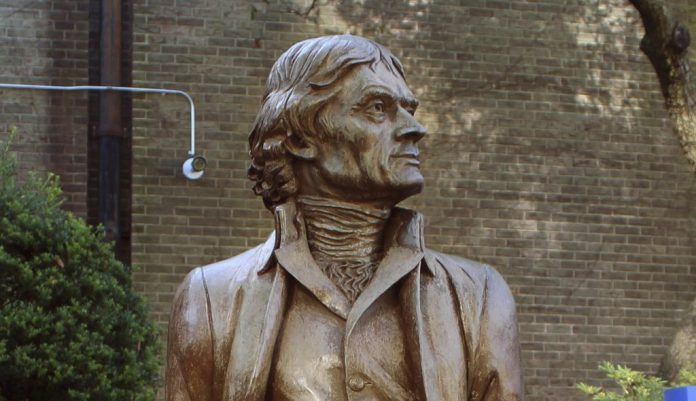
The new DNA claims deserve serious attention, as do questions about sample identification, contamination, comparison groups, and peer review. Former Monticello President Daniel Jordan believes “honorable people can disagree” in the Jefferson-Hemings paternity debate. He believes new evidence might be discovered to fill the ruptured lacunae in the historical record. Thus, neither scientists nor historians can rob Jefferson of his laurels, but they can scribble graffiti on his statue. It is unfortunate that sexual innuendo is so hard to erase.
Unlike his brother, by taste and training, Thomas Jefferson was raised as the perfect Virginia gentleman, a man of refinement and intellect. The personality of the man who figures in the Hemings scandal cannot be attributed to the known nature of Jefferson. Having an affair with a house servant would be preposterously out of character for him. No scientific study can erase that fact or ignore Jefferson’s categorical denial of the affair in a private letter to his Navy secretary in 1805: “You will perceive that I plead guilty to one of their charges, that when young and single, I offered love to a handsome lady. I acknowledge its incorrectness. It is the only one founded on truth among all their allegations against me.” Finally, as Jefferson’s granddaughter once said of the Hemings allegation, “There are such things as moral impossibilities.”
William G. Hyland Jr. is the Amazon bestselling author of four nonfiction books, published by St. Martin’s Press and Regnery Books, including In Defense of Thomas Jefferson.
Continue reading...
[ H/T Washington Examiner ]