


Guest Post by John Walter
County emergency managers deliver the same briefing to a hall of a few hundred people every October, and the hall is always the wrong size, because the households that most need the material are the ones least likely to drive to a community center on a weeknight. What follows rebuilds that briefing for a kitchen table instead, in the order the material actually gets used: what cold does to a body and in what sequence, which geography and which housing stock govern how much warning a household effectively receives, how a forecast is read by the people who write it, the twelve decisions that recur in fatality investigations, and then the house, the power, the vehicle, the shovel, the clothing, the thaw, the paperwork, the animals, and finally the institutions whose thinning has shortened the clock on all of it. The historical spine runs through the Thanksgiving cyclone of 24 to 30 November 1950, which laid as much as sixty-two inches of snow across the central Appalachians, drove a hundred and sixty miles an hour over the summit of Mount Washington, and killed between a hundred and sixty and three hundred and eighty-three people depending on whose count is consulted and how carefully it was kept; the event earns its place as the best-documented American case of what a stalled winter cyclone does to a population that has made arrangements for an ordinary weekend, and every mechanism it exposed remains in service seven and a half decades later.
Weather data throughout comes from the National Weather Service, the National Centers for Environmental Information, the Climate Prediction Center’s outlook of 15 October, and the published post-mortems of the 1950 storm; fatality counts for 2021, 2022, 2025 and 2026 come from state health departments, county medical examiners, the Weather Service’s hazard statistics and the USA TODAY compilation of 28 February 2026, which coroners continue to revise, and contested figures appear with the contest attached rather than resolved toward the more dramatic of the two. Physiological thresholds derive from laboratory and field work at the University of Manitoba’s cold-weather laboratory under Gordon Giesbrecht and from the wind chill tables the Weather Service adopted in 2001, and fit adults produced those numbers, which means anyone with a cardiac history, a beta blocker in the cabinet or a toddler in tow will find them generous. Read the piece in October, build the kit while the shelves hold stock, and treat every figure in it as a floor.
Two residents of the same Buffalo street stepped out of their houses on the twenty-third of December, 2022, and each of them could see the destination.
Lake-effect snow had come ashore that morning off open water on Lake Erie during a cold snap, an arrangement that manufactures the heaviest short-duration snowfalls anywhere in the populated world, and the band had the particular density that comes when the lake is still warmer than the air above it and the air above it is cold enough to wring. Gusts ran past seventy miles an hour. Christmas morning arrived after thirty-nine hours of it, fifty-one and a half inches lay on the airport gauge, and forty-seven people were dead in Erie County with thirty-four of them inside the city limits. Mark Poloncarz, the county executive, spent three days asking people to stay home and three weeks afterward defending a response that reached almost none of them. (Someone you love is bleeding, burning with fever, or struggling to breathe. The ambulance is forty minutes away. Everyone is looking at you. Watch this video now. It could make all the difference.)
Erie County’s review sorts the dead by where they fell. Vehicles. Sidewalks. Yards. A man walking home from a shift. A woman who quit a stranded car because her porch light showed from the road. A couple who went two streets over to look in on a relative. Hypothermia took every one of them within sight of a door, and the ground between each body and warmth measured about forty yards.
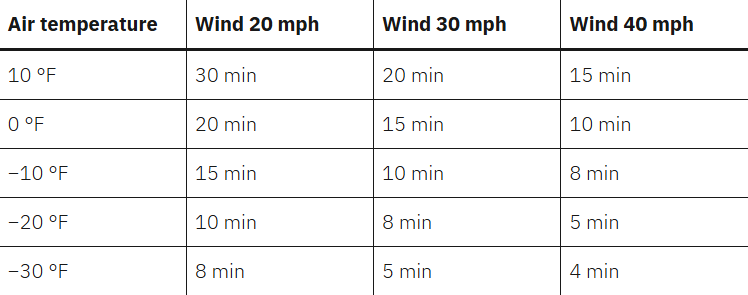
The clock that governs those forty yards runs faster than most people believe. At five below zero with a twenty-five mile an hour wind, exposed skin freezes in half an hour and a lightly dressed adult begins shedding core temperature inside the same window. Take the wind to forty and the countdown halves. Buffalo held between ten and twenty above for most of that Friday with gusts well past forty, which puts frostbite on an exposed cheek inside fifteen minutes and puts a person in sneakers into serious difficulty in the time it takes to clear a walk. Weather Service fatality records reproduce the same pattern across every winter on file: direct deaths bunch into three groups, vehicular, exposure and cardiac, and the exposure group consists almost entirely of people who stepped outside on an errand they judged sufficient. Reaching work. Fetching the mail. Walking the dog. Digging out an exhaust. Each errand is defensible and each has killed somebody who left the house in trainers.
What makes the doorway so consequential is that the decision gets made in about four seconds, with the wind already audible through the gap and the porch light already burning, and every input to it sits within arm’s reach of the latch. A coat on a hook at chest height, a boot rack under it, a torch in a bowl beside it. Or a fleece on a chair in the next room and a pair of sneakers by the sofa. The four seconds decide the clothing, the clothing decides the heat budget, and the heat budget decides whether a walk that takes ninety seconds stays a walk. Everything in this piece is downstream of that latch.
The physics do not care about the errand. Wind chill measures the rate at which moving air strips heat off exposed skin, and the Weather Service’s chart translates the rate into a countdown that runs from half an hour down to four minutes as the temperature falls and the wind climbs. Clothing interrupts the rate by holding a film of warmed air at the skin; water destroys it by conducting heat away roughly twenty-five times faster than dry wool. So the two mechanisms that produce most of the bodies recovered outdoors are the wet-through, in which cotton against the skin soaks and turns a coat into a cold compress, and the walk-back, in which somebody reaches a destination, finds it shut or empty, and turns around with a body already cooled and clothing already damp, and the return leg takes longer than the outward one for reasons that have nothing to do with distance.
Gordon Giesbrecht has spent three decades lowering volunteers into near-freezing water at the University of Manitoba and has reduced cold incapacitation to a sequence he calls the 1-10-1 principle. One minute of cold shock, during which gasping and hyperventilation make panic and drowning the immediate hazards. Ten minutes of useful movement, after which the muscles of the extremities have cooled enough that the hands stop obeying instructions. One hour before core temperature falls far enough to end consciousness in most adults, sooner in the thin, the small and the soaked. His body of work keeps arriving at a conclusion that transfers straight into a blizzard: dexterity fails ahead of judgment, so a person who has lost the use of their hands has already lost most of the capacity to solve the problem they are standing in, and will keep insisting the problem is small.
Understanding what cold does in sequence separates helping somebody from hurting them, and the sequence runs from the skin inward on a schedule that a bystander can read if they know what they are looking at.
Blood vessels in the hands, feet, arms and legs constrict within seconds as the body pulls warm blood into the trunk. Fingers stiffen, grip weakens, and fine work turns clumsy somewhere near forty degrees of skin temperature, well before any shiver begins. This is the stage at which people drop keys, fumble a zip, fail to work a buckle and blame the zip. Cold-weather instructors call it the clumsy window, and it lasts long enough to be mistaken for carelessness, which is why the first thing a partner notices is usually a dropped glove rather than a complaint.
Shivering follows, involuntary and violent, generating heat through muscular work at the cost of glucose and fatigue. Mild hypothermia occupies the band between ninety and ninety-five degrees of core temperature and shivering is its signature. Judgment thins here. People grow argumentative about route, refuse help, insist they feel fine, and the insistence tracks the physiology rather than the personality. Speech thickens and consonants blur, which supplies the mumbles in the standard field mnemonic of stumbles, mumbles, fumbles and grumbles. The mnemonic exists because a hypothermic person makes a poor witness to their own condition and a partner needs something to look for that does not require the patient’s cooperation.
Between eighty-two and ninety degrees the shiver turns violent and then, near the bottom of the band, quits. Stopping is the danger sign, since somebody who has quit shivering looks calmer and has lost the last automatic defense. Muscles go rigid, pupils widen, breathing slows, fine movement disappears. Confusion deepens into apathy, and apathy is what puts people down in the snow to rest, which is the last thing they should do and the first thing they want.
Below eighty-two degrees the picture turns deceptive. Rigidity sets in, the pulse slows to something faint and awkward to locate, breathing drops shallow, and the casualty reads as dead to an untrained hand. Cold myocardium grows irritable and mechanical jostling can throw it into ventricular fibrillation, so the rough handling that helps a conscious patient harms an unconscious one. Pulse and breathing checks belong on a warm trunk for a full minute rather than at a wrist for ten seconds. Paradoxical undressing arrives in the profound stage: peripheral vessels dilate in a final attempt at protecting the skin, warm blood floods to the surface, the patient experiences a surge of heat and strips off in the snow. A body found in shirtsleeves shows how far the cooling had progressed rather than how confused the person had become.
Treatment follows the stage. Anybody shivering and lucid goes into shelter, out of wet clothing, into dry layers, under shared body heat, and takes warm sweet fluid by mouth. Anybody who has stopped shivering gets handled flat, gets the trunk warmed ahead of the limbs, and goes to a hospital, since warming the extremities first drives chilled peripheral blood back into the core and drops it further. A hot bath belongs to the conscious and shivering only. Field practice holds that a patient stays dead only once warm and dead, and the corollary sends the rewarming to somebody with a low-reading thermometer.
Four populations carry most of the risk and each fails on a different route, which matters because the countermeasure differs for each. Older adults lose the vasoconstriction reflex, run lower baseline body temperature, take medications that interfere with shivering, and often keep houses at sixty-two degrees to save money. Many have neuropathy in the feet and lose the sensation that would warn them, and many cannot rise from a floor once down. A daily telephone call during a cold spell has the best record of any intervention and costs nothing, and whoever makes it should know which window the bedroom sits behind.
Infants cannot shiver efficiently before roughly eighteen months and cannot pull a blanket off their own face. They lose heat fast through the scalp and faster when wet, so a cold house calls for one layer beyond an adult’s clothing, a hat indoors and a check every hour, with the check made at the neck rather than the hands because overheating is its own problem.
Chronic illness sits in the worst position of all, because the storm attacks the management of the disease rather than the disease. Somebody on anticoagulants bruises into a fall and bleeds under it. A cardiac patient shovels into an angina. An asthmatic breathes cold air through a constricted airway. A diabetic loses the fridge that keeps the insulin stable. Each of those is a specific preparation rather than a general one, and each belongs on the card described later.
Isolation multiplies every category above. A household of one has nobody to notice a stumble, nobody to take the second end of a mattress, nobody to call an ambulance. Isolation correlates with poverty, with rural distance, with age and with disability, and all four stack on the same address.
American households forget winter in the second week of December and remember it in the third, and the forgetting costs money and occasionally more. The first hard forecast of a season clears the milk and the bread off the shelves and leaves the batteries, the rock salt and the fuel cans where they sat, and the families who queued for the milk get caught three weeks later with a quarter tank and a dead landline.
Blizzards follow geography with a fidelity that makes the map worth reading. Lake-effect snow comes off open water when cold air crosses it and dumps hardest and most often on the Tug Hill Plateau east of Lake Ontario and the Chautauqua Ridge south of Buffalo, on the same roads, year after year, because the topography does not move. Nor’easters build on the Atlantic temperature gradient and strike from New Jersey northward, and their wind does the damage, as the 1950 cyclone demonstrated with a hundred and eight miles an hour at Newark, a hundred and forty at Bear Mountain and salt water over the runways at LaGuardia. Appalachia collects the upslope dump, the orographic snow that let Pickens, West Virginia, take fifty-seven inches from one stalled cyclone. West of the Rockies a separate hazard runs on a separate bulletin, and the avalanche forecast outranks the snowfall total.
Each of those shapes a different kit and a different timeline. A house on a ridge above a valley road wants a week of food and a way to move a foot of snow, since the plow works the valley floor first and the ridge last, sometimes days last. A fifth-floor walk-up wants three days of water, a battery radio and a plan for the boiler, because sixty stairs are a different proposition at seventy years old than at thirty and a lift with no power is a wall. A rural route wants the county’s published snow removal priority list, wants to know that its road sits on the second or third tier of it, and wants to understand that a drift across a single-lane road without a turnaround converts a car into a permanent obstruction.
Housing stock matters as much as address and gets discussed far less. A house with a heat pump and electric resistance backup loses both when the grid goes, while a house with a gas boiler and a standing pilot keeps some capacity and a house with a wood stove keeps more. A flat roof collects load that a pitched roof sheds. A slab-on-grade house runs its pipes through the slab and has nowhere to drain them. A basement floods and a crawlspace mildews and a manufactured home loses heat through a floor pan faster than any wall. Reading a house for its failure points takes an hour and produces a list of specific work, which beats a general sense of dread by a wide margin.
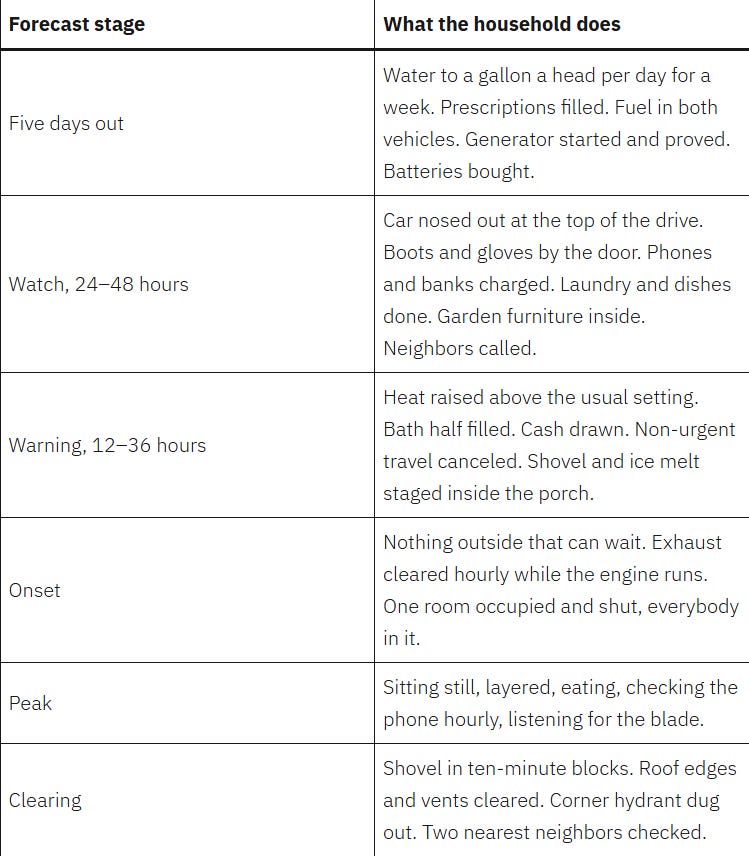
Forecast language is small, public and almost untaught, which is why so many households treat a warning as a weather report rather than an instruction. A watch means the ingredients exist and a forecaster wants three to five days of runway. A warning means the event lands within thirty-six hours and the county is moving, which is when the tank gets filled and the prescriptions collected. A blizzard warning adds two conditions to heavy snow, wind held above thirty-five miles an hour and visibility under a quarter mile for three consecutive hours, and together they describe the state in which a road vanishes from a windshield at the same moment the plow blade vanishes from the driver’s view. An ice storm warning covers accumulations that will bring spans down. A winter weather advisory covers the nuisance end. This season forecasters gained the authority to attach “Particularly Dangerous Situation” language to selected blizzard and ice storm warnings, a phrase borrowed from tornado practice and reserved for events of historic severity where emergency services themselves may lose the ability to reach people.
Two tables carry the arithmetic. The first reduces the Weather Service wind chill chart to the cells that matter in a Great Lakes or New England storm. The second lays out the household day against the forecast language a phone will display.
Minutes to frostbite on exposed skin
The storm day, in the order it arrives
Set the two tables side by side and the arithmetic turns blunt. A man in a fleece and trainers, forty yards from his own porch, at ten degrees with a forty-mile-an-hour wind, holds fifteen minutes of intact skin and roughly the same of working hands. The walk costs ninety seconds. The drift across the path costs four minutes. The keys sit in the pocket of a coat he left indoors.
The Climate Prediction Center’s outlook of 15 October places the warmest odds for December through February across the northern tier and the wettest odds from the Southwest through the South to the East Coast, riding an El Niño the center gives better than an eighty-three per cent chance of holding strong into March. Warm ground across the mid-Atlantic will pass the first heavy rain on a snowpack into basements, since it has nowhere else to go. Marginal temperatures along the Washington to Boston corridor will produce sleet, freezing rain and slush that sets hard, and ice will drop spans in the middle of an afternoon while traffic still runs.
The list follows the order of frequency in investigations. Every entry is a choice a household makes without noticing, inside the twelve hours either side of a storm.
Water and sleep earn more room than a list allows, because households err at both in opposite directions. Water gets skipped and fails first: a body at rest in a cold room still wants around two liters a day, cold suppresses thirst, and intake therefore runs on a schedule or it runs short. Dehydration thickens the blood, thickens it further in a constricted peripheral circulation and loads a heart already working to hold temperature. Coffee and tea count more than folklore allows and the diuretic effect matters less than the volume does. A week at a gallon a head, plus a way to boil more from the bath or a butt, covers the gap until a bowser comes.
Sleep gets improvised badly. Families scatter into separate rooms for privacy and lose the shared heat that carries a night. One room, doors shut, mattresses dragged in, the dog in as well, runs several degrees warmer than the same people in the same number of beds and makes the first person awake the person who finds everyone else. Dry wool overnight rather than the clothes worn all day matters, since damp cotton leaks heat for eight hours.
Official advice compresses into the sentence stay indoors and then stops. A house during a blizzard runs as a machine under load, and the failures it produces are the ones that kill people inside: cold, carbon monoxide, fire and water.
Heat loss leads, since everything else follows it. A house with the power out drifts toward the outdoor temperature over hours to a day depending on insulation, and the fall runs unevenly, because the fabric holds residual warmth and then releases it all at once. Time comes from a small space. One room, doors shut, towels along the bottoms, everyone inside, layers and blankets and hats. A dome tent on a living room floor holds another five to eight degrees and gives children somewhere to be that stays off the floor.
Windows leak worst and improve cheapest. Heavy curtains at dusk, a blanket over the rail, bubble wrap taped to the glass on the north side, a rolled towel on the sill, a blanket hung over the hallway door. Volume governs, since every cubic foot left unheated pulls heat out of the one that gets heated. Attics and crawlspaces behave as holes rather than rooms: an open hatch drains a ceiling in an hour, and a crawlspace vent left open chills a floor from underneath. Closing both takes a minute and buys a day.
Pipes follow and get handled wrong. Bursts happen on outside walls where repairs run highest. Any trickle relieves the pressure that splits copper, open cabinet doors admit room air, a thermostat at fifty-five keeps margin. Once the heat has gone and the house heads below freezing, shutting the main and draining beats a flooded ceiling, and locating the valve this week beats locating it in February. Drinking water is a separate stock: a gallon a head per day for a week, a way to boil more, and the knowledge that a full bath is a flushing reservoir.
Sanitation gets skipped and punishes a one-bathroom house holding five people. A bucket lined with a bag, a sack of sawdust or litter and a lid turn a dead toilet into a working one, and a bin bag over the bowl with the seat down does the same with less dignity and less floor space. Hand sanitizer covers the gap once taps run dry. Wet wipes kept indoors matter more than expected, because washing in cold water is the chore people abandon on day two.
Carbon monoxide kills indoors more reliably than cold and does it silently. The CDC attributes several hundred unintentional deaths a year to it nationwide, peaking in winter. Generators, kerosene heaters, camp stoves, grills and cars in attached garages supply it. Twenty feet out from the wall, exhaust downwind, never in a garage with the door shut, never in a basement. Kerosene needs a cracked window and a tip-over shutoff. A grill indoors counts as a source rather than a heater. Alarms on every level, tested, holding fresh cells, are the only equipment in a house that works while everybody sleeps, and the alarm on the sleeping floor matters most of all because that is where the victims are when the level rises.
Fire comes next, because improvised heat improvises. Space heaters on extension cords draw past the cord rating, ovens left open with the door down cook the cabinets above them, candles get kicked by people who cannot see. Fire during a blizzard is the worst of the fires, since the crew arrives late, the hydrant sits under a drift and the hose freezes where it lies. Clear the hydrant, keep an extinguisher in the kitchen, sweep the chimney before the season and check the flue opens before lighting anything.
Ventilation runs alongside both hazards and gets forgotten in the cold. A house sealed tight against the weather traps moisture, and moisture condenses on the coldest surface, which is usually a window frame or an outside wall, and then mildews. A cracked window on the lee side for twenty minutes twice a day clears it. Any fuel-burning appliance needs its own air, and a boiler flue terminal buried in a drift will back carbon monoxide into the basement within an hour of restarting, which is why clearing the vent ranks beside clearing the exhaust.
Household organization decides how a long outage actually runs. A single room, a written schedule for the night watch, the medicine in one bag with the doses marked, the torch on a hook rather than in a drawer, and one adult nominated to make decisions so the others stop negotiating. Children get a job each, which is worth more to them than reassurance. Anybody with limited mobility gets moved to the ground floor before the storm rather than during it, since a stairwell without power is the hardest obstacle in the house and a fall on it is the second.
Animals change every calculation in the house. A dog needs a week of food and its own water ration, and a short-coated breed cannot stay in a yard for long at twenty degrees. Paws take ice balls between the pads and chemical burns from treated sidewalk, and a rinse in warm water after a walk handles both. Cats retreat to the coldest corner available, which is a hypothermia risk in a forty-degree room, and a box with a blanket in the warm room settles it. Fish lose heater and filter together and want a battery air pump. Pets in a car during a storm ride with their own blanket and a lead that stays attached, since a dog that bolts at a drift turns a walk into a search.
Livestock owners carry a longer list, and the ones who manage it well have already run the pump off a generator in November. Water is the first constraint and it freezes, so tanks get a stock tank heater or a daily breaking with a sledge. Windbreak matters more than warmth, and a solid wall on the weather side saves stock that a shed with an open front loses. Feed goes up before the storm, since a tractor that will not start at four in the morning has killed more cattle than cold has. Veterinary access narrows to a telephone during the storm itself, so a written record of doses, ages and withdrawal periods stays in the barn.
Electricity is the quiet dependency underneath every other section, and a household that has thought about it in advance handles an outage as an inconvenience rather than an emergency.
Generators run wrong after the purchase. A unit sized for the whole panel costs a used car and drinks fuel fast enough to empty a can overnight. A unit carrying the furnace fan, the refrigerator and a lamp or two holds a house for a week on a fraction of the fuel and refills by hand. The furnace is the priority and the one needing a transfer switch or a suicide cord and a competent hand. Fuel goes in labeled cans away from ignition sources and rotates each season. Realistic loads are smaller than people assume: a fridge cycles at roughly a hundred and fifty watts average once it has settled, a boiler circulator draws under a hundred, and a run of LED lamps draws almost nothing, so the true requirement is start-up surge on the motors and not the running figure.
Battery backup covers the shorter gaps and has firm limits. A portable power station of a kilowatt-hour runs a fridge for a few hours, a concentrator for two or three, and a phone bank for a fortnight. Laptops and radios run from banks. A crank radio takes over when the banks empty and gives weather bulletins and a torch in one object. Cold cuts lithium capacity hard, so banks ride inside a coat pocket rather than in a cold car.
Utility communication is worth understanding before it matters. Outage maps take an address and return an estimate, the estimate is optimistic early and accurate late, and crews restore by circuit rather than by house, which means a single dwelling on a long spur sits behind a hundred others. Reporting an outage on the app registers it; reporting a downed line by telephone puts a priority on it, because a conductor on the ground outranks a dark kitchen. A written log of when the power went, when it returned and what spoiled is also the backbone of a claim.
Medical equipment needs a written plan rather than a good intention. Concentrator users want a portable unit, spare batteries and a supplier who answers on a Sunday. Dialysis patients want a second clinic within reach and a conversation about a missed session, since the schedule tolerates one gap at most. Insulin goes in a cooler with a thermometer and a frozen bottle, and the cooler gets opened as little as possible. Oxygen cylinders get strapped so they cannot fall and vent. A one-page sheet with conditions, medications and the clinic number goes on the refrigerator and a copy goes in the go-bag, because a paramedic reads it faster than a relative can recite it.
The same three photographs run every winter: a car nose-down in a drift, a line of red tail lights on a closed interstate, a family at a bonnet on a road without a shoulder. Vehicles kill more people in American blizzards than any other setting, partly because that is where people are when the weather finds them and partly because a car keeps promising mobility until the moment it quits.
Stranding is survivable and the drill is old and dull. Stay with the vehicle unless a building stands visibly nearer than the next exit. Run the engine ten minutes an hour and clear the exhaust before every restart, the failure that kills people on shoulders and in their own driveways. Crack a window downwind. Hazards on. Something bright tied to the aerial or the door handle. Move into the passenger footwell or the back seat with the blanket, the hat, the foil sheet and the spare layers, since a smaller volume heats faster and the seats insulate from the floor. Eat and drink from the kit and eat the sweet things first.
Walking out is arithmetic rather than preference. Daylight, a visible building within a couple of hundred yards and a companion makes a walk defensible. Darkness, whiteout, flat ground without a landmark and one occupant tips it toward staying. Going anyway means the phone, the torch, the foil sheet and a bottle of water, a note on the dashboard carrying the time and the bearing, and a route along the fence line or the guardrail instead of the carriageway, because the carriageway is where the next vehicle arrives at speed and cannot see.
Batteries fail in the cold before they fail in the calendar. Cranking capacity drops by roughly half at zero degrees, which is why a weak battery that starts all autumn quits on the first cold morning and why a jump pack belongs in the boot beside the shovel. Tires behave the same way: all-season rubber stiffens below about twenty degrees and sheds most of its grip on ice, and a set of three-peak mountain snowflake tires changes a front-wheel-drive car for less than a collision deductible. Chains serve the passes and the unpaved roads and live in the boot with gloves and a mat to kneel on. Snow socks compromise for a driver who will not fit chains.
Visibility governs every decision above and behaves counterintuitively. Drifting snow at hood height erases the verge before it erases the road, so a driver keeps tracking the centerline while the shoulder disappears, and then the centerline goes too. Following a plow at distance gives a track to read and a set of tail lights to hold, and following one closely gives a windshield full of thrown salt and a bumper that arrives without warning. Positioning matters as much: the uphill side of a two-lane holds less drift than the downhill side, and the crown sheds better than the gutter.
The kit stays in the boot from October to April and costs less than one tire: folding shovel, bag of sand or non-clumping litter, scraper with a brush, jump pack, tow strap, blanket and a foil sheet per seat, a full change of warm clothes and boots for the driver, high-calorie food, water in a flexible container that survives freezing, torch with spare cells, first-aid kit, phone cable, reflective vest, and a card with the county road condition number. A candle in a metal tin takes the edge off a night in a small cabin.
Around a hundred Americans die every winter with a shovel in their hands, a soft figure because the certificates read myocardial infarction. The physiology underneath stays hard. Lifting wet snow is sustained isometric work in the upper body, done in air that raises peripheral resistance and blood pressure, often within minutes of waking, often after coffee and before water, by people who perform no other isometric work the rest of the year.
Four factors combine in that description and each is worth isolating. Cold air constricts the coronary arteries and raises the afterload the heart must push against. Isometric effort against a fixed load spikes blood pressure more sharply than walking or cycling does, and it spikes it in a body that has not warmed up. Morning carries its own risk, since platelets aggregate more readily and blood is thicker after a night without fluid. Wet snow supplies the load, and snow at thirty-two degrees weighs roughly double powder at fifteen, so the same driveway doubles its demand on the day the heart carries the most strain.
The opening ten minutes are the worst of it, before circulation catches up and while the first lift is still being attempted at full depth. Mitigation looks dull: warm up indoors, ten minutes on and five off, a narrow blade taking half-depth slices, pushing where the surface allows, water at the door, and a full stop at the first chest tightness, jaw ache, breathlessness or wave of sickness. Somebody who stops at the first symptom and sits down for ten minutes loses nothing but time, and somebody who pushes through the first symptom to finish the apron is the person the crew finds.
Blowers amputate. Consumer Product Safety Commission figures run to thousands of injuries a season with a persistent core of finger and hand losses from people clearing a blocked chute with the engine running. The auger keeps turning after the impeller halts, and the shear pins that protect the gearbox do nothing for a hand. Use a stick, and switch the engine off first.
Roofs are the third job and vary most by building. A flat roof, a shallow pitch, an old deck and a foot of wet snow pose a structural question, answered by a rake from the ground for the first four feet and a contractor beyond it. Icicles show where an ice dam has formed, which happens when warm air escapes into the attic, melts the underside of the snow and refreezes at the cold eave until water backs under the shingles and into the plaster. Rake the bottom four feet and get the attic cold.
Driveway shape decides how much work can be avoided. A slope running toward the garage collects the plow line and floods the door, so the first pass cuts a channel down the center and the second clears the apron. Piling on the windward side builds a drift against the wall, while piling on the lee builds a bank you cannot see over in reverse. A path to the meter, the hydrant and the oil fill is compulsory, because three trades will need it inside the week, and the vent terminal for a high-efficiency boiler needs a clear two feet in every direction before the appliance runs at all.
Clothing in cold does one job: hold a moving film of warmed air at the skin and keep liquid water away from it. Three tiers manage it. A base that moves moisture, merino or synthetic, because cotton holds water against the skin and conducts heat off roughly twenty-five times faster than dry wool. A mid layer trapping air. A shell stopping wind. A fourth tier goes over the top when stationary and comes off before exertion. The warning about cotton is measurement rather than folklore, and it explains why jeans with a hoodie is the commonest outfit on people found hypothermic.
Extremities go first and get the most attention in the kit. Mittens beat gloves by keeping the fingers together. A wool hat covers the scalp and a gaiter closes the collar gap, and the pair does more for core temperature than a fourth sweater. Boots run big enough for two pairs of socks, one thin and wicking, one thick and wool, and get unlaced rather than dragged on. Hand warmers cost a pound and run eight hours.
Two dress codes follow from one article of clothing, which is the fourth layer. A person who will be moving wears three tiers and carries the fourth in a pack. A person who will be stationary wears the fourth from the start and adds a spare over the top, because sitting still in a stadium or at a roadside changes the whole budget. Standing on a platform waiting for a train in three tiers is colder than walking to the station in three tiers by a wide margin, and the difference has killed people who dressed for the walk.
Frostbite is a burn on a different route with the same first aid: water at body temperature, a hundred to a hundred and eight degrees, twenty to thirty minutes, then leave it alone. Rubbing with snow damages the ice in the tissue. Refrain from thawing a foot that still has to carry somebody out, since a thawed foot that refreezes does worse than one that never thawed. Fingers go in an armpit for the walk home, and a frostbitten ear gets covered rather than rubbed.
Judgment outdoors degrades before the body announces anything, which is why pairs work and singles fail. Agree a turnaround time before setting out and keep it when it arrives. Eat something every hour, since cold burns glucose and a bonked walker makes poor choices. Turn the phone to low power and check it sparingly, because the battery is a safety item and not a distraction.
Danger changes shape three days on, when the sun returns. Roof loads release, ice leaves the eaves in sheets, and gutters and drains already stand full. Roof avalanches kill people at back doors and children playing under overhangs, and the sound arrives as a crack rather than a slide. A path worn under an eave gets walked a dozen times a day and is the single worst place to stand in a thaw.
Water follows. Basements take it, sumps have no power, and the ground beneath a deep pack stays frozen so melt runs over the surface into whatever sits lowest. A house on a slope wants the snow off the uphill side and the drains open. A house in a hollow wants the pump proved and the floor cleared. Rivers answer two to four days behind the temperature, and an ice jam releases everything at once as a wall of water and floes instead of a rise. The 1950 cyclone did precisely this, and Pittsburgh and Cincinnati flooded over the first four days of December after the snow had quit.
Trees finish it. A week of wet snow and ice leaves hangers in the canopy that come down in the first wind after the thaw, and limbs weigh more than they look. Clear the ground beneath anything leaning over the drive before the car returns to it, and keep clear of trunks with a split crotch or a soil plate lifting at the base.
Electrical hazards belong to this phase rather than the storm itself. A limb takes a service drop down hours after the wind has gone, and the conductor lies in the snow looking inert. Anything touching a downed line stays untouched at ten feet, and a person who has to step over one keeps both feet together and shuffles. Generators left connected when the power returns back-feed the line and can injure a lineman, which is the reason for a transfer switch and not merely a convenience.
Structural inspection takes an hour and belongs before the furniture goes back. Ceiling sag, a crack that has opened across a room, a door that has stopped closing, a floor that has gone springy, water staining that has spread since the morning. Any of the five earns a call to the insurer and a professional look. Water in a wall shows up as a smell before it shows as a stain, and a musty room two days after a thaw has a source that wants finding.
Claims work has a sequence and the sequence rewards speed. Photographs before anything moves, of the drift line on the wall, the water mark on the skirting, the limb through the fence, each with a note of the time taken. Receipts for the plumber, the glazier, the tree surgeon and the motel go in one folder. A written list of what was damaged and when, in the order it happened.
An adjuster wants the timeline and a household holding the timeline keeps it out of an adjuster’s memory. Anything moved before it is photographed becomes an argument. Anything bought before it is approved risks being refused, so a call to the insurer precedes the contractor wherever the water is still coming in and the cost can wait an hour. Emergency work that stops further damage is a different category from improvement, and saying which one is being done at the time protects both the claim and the house.
Temporary accommodation is the line item most often forgotten and the one that keeps a family out of a cold house with a baby. Keep the motel receipts, keep the mileage, and keep the name of whoever at the insurer authorized the night. Where the house is uninhabitable, the policy usually carries a duty on the household to mitigate, and mitigation means leaving rather than enduring.
Documents go in a plastic sleeve in the go-bag: policy number, deeds, passports, prescriptions, insurance photographs of each room taken in calmer weather, and the contact sheet for the utility and the county. A house that burns with the paperwork in it takes a year longer to rebuild than one that does not, because every fact has to be reconstructed from somebody’s memory of it.
Household work happens against a background that has been thinning for eighteen months, and the background changes the timing of the twelve decisions because it changes how long help takes.
The National Oceanic and Atmospheric Administration has shed roughly a fifth of its staff since January 2025, more than three thousand people and the steepest fall in a decade, and the Weather Service inside it absorbed the same blow through firings and incentivized retirements concentrated among the most experienced forecasters. Forty meteorologists joined between January and August against hundreds of vacancies, and hiring since the start of 2025 totals five hundred and twenty-five against a shortfall of twenty-five hundred. Offices ran double shifts last September to stay open.
“The system has not really been tested since all the cuts happened,” Tom Di Liberto, a former NOAA climate scientist now at Climate Central, told The Guardian in October. The winter since has supplied the test and the offices held, the strongest point in the agency’s favor, since February’s blizzard drew a Weather Prediction Center flag from mid-month and Rhode Island’s record fell inside a warning envelope. “We are more capable than we have been in the past because of the developments in the technology, the satellites that we’re flying, the observing systems that we’ve put in place,” said Rick Spinrad, who ran the agency under the previous administration, before adding that current planning suggests the capability will go unsustained.
Documented losses reach households in specific ways. Skipped and delayed balloon launches left parts of the Great Plains underinformed ahead of tornado activity. The Government Accountability Office found the service failing on non-English alerts, leaving twenty-six million Americans at higher risk, which bears hardest on households least likely to keep a battery radio. Public affairs staff, whose function is pushing information outward, were cut about in half. Six billion dollars came off a satellite program the GAO says could open a coverage gap, and the administration proposes a further twenty-six per cent cut.
Behind the forecast sits a municipal response layer with fixed limits. A city holds a set number of plows, a set salt shed and a roster of drivers bound by hours-of-service rules. Two storms inside a fortnight exhaust all three, and mutual aid from three counties away takes a day to arrive. A household counting on a plow by mid-morning of the second day plans against a fleet already out for thirty hours. Salt runs out before the fleet does, and a shed that empties in the first storm is a shed that stays empty through the second, which is why the ice melt in the porch matters more in week two than in week one.
The entire piece compresses into one object, and the object is a drawer.
A plastic crate beside the coat rack holding what turns the four seconds at a doorway into a decision with an answer: boots that go on standing up, wool socks, mittens, hat, gaiter, head torch, hand warmers, folding shovel, ice melt, reflective vest, spare cells, and the card with two neighbors and the utility line. A second crate in the boot with sand, foil sheets, blanket, jump pack and tow strap. A third in the kitchen with water, food needing no cooking, a manual opener, a radio, banks and prescriptions.
Three crates take an afternoon and about two hundred pounds, and the afternoon belongs in November rather than in the four hours after a warning when the shops stand stripped. Water goes in first for being heaviest and least interesting and therefore most often skipped. Prescriptions follow on a rotation card, since a fortnight of somebody’s tablets cannot be improvised at nine in the evening.
Then the two calls. The neighbor of eighty-two living alone, and the one across the road with a van, and the arrangement runs both directions: whoever stays upright checks the other. That arrangement has found more people in more storms than any federal program and costs a text. A third call goes to whoever will worry, with the specific instruction to ring at a set hour and to come if the ringing goes unanswered twice.
One item takes the form of a decision rather than a thing, written on a card and taped inside a cupboard door because the moment itself is the worst time to make it. Which room, which neighbor, which number, whether the car moves or stays, at what temperature the pipes get drained, where the spare key waits for whoever comes to look. Five lines, written in October, and the whole household knows where they are.
Children get their own arrangements and they are shorter than adults expect. A torch beside the bed, a job in the warm room, one familiar blanket, and a rule that nobody goes outside alone. Confinement is the harder half for them, so the day gets a shape: a card game at ten, a film at two, a walk to the end of the cleared path at four if the wind allows. Boredom is a manageable problem and a frightened child is a harder one, and the difference is usually structure.
A forecast turns on a Tuesday and a warning lands at six. Everything above becomes sequence.
Both vehicles get filled and the one you need goes nose-out at the top of the drive. The recycling bin, the garden chairs and anything the wind can throw come inside. Heat goes to sixty-eight and stays, since a house at sixty-eight holds its margin four hours longer than one at sixty-two. Half a bath of water. Every phone and bank charged to capacity with two banks in the kitchen crate. Prescriptions collected. A hundred pounds in cash. Something cooked on the Monday that eats cold on the Tuesday. The neighbor texted, and the one who will worry.
Through the night, one room, doors shut, everyone in it, layers and hats, the phone face-up with the road line and the outage line in the favorites. Engine ten minutes in the hour, exhaust cleared before each start. Somebody awake for the first four hours and then a handover.
Morning arrives gray and loud with a drift across the drive. Ten minutes with the shovel and five off, water at the door, exhaust first, boiler vent second, the corner hydrant third if there is one. The car stays put until the road below has been plowed twice, because a car in a drift at the foot of a hill becomes an abandoned car and a walk back up.
By day three the pack releases and the roof edges want raking, the gutters want clearing, the ice comes off in sheets. By day four the temperature has climbed and water runs somewhere it should not, and the answer is the main valve and a bucket.
Winter has already begun booking its appointments, and the pattern on the board is the sort that fills a plow roster and a coroner’s docket in the same fortnight.
An El Niño the forecasters give better than an eighty-three per cent chance of holding strong into March sits over the Pacific. It loads the dice toward a wet southern tier, a warm northern one and a marginal corridor from Washington to Boston where the thermometer parks at thirty-two and ice takes spans down in the middle of an afternoon. Warm ground across the mid-Atlantic will pass the first heavy rain on a snowpack straight into basements, and the burned hillsides of southern California will pass it into the streets as mud. Two storms inside a fortnight will empty the salt sheds and time out the crews, and the third will find a county running on mutual aid from three hours away.
The warning machinery that used to be taken for granted now runs five hundred and twenty-five hires short of a twenty-five hundred deficit, with a fifth of the agency gone and a further quarter proposed to follow. Forecasters held through February on the offices they had. What the coming weeks put to a household is narrower than any of that, and it gets answered in a hallway at four in the morning with the wind already loud.
The arithmetic breaks in three places and each one is worth rehearsing before it happens. The first break comes at the door: a person who has decided the walk is short enough steps out in whatever was nearest the handle, and the outcome is then settled by a coat hook and a boot rack, which is why the crate sits under the coat rack and not in the basement. The second comes at the exhaust: somebody starts the engine to warm the cabin and does not walk round the back, and the drift against the bumper is the whole of the story, which is why two minutes of scraping and one look under the rear valance separate a warm night from a cold one. The third comes at the shovel: a driveway cleared every hour by a fit man in his fifties at a pace of ten on and five off does not produce the cardiac call that a driveway attacked in one two-hour push produces, and the snow gets moved either way while the difference is who is standing at the end.
Everything in this piece is an arrangement between a decision and its consequence, and the arrangements that work are the ones made while the shelves still hold stock and the forecast still reads like a possibility. A crate under the coat rack. Boots that go on standing up. A tailpipe cleared before every start. Ten minutes of shovel and five of rest. One warm room with the doors shut and everybody in it. A generator twenty feet from the wall and an alarm on every level with a battery changed this season. A tank above half. A card with two telephone numbers on it and a neighbor who has agreed to answer.
The historical record supplies the calibration and then steps out of the way. In November 1950 a stalled cyclone put five feet of snow on the central Appalachians, drove a hundred and sixty miles an hour over Mount Washington and killed somewhere between a hundred and sixty and three hundred and eighty-three people across twenty-two states, and the men who died in Fayette County were walking home from work in a month that had never done this before. Buffalo in December 2022 killed forty-seven people in one county in thirty-nine hours, most of them within sight of a door, in a city with a modern forecast, a plow fleet and a cellular network. Two winters, seventy-six years apart, the same six mechanisms, the same forty yards.
The instruments have improved and the margins behind them have thinned. A fifth of the agency that writes the forecast is gone, a quarter more is proposed, and the plow fleets and salt sheds are municipal quantities with municipal limits. What a household controls is smaller than the pattern and larger than it looks: the crate, the boots, the pace of the shovel, the half-full tank, the call to the neighbor, the five lines on a card inside a cupboard door.
Winter will arrive with three days of notice and a band drawn across a map, and the four seconds at the latch will still be four seconds. The household that has spent the afternoon in October spends them indoors.
Tweet
Continue reading...
[ H/T The Burning Platform ]
EDITOR’S NOTE
County emergency managers deliver the same briefing to a hall of a few hundred people every October, and the hall is always the wrong size, because the households that most need the material are the ones least likely to drive to a community center on a weeknight. What follows rebuilds that briefing for a kitchen table instead, in the order the material actually gets used: what cold does to a body and in what sequence, which geography and which housing stock govern how much warning a household effectively receives, how a forecast is read by the people who write it, the twelve decisions that recur in fatality investigations, and then the house, the power, the vehicle, the shovel, the clothing, the thaw, the paperwork, the animals, and finally the institutions whose thinning has shortened the clock on all of it. The historical spine runs through the Thanksgiving cyclone of 24 to 30 November 1950, which laid as much as sixty-two inches of snow across the central Appalachians, drove a hundred and sixty miles an hour over the summit of Mount Washington, and killed between a hundred and sixty and three hundred and eighty-three people depending on whose count is consulted and how carefully it was kept; the event earns its place as the best-documented American case of what a stalled winter cyclone does to a population that has made arrangements for an ordinary weekend, and every mechanism it exposed remains in service seven and a half decades later.
Weather data throughout comes from the National Weather Service, the National Centers for Environmental Information, the Climate Prediction Center’s outlook of 15 October, and the published post-mortems of the 1950 storm; fatality counts for 2021, 2022, 2025 and 2026 come from state health departments, county medical examiners, the Weather Service’s hazard statistics and the USA TODAY compilation of 28 February 2026, which coroners continue to revise, and contested figures appear with the contest attached rather than resolved toward the more dramatic of the two. Physiological thresholds derive from laboratory and field work at the University of Manitoba’s cold-weather laboratory under Gordon Giesbrecht and from the wind chill tables the Weather Service adopted in 2001, and fit adults produced those numbers, which means anyone with a cardiac history, a beta blocker in the cabinet or a toddler in tow will find them generous. Read the piece in October, build the kit while the shelves hold stock, and treat every figure in it as a floor.
A wall of lake snow arrives before dawn and the first decisions get made in a hallway with the wind already loud
Two residents of the same Buffalo street stepped out of their houses on the twenty-third of December, 2022, and each of them could see the destination.
Lake-effect snow had come ashore that morning off open water on Lake Erie during a cold snap, an arrangement that manufactures the heaviest short-duration snowfalls anywhere in the populated world, and the band had the particular density that comes when the lake is still warmer than the air above it and the air above it is cold enough to wring. Gusts ran past seventy miles an hour. Christmas morning arrived after thirty-nine hours of it, fifty-one and a half inches lay on the airport gauge, and forty-seven people were dead in Erie County with thirty-four of them inside the city limits. Mark Poloncarz, the county executive, spent three days asking people to stay home and three weeks afterward defending a response that reached almost none of them. (Someone you love is bleeding, burning with fever, or struggling to breathe. The ambulance is forty minutes away. Everyone is looking at you. Watch this video now. It could make all the difference.)
Erie County’s review sorts the dead by where they fell. Vehicles. Sidewalks. Yards. A man walking home from a shift. A woman who quit a stranded car because her porch light showed from the road. A couple who went two streets over to look in on a relative. Hypothermia took every one of them within sight of a door, and the ground between each body and warmth measured about forty yards.
The clock that governs those forty yards runs faster than most people believe. At five below zero with a twenty-five mile an hour wind, exposed skin freezes in half an hour and a lightly dressed adult begins shedding core temperature inside the same window. Take the wind to forty and the countdown halves. Buffalo held between ten and twenty above for most of that Friday with gusts well past forty, which puts frostbite on an exposed cheek inside fifteen minutes and puts a person in sneakers into serious difficulty in the time it takes to clear a walk. Weather Service fatality records reproduce the same pattern across every winter on file: direct deaths bunch into three groups, vehicular, exposure and cardiac, and the exposure group consists almost entirely of people who stepped outside on an errand they judged sufficient. Reaching work. Fetching the mail. Walking the dog. Digging out an exhaust. Each errand is defensible and each has killed somebody who left the house in trainers.
What makes the doorway so consequential is that the decision gets made in about four seconds, with the wind already audible through the gap and the porch light already burning, and every input to it sits within arm’s reach of the latch. A coat on a hook at chest height, a boot rack under it, a torch in a bowl beside it. Or a fleece on a chair in the next room and a pair of sneakers by the sofa. The four seconds decide the clothing, the clothing decides the heat budget, and the heat budget decides whether a walk that takes ninety seconds stays a walk. Everything in this piece is downstream of that latch.
The physics do not care about the errand. Wind chill measures the rate at which moving air strips heat off exposed skin, and the Weather Service’s chart translates the rate into a countdown that runs from half an hour down to four minutes as the temperature falls and the wind climbs. Clothing interrupts the rate by holding a film of warmed air at the skin; water destroys it by conducting heat away roughly twenty-five times faster than dry wool. So the two mechanisms that produce most of the bodies recovered outdoors are the wet-through, in which cotton against the skin soaks and turns a coat into a cold compress, and the walk-back, in which somebody reaches a destination, finds it shut or empty, and turns around with a body already cooled and clothing already damp, and the return leg takes longer than the outward one for reasons that have nothing to do with distance.
Gordon Giesbrecht has spent three decades lowering volunteers into near-freezing water at the University of Manitoba and has reduced cold incapacitation to a sequence he calls the 1-10-1 principle. One minute of cold shock, during which gasping and hyperventilation make panic and drowning the immediate hazards. Ten minutes of useful movement, after which the muscles of the extremities have cooled enough that the hands stop obeying instructions. One hour before core temperature falls far enough to end consciousness in most adults, sooner in the thin, the small and the soaked. His body of work keeps arriving at a conclusion that transfers straight into a blizzard: dexterity fails ahead of judgment, so a person who has lost the use of their hands has already lost most of the capacity to solve the problem they are standing in, and will keep insisting the problem is small.
Cold works through a body in a fixed order and the order tells a bystander what to do
Understanding what cold does in sequence separates helping somebody from hurting them, and the sequence runs from the skin inward on a schedule that a bystander can read if they know what they are looking at.
Blood vessels in the hands, feet, arms and legs constrict within seconds as the body pulls warm blood into the trunk. Fingers stiffen, grip weakens, and fine work turns clumsy somewhere near forty degrees of skin temperature, well before any shiver begins. This is the stage at which people drop keys, fumble a zip, fail to work a buckle and blame the zip. Cold-weather instructors call it the clumsy window, and it lasts long enough to be mistaken for carelessness, which is why the first thing a partner notices is usually a dropped glove rather than a complaint.
Shivering follows, involuntary and violent, generating heat through muscular work at the cost of glucose and fatigue. Mild hypothermia occupies the band between ninety and ninety-five degrees of core temperature and shivering is its signature. Judgment thins here. People grow argumentative about route, refuse help, insist they feel fine, and the insistence tracks the physiology rather than the personality. Speech thickens and consonants blur, which supplies the mumbles in the standard field mnemonic of stumbles, mumbles, fumbles and grumbles. The mnemonic exists because a hypothermic person makes a poor witness to their own condition and a partner needs something to look for that does not require the patient’s cooperation.
Between eighty-two and ninety degrees the shiver turns violent and then, near the bottom of the band, quits. Stopping is the danger sign, since somebody who has quit shivering looks calmer and has lost the last automatic defense. Muscles go rigid, pupils widen, breathing slows, fine movement disappears. Confusion deepens into apathy, and apathy is what puts people down in the snow to rest, which is the last thing they should do and the first thing they want.
Below eighty-two degrees the picture turns deceptive. Rigidity sets in, the pulse slows to something faint and awkward to locate, breathing drops shallow, and the casualty reads as dead to an untrained hand. Cold myocardium grows irritable and mechanical jostling can throw it into ventricular fibrillation, so the rough handling that helps a conscious patient harms an unconscious one. Pulse and breathing checks belong on a warm trunk for a full minute rather than at a wrist for ten seconds. Paradoxical undressing arrives in the profound stage: peripheral vessels dilate in a final attempt at protecting the skin, warm blood floods to the surface, the patient experiences a surge of heat and strips off in the snow. A body found in shirtsleeves shows how far the cooling had progressed rather than how confused the person had become.
Treatment follows the stage. Anybody shivering and lucid goes into shelter, out of wet clothing, into dry layers, under shared body heat, and takes warm sweet fluid by mouth. Anybody who has stopped shivering gets handled flat, gets the trunk warmed ahead of the limbs, and goes to a hospital, since warming the extremities first drives chilled peripheral blood back into the core and drops it further. A hot bath belongs to the conscious and shivering only. Field practice holds that a patient stays dead only once warm and dead, and the corollary sends the rewarming to somebody with a low-reading thermometer.
Four populations carry most of the risk and each fails on a different route, which matters because the countermeasure differs for each. Older adults lose the vasoconstriction reflex, run lower baseline body temperature, take medications that interfere with shivering, and often keep houses at sixty-two degrees to save money. Many have neuropathy in the feet and lose the sensation that would warn them, and many cannot rise from a floor once down. A daily telephone call during a cold spell has the best record of any intervention and costs nothing, and whoever makes it should know which window the bedroom sits behind.
Infants cannot shiver efficiently before roughly eighteen months and cannot pull a blanket off their own face. They lose heat fast through the scalp and faster when wet, so a cold house calls for one layer beyond an adult’s clothing, a hat indoors and a check every hour, with the check made at the neck rather than the hands because overheating is its own problem.
Chronic illness sits in the worst position of all, because the storm attacks the management of the disease rather than the disease. Somebody on anticoagulants bruises into a fall and bleeds under it. A cardiac patient shovels into an angina. An asthmatic breathes cold air through a constricted airway. A diabetic loses the fridge that keeps the insulin stable. Each of those is a specific preparation rather than a general one, and each belongs on the card described later.
Isolation multiplies every category above. A household of one has nobody to notice a stumble, nobody to take the second end of a mattress, nobody to call an ambulance. Isolation correlates with poverty, with rural distance, with age and with disability, and all four stack on the same address.
Geography, housing stock and the shape of a road decide how much time a household gets
American households forget winter in the second week of December and remember it in the third, and the forgetting costs money and occasionally more. The first hard forecast of a season clears the milk and the bread off the shelves and leaves the batteries, the rock salt and the fuel cans where they sat, and the families who queued for the milk get caught three weeks later with a quarter tank and a dead landline.
Blizzards follow geography with a fidelity that makes the map worth reading. Lake-effect snow comes off open water when cold air crosses it and dumps hardest and most often on the Tug Hill Plateau east of Lake Ontario and the Chautauqua Ridge south of Buffalo, on the same roads, year after year, because the topography does not move. Nor’easters build on the Atlantic temperature gradient and strike from New Jersey northward, and their wind does the damage, as the 1950 cyclone demonstrated with a hundred and eight miles an hour at Newark, a hundred and forty at Bear Mountain and salt water over the runways at LaGuardia. Appalachia collects the upslope dump, the orographic snow that let Pickens, West Virginia, take fifty-seven inches from one stalled cyclone. West of the Rockies a separate hazard runs on a separate bulletin, and the avalanche forecast outranks the snowfall total.
Each of those shapes a different kit and a different timeline. A house on a ridge above a valley road wants a week of food and a way to move a foot of snow, since the plow works the valley floor first and the ridge last, sometimes days last. A fifth-floor walk-up wants three days of water, a battery radio and a plan for the boiler, because sixty stairs are a different proposition at seventy years old than at thirty and a lift with no power is a wall. A rural route wants the county’s published snow removal priority list, wants to know that its road sits on the second or third tier of it, and wants to understand that a drift across a single-lane road without a turnaround converts a car into a permanent obstruction.
Housing stock matters as much as address and gets discussed far less. A house with a heat pump and electric resistance backup loses both when the grid goes, while a house with a gas boiler and a standing pilot keeps some capacity and a house with a wood stove keeps more. A flat roof collects load that a pitched roof sheds. A slab-on-grade house runs its pipes through the slab and has nowhere to drain them. A basement floods and a crawlspace mildews and a manufactured home loses heat through a floor pan faster than any wall. Reading a house for its failure points takes an hour and produces a list of specific work, which beats a general sense of dread by a wide margin.
Forecast language is small, public and almost untaught, which is why so many households treat a warning as a weather report rather than an instruction. A watch means the ingredients exist and a forecaster wants three to five days of runway. A warning means the event lands within thirty-six hours and the county is moving, which is when the tank gets filled and the prescriptions collected. A blizzard warning adds two conditions to heavy snow, wind held above thirty-five miles an hour and visibility under a quarter mile for three consecutive hours, and together they describe the state in which a road vanishes from a windshield at the same moment the plow blade vanishes from the driver’s view. An ice storm warning covers accumulations that will bring spans down. A winter weather advisory covers the nuisance end. This season forecasters gained the authority to attach “Particularly Dangerous Situation” language to selected blizzard and ice storm warnings, a phrase borrowed from tornado practice and reserved for events of historic severity where emergency services themselves may lose the ability to reach people.
Two tables carry the arithmetic. The first reduces the Weather Service wind chill chart to the cells that matter in a Great Lakes or New England storm. The second lays out the household day against the forecast language a phone will display.
Minutes to frostbite on exposed skin
The storm day, in the order it arrives
Set the two tables side by side and the arithmetic turns blunt. A man in a fleece and trainers, forty yards from his own porch, at ten degrees with a forty-mile-an-hour wind, holds fifteen minutes of intact skin and roughly the same of working hands. The walk costs ninety seconds. The drift across the path costs four minutes. The keys sit in the pocket of a coat he left indoors.
The Climate Prediction Center’s outlook of 15 October places the warmest odds for December through February across the northern tier and the wettest odds from the Southwest through the South to the East Coast, riding an El Niño the center gives better than an eighty-three per cent chance of holding strong into March. Warm ground across the mid-Atlantic will pass the first heavy rain on a snowpack into basements, since it has nowhere else to go. Marginal temperatures along the Washington to Boston corridor will produce sleet, freezing rain and slush that sets hard, and ice will drop spans in the middle of an afternoon while traffic still runs.
Twelve decisions show up in the fatality files and rarely in the forecast
The list follows the order of frequency in investigations. Every entry is a choice a household makes without noticing, inside the twelve hours either side of a storm.
- Moving the car before the snow starts. A vehicle under a drift is a vehicle you cannot use and an exhaust you cannot see. Nose it out at the top of the drive before the first band, which takes four minutes and removes a whole category of death, then fill the tank on the return. Below half a tank during a storm gambles on the pumps.
- Where the boots live. Sneakers soak and then cool in the wrong order. Waterproof boots two sizes large for wool socks, unlaced beside the door, remove the excuse to go out in anything else.
- Answering the telephone at the watch stage. The neighbor who rings during a watch is the one who comes looking. Reciprocity runs the whole mechanism, since the calls placed going out are the calls that come back.
- Whether the walk earns itself. Forty yards is where people overrate themselves. Walk only if the destination is visible and nearer than the next streetlight, leave the porch light burning, text somebody before the door shuts.
- Clearing the exhaust and the vents. Every hour the engine idles and again after any gust that moves the drift. Carbon monoxide enters a cabin through the floor without smell or sound, so the sequence runs as drowsiness that reads as tiredness and then a sleep that finishes it.
- Shoveling in one push or in shifts. Ten minutes on and five off, water at the door, heaviest work before the second coffee rather than after lunch. Cardiac arrest behind a shovel is the leading cardiac death of the American winter and it prefers men in their fifties who consider themselves fit.
- Where the generator stands. Outdoors, twenty feet clear of any wall, exhaust downwind, cord rated to the load, and an alarm on every level holding a battery that has gone in since the last one came out.
- Running the pipes. A pencil-lead trickle at the farthest faucet, cabinet doors open under the sinks, heat held at fifty-five or above. A split copper line runs to five figures and takes the ceiling down with it.
- Leaving once the warning verifies. Staying wins nearly every time and the exceptions stay narrow: fire, gas, a medical emergency that waits for nothing, a structural failure.
- Sleeping in the coat. Layers in the bed beat one duvet and a hat beats pride. Wool on the head indoors is the cheapest four degrees in the house.
- Eating and drinking. Digestion makes heat, dehydration accelerates cooling, and the instinct to sit still suppresses both. Warm, sweet and without alcohol, on a schedule rather than on thirst.
- Digging out the hydrant. The one on the corner belongs to everybody and to nobody, and four feet cleared during the first hour separates a crew that attaches a line from a crew that shovels while a house burns.
Water and sleep earn more room than a list allows, because households err at both in opposite directions. Water gets skipped and fails first: a body at rest in a cold room still wants around two liters a day, cold suppresses thirst, and intake therefore runs on a schedule or it runs short. Dehydration thickens the blood, thickens it further in a constricted peripheral circulation and loads a heart already working to hold temperature. Coffee and tea count more than folklore allows and the diuretic effect matters less than the volume does. A week at a gallon a head, plus a way to boil more from the bath or a butt, covers the gap until a bowser comes.
Sleep gets improvised badly. Families scatter into separate rooms for privacy and lose the shared heat that carries a night. One room, doors shut, mattresses dragged in, the dog in as well, runs several degrees warmer than the same people in the same number of beds and makes the first person awake the person who finds everyone else. Dry wool overnight rather than the clothes worn all day matters, since damp cotton leaks heat for eight hours.
A house under load fails at four points and one of them takes people in their sleep
Official advice compresses into the sentence stay indoors and then stops. A house during a blizzard runs as a machine under load, and the failures it produces are the ones that kill people inside: cold, carbon monoxide, fire and water.
Heat loss leads, since everything else follows it. A house with the power out drifts toward the outdoor temperature over hours to a day depending on insulation, and the fall runs unevenly, because the fabric holds residual warmth and then releases it all at once. Time comes from a small space. One room, doors shut, towels along the bottoms, everyone inside, layers and blankets and hats. A dome tent on a living room floor holds another five to eight degrees and gives children somewhere to be that stays off the floor.
Windows leak worst and improve cheapest. Heavy curtains at dusk, a blanket over the rail, bubble wrap taped to the glass on the north side, a rolled towel on the sill, a blanket hung over the hallway door. Volume governs, since every cubic foot left unheated pulls heat out of the one that gets heated. Attics and crawlspaces behave as holes rather than rooms: an open hatch drains a ceiling in an hour, and a crawlspace vent left open chills a floor from underneath. Closing both takes a minute and buys a day.
Pipes follow and get handled wrong. Bursts happen on outside walls where repairs run highest. Any trickle relieves the pressure that splits copper, open cabinet doors admit room air, a thermostat at fifty-five keeps margin. Once the heat has gone and the house heads below freezing, shutting the main and draining beats a flooded ceiling, and locating the valve this week beats locating it in February. Drinking water is a separate stock: a gallon a head per day for a week, a way to boil more, and the knowledge that a full bath is a flushing reservoir.
Sanitation gets skipped and punishes a one-bathroom house holding five people. A bucket lined with a bag, a sack of sawdust or litter and a lid turn a dead toilet into a working one, and a bin bag over the bowl with the seat down does the same with less dignity and less floor space. Hand sanitizer covers the gap once taps run dry. Wet wipes kept indoors matter more than expected, because washing in cold water is the chore people abandon on day two.
Carbon monoxide kills indoors more reliably than cold and does it silently. The CDC attributes several hundred unintentional deaths a year to it nationwide, peaking in winter. Generators, kerosene heaters, camp stoves, grills and cars in attached garages supply it. Twenty feet out from the wall, exhaust downwind, never in a garage with the door shut, never in a basement. Kerosene needs a cracked window and a tip-over shutoff. A grill indoors counts as a source rather than a heater. Alarms on every level, tested, holding fresh cells, are the only equipment in a house that works while everybody sleeps, and the alarm on the sleeping floor matters most of all because that is where the victims are when the level rises.
Fire comes next, because improvised heat improvises. Space heaters on extension cords draw past the cord rating, ovens left open with the door down cook the cabinets above them, candles get kicked by people who cannot see. Fire during a blizzard is the worst of the fires, since the crew arrives late, the hydrant sits under a drift and the hose freezes where it lies. Clear the hydrant, keep an extinguisher in the kitchen, sweep the chimney before the season and check the flue opens before lighting anything.
Ventilation runs alongside both hazards and gets forgotten in the cold. A house sealed tight against the weather traps moisture, and moisture condenses on the coldest surface, which is usually a window frame or an outside wall, and then mildews. A cracked window on the lee side for twenty minutes twice a day clears it. Any fuel-burning appliance needs its own air, and a boiler flue terminal buried in a drift will back carbon monoxide into the basement within an hour of restarting, which is why clearing the vent ranks beside clearing the exhaust.
Household organization decides how a long outage actually runs. A single room, a written schedule for the night watch, the medicine in one bag with the doses marked, the torch on a hook rather than in a drawer, and one adult nominated to make decisions so the others stop negotiating. Children get a job each, which is worth more to them than reassurance. Anybody with limited mobility gets moved to the ground floor before the storm rather than during it, since a stairwell without power is the hardest obstacle in the house and a fall on it is the second.
Animals change every calculation in the house. A dog needs a week of food and its own water ration, and a short-coated breed cannot stay in a yard for long at twenty degrees. Paws take ice balls between the pads and chemical burns from treated sidewalk, and a rinse in warm water after a walk handles both. Cats retreat to the coldest corner available, which is a hypothermia risk in a forty-degree room, and a box with a blanket in the warm room settles it. Fish lose heater and filter together and want a battery air pump. Pets in a car during a storm ride with their own blanket and a lead that stays attached, since a dog that bolts at a drift turns a walk into a search.
Livestock owners carry a longer list, and the ones who manage it well have already run the pump off a generator in November. Water is the first constraint and it freezes, so tanks get a stock tank heater or a daily breaking with a sledge. Windbreak matters more than warmth, and a solid wall on the weather side saves stock that a shed with an open front loses. Feed goes up before the storm, since a tractor that will not start at four in the morning has killed more cattle than cold has. Veterinary access narrows to a telephone during the storm itself, so a written record of doses, ages and withdrawal periods stays in the barn.
Generators, batteries and the machines that keep somebody breathing
Electricity is the quiet dependency underneath every other section, and a household that has thought about it in advance handles an outage as an inconvenience rather than an emergency.
Generators run wrong after the purchase. A unit sized for the whole panel costs a used car and drinks fuel fast enough to empty a can overnight. A unit carrying the furnace fan, the refrigerator and a lamp or two holds a house for a week on a fraction of the fuel and refills by hand. The furnace is the priority and the one needing a transfer switch or a suicide cord and a competent hand. Fuel goes in labeled cans away from ignition sources and rotates each season. Realistic loads are smaller than people assume: a fridge cycles at roughly a hundred and fifty watts average once it has settled, a boiler circulator draws under a hundred, and a run of LED lamps draws almost nothing, so the true requirement is start-up surge on the motors and not the running figure.
Battery backup covers the shorter gaps and has firm limits. A portable power station of a kilowatt-hour runs a fridge for a few hours, a concentrator for two or three, and a phone bank for a fortnight. Laptops and radios run from banks. A crank radio takes over when the banks empty and gives weather bulletins and a torch in one object. Cold cuts lithium capacity hard, so banks ride inside a coat pocket rather than in a cold car.
Utility communication is worth understanding before it matters. Outage maps take an address and return an estimate, the estimate is optimistic early and accurate late, and crews restore by circuit rather than by house, which means a single dwelling on a long spur sits behind a hundred others. Reporting an outage on the app registers it; reporting a downed line by telephone puts a priority on it, because a conductor on the ground outranks a dark kitchen. A written log of when the power went, when it returned and what spoiled is also the backbone of a claim.
Medical equipment needs a written plan rather than a good intention. Concentrator users want a portable unit, spare batteries and a supplier who answers on a Sunday. Dialysis patients want a second clinic within reach and a conversation about a missed session, since the schedule tolerates one gap at most. Insulin goes in a cooler with a thermometer and a frozen bottle, and the cooler gets opened as little as possible. Oxygen cylinders get strapped so they cannot fall and vent. A one-page sheet with conditions, medications and the clinic number goes on the refrigerator and a copy goes in the go-bag, because a paramedic reads it faster than a relative can recite it.
A stranded car with four walls and a pipe that poisons the cabin
The same three photographs run every winter: a car nose-down in a drift, a line of red tail lights on a closed interstate, a family at a bonnet on a road without a shoulder. Vehicles kill more people in American blizzards than any other setting, partly because that is where people are when the weather finds them and partly because a car keeps promising mobility until the moment it quits.
Stranding is survivable and the drill is old and dull. Stay with the vehicle unless a building stands visibly nearer than the next exit. Run the engine ten minutes an hour and clear the exhaust before every restart, the failure that kills people on shoulders and in their own driveways. Crack a window downwind. Hazards on. Something bright tied to the aerial or the door handle. Move into the passenger footwell or the back seat with the blanket, the hat, the foil sheet and the spare layers, since a smaller volume heats faster and the seats insulate from the floor. Eat and drink from the kit and eat the sweet things first.
Walking out is arithmetic rather than preference. Daylight, a visible building within a couple of hundred yards and a companion makes a walk defensible. Darkness, whiteout, flat ground without a landmark and one occupant tips it toward staying. Going anyway means the phone, the torch, the foil sheet and a bottle of water, a note on the dashboard carrying the time and the bearing, and a route along the fence line or the guardrail instead of the carriageway, because the carriageway is where the next vehicle arrives at speed and cannot see.
Batteries fail in the cold before they fail in the calendar. Cranking capacity drops by roughly half at zero degrees, which is why a weak battery that starts all autumn quits on the first cold morning and why a jump pack belongs in the boot beside the shovel. Tires behave the same way: all-season rubber stiffens below about twenty degrees and sheds most of its grip on ice, and a set of three-peak mountain snowflake tires changes a front-wheel-drive car for less than a collision deductible. Chains serve the passes and the unpaved roads and live in the boot with gloves and a mat to kneel on. Snow socks compromise for a driver who will not fit chains.
Visibility governs every decision above and behaves counterintuitively. Drifting snow at hood height erases the verge before it erases the road, so a driver keeps tracking the centerline while the shoulder disappears, and then the centerline goes too. Following a plow at distance gives a track to read and a set of tail lights to hold, and following one closely gives a windshield full of thrown salt and a bumper that arrives without warning. Positioning matters as much: the uphill side of a two-lane holds less drift than the downhill side, and the crown sheds better than the gutter.
The kit stays in the boot from October to April and costs less than one tire: folding shovel, bag of sand or non-clumping litter, scraper with a brush, jump pack, tow strap, blanket and a foil sheet per seat, a full change of warm clothes and boots for the driver, high-calorie food, water in a flexible container that survives freezing, torch with spare cells, first-aid kit, phone cable, reflective vest, and a card with the county road condition number. A candle in a metal tin takes the edge off a night in a small cabin.
Shovels, blowers, roof load and why the fittest man on the street falls first
Around a hundred Americans die every winter with a shovel in their hands, a soft figure because the certificates read myocardial infarction. The physiology underneath stays hard. Lifting wet snow is sustained isometric work in the upper body, done in air that raises peripheral resistance and blood pressure, often within minutes of waking, often after coffee and before water, by people who perform no other isometric work the rest of the year.
Four factors combine in that description and each is worth isolating. Cold air constricts the coronary arteries and raises the afterload the heart must push against. Isometric effort against a fixed load spikes blood pressure more sharply than walking or cycling does, and it spikes it in a body that has not warmed up. Morning carries its own risk, since platelets aggregate more readily and blood is thicker after a night without fluid. Wet snow supplies the load, and snow at thirty-two degrees weighs roughly double powder at fifteen, so the same driveway doubles its demand on the day the heart carries the most strain.
The opening ten minutes are the worst of it, before circulation catches up and while the first lift is still being attempted at full depth. Mitigation looks dull: warm up indoors, ten minutes on and five off, a narrow blade taking half-depth slices, pushing where the surface allows, water at the door, and a full stop at the first chest tightness, jaw ache, breathlessness or wave of sickness. Somebody who stops at the first symptom and sits down for ten minutes loses nothing but time, and somebody who pushes through the first symptom to finish the apron is the person the crew finds.
Blowers amputate. Consumer Product Safety Commission figures run to thousands of injuries a season with a persistent core of finger and hand losses from people clearing a blocked chute with the engine running. The auger keeps turning after the impeller halts, and the shear pins that protect the gearbox do nothing for a hand. Use a stick, and switch the engine off first.
Roofs are the third job and vary most by building. A flat roof, a shallow pitch, an old deck and a foot of wet snow pose a structural question, answered by a rake from the ground for the first four feet and a contractor beyond it. Icicles show where an ice dam has formed, which happens when warm air escapes into the attic, melts the underside of the snow and refreezes at the cold eave until water backs under the shingles and into the plaster. Rake the bottom four feet and get the attic cold.
Driveway shape decides how much work can be avoided. A slope running toward the garage collects the plow line and floods the door, so the first pass cuts a channel down the center and the second clears the apron. Piling on the windward side builds a drift against the wall, while piling on the lee builds a bank you cannot see over in reverse. A path to the meter, the hydrant and the oil fill is compulsory, because three trades will need it inside the week, and the vent terminal for a high-efficiency boiler needs a clear two feet in every direction before the appliance runs at all.
Three layers, wet cotton and the staged collapse of a warm body
Clothing in cold does one job: hold a moving film of warmed air at the skin and keep liquid water away from it. Three tiers manage it. A base that moves moisture, merino or synthetic, because cotton holds water against the skin and conducts heat off roughly twenty-five times faster than dry wool. A mid layer trapping air. A shell stopping wind. A fourth tier goes over the top when stationary and comes off before exertion. The warning about cotton is measurement rather than folklore, and it explains why jeans with a hoodie is the commonest outfit on people found hypothermic.
Extremities go first and get the most attention in the kit. Mittens beat gloves by keeping the fingers together. A wool hat covers the scalp and a gaiter closes the collar gap, and the pair does more for core temperature than a fourth sweater. Boots run big enough for two pairs of socks, one thin and wicking, one thick and wool, and get unlaced rather than dragged on. Hand warmers cost a pound and run eight hours.
Two dress codes follow from one article of clothing, which is the fourth layer. A person who will be moving wears three tiers and carries the fourth in a pack. A person who will be stationary wears the fourth from the start and adds a spare over the top, because sitting still in a stadium or at a roadside changes the whole budget. Standing on a platform waiting for a train in three tiers is colder than walking to the station in three tiers by a wide margin, and the difference has killed people who dressed for the walk.
Frostbite is a burn on a different route with the same first aid: water at body temperature, a hundred to a hundred and eight degrees, twenty to thirty minutes, then leave it alone. Rubbing with snow damages the ice in the tissue. Refrain from thawing a foot that still has to carry somebody out, since a thawed foot that refreezes does worse than one that never thawed. Fingers go in an armpit for the walk home, and a frostbitten ear gets covered rather than rubbed.
Judgment outdoors degrades before the body announces anything, which is why pairs work and singles fail. Agree a turnaround time before setting out and keep it when it arrives. Eat something every hour, since cold burns glucose and a bonked walker makes poor choices. Turn the phone to low power and check it sparingly, because the battery is a safety item and not a distraction.
Clear skies release the roof, the ice and the river
Danger changes shape three days on, when the sun returns. Roof loads release, ice leaves the eaves in sheets, and gutters and drains already stand full. Roof avalanches kill people at back doors and children playing under overhangs, and the sound arrives as a crack rather than a slide. A path worn under an eave gets walked a dozen times a day and is the single worst place to stand in a thaw.
Water follows. Basements take it, sumps have no power, and the ground beneath a deep pack stays frozen so melt runs over the surface into whatever sits lowest. A house on a slope wants the snow off the uphill side and the drains open. A house in a hollow wants the pump proved and the floor cleared. Rivers answer two to four days behind the temperature, and an ice jam releases everything at once as a wall of water and floes instead of a rise. The 1950 cyclone did precisely this, and Pittsburgh and Cincinnati flooded over the first four days of December after the snow had quit.
Trees finish it. A week of wet snow and ice leaves hangers in the canopy that come down in the first wind after the thaw, and limbs weigh more than they look. Clear the ground beneath anything leaning over the drive before the car returns to it, and keep clear of trunks with a split crotch or a soil plate lifting at the base.
Electrical hazards belong to this phase rather than the storm itself. A limb takes a service drop down hours after the wind has gone, and the conductor lies in the snow looking inert. Anything touching a downed line stays untouched at ten feet, and a person who has to step over one keeps both feet together and shuffles. Generators left connected when the power returns back-feed the line and can injure a lineman, which is the reason for a transfer switch and not merely a convenience.
Structural inspection takes an hour and belongs before the furniture goes back. Ceiling sag, a crack that has opened across a room, a door that has stopped closing, a floor that has gone springy, water staining that has spread since the morning. Any of the five earns a call to the insurer and a professional look. Water in a wall shows up as a smell before it shows as a stain, and a musty room two days after a thaw has a source that wants finding.
Receipts, photographs and the order in which a claim survives
Claims work has a sequence and the sequence rewards speed. Photographs before anything moves, of the drift line on the wall, the water mark on the skirting, the limb through the fence, each with a note of the time taken. Receipts for the plumber, the glazier, the tree surgeon and the motel go in one folder. A written list of what was damaged and when, in the order it happened.
An adjuster wants the timeline and a household holding the timeline keeps it out of an adjuster’s memory. Anything moved before it is photographed becomes an argument. Anything bought before it is approved risks being refused, so a call to the insurer precedes the contractor wherever the water is still coming in and the cost can wait an hour. Emergency work that stops further damage is a different category from improvement, and saying which one is being done at the time protects both the claim and the house.
Temporary accommodation is the line item most often forgotten and the one that keeps a family out of a cold house with a baby. Keep the motel receipts, keep the mileage, and keep the name of whoever at the insurer authorized the night. Where the house is uninhabitable, the policy usually carries a duty on the household to mitigate, and mitigation means leaving rather than enduring.
Documents go in a plastic sleeve in the go-bag: policy number, deeds, passports, prescriptions, insurance photographs of each room taken in calmer weather, and the contact sheet for the utility and the county. A house that burns with the paperwork in it takes a year longer to rebuild than one that does not, because every fact has to be reconstructed from somebody’s memory of it.
The people paid to warn you have been thinned out while the pattern loads
Household work happens against a background that has been thinning for eighteen months, and the background changes the timing of the twelve decisions because it changes how long help takes.
The National Oceanic and Atmospheric Administration has shed roughly a fifth of its staff since January 2025, more than three thousand people and the steepest fall in a decade, and the Weather Service inside it absorbed the same blow through firings and incentivized retirements concentrated among the most experienced forecasters. Forty meteorologists joined between January and August against hundreds of vacancies, and hiring since the start of 2025 totals five hundred and twenty-five against a shortfall of twenty-five hundred. Offices ran double shifts last September to stay open.
“The system has not really been tested since all the cuts happened,” Tom Di Liberto, a former NOAA climate scientist now at Climate Central, told The Guardian in October. The winter since has supplied the test and the offices held, the strongest point in the agency’s favor, since February’s blizzard drew a Weather Prediction Center flag from mid-month and Rhode Island’s record fell inside a warning envelope. “We are more capable than we have been in the past because of the developments in the technology, the satellites that we’re flying, the observing systems that we’ve put in place,” said Rick Spinrad, who ran the agency under the previous administration, before adding that current planning suggests the capability will go unsustained.
Documented losses reach households in specific ways. Skipped and delayed balloon launches left parts of the Great Plains underinformed ahead of tornado activity. The Government Accountability Office found the service failing on non-English alerts, leaving twenty-six million Americans at higher risk, which bears hardest on households least likely to keep a battery radio. Public affairs staff, whose function is pushing information outward, were cut about in half. Six billion dollars came off a satellite program the GAO says could open a coverage gap, and the administration proposes a further twenty-six per cent cut.
Behind the forecast sits a municipal response layer with fixed limits. A city holds a set number of plows, a set salt shed and a roster of drivers bound by hours-of-service rules. Two storms inside a fortnight exhaust all three, and mutual aid from three counties away takes a day to arrive. A household counting on a plow by mid-morning of the second day plans against a fleet already out for thirty hours. Salt runs out before the fleet does, and a shed that empties in the first storm is a shed that stays empty through the second, which is why the ice melt in the porch matters more in week two than in week one.
Three crates, two telephone calls and a card inside a cupboard door
The entire piece compresses into one object, and the object is a drawer.
A plastic crate beside the coat rack holding what turns the four seconds at a doorway into a decision with an answer: boots that go on standing up, wool socks, mittens, hat, gaiter, head torch, hand warmers, folding shovel, ice melt, reflective vest, spare cells, and the card with two neighbors and the utility line. A second crate in the boot with sand, foil sheets, blanket, jump pack and tow strap. A third in the kitchen with water, food needing no cooking, a manual opener, a radio, banks and prescriptions.
Three crates take an afternoon and about two hundred pounds, and the afternoon belongs in November rather than in the four hours after a warning when the shops stand stripped. Water goes in first for being heaviest and least interesting and therefore most often skipped. Prescriptions follow on a rotation card, since a fortnight of somebody’s tablets cannot be improvised at nine in the evening.
Then the two calls. The neighbor of eighty-two living alone, and the one across the road with a van, and the arrangement runs both directions: whoever stays upright checks the other. That arrangement has found more people in more storms than any federal program and costs a text. A third call goes to whoever will worry, with the specific instruction to ring at a set hour and to come if the ringing goes unanswered twice.
One item takes the form of a decision rather than a thing, written on a card and taped inside a cupboard door because the moment itself is the worst time to make it. Which room, which neighbor, which number, whether the car moves or stays, at what temperature the pipes get drained, where the spare key waits for whoever comes to look. Five lines, written in October, and the whole household knows where they are.
Children get their own arrangements and they are shorter than adults expect. A torch beside the bed, a job in the warm room, one familiar blanket, and a rule that nobody goes outside alone. Confinement is the harder half for them, so the day gets a shape: a card game at ten, a film at two, a walk to the end of the cleared path at four if the wind allows. Boredom is a manageable problem and a frightened child is a harder one, and the difference is usually structure.
The final twelve hours, in the sequence they actually run
A forecast turns on a Tuesday and a warning lands at six. Everything above becomes sequence.
Both vehicles get filled and the one you need goes nose-out at the top of the drive. The recycling bin, the garden chairs and anything the wind can throw come inside. Heat goes to sixty-eight and stays, since a house at sixty-eight holds its margin four hours longer than one at sixty-two. Half a bath of water. Every phone and bank charged to capacity with two banks in the kitchen crate. Prescriptions collected. A hundred pounds in cash. Something cooked on the Monday that eats cold on the Tuesday. The neighbor texted, and the one who will worry.
Through the night, one room, doors shut, everyone in it, layers and hats, the phone face-up with the road line and the outage line in the favorites. Engine ten minutes in the hour, exhaust cleared before each start. Somebody awake for the first four hours and then a handover.
Morning arrives gray and loud with a drift across the drive. Ten minutes with the shovel and five off, water at the door, exhaust first, boiler vent second, the corner hydrant third if there is one. The car stays put until the road below has been plowed twice, because a car in a drift at the foot of a hill becomes an abandoned car and a walk back up.
By day three the pack releases and the roof edges want raking, the gutters want clearing, the ice comes off in sheets. By day four the temperature has climbed and water runs somewhere it should not, and the answer is the main valve and a bucket.
What the coming weeks will test and where the arithmetic breaks
Winter has already begun booking its appointments, and the pattern on the board is the sort that fills a plow roster and a coroner’s docket in the same fortnight.
An El Niño the forecasters give better than an eighty-three per cent chance of holding strong into March sits over the Pacific. It loads the dice toward a wet southern tier, a warm northern one and a marginal corridor from Washington to Boston where the thermometer parks at thirty-two and ice takes spans down in the middle of an afternoon. Warm ground across the mid-Atlantic will pass the first heavy rain on a snowpack straight into basements, and the burned hillsides of southern California will pass it into the streets as mud. Two storms inside a fortnight will empty the salt sheds and time out the crews, and the third will find a county running on mutual aid from three hours away.
The warning machinery that used to be taken for granted now runs five hundred and twenty-five hires short of a twenty-five hundred deficit, with a fifth of the agency gone and a further quarter proposed to follow. Forecasters held through February on the offices they had. What the coming weeks put to a household is narrower than any of that, and it gets answered in a hallway at four in the morning with the wind already loud.
The arithmetic breaks in three places and each one is worth rehearsing before it happens. The first break comes at the door: a person who has decided the walk is short enough steps out in whatever was nearest the handle, and the outcome is then settled by a coat hook and a boot rack, which is why the crate sits under the coat rack and not in the basement. The second comes at the exhaust: somebody starts the engine to warm the cabin and does not walk round the back, and the drift against the bumper is the whole of the story, which is why two minutes of scraping and one look under the rear valance separate a warm night from a cold one. The third comes at the shovel: a driveway cleared every hour by a fit man in his fifties at a pace of ten on and five off does not produce the cardiac call that a driveway attacked in one two-hour push produces, and the snow gets moved either way while the difference is who is standing at the end.
Conclusion
Everything in this piece is an arrangement between a decision and its consequence, and the arrangements that work are the ones made while the shelves still hold stock and the forecast still reads like a possibility. A crate under the coat rack. Boots that go on standing up. A tailpipe cleared before every start. Ten minutes of shovel and five of rest. One warm room with the doors shut and everybody in it. A generator twenty feet from the wall and an alarm on every level with a battery changed this season. A tank above half. A card with two telephone numbers on it and a neighbor who has agreed to answer.
The historical record supplies the calibration and then steps out of the way. In November 1950 a stalled cyclone put five feet of snow on the central Appalachians, drove a hundred and sixty miles an hour over Mount Washington and killed somewhere between a hundred and sixty and three hundred and eighty-three people across twenty-two states, and the men who died in Fayette County were walking home from work in a month that had never done this before. Buffalo in December 2022 killed forty-seven people in one county in thirty-nine hours, most of them within sight of a door, in a city with a modern forecast, a plow fleet and a cellular network. Two winters, seventy-six years apart, the same six mechanisms, the same forty yards.
The instruments have improved and the margins behind them have thinned. A fifth of the agency that writes the forecast is gone, a quarter more is proposed, and the plow fleets and salt sheds are municipal quantities with municipal limits. What a household controls is smaller than the pattern and larger than it looks: the crate, the boots, the pace of the shovel, the half-full tank, the call to the neighbor, the five lines on a card inside a cupboard door.
Winter will arrive with three days of notice and a band drawn across a map, and the four seconds at the latch will still be four seconds. The household that has spent the afternoon in October spends them indoors.
Tweet
Continue reading...
[ H/T The Burning Platform ]