






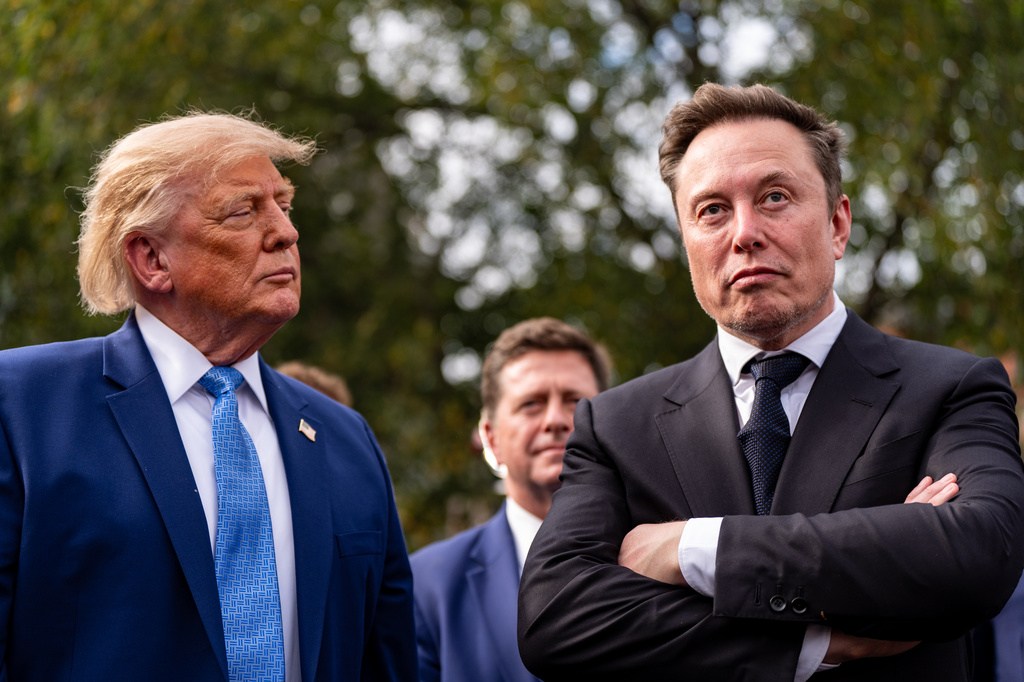
President Donald Trump and other senior U.S. officials have given a range of explanations, some of which appeared contradictory, for Ukraine’s SpaceX-related connectivity disruptions earlier this week.
The collection of Trump, Secretary of State Marco Rubio, Secretary of War Pete Hegseth, and Republican donor and SpaceX founder Elon Musk have offered a variety of confusing statements about who ultimately was the final decision-maker behind a choice that Ukrainians feel like resulted in civilian casualties.
This ongoing dispute began last week when Ukrainian leaders announced their access to Starlink and Starshield connectivity had been slowed. They use Starlink and the non-commercially available Starshield to communicate quickly and to launch and defend against drone attacks.
Marco Rubio:
Speaking from Mumbai, India, on Wednesday, Rubio said, “Suffice it to say that the reporting out there was that somehow the United States government was denying them something they needed in order to defend their country. That’s not true. That’s not accurate. And for leaders in Ukraine to continue to represent that is also not accurate.
“The bottom line is that [this] is governed by a private commercial contract as to the – how their stuff can be used and what speeds they allow it to be used at,” he said. “And so we’ll continue to engage on the matter, but the reporting initially was that somehow this was part of a directive from the United States Government, and I’m just here to tell you, as I’ve said repeatedly from the very beginning and the President has made clear, at no point did he say deny them the use of this system because I’m trying to punish them or teach them a lesson.”
Pete Hegseth:
Like Rubio, Hegseth said during an unrelated trip to Ohio on Tuesday, the department’s “policy hasn’t changed” with regard to Ukraine.
“There are terms of service that ultimately need to be complied to and that’s where Starlink has the option to make those decisions. But nothing’s changed from our view; we haven’t made any directives or anything like that,” he said.
Hegseth’s remarks appear to differ from the department’s stance regarding Anthropic, the company that created the artificial intelligence chatbot Claude. While Anthropic wanted to ensure the department formally agreed to specific use requirements, the Pentagon refused, arguing that it would not let private companies dictate to the military how it would use its equipment as long as it fell within legal guardrails.
Elon Musk:
Their comments appear to put the onus of this on SpaceX, or at least deflect the administration from the decision, though Musk has already denied that SpaceX played a role in the plan. The entrepreneur said last week Starshield is “owned and controlled by the US government” and “any limits on speed or usage are decided by the US military and ultimately POTUS.”
In prior posts, he has explained that Starlink is for civilian use and is not allowed to be used for offensive military operations, while Starshield was built for and is operated by the government.
“Once again, important to emphasize that there are two different systems: Starlink for civilian usage and Starshield that is built & operated for US govt,” he said in May. “We try hard to keep these separate.”
Donald Trump:
Last week, Trump told reporters on the White House lawn, “I don’t know if it was anybody, because it wasn’t me and I don’t think it was Elon.”
To add to the confusion over who was ultimately responsible for the decision, the Wall Street Journal reported it came from Musk, but even the outlet’s own sources disputed whether Musk acted unilaterally. Reuters, for its part, reported that the decision came from the White House, though it did not specify whether that meant the president ordered it or another White House official.
Volodymyr Zelensky:
Zelensky, in a Fox News interview on Wednesday morning, said Ukraine’s connectivity had slowed fivefold and warned that it had a direct impact on its counter-drone measures.
“The message came from government,” Zelensky said in a weekend interview on Meet the Press, pointing the blame on the administration. “I don’t know from whom, what cabinet, and et cetera. And I think it doesn’t work either way. I don’t know, really. But it’s not my opinion. It’s opinion of our generals, of our government, and of course my also opinion, that it was a message from American government to limit the speed. And technically, SpaceX did it.”
The Starshield debacle is happening at a time when the president is making other overtures to Russia, primarily related to oil sanctions relief, while intensifying his criticism of Zelensky. Over the last week or so, Trump has called on Zelensky to step down and accused him of trying to prolong the war.
Zelensky has also claimed that the Ukrainian military had not recently received early warning alerts about incoming attacks, which have also resulted in unnecessary casualties. He said in the Wednesday television interview that the early warnings have since been restored.
In the Meet the Press interview, the Ukrainian president said the United States has “this unique intelligence to tell our side when Russia uses ballistic missiles, and we didn’t get it during ballistic attacks during three days.”
The sanctions relief decision was widely criticized by members of both parties on Capitol Hill, as was the Starshield slowdown.
A bipartisan group of senators requested the Department of Defense Office of the Inspector General investigate the Starshield connectivity issue, while another group of lawmakers sought additional information from SpaceX. The Pentagon’s IG has not announced whether it would begin an investigation.
U.S. envoys Jared Kushner, who is Trump’s son-in-law, and Steve Witkoff, Trump’s longtime friend, have led the administration’s negotiating efforts, and they most recently met with Zelensky in Oslo, Norway, on Tuesday and in St. Petersburg, Russia, to meet with Russian leader Vladimir Putin.
‘CHANGES THE BALANCE OF LEVERAGE’: ZELENSKY TRIES TO HOLD ON AS TRUMP PRESSURES HIM TO CONCEDE
“These discussions were constructive, and will continue with trilateral talks between the United States, Russia, and Ukraine at the technical level,” Witkoff wrote on social media. “While there is still important work left to do, President Trump remains committed to seeing this war end and achieving a comprehensive, durable peace that will provide security and prosperity for generations to come.”
The episode has devolved the Trump-Zelensky relationship to its lowest point since Trump threw Zelensky out of the Oval Office last year.
The Starlink debacle raises broader concerns about overreliance on a single platform or weapon, a situation rife with the possibility of unintended consequences should there be any hiccups in the supply chain support or infrastructure of the platform.
The ongoing tension between Trump and Zelensky also pertains to recent Ukrainian strikes on Russian oil refineries, which the Trump administration has said is a contributing factor to rising energy prices globally and could hurt them in next month’s midterm elections. Zelensky offered to stop such attacks if the U.S. gave it the needed intelligence to target their missile launchers deep within Russian territory.
Continue reading...
[ H/T Washington Examiner ]