


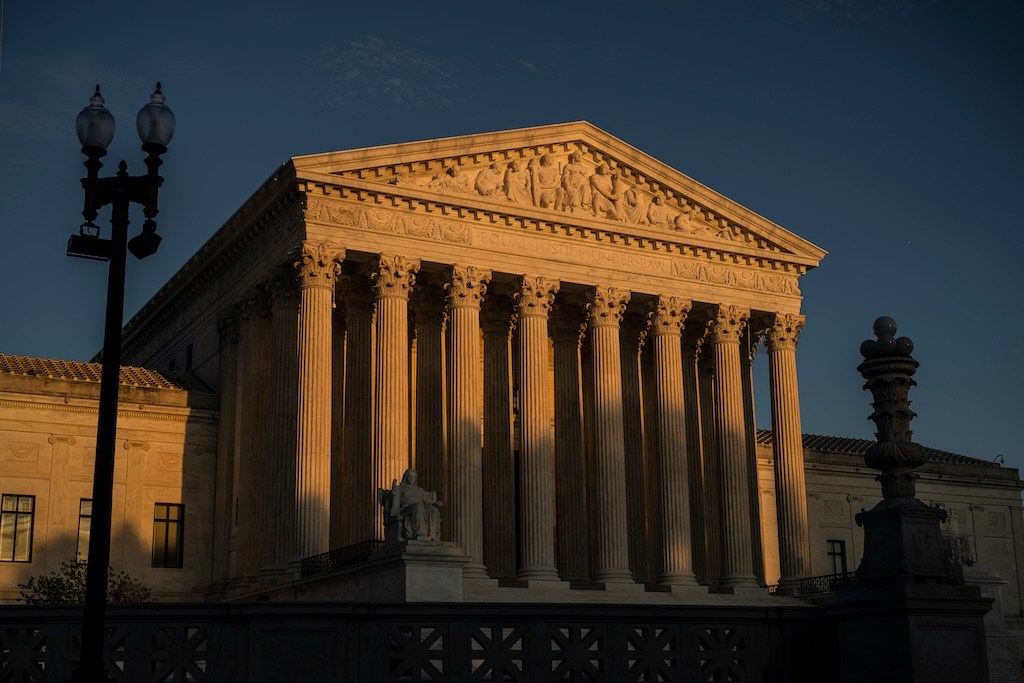
The Supreme Court declined on Monday to hear Lester Landrum’s case. His petition, No. 25-7530, sits on the Oct. 19 order list under “certiorari denied,” with no noted dissent and no explanation. I’m disappointed, and I’d rather say so plainly than dress it up.
Landrum asked a simple question. Can Congress make possession of a gun inside a Mississippi home a federal crime because the gun was manufactured elsewhere? According to his reply brief, that was the government’s only commerce evidence. Under Scarborough v. United States (1977), prosecutors need show only “the minimal nexus that the firearm have been, at some time, in interstate commerce.” At some time has no expiration date. A Massachusetts pistol that has sat 40 years in one Mississippi nightstand is still federal business. Call it the Hotel California rule. The gun can check out of commerce any time it likes, but it can never leave.
I own a small business, I’m raising three sons, and I’ve spent plenty of Saturdays explaining the rules of rugby to parents who didn’t ask. Thirty years of reading contracts for a living taught me that the Constitution is the one that matters most. It lets Congress “regulate Commerce … among the several States.” In Federalist No. 45, Madison promised the federal powers would be “few and defined.” A power that attaches to an object’s history and never lapses is neither.
This problem isn’t new to the Justices. In United States v. Lopez (1995), a 5–4 majority struck down a federal ban on guns near schools, warning that upholding it would require the court “to pile inference upon inference.” This June, in United States v. Hemani, Justice Clarence Thomas wrote separately that “Congress lacks the power to regulate the possession of firearms solely on the ground that they crossed state lines,” and that the question “merits a closer look in an appropriate case.” Landrum, it seems, wasn’t that case. The court didn’t say why.
Prosecutors did offer a reason. Their brief in opposition described a revolver found beside cocaine, scales, and a money counter while Landrum was on probation, and called him a poor vehicle. That’s a fair description of Landrum. It isn’t a description of the statute. Nor is a denial a ruling. Justice Felix Frankfurter wrote in Maryland v. Baltimore Radio Show (1950) that it “carries with it no implication whatever regarding the Court’s views on the merits.”
Another vehicle is already moving. On July 20, the full Fifth Circuit voted to rehear United States v. Squire on the Commerce Clause question alone, over a dissent from Judge Stephen Higginson warning it could “imperil much of the United States Code.” (Some of us read that as a selling point.) I wrote about Squire in August, a case that begins with a handgun in a New Orleans living room. In September, the court also agreed to rehear a second felon-in-possession case, Cordova. Whoever loses in New Orleans will petition, and that petition will arrive with a full court’s reasoning attached.
THE EXECUTIVE BRANCH NEEDS AN EXECUTIVE
Here’s what I’d ask for. The Justices should take the Fifth Circuit’s ruling, whichever way it goes. Congress shouldn’t wait on them, and should rewrite § 922(g) so a conviction requires possession tied to an interstate purchase, shipment, or trafficking offense. Mississippi, for one, already has its own felon-in-possession statute, and 89% of the 7,245 § 922(g) cases prosecuted federally in fiscal 2025 rested on a prior felony. Running guns across state lines would stay federal. Purely local possession would return to the states, where Madison put it.
Marcus Aurelius wrote that “that which is an obstacle on the road helps us on this road.” I’d put it in coaching terms. After a loss, I don’t blame the umpire. I make the team watch film. Thomas has been calling this play since his 1995 Lopez concurrence, where he wrote that the substantial effects test is “but an innovation of the 20th century.” The Fifth Circuit is about to add footage. I want the Justices to answer the question while a court that takes enumerated powers seriously is still the court deciding it. Majorities don’t come with warranties.
Jay Rogers is a financial professional with more than 30 years of experience in private equity, private credit, hedge funds, and wealth management. He has a Bachelor of Science in criminal justice from Northeastern University and has completed postgraduate studies at UCLA, the University of Pennsylvania, and Harvard. He writes about issues in finance, constitutional law, national security, human nature, and public policy.
Continue reading...
[ H/T Washington Examiner ]