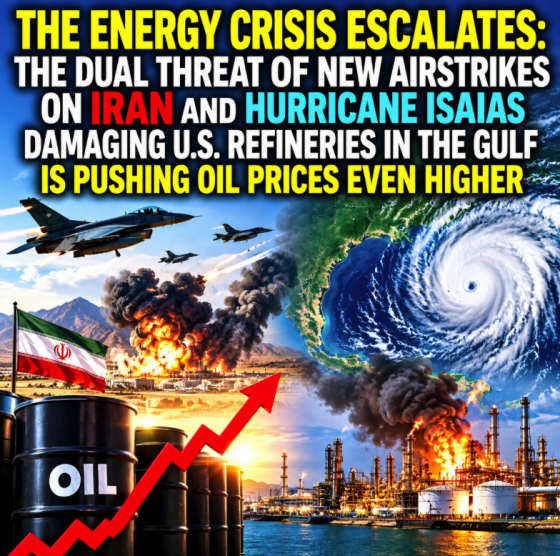
When you are working as hard as you can and you still don’t even come close to being able to pay all the bills, it can be absolutely soul crushing. Millions upon millions of Americans are living lives of quiet desperation as they attempt to scrape by from month to month. Many of them have a really hard time sleeping at night because the financial pressure never ends. This is the result of decades of bad policies from our leaders in Washington, and the cost of living is only going to go higher. As you will see below, the global energy crisis continues to escalate, and that means that just about everything that we purchase on a regular basis will soon be even more expensive.
Right now, lines at food banks all over America are the longest that they have been since the early days of the last pandemic.
But we don’t have a pandemic to blame for the long lines this time around.
At a food bank in West Virginia on one recent morning, vehicles were lined up for half a mile
before the sun even came up…
Bill Likens stared down a half-mile-long line of cars that started forming before the sun came up over the Appalachian Mountains. He had one job: figure out how to feed them all.
Some had driven more than 30 miles in aging cars and trucks that wheezed down flood-prone roads through the steep hills. They sat silently as the temperature rose into the 80s, their vehicles turned off with no air conditioning to preserve gas, waiting hours for a few boxes of food.
Aided by a cane, Likens, 51, surveyed the pallets being unloaded off a semitruck that arrived that morning. He counted cartons of eggs and sacks of potatoes to calculate how much each waiting car could get — an algorithm of hunger he is constantly trying to solve.
More Americans are seeking help from food banks because grocery prices have soared to absurd heights.
If you can still afford to eat three meals a day, you should be very grateful, because there are millions of Americans that cannot.
73-year-old Joanne Girvin has lost 20 pounds during the past year because she can’t afford to buy enough food, and some nights
she just sits down and cries as she tries to figure out what to eat…
Girvin, 73, used to own a restaurant nearby and is now living off Social Security, which is barely enough to cover her monthly bills. Already on a tight budget, she has no extra room for $4 gallons of gas or a rising electric bill. That has left one place to cut — her food.
She said she has lost 20 pounds over the past year because she has been eating less. The night before, she’d eaten canned deer meat left over from last fall’s hunting season with rice and gravy. Some nights she eats a bag of frozen broccoli with butter.
“Sometimes I just sit down and cry when I’m trying to figure out what you’re going to eat out of a can or something because you don’t have no meat,” Girvin said as her eyes welled with tears. “It’s just really bad, this economy. It’s horrible.”
This is what life is like in West Virginia in 2026, and it has been this way for many years.
Of course it isn’t just residents of West Virginia that are struggling.
Food banks all over the country
are reporting increased demand this year…
The challenges extend far beyond Appalachia. An NBC News survey of 48 of the largest food banks across 35 states and Washington, D.C., found that nearly three-quarters said more people are showing up at their doors over the past year, from workers on their lunch breaks to older adults overwhelmed with medical expenses. At the same time, more than 80% said the food and funding they received through the U.S. Department of Agriculture had dropped and they were struggling with higher fuel costs for transporting food.
In Maine, Good Shepherd Food Bank said the USDA cut the amount of food it received from 13 million pounds to 9 million pounds in one year. A Michigan food bank, Forgotten Harvest, said it’s handing out less food to make sure there is enough to go around: one bag of potatoes instead of two, two tubs of yogurt as opposed to six.
If you are like most of us, nearly all of your bills have gone up over the past 12 months.
If your income has not been going up at the same rate, you are falling behind.
Once upon a time, if you earned $100,000 or more a year you were living very comfortably.
But now even many of those that are earning $100,000 a year
are really struggling…
And though $100,000 is more than double the national median salary of $46,960, financial stress remains for many six-figure earners.
In fact, those making $100,000 or more have now adopted the shopping habits of lower-income households as they struggle with affordability, Dollar General CEO Todd Vasos said at a recent retail conference. That remark has some consumers second-guessing the value of such a salary.
“I think a lot of people got to six figures and thought, ‘Wait, why doesn’t this feel like as much money as I expected?’” Steve Sexton, owner of financial firm Sexton Advisory Group, told The Independent in an email.
For decades, our politicians have been spending way too much money and have been destroying the value of our currency.
Now we are stuck with the consequences.
Unfortunately, our cost of living crisis is going to get even worse because the global energy crisis is only going to intensify.
On Saturday, the Houthis hit King Khalid International Airport in Saudi Arabia really hard.
12 people died as a result of that attack, and 309 were injured…
Saudi Arabia said Sunday it would “respond decisively” against the Iranian-backed Houthi rebels in Yemen a day after a strike on Riyadh’s international airport brought the expanding Middle East conflict home for the Saudi capital and its residents.
The attack, which left 12 dead and 309 injured and came without warning, revealed the vulnerability of the U.S. ally and the ramifications of the Trump administration’s reluctance to openly help fight the Houthis more than seven months into Washington’s war with Iran. Riyadh’s airport is the country’s second largest for civilians and is frequently used by royals and visiting dignitaries, including President Donald Trump in his last visit to the kingdom.
The United States is providing Saudi Arabia with intelligence support, analysts and U.S. officials say. But the administration has so far stopped short of the direct military assistance that officials in Saudi Arabia and its allies in Yemen’s internationally recognized government have sought.
The Saudis responded with a huge wave of airstrikes, and then the Houthis struck King Khalid International Airport
again on Sunday…
A passenger terminal at the international airport in Riyadh, Saudi Arabia, was attacked again on Sunday, one day after a deadly strike on the Riyadh airport killed at least 12 people, including a U.S. citizen, and wounded hundreds of others.
The second attack comes as Yemen’s Houthi group said they carried out at least four operations targeting King Khalid International Airport in Riyadh since Saturday.
Saudi’s civil aviation authority said the latest Riyadh airport attack caused injuries and that damage assessments are underway.
In addition to hitting the airport, the Houthis
also attacked a number of Saudi Arabia’s most important energy production facilities…
Houthi military spokesman Brig. Gen. Yahya Saree said on Telegram that the attacks are in response to “brutal Saudi aggression against our country and our people,” CBS News partner BBC News reported. He claimed Saudi Arabia launched more than 120 airstrikes in the past 24 hours in Houthi-controlled territory in Yemen.
The Houthis said their other targets included the Shugadam gas facility, which belongs to Saudi’s national petroleum and natural gas company Aramco, the Tanajib oil refinery, and King Fahd International Airport in Dammam, the BBC reported.
It could take months or even years for the Saudis to repair or rebuild all of the energy infrastructure that has been damaged by the Houthis in recent weeks.
Meanwhile, the Iranians have really stepped up the pace of tanker attacks in the Strait of Hormuz
this month…
There have been nearly a dozen attacks on ships in the Strait of Hormuz so far this month — as it emerged that some Western officials are sounding the alarm on Iran’s military capacity despite President Donald Trump’s insistence the country’s military has been destroyed.
Iran has plenty of ballistic missiles and can speedily ramp up its stockpile, even after more than seven months of bombing by the United States, anonymous Western officials told Bloomberg.
Word that Iran’s ability to strike back is still strong comes as reports show 11 ships in Strait of Hormuz or nearby, off the coast of Oman, so far in October, according to Fox News, which cited maritime officials in the United States and the UK.
Also, it appears that the Iranians have also now mined the U.S.-backed southern corridor through the Strait of Hormuz near the coast of Oman.
A very large tanker traveling through that corridor hit a mine
on Saturday, and another tanker traveling through that corridor hit a mine
on Sunday.
Over the past couple of months tankers had snuck a lot of oil through the Strait of Hormuz using that corridor, but at this point the Iranians have decided to crack down really hard.
So what this means is that global energy prices are poised to jump even higher.
And that is really bad news because the price of diesel in the U.S. is already
about 70 percent higher than last year…
The national average for diesel stood at roughly $6.32 per gallon Monday, according to AAA — up from about $3.69 at the same time last year, a jump of more than 70%. The surge has also eclipsed the previous record of $5.816 per gallon, set in June 2022 under former President Joe Biden as Russia’s invasion of Ukraine sent global energy prices soaring.
Even if you don’t have any diesel vehicles, this is going to affect you directly.
Our trucks, our trains and our tractors run on diesel.
It is inevitable that higher diesel prices will get passed along to U.S. consumers, and the cost of living will increase as a result.
The most painful chapters of the global energy crisis are ahead of us, and the entire global economy will be thrown into a state of turmoil.
A lot of people out there didn’t believe that things would ever get this bad, and those skeptics will be completely shocked by what is coming next.
Michael’s new book entitled “10 Prophetic Events That Are Coming Next” is available in paperback and for the Kindle on Amazon.com, and you can subscribe to his Substack newsletter at michaeltsnyder.substack.com.
 About the Author:
 Michael Snyder’s new book entitled
“10 Prophetic Events That Are Coming Next” is available
in paperback and
for the Kindle on Amazon.com. He has also written nine other books that are available on Amazon.com including
“Chaos”,
“End Times”,
“7 Year Apocalypse”,
“Lost Prophecies Of The Future Of America”,
“The Beginning Of The End”, and
“Living A Life That Really Matters”. When you purchase any of Michael’s books you help to support the work that he is doing. You can also get his articles by email as soon as he publishes them by subscribing to his
Substack newsletter. Michael has published thousands of articles on
The Economic Collapse Blog,
End Of The American Dream and
The Most Important News, and he always freely and happily allows others to republish those articles on their own websites. These are such troubled times, and people need hope. John 3:16 tells us about the hope that God has given us through Jesus Christ: “For God so loved the world, that he gave his only begotten Son, that whosoever believeth in him should not perish, but have everlasting life.” If you have not already done so, we strongly urge you to invite Jesus Christ
to be your Lord and Savior today.
The post
The Rising Cost Of Living Is Absolutely Crushing U.S. Households – And Here Is Why It Is About To Get Even More Painful appeared first on
The Economic Collapse.
Continue reading...
[ H/T The Economic Collapse Blog ]