
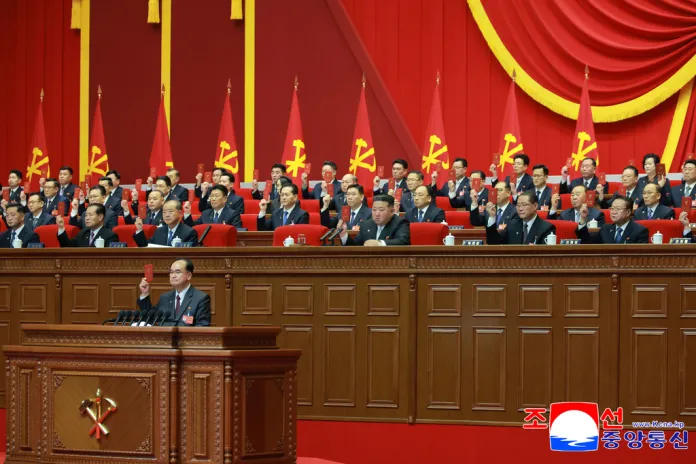
On Oct. 10, North Korea marked the 81st anniversary of the founding of the Workers’ Party of Korea. Unlike last year’s large-scale military parade for the party’s 80th anniversary, which drew senior foreign dignitaries, this year’s event in Pyongyang featured celebratory performances rather than a military parade. Leader Kim Jong Un attended with his wife, Ri Sol Ju, and his daughter, Kim Ju Ae, but delivered no public speech or separate message.
At first glance, it was a subdued anniversary. Yet the smaller scale of the event does not necessarily mean that the political message North Korea seeks to convey has weakened. Instead, the occasion offers a useful lens through which to examine how the regime defines itself: consolidating domestic unity through loyalty to the party, expanding its diplomatic room for maneuver through relations with China and Russia, and presenting nuclear weapons as a symbol of national survival and independence.
In North Korea’s political system, the Workers’ Party is more than a ruling party. It serves as the institution that interprets the nation’s history and achievements, defines the direction society should follow, and legitimizes the authority of its leader. The party’s founding anniversary, therefore, commemorates not only its establishment but also the political order the regime insists must endure.
In the lead-up to this year’s anniversary, North Korean state media portrayed the party as the driving force behind postwar reconstruction, industrialization, and national development. This narrative connects the country’s achievements to party leadership and reinforces the demand for loyalty from the population. To preserve its legitimacy amid continuing economic difficulties and international isolation, the leadership must sustain the belief that the party is responsible not only for the country’s past and present but also for its future.
Domestic unity, however, cannot by itself transform a country’s strategic environment. North Korea needs external partners to ease its isolation and expand its economic and diplomatic options. In this respect, China and Russia play important roles.
China remains one of North Korea’s principal trading partners, while relations with Russia have expanded in recent years, particularly through military and strategic cooperation. Ties with both countries give Pyongyang additional diplomatic space and more options in dealing with the United States, South Korea, and other Western countries. The deepening relationship with Russia, in particular, reflects Pyongyang’s efforts to use shifts in the international environment to increase its strategic value.
Yet cooperation with China and Russia does not replace North Korea’s long-standing claim to independence. The regime seeks to maintain that it retains control over major national decisions even as it works with external partners. It wants to benefit from outside support without being defined simply as a country dependent on others.
This is where the political significance of nuclear weapons becomes crucial. For North Korea, its nuclear arsenal is more than a means of deterring military attack. The leadership has repeatedly presented nuclear weapons as symbols of national dignity, independence, and international standing. Its identity as a nuclear-armed state reinforces the claim that North Korea can determine its own security policy without submitting to external pressure.
This logic matters when assessing the country’s nuclear policy. If nuclear weapons were viewed solely in terms of military utility, their role and potential price could be discussed in diplomatic negotiations. But the challenge becomes more complicated when the nuclear arsenal is embedded in the regime’s legitimacy and national identity. Giving up nuclear weapons could mean more than dismantling a weapons system; it could require the leadership to redefine a narrative of national achievement and independence that it has promoted for years.
This symbolic role does not mean that North Korea could never abandon its nuclear weapons. It does mean, however, that any assessment of its nuclear policy or the prospects for future negotiations must account for more than military calculations. The role nuclear weapons play in domestic politics and national identity must also be considered.
These three elements are not separate from one another. Loyalty to the party sustains domestic political cohesion. Cooperation with China and Russia broadens North Korea’s external options. Its nuclear arsenal underpins the strategic autonomy it claims to possess. Together, they help the regime construct an image of a state willing to engage with the outside world while refusing to surrender control over its political system or nuclear policy.
The absence of a large military parade this year is not, by itself, evidence that North Korea’s strategy has changed. Nor can the slogans used during an anniversary reveal how autonomous the country actually is. There may always be a gap between a state’s declared independence and the extent to which it relies on outside powers.
Even so, the political direction North Korea is presenting deserves attention. It would be difficult to conclude that Pyongyang wants complete isolation from the international community. A more plausible interpretation is that it seeks recognition as a state that can cooperate with countries it needs and make use of those relationships while retaining the final say over its political system and nuclear arsenal.
OPINION: SEOUL KEPT THE DOOR OPEN. KIM JONG UN JUST SLAMMED IT SHUT
To understand North Korea’s strategy, therefore, it is not enough to ask with whom it cooperates. We must also ask what it seeks to protect through that cooperation. China and Russia are important partners, but neither can substitute for North Korea’s own objectives. At the center of those objectives are the preservation of party rule, the reinforcement of regime legitimacy, and the defense of its status as a nuclear-armed state.
Does the independence North Korea claims mean complete freedom from the outside world? Or does it mean engaging with that world and drawing on its resources while insisting that no outside power can constrain its choices? The Workers’ Party anniversary did not directly answer these questions. But examining the three pillars of party loyalty, diplomatic cooperation, and nuclear power makes it somewhat clearer what kind of state North Korea wants the world to recognize.
Park Joonhye is a research fellow at the Institute for Far Eastern Studies, Kyungnam University. She holds a Master of Arts and a doctorate in politics and unification studies from the University of North Korean Studies. Her research focuses on North Korean politics, nuclear policy, society and culture, and unification discourse. She has published peer-reviewed research and writes regularly on North Korea and Northeast Asian security.
Continue reading...
[ H/T Washington Examiner ]