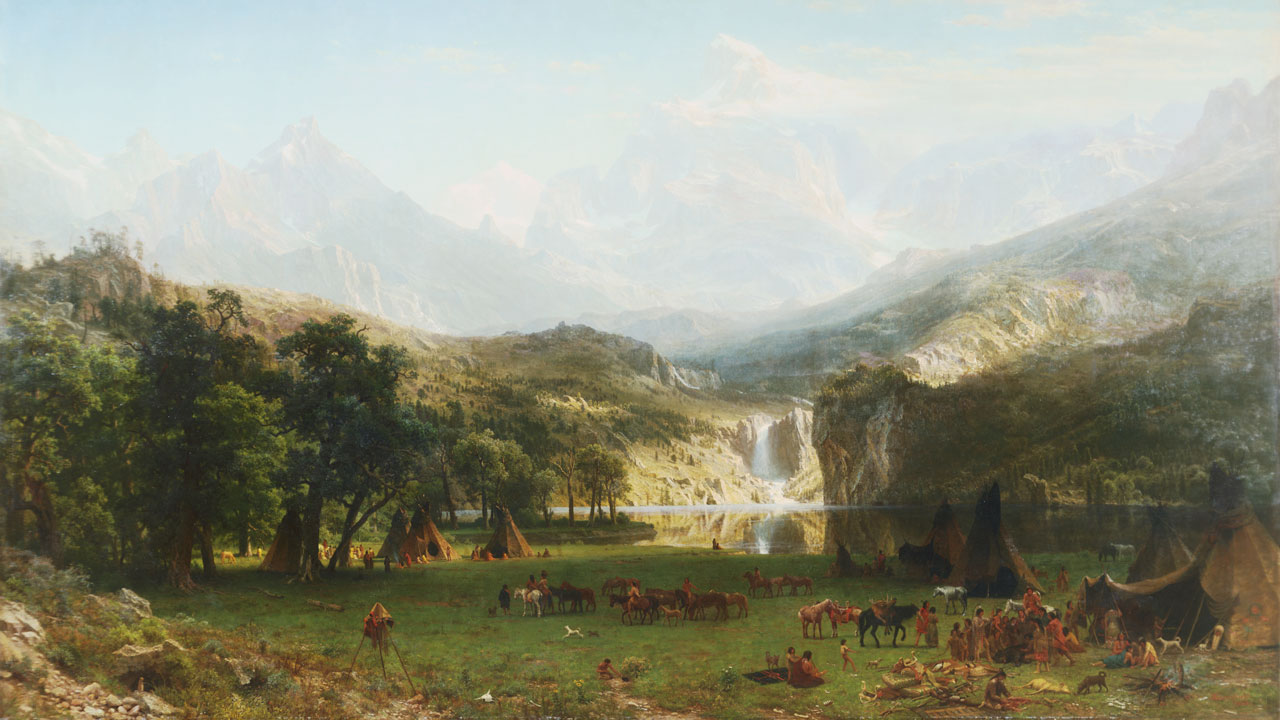
Col. Frederick Lander’s men, sent west to build a wagon road for emigrants to the American west, set off fireworks to mark the 83rd anniversary of American independence on the night of July 3, 1859. The Shoshone camped alongside them on the banks of the Green River in what is now Wyoming watched in astonishment, then joined the dancing around the campfires. For one evening, settler and native shared a celebration in a majestic landscape that seemed to promise plenty for everyone.
Among the revelers was a young painter named Albert Bierstadt, whom Lander had recruited to join the expedition on the theory that there was little point in building a road no one wanted to travel because they were terrified of what might be at the end. The colonel, although a man of action who had earned the nickname “Old Grizzly” in honor of a successful encounter with a large bear, was also a man of letters who wanted to encourage the development of the arts in the new world.
Bierstadt diligently sketched and photographed extensively to give himself building blocks for the paintings he would do when he returned to New York to entice settlers to head west. He could not know that within two years the country would be at war with itself, that he would follow Lander into the Virginia countryside to sketch Union sharpshooters, or that Lander himself would be dead by March 1862 from a gunshot wound suffered in the war.
Back in his studio Bierstadt began his “great picture,” “The Rocky Mountains, Lander’s Peak”—six feet high and 10 feet wide, the largest canvas he had ever attempted. He moved the Shoshone encampment to the foot of a towering summit he named for his fallen friend, turned the river into a mountain-fed lake, and painted out every trace of the survey party. What emerged was not a factual record but an idealized vision: the American West as a land of almost limitless abundance, waiting for enterprising settlers to arrive.
The painting went on view in Boston in the spring of 1863, one of the darkest years in the life of the republic, and caused a sensation. Crowds paid a quarter apiece to see it. That summer brought Gettysburg. And on Oct. 3, President Abraham Lincoln issued a proclamation setting apart the last Thursday of November as a national day of Thanksgiving.
Read the proclamation alongside Bierstadt’s canvas, and the two seem to be in conversation. Lincoln began not with the war but with “the blessings of fruitful fields and healthful skies.” He noted that the mines, “as well of iron and coal as of the precious metals,” had yielded more abundantly than ever, and that the nation could look forward to years “with large increase of freedom.” President and painter alike looked past the carnage to the bounty of the continent, and both insisted that bounty was a reason for hope rather than despair.
Neither was naive. Lincoln acknowledged a civil war “of unequaled magnitude and severity,” asked Americans to pray that the Almighty would “heal the wounds of the nation.” And Bierstadt’s idyll was not realized for everyone. Lander had hoped settlers and Indians could live side by side; but the decades that followed brought violence and dispossession instead. An honest Thanksgiving makes room for that history, just as it makes room for the Wampanoag alongside the Pilgrims at the original Thanksgiving.
But the deeper lesson of 1863 is that Americans chose to give thanks precisely when it was hardest to do so. In April 1864, Bierstadt’s painting hung beside his teacher Emanuel Leutze’s 1851 “Washington Crossing the Delaware” at New York’s Metropolitan Fair, raising money for Union Army hospitals. Leutze’s heroic past and Bierstadt’s hopeful future, displayed together in a nation still at war, made a simple but powerful argument: the American experiment had not been a mistake, and it was worth saving.
This Thanksgiving closes the 250th year of that experiment. We are, by most measures, a divided country—though nothing like the country that bled at Antietam and Gettysburg. Our fields remain fruitful, our skies largely healthful, and the abundance Bierstadt imagined has been realized beyond anything he could have dreamed. The question his canvas poses is whether we can still see it—whether we can look out at our own landscape and recognize, as Lincoln did in the worst of times, that our blessings outweigh our grievances.
“The Rocky Mountains, Lander’s Peak” hangs today in the Metropolitan Museum of Art. It is worth a visit this holiday weekend, not as a factual record of the West, which it never was never meant to be, but as a reminder of what a wounded nation chose to believe about itself. Bierstadt painted the promise of what America could be. Lincoln proclaimed a day to give thanks for it. Two and a half centuries on from the original experiment, we are the heirs of both.
Continue reading...
[ H/T The Daily Signal ]