






Guest Post by John Walter
Editor’s Note
This account draws upon declassified test records from the Defense Nuclear Agency, congressional testimony from the Commission to Assess the Threat to the United States from Electromagnetic Pulse (EMP) Attack (2001–2017), technical assessments from the Federal Energy Regulatory Commission and the Department of Energy, and verified historical documentation from the National Archives and Records Administration. All named individuals held the positions described; all technical specifications appear in public records or declassified documents available through the Government Attic repository.
Distinctions between established fact, informed analysis, and informed speculation are clearly marked throughout. No dialogue has been invented; no scenes fabricated; no characters created for narrative convenience. The distinction between what happened, what could have happened, and what remains uncertain is maintained with strict editorial rigor.
Introduction: The Morning the Lights Died in Paradise
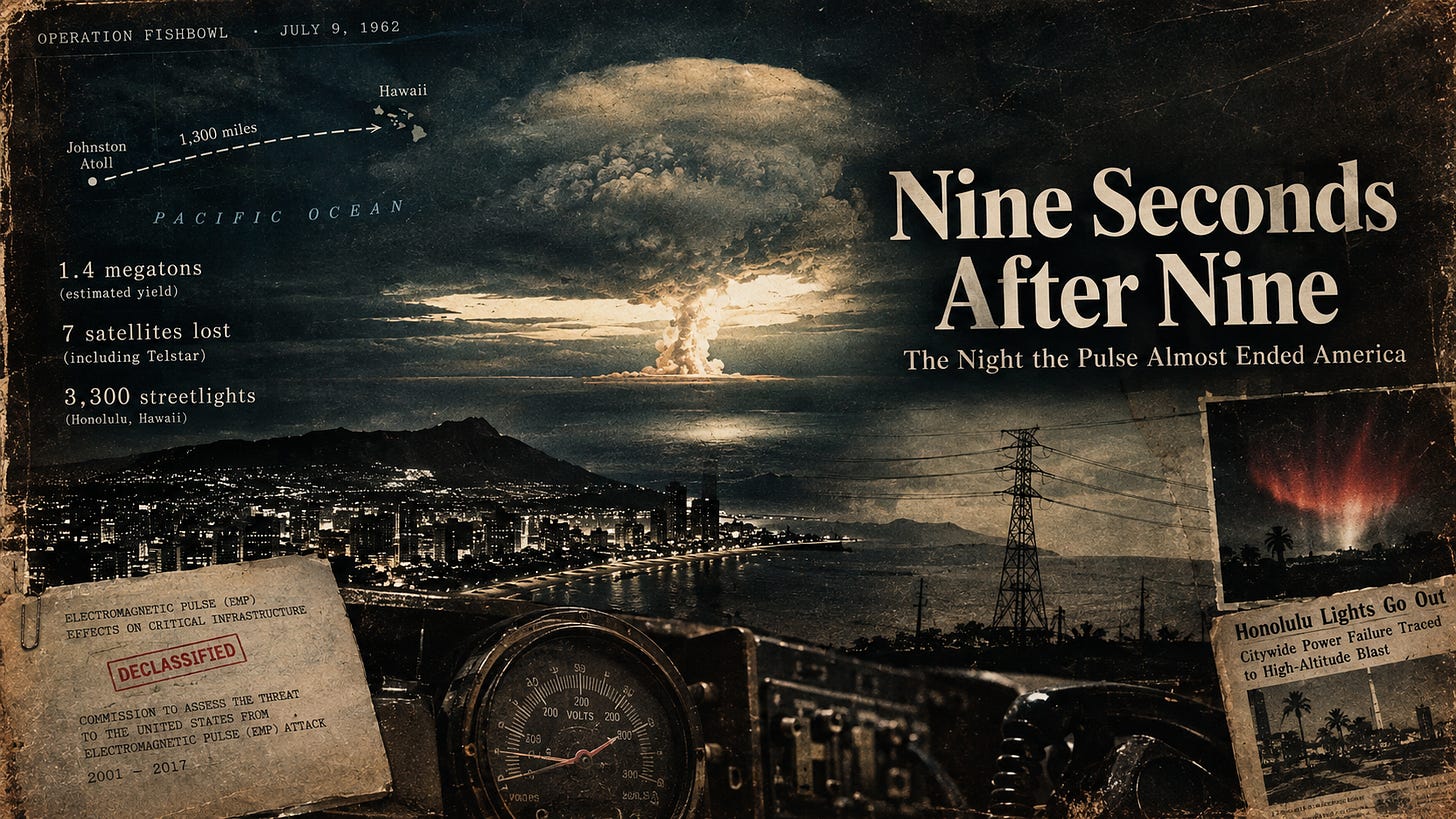
At 09:00:09 Coordinated Universal Time on July 9, 1962, a Thor DM-21 rocket motor ignited on Launch Pad 1 at Johnston Atoll, a coral outpost thirteen hundred miles southwest of Honolulu. The missile carried a W49 thermonuclear warhead with a designed yield of 1.4 megatons—roughly one hundred times the explosive force that destroyed Hiroshima. Forty-nine seconds after launch, at an altitude of 400 kilometers above the Pacific Ocean, the device detonated.
The fireball never touched Earth. No crater formed on the atoll below. No shockwave rattled the corrugated metal huts where technicians waited, shielding their eyes from the tropical sun. The explosion occurred above the discernible atmosphere, in the ionosphere, where the air is so rarefied that molecules exist as individual particles rather than as a coherent gas. From the launch pad, the detonation was invisible—a theoretical event marked only by instruments.
But 1,400 kilometers away, in Honolulu, the effects arrived milliseconds later, traveling at the speed of light. Streetlights along King Street extinguished simultaneously—not flickered, not dimmed, but died instantly, their circuits overwhelmed by electrical energy induced in power lines that had never been designed to carry such currents. At the University of Hawaii’s Manoa campus, radiation detectors designed to measure background gamma radiation spiked simultaneously, recording levels that suggested a local source despite the distance. Telephone service between Oahu and neighboring islands stuttered and failed. Microwave relay stations—then the backbone of Pacific communications—suffered automatic shutdowns as their protective systems interpreted induced currents as catastrophic equipment faults. Burglar alarms triggered without proximate cause, their sensors overwhelmed by electrical noise. And above the Hawaiian islands, curtains of red and white light danced in the upper atmosphere—auroral displays at 21 degrees north latitude, where such phenomena had no business appearing, ionized air glowing in the pre-dawn darkness like a warning written in neon.
Technicians at the Hawaiian Electric Company initially attributed the streetlight failures to routine maintenance issues, perhaps a voltage regulator malfunction or a coincidental transformer fault. It was only after patterns emerged—simultaneous failures across multiple circuits, correlations with the precise moment of detonation recorded at Johnston—that the cause became clear. Starfish Prime, as the test was designated, had demonstrated, inadvertently but conclusively, that a nuclear explosion need not touch ground to damage infrastructure. Distance offered no protection. Fallout was irrelevant. The pulse required no mass casualties to achieve strategic effect—only the instantaneous collapse of electrical continuity.
Seven satellites died in the weeks following the test, including Telstar, launched just one day before Starfish Prime and destroyed by the artificial radiation belts—enhanced Van Allen belts of trapped charged particles—that the detonation created and that persisted for months, circling the Earth like radioactive halos. But the electromagnetic effects received less immediate attention than the nuclear debris or the satellite losses. The knowledge of what had happened to Honolulu’s streetlights entered classified archives and specialized journals, visible to weapons physicists and invisible to the utilities whose infrastructure had just been revealed as fragile.
William R. Graham would later spend decades contemplating that morning. A physicist by training, he had not been present at Johnston Atoll in 1962, but he would come to understand the implications of that test more thoroughly than perhaps any other American official. As chairman of the EMP Commission established by Congress in 2001, Graham would oversee the production of reports describing how a similar event above the continental United States might affect infrastructure that had grown exponentially more complex—and more dependent—since that July morning. The commission’s findings, available in public archives, describe cascading failures across the North American grid: the simultaneous incapacitation of hundreds of extra-high-voltage transformers, manufacturing lead times exceeding eighteen months, potential restoration periods measured in months or years rather than days.
But in 1962, these implications were not yet apparent. The test continued as planned. The radiation belts were monitored, their persistence noted, their effects on satellites catalogued. The streetlights of Honolulu were repaired within hours. The telephone service was restored. The microwave links were checked and rebooted. Life continued, and the knowledge of vulnerability was filed away—demonstrated once, then largely forgotten, as the infrastructure grew more complex, more interconnected, and more essential around it.
What follows is an examination of that vulnerability: how it was discovered, how it was understood, how it was neglected, and what it means for the civilization that depends upon the invisible flow of electrons through wires.
What the Evidence Reveals
• The Physics of the Pulse: How a nuclear detonation 400 kilometers above the Pacific generated electromagnetic effects detectable 1,400 kilometers away, and why the same physics threaten continental infrastructure today.
• The Transformer Problem: Why the 2,500 extra-high-voltage transformers that form the backbone of the North American grid represent irreplaceable chokepoints, with manufacturing lead times of 12–24 months and 97% dependence on foreign production.
• The Commission’s Warning: How the EMP Commission (2001–2017), chaired by William R. Graham with members including John S. Foster Jr. and executive director Michael J. Frankel, documented catastrophic vulnerability in reports that remain largely unimplemented.
• The Strategic Environment: How ballistic missile proliferation, particularly demonstrated by North Korea in 2017, and the development of non-nuclear EMP weapons have transformed a theoretical Cold War threat into a contemporary strategic concern.
The Atoll and the Test
Johnston Atoll consists of four small islands built from coral reef accretion, totaling less than three square kilometers of land area, surrounded by ocean nearly a mile deep. The United States claimed the atoll in 1857 under the Guano Islands Act, and it served various military purposes through the twentieth century: a refueling station, a chemical weapons storage site, a launch facility for atmospheric nuclear tests. By 1962, it was one of the primary sites for Operation Fishbowl, a series of high-altitude nuclear tests designed to understand the effects of electromagnetic phenomena on ballistic missile reentry vehicles and command-and-control systems.
The Thor missile that launched on July 9 was a DM-21, a single-stage liquid-fueled rocket derived from the Intermediate Range Ballistic Missile (IRBM) deployed by the United States in the United Kingdom. The DM-21 used liquid oxygen and RP-1 kerosene, propellants that required careful temperature management in the tropical heat. Technicians had spent the night of July 8 fueling the missile, checking seals, verifying the trajectory calculations that would carry the warhead to precisely 400 kilometers altitude—high enough to ensure no fireball touched the Earth, low enough to maximize electromagnetic coupling with the atmosphere.
The W49 warhead was a thermonuclear device designed by the Lawrence Livermore National Laboratory, utilizing a two-stage radiation implosion design. The primary stage used conventional explosives to compress a plutonium pit, initiating fission; the secondary stage used the radiation from the primary to compress a lithium deuteride fuel, initiating fusion. The designed yield of 1.4 megatons made it one of the most powerful devices tested by the United States up to that time.
The test protocol called for detonation at 09:00:09 UTC, a timing chosen for optimal visibility from tracking stations and minimal interference with other operations. The Thor’s guidance system was programmed to release the warhead at the apogee of its trajectory, after which the missile would continue on a ballistic path while the warhead remained stationary relative to the ground for the microseconds required for the fission-fusion sequence to complete.
When the detonation occurred, the energy released was 5.9 petajoules, equivalent to the annihilation of approximately 0.07 kilograms of matter converted entirely to energy according to Einstein’s mass-energy equivalence. The temperature at the detonation point reached approximately 100 million degrees Kelvin, comparable to the core of the sun. But these numbers, while impressive, describe only the energy released, not its effects.
The critical effect was electromagnetic. The gamma radiation produced by the nuclear reaction—high-energy photons traveling at light speed—interacted with atmospheric molecules in the ionosphere, primarily nitrogen and oxygen. Through a process called Compton scattering, these gamma rays knocked electrons from their atomic orbits, creating a flood of free electrons and ionized atoms. Because the Earth’s magnetic field lines run roughly north-south at the longitude of Johnston Atoll (approximately 169 degrees west), these free electrons were constrained to spiral along the field lines, creating a coherent oscillating current that radiated electromagnetic energy downward toward the surface.
This Compton current, as it is known, produced an electromagnetic pulse that propagated through the ionosphere as a wave, traveling at the speed of light, reaching Honolulu 4.7 milliseconds after the detonation. The pulse lasted approximately 1 microsecond at peak intensity, but that microsecond was sufficient to induce voltages of hundreds or thousands of volts in any conductor long enough to act as an antenna. Power lines, telephone cables, railroad tracks, metal fences, and the structural steel of buildings all received induced currents that overwhelmed their design limits.
In Honolulu, the effect was selective but significant. The Hawaiian Electric Company operated a grid that was, by mainland standards, relatively simple: generating stations on Oahu, distribution networks across the island, undersea cables connecting to neighboring islands. The streetlights that failed were primarily mercury vapor lamps on King Street, Beretania Street, and Ala Moana Boulevard, circuits that ran for miles and thus presented sufficient length to receive the induced currents. The lamps themselves were not destroyed; their filaments remained intact. But the ballasts—the transformers that regulated current to the lamps—were overwhelmed, their internal wiring fused by the transient overvoltage.
Telephone service failed because the crossbar switches then in use relied on delicate electromechanical relays that interpreted the induced currents as signal noise, causing them to disconnect or jam. The microwave links—TD-2 and TH systems operating at frequencies between 2 and 12 gigahertz—suffered automatic shutdowns when their receivers detected power levels far exceeding their dynamic range, triggering protective circuits that required manual reset.
The auroral displays were perhaps the most visible effect. Normally confined to polar regions where the Earth’s magnetic field lines intersect the atmosphere at steep angles, auroras occur when charged particles spiral along field lines and collide with atmospheric gases, exciting them to emit light. The Starfish Prime detonation injected sufficient charged particles into the magnetosphere to create artificial auroras visible from Hawaii to New Zealand, red and white curtains hanging in the sky for hours after the detonation, beautiful and entirely unnatural.
Edward Teller, father of the hydrogen bomb and director emeritus of Livermore, reportedly followed the test results with interest, though he was not present at Johnston. The physicists who had designed the W49 understood the theoretical possibility of electromagnetic effects, but the magnitude of the pulse exceeded predictions. The RAND Corporation had conducted theoretical analyses of high-altitude nuclear effects in the late 1950s, but the empirical data from Starfish Prime provided the first real-world confirmation of the magnitude of threat.
The test was one of five conducted during Operation Fishbowl. Starfish Prime was the third attempt; two previous launches had failed due to radar tracking issues and range safety aborts. The success of the July 9 launch provided the data sought by the Defense Atomic Support Agency, but it also provided something unintended: a demonstration of civilizational vulnerability that would remain largely unaddressed for six decades.
The Grid and Its Transformers
To understand what Starfish Prime revealed, one must understand what had been built in the decades preceding it, and what has been built since. The North American power grid is the largest machine ever constructed by humans, a continent-spanning network of generation, transmission, and distribution that operates as a single synchronized system across the United States, Canada, and portions of Mexico.
The grid consists of approximately 450,000 miles of high-voltage transmission lines operating at voltages from 69 kilovolts to 765 kilovolts, connecting 55,000 substations to 5,800 major power plants and millions of distributed generation sources. These transmission lines are supported by towers and poles numbering in the millions, carrying current across deserts, mountains, and plains. The system operates at a synchronized frequency of 60 hertz, maintained within tight tolerances by automatic governors and human operators working from control centers scattered across the continent.
At the heart of this system stand the extra-high-voltage transformers, specifically those handling 345 kilovolts and above. There are approximately 2,500 of these units in service across the United States, each weighing between 100 and 400 tons, each filled with 10,000 to 50,000 gallons of insulating and cooling oil, each containing copper windings and steel cores worth millions of dollars. These transformers are not manufactured to stock; they are built to order by a small number of companies worldwide—Siemens and ABB in Europe, Hyundai and Hyosung in South Korea, CG Power and Siemens India in Asia.
The manufacturing process takes 12 to 24 months under normal conditions. The steel cores must be laminated and annealed to precise specifications to minimize eddy current losses. The copper windings must be insulated with paper and varnish, then dried under vacuum for weeks to remove moisture. The tanks must be welded, pressure-tested, and fitted with radiators, pumps, and bushings. The units are too large for air transport; they move by specialized heavy trucks and ocean-going vessels, requiring intact roads, bridges, and ports.
In 1962, the grid contained hundreds of these transformers, not thousands. Manufacturing capacity existed within the United States; Westinghouse and General Electric maintained facilities capable of producing large power transformers domestically. The grid was less centralized, less synchronized, less dependent upon precise voltage regulation. Recovery from the Honolulu streetlight failures took hours because the damage was limited to secondary distribution systems, not the primary transmission infrastructure.
By 2024, the situation has transformed. The grid has grown denser, more interconnected, more essential. The 2,500 extra-high-voltage transformers currently in service represent chokepoints of civilizational significance. Their loss would not merely cause inconvenience; it would initiate a cascade of failures that would render modern urban existence impossible within days.
The vulnerability is specific and technical. When an electromagnetic pulse induces current in the long transmission lines connected to these transformers, the effect arrives as a transient overvoltage—a voltage spike that rises in nanoseconds, far faster than any mechanical protective relay can respond. The transformer windings, designed to handle steady-state voltages within specific limits, experience dielectric breakdown. The insulation between windings fails. Internal arcing occurs, ionizing the oil, creating pressure waves that can rupture the tank. Even when the damage is less dramatic—winding deformation, insulation degradation, hotspot heating—the transformer is rendered unusable.
Crucially, these transformers cannot be repaired in the field. When internal damage occurs, the unit must be de-energized, drained of oil, disconnected from bushings, lifted by crane onto specialized heavy-transport vehicles, and moved to a remanufacturing facility—of which there are few, and which themselves require electrical power to operate. A simultaneous failure of multiple units, as would occur in a continental-scale EMP event, would overwhelm replacement capacity. The bootstrap problem is immediate: without electricity, transformers cannot be manufactured; without transformers, electricity cannot be restored.
John S. Foster Jr., in testimony before the House Armed Services Committee in 2008, emphasized this bootstrap problem. The grid’s protective systems—relays, circuit breakers, surge arrestors—are designed for conventional threats: lightning strikes, equipment faults, weather events. They assume that failures will be limited in scope and that restoration resources will be available. EMP-induced failures overwhelm these assumptions, creating damage at scales that preclude rapid recovery. The system is designed for continuity, not resurrection.
The Commission and Its Findings
Between 1962 and 2001, knowledge of electromagnetic pulse vulnerability persisted in classified assessments and specialized literature, but faded from public consciousness and policy priority. The Cold War focused attention on nuclear exchange as mass destruction, not as infrastructure disablement. The end of the Cold War reduced perceived nuclear threats generally. The deregulation of electrical utilities in the 1990s shifted priorities toward economic efficiency and away from infrastructure resilience.
William R. Graham changed this. A physicist who had served as President Reagan’s Science Advisor from 1986 to 1989, Graham possessed both the technical expertise and the security clearances to examine classified EMP assessments. In 2001, Congress established the Commission to Assess the Threat to the United States from Electromagnetic Pulse Attack, with Graham as chairman, John S. Foster Jr. as member, and Michael J. Frankel as executive director. Lowell Wood, a physicist and former Livermore researcher, contributed technical expertise. The commission was tasked with examining not merely the physics of EMP but the practical implications for infrastructure, economy, and national security.
The commission held hearings, reviewed classified intelligence, examined infrastructure vulnerabilities, and produced reports in 2004 and 2008 that remain the definitive unclassified assessments of EMP threat. These reports, available through the Government Attic repository and congressional records, describe the threat with precision that is both technical and sobering.
The 2004 report established the physics baseline: a nuclear detonation at 40 to 400 kilometers altitude above the continental United States would generate an electromagnetic pulse detectable across thousands of miles. The resulting electric field—potentially 10 to 50 kilovolts per meter—would induce currents in power lines sufficient to damage or destroy E1 (fast pulse) and E3 (slow pulse, similar to geomagnetic storm) components affecting different aspects of infrastructure.
The E1 component arrives within nanoseconds, affecting solid-state electronics, control systems, and protective relays. The E3 component arrives over seconds, affecting long power lines and transformers through quasi-DC currents that saturate magnetic cores. Together, these components could cause simultaneous failures across the interconnected grid.
The commission estimated that a single well-placed high-altitude detonation could damage or destroy several hundred extra-high-voltage transformers, triggering cascading failures across the Eastern and Western interconnections. The Eastern Interconnection, serving everything from Chicago to Florida, could separate into isolated islands of generation and load, unable to balance demand, triggering automatic protective shutdowns. The Western Interconnection, from British Columbia to Baja California, could suffer similar fragmentation. The Texas Interconnection, smaller but critical, could face complete blackout.
The 2008 report expanded these findings, examining specific infrastructure sectors. Communications: cell towers, switching centers, and broadcast stations would suffer simultaneous failures, with backup power lasting hours to days. Banking: electronic transactions would cease, ATMs would fail, and the financial system would revert to cash—if cash could be distributed without functioning transportation. Transportation: modern vehicles with electronic engine control modules could stall; fuel pumps would become inoperative; traffic control systems would fail. Water and food: treatment plants would cease pumping; distribution systems would fail; refrigeration would end, spoiling perishables within days.
Michael J. Frankel, the commission’s executive director, emphasized in congressional testimony that the vulnerability was organizational as well as technical. The fragmentation of regulatory authority between the Federal Energy Regulatory Commission (FERC), the North American Electric Reliability Corporation (NERC), and individual state utility commissions created gaps in EMP preparedness. Economic incentives favored immediate operational efficiency over long-term resilience. Temporal discounting—the human tendency to value present benefits over future risks—made investments in EMP protection politically difficult.
The commission recommended comprehensive hardening of the civilian grid: shielding control systems, installing surge protection, establishing transformer reserves, developing rapid replacement capabilities. The cost was estimated at $10 to $20 billion—substantial, but trivial compared to the trillions in economic losses that a continental blackout would generate within the first year.
The recommendations were not implemented. The commission was disbanded in 2017 after producing its final reports. Some military facilities were hardened. Some discussion occurred within the utilities industry. But the comprehensive civilian grid protection that the commission deemed essential remained unbuilt.
The Strategic Environment Transformed
Between 1962 and 2024, the strategic environment surrounding EMP vulnerability transformed fundamentally. The bipolar Cold War standoff gave way to a multipolar world where multiple nation-states possess nuclear weapons and ballistic missile delivery systems capable of reaching the continental United States.
North Korea demonstrated high-altitude launch capabilities in 2017, with missile trajectories indicating potential to reach 4,000 kilometers altitude—sufficient for EMP effect across the continental United States. The Hwasong-14 and Hwasong-15 missiles tested that year demonstrated lofted trajectories suggesting capability to deliver warheads to high altitude over North America. While the precise yield of North Korean warheads remains uncertain, even a sub-megaton device detonated at optimal altitude could generate EMP effects sufficient to damage unhardened infrastructure.
Iran maintains ballistic missile capabilities and a nuclear program that, while currently constrained by international agreement, represents a potential future EMP threat. Russia and China both possess extensive nuclear arsenals and sophisticated understanding of EMP effects; Russian military doctrine reportedly includes EMP as a strategic option for disabling enemy infrastructure while avoiding immediate mass casualties that would trigger full-scale nuclear retaliation.
The doctrine of mutually assured destruction, which stabilized Cold War nuclear relationships by ensuring that any nuclear attack would invite devastating retaliation, offers limited deterrence against EMP attacks. EMP produces no immediate mass casualties, no radioactive contamination of the attacker’s territory, no mushroom cloud visible on satellite imagery to confirm attribution immediately. The destruction is indirect, mediated through infrastructure collapse, occurring days and weeks after the initial event. The attacking state might calculate that the victim’s degraded state would preclude effective retaliation, or that attribution ambiguity would complicate the decision to retaliate.
Non-nuclear EMP weapons have also proliferated. High-power microwave (HPM) devices capable of localized electromagnetic effects have been developed by the United States, Russia, China, and other nations. These devices use conventional explosives or electrical energy to generate intense microwave pulses that can damage electronics within line-of-sight range. While lacking the continental-scale effects of nuclear EMP, HPM weapons could achieve strategic impact through distributed attacks—targeting specific transformer stations, control centers, or manufacturing facilities with precision that nuclear weapons cannot achieve.
The convergence of cyber and electromagnetic threats creates additional complexity. Cyber attacks can disable protective systems, leaving infrastructure more vulnerable to EMP. EMP can damage the hardware that cyber attacks target. The 2015 cyber attack on Ukraine’s power grid, which caused temporary blackouts for hundreds of thousands of customers, demonstrated that determined adversaries could achieve physical effects through digital means. An EMP attack achieves physical effects directly, without the reconnaissance and preparation required for cyber intrusion, but with similar strategic implications.
Christopher Inglis, serving as National Cyber Director from 2021 to 2024, received briefings regarding these converging threats, though public records contain no explicit acknowledgment of specific EMP attack planning. The Cybersecurity and Infrastructure Security Agency (CISA), established in 2018, has identified electromagnetic threats among its priorities, but public documentation of specific protective measures remains limited for security reasons.
The Night That Has Not Happened—Yet
July 9, 1962, was the night the EMP almost ended America—not through destruction, but through demonstration. Since then, the night has been repeated in simulation, in exercise, in warning, but not in actuality. The grid has failed for other reasons—ice storms, hurricanes, operational errors, cyber attacks—but not for EMP. The physics remain theoretical until they are not.
Any night could be the night. The conditions are simple: a nuclear device detonated at sufficient altitude above the continent, or a geomagnetic storm of sufficient intensity, or a coordinated attack using non-nuclear EMP weapons. The probability of any specific night is low; the probability over a decade or a generation is higher; the consequences are catastrophic.
The 1989 Quebec blackout demonstrated geomagnetic vulnerability. On March 13, 1989, a geomagnetic storm induced by solar activity caused the Hydro-Québec grid to collapse in 92 seconds, leaving 6 million customers without power for 9 hours. The storm was moderate by historical standards—far less intense than the 1859 Carrington Event, the most intense geomagnetic storm in recorded history, which occurred before electrical infrastructure existed but which, if repeated today, would induce currents comparable to nuclear EMP effects.
The 1859 Carrington Event—named for Richard Carrington, the English astronomer who observed the solar flare that caused it—created auroras visible in tropical regions, shocked telegraph operators, and delivered an electromagnetic pulse that traveled through the primitive electrical infrastructure of the time. A recurrence today, affecting the modern grid, could cause continental-scale blackout.
What would the night look like? At time zero, the pulse arrives. Within seconds, transformers across a region fail—circuit breakers trip, protective relays activate too late, internal arcing destroys windings. Within minutes, the grid segments, frequency drops trigger automatic disconnections, generation separates from load. Within hours, fuel reserves at generating stations deplete; backup generators at hospitals, water plants, and communication facilities activate, drawing from diesel tanks that will last perhaps 72 hours under optimal conditions.
Within days, those tanks empty. Water pressure drops, triggering contamination protocols requiring boil-water advisories that cannot be communicated without functioning media. Refrigeration fails, spoiling food and medicine. Banking systems suspend operations; cash becomes the only medium of exchange, but ATMs do not function and banks do not open without power. Fuel pumps cannot operate without electricity, preventing refueling of emergency vehicles, generators, or transportation. The just-in-time logistics system that stocks grocery stores collapses. Medical equipment shifts to battery power, then falls silent.
The Strategic National Stockpile contains medical supplies, but cannot manufacture insulin or maintain cold chains indefinitely. The Defense Production Act provides authority to compel manufacturing, but cannot instantly create facilities that require years to construct and depend themselves upon electrical supply and functioning supply chains. Military bases with hardened power systems can maintain operations, but cannot feed civilian populations.
The bootstrap problem is absolute. Restoration requires electricity. Electricity requires transformers. Transformers require manufacturing. Manufacturing requires electricity. The lead times—12 to 24 months under normal conditions—extend indefinitely in a post-EMP environment where global supply chains have collapsed and foreign manufacturers face their own existential crises.
The Forgetting and the Remembering
After Starfish Prime, after the streetlights were repaired and the satellites replaced and the radiation belts dissipated, the knowledge of vulnerability persisted in technical literature and classified assessments, but faded from public consciousness. The test had demonstrated fragility; the demonstration was not translated into resilience.
Between 1962 and 2001, the United States transformed its electrical infrastructure multiple times. Solid-state control systems replaced electromechanical relays. Digital supervisory control and data acquisition (SCADA) systems replaced analog monitoring. The grid grew from hundreds of thousands of miles of transmission lines to nearly half a million miles. The number of extra-high-voltage transformers grew into the thousands. And the civilization that depended upon this infrastructure grew more dependent still—refrigeration, air conditioning, medical equipment, financial markets, communication networks, water treatment, fuel distribution, all assuming electrical continuity that had become as invisible and expected as gravity.
The EMP Commission represented an attempt to reverse this forgetting, to bring the knowledge of 1962 into the context of 21st-century infrastructure. But the commission was disbanded in 2017, and its recommendations remain largely unimplemented. The cost—estimated at $10 to $20 billion—was deemed prohibitive. The threat remained hypothetical. The political economy of infrastructure investment favored immediate operational needs over long-term risk mitigation.
And so the vulnerability persists. The transformers age. The manufacturing capacity remains offshore. The institutional knowledge disperses. The threat environment grows more complex. The night approaches—not with footsteps, but with silence, with the invisible geometry of electromagnetic fields that surround us always, sustaining our lives and threatening them in equal measure, unnoticed until they fail.
Tweet
Continue reading...
[ H/T The Burning Platform ]
Editor’s Note
This account draws upon declassified test records from the Defense Nuclear Agency, congressional testimony from the Commission to Assess the Threat to the United States from Electromagnetic Pulse (EMP) Attack (2001–2017), technical assessments from the Federal Energy Regulatory Commission and the Department of Energy, and verified historical documentation from the National Archives and Records Administration. All named individuals held the positions described; all technical specifications appear in public records or declassified documents available through the Government Attic repository.
Distinctions between established fact, informed analysis, and informed speculation are clearly marked throughout. No dialogue has been invented; no scenes fabricated; no characters created for narrative convenience. The distinction between what happened, what could have happened, and what remains uncertain is maintained with strict editorial rigor.
Introduction: The Morning the Lights Died in Paradise
At 09:00:09 Coordinated Universal Time on July 9, 1962, a Thor DM-21 rocket motor ignited on Launch Pad 1 at Johnston Atoll, a coral outpost thirteen hundred miles southwest of Honolulu. The missile carried a W49 thermonuclear warhead with a designed yield of 1.4 megatons—roughly one hundred times the explosive force that destroyed Hiroshima. Forty-nine seconds after launch, at an altitude of 400 kilometers above the Pacific Ocean, the device detonated.
The fireball never touched Earth. No crater formed on the atoll below. No shockwave rattled the corrugated metal huts where technicians waited, shielding their eyes from the tropical sun. The explosion occurred above the discernible atmosphere, in the ionosphere, where the air is so rarefied that molecules exist as individual particles rather than as a coherent gas. From the launch pad, the detonation was invisible—a theoretical event marked only by instruments.
But 1,400 kilometers away, in Honolulu, the effects arrived milliseconds later, traveling at the speed of light. Streetlights along King Street extinguished simultaneously—not flickered, not dimmed, but died instantly, their circuits overwhelmed by electrical energy induced in power lines that had never been designed to carry such currents. At the University of Hawaii’s Manoa campus, radiation detectors designed to measure background gamma radiation spiked simultaneously, recording levels that suggested a local source despite the distance. Telephone service between Oahu and neighboring islands stuttered and failed. Microwave relay stations—then the backbone of Pacific communications—suffered automatic shutdowns as their protective systems interpreted induced currents as catastrophic equipment faults. Burglar alarms triggered without proximate cause, their sensors overwhelmed by electrical noise. And above the Hawaiian islands, curtains of red and white light danced in the upper atmosphere—auroral displays at 21 degrees north latitude, where such phenomena had no business appearing, ionized air glowing in the pre-dawn darkness like a warning written in neon.
Technicians at the Hawaiian Electric Company initially attributed the streetlight failures to routine maintenance issues, perhaps a voltage regulator malfunction or a coincidental transformer fault. It was only after patterns emerged—simultaneous failures across multiple circuits, correlations with the precise moment of detonation recorded at Johnston—that the cause became clear. Starfish Prime, as the test was designated, had demonstrated, inadvertently but conclusively, that a nuclear explosion need not touch ground to damage infrastructure. Distance offered no protection. Fallout was irrelevant. The pulse required no mass casualties to achieve strategic effect—only the instantaneous collapse of electrical continuity.
Seven satellites died in the weeks following the test, including Telstar, launched just one day before Starfish Prime and destroyed by the artificial radiation belts—enhanced Van Allen belts of trapped charged particles—that the detonation created and that persisted for months, circling the Earth like radioactive halos. But the electromagnetic effects received less immediate attention than the nuclear debris or the satellite losses. The knowledge of what had happened to Honolulu’s streetlights entered classified archives and specialized journals, visible to weapons physicists and invisible to the utilities whose infrastructure had just been revealed as fragile.
William R. Graham would later spend decades contemplating that morning. A physicist by training, he had not been present at Johnston Atoll in 1962, but he would come to understand the implications of that test more thoroughly than perhaps any other American official. As chairman of the EMP Commission established by Congress in 2001, Graham would oversee the production of reports describing how a similar event above the continental United States might affect infrastructure that had grown exponentially more complex—and more dependent—since that July morning. The commission’s findings, available in public archives, describe cascading failures across the North American grid: the simultaneous incapacitation of hundreds of extra-high-voltage transformers, manufacturing lead times exceeding eighteen months, potential restoration periods measured in months or years rather than days.
But in 1962, these implications were not yet apparent. The test continued as planned. The radiation belts were monitored, their persistence noted, their effects on satellites catalogued. The streetlights of Honolulu were repaired within hours. The telephone service was restored. The microwave links were checked and rebooted. Life continued, and the knowledge of vulnerability was filed away—demonstrated once, then largely forgotten, as the infrastructure grew more complex, more interconnected, and more essential around it.
What follows is an examination of that vulnerability: how it was discovered, how it was understood, how it was neglected, and what it means for the civilization that depends upon the invisible flow of electrons through wires.
What the Evidence Reveals
• The Physics of the Pulse: How a nuclear detonation 400 kilometers above the Pacific generated electromagnetic effects detectable 1,400 kilometers away, and why the same physics threaten continental infrastructure today.
• The Transformer Problem: Why the 2,500 extra-high-voltage transformers that form the backbone of the North American grid represent irreplaceable chokepoints, with manufacturing lead times of 12–24 months and 97% dependence on foreign production.
• The Commission’s Warning: How the EMP Commission (2001–2017), chaired by William R. Graham with members including John S. Foster Jr. and executive director Michael J. Frankel, documented catastrophic vulnerability in reports that remain largely unimplemented.
• The Strategic Environment: How ballistic missile proliferation, particularly demonstrated by North Korea in 2017, and the development of non-nuclear EMP weapons have transformed a theoretical Cold War threat into a contemporary strategic concern.
The Atoll and the Test
Johnston Atoll consists of four small islands built from coral reef accretion, totaling less than three square kilometers of land area, surrounded by ocean nearly a mile deep. The United States claimed the atoll in 1857 under the Guano Islands Act, and it served various military purposes through the twentieth century: a refueling station, a chemical weapons storage site, a launch facility for atmospheric nuclear tests. By 1962, it was one of the primary sites for Operation Fishbowl, a series of high-altitude nuclear tests designed to understand the effects of electromagnetic phenomena on ballistic missile reentry vehicles and command-and-control systems.
The Thor missile that launched on July 9 was a DM-21, a single-stage liquid-fueled rocket derived from the Intermediate Range Ballistic Missile (IRBM) deployed by the United States in the United Kingdom. The DM-21 used liquid oxygen and RP-1 kerosene, propellants that required careful temperature management in the tropical heat. Technicians had spent the night of July 8 fueling the missile, checking seals, verifying the trajectory calculations that would carry the warhead to precisely 400 kilometers altitude—high enough to ensure no fireball touched the Earth, low enough to maximize electromagnetic coupling with the atmosphere.
The W49 warhead was a thermonuclear device designed by the Lawrence Livermore National Laboratory, utilizing a two-stage radiation implosion design. The primary stage used conventional explosives to compress a plutonium pit, initiating fission; the secondary stage used the radiation from the primary to compress a lithium deuteride fuel, initiating fusion. The designed yield of 1.4 megatons made it one of the most powerful devices tested by the United States up to that time.
The test protocol called for detonation at 09:00:09 UTC, a timing chosen for optimal visibility from tracking stations and minimal interference with other operations. The Thor’s guidance system was programmed to release the warhead at the apogee of its trajectory, after which the missile would continue on a ballistic path while the warhead remained stationary relative to the ground for the microseconds required for the fission-fusion sequence to complete.
When the detonation occurred, the energy released was 5.9 petajoules, equivalent to the annihilation of approximately 0.07 kilograms of matter converted entirely to energy according to Einstein’s mass-energy equivalence. The temperature at the detonation point reached approximately 100 million degrees Kelvin, comparable to the core of the sun. But these numbers, while impressive, describe only the energy released, not its effects.
The critical effect was electromagnetic. The gamma radiation produced by the nuclear reaction—high-energy photons traveling at light speed—interacted with atmospheric molecules in the ionosphere, primarily nitrogen and oxygen. Through a process called Compton scattering, these gamma rays knocked electrons from their atomic orbits, creating a flood of free electrons and ionized atoms. Because the Earth’s magnetic field lines run roughly north-south at the longitude of Johnston Atoll (approximately 169 degrees west), these free electrons were constrained to spiral along the field lines, creating a coherent oscillating current that radiated electromagnetic energy downward toward the surface.
This Compton current, as it is known, produced an electromagnetic pulse that propagated through the ionosphere as a wave, traveling at the speed of light, reaching Honolulu 4.7 milliseconds after the detonation. The pulse lasted approximately 1 microsecond at peak intensity, but that microsecond was sufficient to induce voltages of hundreds or thousands of volts in any conductor long enough to act as an antenna. Power lines, telephone cables, railroad tracks, metal fences, and the structural steel of buildings all received induced currents that overwhelmed their design limits.
In Honolulu, the effect was selective but significant. The Hawaiian Electric Company operated a grid that was, by mainland standards, relatively simple: generating stations on Oahu, distribution networks across the island, undersea cables connecting to neighboring islands. The streetlights that failed were primarily mercury vapor lamps on King Street, Beretania Street, and Ala Moana Boulevard, circuits that ran for miles and thus presented sufficient length to receive the induced currents. The lamps themselves were not destroyed; their filaments remained intact. But the ballasts—the transformers that regulated current to the lamps—were overwhelmed, their internal wiring fused by the transient overvoltage.
Telephone service failed because the crossbar switches then in use relied on delicate electromechanical relays that interpreted the induced currents as signal noise, causing them to disconnect or jam. The microwave links—TD-2 and TH systems operating at frequencies between 2 and 12 gigahertz—suffered automatic shutdowns when their receivers detected power levels far exceeding their dynamic range, triggering protective circuits that required manual reset.
The auroral displays were perhaps the most visible effect. Normally confined to polar regions where the Earth’s magnetic field lines intersect the atmosphere at steep angles, auroras occur when charged particles spiral along field lines and collide with atmospheric gases, exciting them to emit light. The Starfish Prime detonation injected sufficient charged particles into the magnetosphere to create artificial auroras visible from Hawaii to New Zealand, red and white curtains hanging in the sky for hours after the detonation, beautiful and entirely unnatural.
Edward Teller, father of the hydrogen bomb and director emeritus of Livermore, reportedly followed the test results with interest, though he was not present at Johnston. The physicists who had designed the W49 understood the theoretical possibility of electromagnetic effects, but the magnitude of the pulse exceeded predictions. The RAND Corporation had conducted theoretical analyses of high-altitude nuclear effects in the late 1950s, but the empirical data from Starfish Prime provided the first real-world confirmation of the magnitude of threat.
The test was one of five conducted during Operation Fishbowl. Starfish Prime was the third attempt; two previous launches had failed due to radar tracking issues and range safety aborts. The success of the July 9 launch provided the data sought by the Defense Atomic Support Agency, but it also provided something unintended: a demonstration of civilizational vulnerability that would remain largely unaddressed for six decades.
The Grid and Its Transformers
To understand what Starfish Prime revealed, one must understand what had been built in the decades preceding it, and what has been built since. The North American power grid is the largest machine ever constructed by humans, a continent-spanning network of generation, transmission, and distribution that operates as a single synchronized system across the United States, Canada, and portions of Mexico.
The grid consists of approximately 450,000 miles of high-voltage transmission lines operating at voltages from 69 kilovolts to 765 kilovolts, connecting 55,000 substations to 5,800 major power plants and millions of distributed generation sources. These transmission lines are supported by towers and poles numbering in the millions, carrying current across deserts, mountains, and plains. The system operates at a synchronized frequency of 60 hertz, maintained within tight tolerances by automatic governors and human operators working from control centers scattered across the continent.
At the heart of this system stand the extra-high-voltage transformers, specifically those handling 345 kilovolts and above. There are approximately 2,500 of these units in service across the United States, each weighing between 100 and 400 tons, each filled with 10,000 to 50,000 gallons of insulating and cooling oil, each containing copper windings and steel cores worth millions of dollars. These transformers are not manufactured to stock; they are built to order by a small number of companies worldwide—Siemens and ABB in Europe, Hyundai and Hyosung in South Korea, CG Power and Siemens India in Asia.
The manufacturing process takes 12 to 24 months under normal conditions. The steel cores must be laminated and annealed to precise specifications to minimize eddy current losses. The copper windings must be insulated with paper and varnish, then dried under vacuum for weeks to remove moisture. The tanks must be welded, pressure-tested, and fitted with radiators, pumps, and bushings. The units are too large for air transport; they move by specialized heavy trucks and ocean-going vessels, requiring intact roads, bridges, and ports.
In 1962, the grid contained hundreds of these transformers, not thousands. Manufacturing capacity existed within the United States; Westinghouse and General Electric maintained facilities capable of producing large power transformers domestically. The grid was less centralized, less synchronized, less dependent upon precise voltage regulation. Recovery from the Honolulu streetlight failures took hours because the damage was limited to secondary distribution systems, not the primary transmission infrastructure.
By 2024, the situation has transformed. The grid has grown denser, more interconnected, more essential. The 2,500 extra-high-voltage transformers currently in service represent chokepoints of civilizational significance. Their loss would not merely cause inconvenience; it would initiate a cascade of failures that would render modern urban existence impossible within days.
The vulnerability is specific and technical. When an electromagnetic pulse induces current in the long transmission lines connected to these transformers, the effect arrives as a transient overvoltage—a voltage spike that rises in nanoseconds, far faster than any mechanical protective relay can respond. The transformer windings, designed to handle steady-state voltages within specific limits, experience dielectric breakdown. The insulation between windings fails. Internal arcing occurs, ionizing the oil, creating pressure waves that can rupture the tank. Even when the damage is less dramatic—winding deformation, insulation degradation, hotspot heating—the transformer is rendered unusable.
Crucially, these transformers cannot be repaired in the field. When internal damage occurs, the unit must be de-energized, drained of oil, disconnected from bushings, lifted by crane onto specialized heavy-transport vehicles, and moved to a remanufacturing facility—of which there are few, and which themselves require electrical power to operate. A simultaneous failure of multiple units, as would occur in a continental-scale EMP event, would overwhelm replacement capacity. The bootstrap problem is immediate: without electricity, transformers cannot be manufactured; without transformers, electricity cannot be restored.
John S. Foster Jr., in testimony before the House Armed Services Committee in 2008, emphasized this bootstrap problem. The grid’s protective systems—relays, circuit breakers, surge arrestors—are designed for conventional threats: lightning strikes, equipment faults, weather events. They assume that failures will be limited in scope and that restoration resources will be available. EMP-induced failures overwhelm these assumptions, creating damage at scales that preclude rapid recovery. The system is designed for continuity, not resurrection.
The Commission and Its Findings
Between 1962 and 2001, knowledge of electromagnetic pulse vulnerability persisted in classified assessments and specialized literature, but faded from public consciousness and policy priority. The Cold War focused attention on nuclear exchange as mass destruction, not as infrastructure disablement. The end of the Cold War reduced perceived nuclear threats generally. The deregulation of electrical utilities in the 1990s shifted priorities toward economic efficiency and away from infrastructure resilience.
William R. Graham changed this. A physicist who had served as President Reagan’s Science Advisor from 1986 to 1989, Graham possessed both the technical expertise and the security clearances to examine classified EMP assessments. In 2001, Congress established the Commission to Assess the Threat to the United States from Electromagnetic Pulse Attack, with Graham as chairman, John S. Foster Jr. as member, and Michael J. Frankel as executive director. Lowell Wood, a physicist and former Livermore researcher, contributed technical expertise. The commission was tasked with examining not merely the physics of EMP but the practical implications for infrastructure, economy, and national security.
The commission held hearings, reviewed classified intelligence, examined infrastructure vulnerabilities, and produced reports in 2004 and 2008 that remain the definitive unclassified assessments of EMP threat. These reports, available through the Government Attic repository and congressional records, describe the threat with precision that is both technical and sobering.
The 2004 report established the physics baseline: a nuclear detonation at 40 to 400 kilometers altitude above the continental United States would generate an electromagnetic pulse detectable across thousands of miles. The resulting electric field—potentially 10 to 50 kilovolts per meter—would induce currents in power lines sufficient to damage or destroy E1 (fast pulse) and E3 (slow pulse, similar to geomagnetic storm) components affecting different aspects of infrastructure.
The E1 component arrives within nanoseconds, affecting solid-state electronics, control systems, and protective relays. The E3 component arrives over seconds, affecting long power lines and transformers through quasi-DC currents that saturate magnetic cores. Together, these components could cause simultaneous failures across the interconnected grid.
The commission estimated that a single well-placed high-altitude detonation could damage or destroy several hundred extra-high-voltage transformers, triggering cascading failures across the Eastern and Western interconnections. The Eastern Interconnection, serving everything from Chicago to Florida, could separate into isolated islands of generation and load, unable to balance demand, triggering automatic protective shutdowns. The Western Interconnection, from British Columbia to Baja California, could suffer similar fragmentation. The Texas Interconnection, smaller but critical, could face complete blackout.
The 2008 report expanded these findings, examining specific infrastructure sectors. Communications: cell towers, switching centers, and broadcast stations would suffer simultaneous failures, with backup power lasting hours to days. Banking: electronic transactions would cease, ATMs would fail, and the financial system would revert to cash—if cash could be distributed without functioning transportation. Transportation: modern vehicles with electronic engine control modules could stall; fuel pumps would become inoperative; traffic control systems would fail. Water and food: treatment plants would cease pumping; distribution systems would fail; refrigeration would end, spoiling perishables within days.
Michael J. Frankel, the commission’s executive director, emphasized in congressional testimony that the vulnerability was organizational as well as technical. The fragmentation of regulatory authority between the Federal Energy Regulatory Commission (FERC), the North American Electric Reliability Corporation (NERC), and individual state utility commissions created gaps in EMP preparedness. Economic incentives favored immediate operational efficiency over long-term resilience. Temporal discounting—the human tendency to value present benefits over future risks—made investments in EMP protection politically difficult.
The commission recommended comprehensive hardening of the civilian grid: shielding control systems, installing surge protection, establishing transformer reserves, developing rapid replacement capabilities. The cost was estimated at $10 to $20 billion—substantial, but trivial compared to the trillions in economic losses that a continental blackout would generate within the first year.
The recommendations were not implemented. The commission was disbanded in 2017 after producing its final reports. Some military facilities were hardened. Some discussion occurred within the utilities industry. But the comprehensive civilian grid protection that the commission deemed essential remained unbuilt.
The Strategic Environment Transformed
Between 1962 and 2024, the strategic environment surrounding EMP vulnerability transformed fundamentally. The bipolar Cold War standoff gave way to a multipolar world where multiple nation-states possess nuclear weapons and ballistic missile delivery systems capable of reaching the continental United States.
North Korea demonstrated high-altitude launch capabilities in 2017, with missile trajectories indicating potential to reach 4,000 kilometers altitude—sufficient for EMP effect across the continental United States. The Hwasong-14 and Hwasong-15 missiles tested that year demonstrated lofted trajectories suggesting capability to deliver warheads to high altitude over North America. While the precise yield of North Korean warheads remains uncertain, even a sub-megaton device detonated at optimal altitude could generate EMP effects sufficient to damage unhardened infrastructure.
Iran maintains ballistic missile capabilities and a nuclear program that, while currently constrained by international agreement, represents a potential future EMP threat. Russia and China both possess extensive nuclear arsenals and sophisticated understanding of EMP effects; Russian military doctrine reportedly includes EMP as a strategic option for disabling enemy infrastructure while avoiding immediate mass casualties that would trigger full-scale nuclear retaliation.
The doctrine of mutually assured destruction, which stabilized Cold War nuclear relationships by ensuring that any nuclear attack would invite devastating retaliation, offers limited deterrence against EMP attacks. EMP produces no immediate mass casualties, no radioactive contamination of the attacker’s territory, no mushroom cloud visible on satellite imagery to confirm attribution immediately. The destruction is indirect, mediated through infrastructure collapse, occurring days and weeks after the initial event. The attacking state might calculate that the victim’s degraded state would preclude effective retaliation, or that attribution ambiguity would complicate the decision to retaliate.
Non-nuclear EMP weapons have also proliferated. High-power microwave (HPM) devices capable of localized electromagnetic effects have been developed by the United States, Russia, China, and other nations. These devices use conventional explosives or electrical energy to generate intense microwave pulses that can damage electronics within line-of-sight range. While lacking the continental-scale effects of nuclear EMP, HPM weapons could achieve strategic impact through distributed attacks—targeting specific transformer stations, control centers, or manufacturing facilities with precision that nuclear weapons cannot achieve.
The convergence of cyber and electromagnetic threats creates additional complexity. Cyber attacks can disable protective systems, leaving infrastructure more vulnerable to EMP. EMP can damage the hardware that cyber attacks target. The 2015 cyber attack on Ukraine’s power grid, which caused temporary blackouts for hundreds of thousands of customers, demonstrated that determined adversaries could achieve physical effects through digital means. An EMP attack achieves physical effects directly, without the reconnaissance and preparation required for cyber intrusion, but with similar strategic implications.
Christopher Inglis, serving as National Cyber Director from 2021 to 2024, received briefings regarding these converging threats, though public records contain no explicit acknowledgment of specific EMP attack planning. The Cybersecurity and Infrastructure Security Agency (CISA), established in 2018, has identified electromagnetic threats among its priorities, but public documentation of specific protective measures remains limited for security reasons.
The Night That Has Not Happened—Yet
July 9, 1962, was the night the EMP almost ended America—not through destruction, but through demonstration. Since then, the night has been repeated in simulation, in exercise, in warning, but not in actuality. The grid has failed for other reasons—ice storms, hurricanes, operational errors, cyber attacks—but not for EMP. The physics remain theoretical until they are not.
Any night could be the night. The conditions are simple: a nuclear device detonated at sufficient altitude above the continent, or a geomagnetic storm of sufficient intensity, or a coordinated attack using non-nuclear EMP weapons. The probability of any specific night is low; the probability over a decade or a generation is higher; the consequences are catastrophic.
The 1989 Quebec blackout demonstrated geomagnetic vulnerability. On March 13, 1989, a geomagnetic storm induced by solar activity caused the Hydro-Québec grid to collapse in 92 seconds, leaving 6 million customers without power for 9 hours. The storm was moderate by historical standards—far less intense than the 1859 Carrington Event, the most intense geomagnetic storm in recorded history, which occurred before electrical infrastructure existed but which, if repeated today, would induce currents comparable to nuclear EMP effects.
The 1859 Carrington Event—named for Richard Carrington, the English astronomer who observed the solar flare that caused it—created auroras visible in tropical regions, shocked telegraph operators, and delivered an electromagnetic pulse that traveled through the primitive electrical infrastructure of the time. A recurrence today, affecting the modern grid, could cause continental-scale blackout.
What would the night look like? At time zero, the pulse arrives. Within seconds, transformers across a region fail—circuit breakers trip, protective relays activate too late, internal arcing destroys windings. Within minutes, the grid segments, frequency drops trigger automatic disconnections, generation separates from load. Within hours, fuel reserves at generating stations deplete; backup generators at hospitals, water plants, and communication facilities activate, drawing from diesel tanks that will last perhaps 72 hours under optimal conditions.
Within days, those tanks empty. Water pressure drops, triggering contamination protocols requiring boil-water advisories that cannot be communicated without functioning media. Refrigeration fails, spoiling food and medicine. Banking systems suspend operations; cash becomes the only medium of exchange, but ATMs do not function and banks do not open without power. Fuel pumps cannot operate without electricity, preventing refueling of emergency vehicles, generators, or transportation. The just-in-time logistics system that stocks grocery stores collapses. Medical equipment shifts to battery power, then falls silent.
The Strategic National Stockpile contains medical supplies, but cannot manufacture insulin or maintain cold chains indefinitely. The Defense Production Act provides authority to compel manufacturing, but cannot instantly create facilities that require years to construct and depend themselves upon electrical supply and functioning supply chains. Military bases with hardened power systems can maintain operations, but cannot feed civilian populations.
The bootstrap problem is absolute. Restoration requires electricity. Electricity requires transformers. Transformers require manufacturing. Manufacturing requires electricity. The lead times—12 to 24 months under normal conditions—extend indefinitely in a post-EMP environment where global supply chains have collapsed and foreign manufacturers face their own existential crises.
The Forgetting and the Remembering
After Starfish Prime, after the streetlights were repaired and the satellites replaced and the radiation belts dissipated, the knowledge of vulnerability persisted in technical literature and classified assessments, but faded from public consciousness. The test had demonstrated fragility; the demonstration was not translated into resilience.
Between 1962 and 2001, the United States transformed its electrical infrastructure multiple times. Solid-state control systems replaced electromechanical relays. Digital supervisory control and data acquisition (SCADA) systems replaced analog monitoring. The grid grew from hundreds of thousands of miles of transmission lines to nearly half a million miles. The number of extra-high-voltage transformers grew into the thousands. And the civilization that depended upon this infrastructure grew more dependent still—refrigeration, air conditioning, medical equipment, financial markets, communication networks, water treatment, fuel distribution, all assuming electrical continuity that had become as invisible and expected as gravity.
The EMP Commission represented an attempt to reverse this forgetting, to bring the knowledge of 1962 into the context of 21st-century infrastructure. But the commission was disbanded in 2017, and its recommendations remain largely unimplemented. The cost—estimated at $10 to $20 billion—was deemed prohibitive. The threat remained hypothetical. The political economy of infrastructure investment favored immediate operational needs over long-term risk mitigation.
And so the vulnerability persists. The transformers age. The manufacturing capacity remains offshore. The institutional knowledge disperses. The threat environment grows more complex. The night approaches—not with footsteps, but with silence, with the invisible geometry of electromagnetic fields that surround us always, sustaining our lives and threatening them in equal measure, unnoticed until they fail.
Tweet
Continue reading...
[ H/T The Burning Platform ]