



Guest Post by Ron Unz

Our Iran War has fully resumed and last week I published an article on that subject.
After many weeks of negotiations, President Donald Trump finally signed a “Memorandum of Understanding” with Iran on June 17th. This was intended to set the stage for 60 days of additional peace talks aimed at permanently ending the conflict.
Unfortunately, that preliminary agreement remained on life-support during its entire existence. Many of its provisions were ignored or violated from almost the very first day, and within three weeks the plug was pulled, restarting the war. The end finally came on Monday when the Iranians declared that they had once again closed the Strait of Hormuz to oil tankers and other cargo traffic.
Aside from briefly recapitulating the current state of the conflict and its origins, my article also discussed the impact upon global oil supplies. Near the end I included a chart showing the trajectory of oil futures prices during 2026.

After months of rising and falling, on July 10th the widely quoted price for a barrel of WTI oil stood at around $71, almost exactly the same as its $67 price on February 27th, the day before the war originally began.
Thus, more than four months of war and blockade had left oil prices virtually unchanged. Some 1.3 billion barrels of oil had been lost and global stockpiles had reached their lowest levels in many decades, but prices had returned to their prewar levels, an extremely strange development that had important political consequences.
This complete stability must have surely helped convince Trump that he held a very strong hand on that issue and there would be few adverse consequences in the oil markets to his full resumption of the war. Indeed, just after he began bombing and blockading Iran once again, he declared at a press conference that he expected oil prices to fall because the world had “an oil glut.”
Back in April, Trump had ridiculed those who had warned him that oil prices would skyrocket if he attacked Iran, saying that they had been proven completely wrong. So with oil prices having now fully returned to peacetime levels, he may have been emboldened to attack Iran a second time.
For these reasons, global oil prices and the markets that set them have been a central element of our war with Iran, and I regularly discussed these matters in my articles.
The Iranians had threatened for decades that if they were attacked, they would close the Strait of Hormuz to oil shipments and other cargo traffic, and the conventional wisdom had been that the resulting loss of supply would quickly cause a huge spike in global prices.
I had fully accepted that argument and repeated it in my own recent articles, citing all the many experts who predicted that prices would soon rise to very high levels. But for four and a half months prices never did so, proving me wrong over and over and over again, a source of considerable personal embarrassment.
With the war now fully resumed and the Strait once again closed, oil prices are coming under renewed pressure. So it is worth exploring why prices have generally remained so surprisingly low and whether this situation will continue.
Most of us possess small islands of solid knowledge scattered amidst a vast sea of ignorance, and that is certainly true in my own case.
Until a few months ago, I’d never paid any attention to oil markets. So when the war began I relied upon media outlets and industry analysts who seemed to have the greatest expertise in that subject. These uniformly agreed that oil prices would rise dramatically as a global shortage developed.
That hardly surprised me. I’ve always been quite skeptical of many of the more complex and arcane aspects of modern economic theory. But the Law of Supply and Demand always seemed rock-solid. So if much of the supply of a vital commodity such as oil were suddenly removed, demand would force prices to sharply rise as users bid up the barrels that remained available.
The Strait normally carried 20% of global oil supplies, so once the Iranians closed it and blocked those shipments, there was a widespread belief that prices would soon skyrocket to $150 per barrel or even higher, an expectation that I fully accepted.
This certainly seemed supported by recent history. For example, after Russia invaded Ukraine in February 2022, Western countries banned the import of Russian oil, and as a result Brent oil prices soon almost touched $140 per barrel. But Russian oil only accounted for about 10% of the global supply, and Russia merely sold its banned oil to India, which refined the crude and then resold it to Europe, so none of the Russian oil had actually been taken off the market.
If the temporary rerouting of 10 million barrels a day of Russian crude had caused such an extremely large price shock, it seemed obvious that the actual loss of most Persian Gulf oil would have a far greater impact on market prices.
The Trump Administration certainly feared that this would happen. Trump had originally assumed that his surprise attack would successfully overthrow the Iranian government within a few days, so the Strait would quickly be reopened. But when his optimism proved unwarranted, his administration did everything it could to cushion the expected impact upon world oil markets.
Iran still exported its own oil and the Saudis were able to use a pipeline to redirect most of their crude to a port on the Red Sea. But the Iranian closure still took around 10 million barrels of oil per day off the world market, representing roughly 10% of total global consumption, resulting in an enormous shock to the system. Numerous experts claimed that if this loss of supply continued for any extended period of time, huge price hikes would inevitably result, producing a severe global recession or even a worldwide depression.
The International Energy Agency (IEA) declared that the Iran War was causing “the largest supply disruption in the history of oil markets.” Brent oil prices quickly approached $95 per barrel, with expectations that they would go far, far higher if the Iranians kept the Strait closed for any length of time.
In response, Trump officials urgently announced that the 32 nations in the IEA were releasing 400 million barrels of oil and refined products from their reserves, which included 172 million barrels from our own Strategic Petroleum Reserve (SPR).
During 2022 the Biden Administration had already drawn down our SPR to unusually low levels, perhaps in order to keep gasoline prices low for consumers prior to the midterm elections of that year. So Trump’s additional release would reduce our strategic reserve to the lowest level since 1983.

Despite these large announced releases, Brent oil prices still continued rising, easily passing $100 per barrel.
Faced with an economic disaster, the Trump Administration removed all existing sanctions on Russian oil, thereby allowing countries to easily purchase it. This included the 200 million barrels that Russia had already exported but that had been sitting at sea without buyers.
That huge injection of additional oil supplies only slowed the rise in global prices. So even more remarkably, a week later the desperate American government removed all sanctions on Iranian oil. This allowed the country we were seeking to defeat and destroy to freely market the 140 million or more barrels of crude they had already shipped but been unable to sell. This financial windfall amounted to around $15 billion, almost twice Iran’s annual military spending. I had never previously heard of any country during wartime deliberately boosting the government finances of the enemy it was facing in the field.
Thus, within three weeks of the Strait being closed, the Trump Administration had grown so desperate to halt the relentless rise in oil prices that it unilaterally lifted all the sanctions on Iranian oil even as it was massively bombing that same country. Trump officials certainly seemed to accept the reality of supply and demand at that point.
With so many hundreds of millions of extra barrels of oil now placed on the global markets, there was suddenly a great abundance of that commodity available for sale. The daily shortfall of Persian Gulf crude was temporarily mitigated, allowing supplies to remain stable for the next month or two until that large surplus was exhausted.
But it seemed obvious to me that perspicacious traders would look past these temporary ameliatory measures and recognize the severe oil shortages that loomed just beyond, so the futures prices they quoted would reflect that reality. And indeed, that was exactly what happened, with Brent oil futures soon rising about $25 per barrel and reaching $112 within the next couple of weeks.
At that point, Trump grew so extremely desperate that he famously posted his profanity-laced Easter Sunday warning that he would destroy Iran unless it reopened the Strait, followed a couple of days later by an even wilder, genocidal threat. These statements outraged some of his strongest erstwhile supporters such as Marjorie Taylor Greene and Carrie Prejean Boller.
When Trump declared that “A whole civilization will die tonight, never to be brought back again” many reasonably interpreted that phrase as the threat to use nuclear weapons to annihilate Iran and its 93 million people.
But the Iranians remained absolutely steadfast against these outrageous threats. From the beginning, they had emphasized that they would retaliate to such blows to their civilian infrastructure by inflicting similar damage upon America’s Gulf Arab allies who were enabling all these attacks against their country, and they had always followed through on those threats. They even released a couple of their popular LEGO animations dramatizing these horrific scenarios that might permanently eliminate Persian Gulf oil.
So it was Trump who blinked first. Instead of launching a nuclear strike against Iran, our president declared that he accepted as “a workable basis” for peace negotiations the ten-point proposal that the Iranians had previously offered. By bowing to the Iranian demands, he obtained a two week cease-fire, providing time for all the details to be worked out and an agreement signed. Peace was apparently at hand and the Strait would soon be reopened.
The markets were hugely relieved at these prospects for peace and a resumption of the regular flow of oil. Therefore, on April 7th the futures price of WTI crude fell by more than $35 a barrel, one of the largest single-day drops in the last twenty-five years.
Unfortunately, the actual peace talks turned out to be a total bust.
A seventy member Iranian delegation, heavy on diplomats and technical experts, arrived in Islamabad, Pakistan only to discover that the peace proposal offered by JD Vance, Jared Kushner, and Steve Witkoff was entirely different than what Trump had suggested, merely amounting to the original, totally unacceptable set of American demands.
Whether it had been planned all along or was simply a product of Trump’s erratic behavior, the Iranians had been the victims of a bait-and-switch offer, so the talks broke up after less than 24 hours. Their plane returned to Iran, escorted by Pakistani fighter jets due to reports that the Israelis had planned to shoot it down, killing all the negotiators.
But although the peace effort was stillborn and the Strait remained closed, oil prices only recovered a fraction of the huge amount that they dropped a few days earlier. This may have had important consequences.
During previous weeks, the Trump Administration had put hundreds of millions of additional barrels of oil on the market, and prices had naturally fallen at those points. But Trump’s mere announcement that peace with Iran was at hand and the Strait was about to be reopened had produced a drop almost three times larger, and prices stayed down even after his statement turned out to be erroneous. So perhaps Trump officials took that important lesson to heart and began to regularly exploit it.
Prior to this incident, movements in oil prices had generally been understandable and based upon considerations of supply and demand. But during the next couple of months, they often seemed driven instead by Trump’s loud public announcements that the Iranians were about to reopen the Strait even though all of those statements were false.
On several occasions, quoted oil prices dropped to levels only somewhat above what they had been before the war began, when the Strait had been open and before any damage had been done to the oil facilities of either Iran or the Gulf Arabs. This pricing development made no sense to me.
Furthermore, a very puzzling gap had also appeared between the widely quoted futures prices and the actual prices charged for physical barrels of oil.
These extremely strange developments were covered by major articles in the New York Times and the Wall Street Journal, quoting top oil industry experts.

A few days later, an article in the Wall Street Journal told the same story of the strange, massive gap that had suddenly appeared between “fictional” and physical oil prices:
A CNBC article quoted similar dire warnings:
By this point in April, South Korea and some European countries had already begun rationing their gasoline and some large airlines had cut tens of thousands of their flights. Nothing like this had happened during the previous 2022 oil-shock following the Russian invasion of Ukraine, so the current one was obviously much worse. But no one would have ever suspected any of this from the oil prices that were so widely quoted everywhere.
I considered myself a total ignoramus on the oil markets, but I saw that top figures in the industry were expressing their bewilderment. On May 1st, the Exxon-Mobil CEO warned that public oil prices still did not reflect anything like the true impact of the ongoing market disruptions.
Subscribe to New Columns
Later that month, a major article in the Wall Street Journal emphasized that the existing oil stockpiles that had been cushioning our current shortfall were rapidly being exhausted:

Being very naive about such things, I’d always vaguely assumed that buyers of oil generally paid something close to the prices widely quoted in the media. But I gradually discovered that was not at all the case, at least according to seemingly knowledgeable individuals.
For example, the Saudi Finance Minister said that those quoted prices had no relationship to the actual prices at which physical barrels of oil were changing hands.
A top energy expert who had held a senior role in the Biden Administration was interviewed on Bloomberg TV and he said much the same thing, declaring that physical barrels of oil were actually selling at $150 or $170.
Video Link
Bloomberg was one of our top business channels, probably watched by large numbers of the global oil brokers who know the reality of those physical prices. So if Bloomberg and the influential guest it promoted were talking total nonsense about something as extremely important as world oil prices, surely someone would have gotten fired.
Numerous other individuals interviewed on various podcasts made these same claims that the market prices quoted for oil were essentially fictional, being wildly different from what people were actually being forced to pay for physical barrels.
But at the time, I still wondered whether it were really possible that the actual price for oil had already passed $150 per barrel without almost anyone becoming aware of that fact.
Then at the beginning of July, a Financial Times article said exactly that. The writer made a huge distinction between “physical oil” and “paper oil,” saying that the price paid for physical barrels of oil was dramatically higher than the quoted figure:
So “physical oil” may have indeed been selling for $180 or $200 per barrel a couple of months ago just as those individuals had claimed at the time. I found it difficult to believe that the FT would publish total nonsense on such an important business/financial matter.
I think that further evidence for the total unreality of quoted oil prices appeared in the first half of June, just before Trump signed the preliminary agreement with Iran that temporarily reopened the Strait.
During that two week period, WTI oil prices generally hovered around $80 per barrel, only somewhat above what they had been prior to the beginning of the war, with Brent being a few dollars higher. These prices certainly failed to suggest any alarming shortage of oil.
But during that same period, oil company executives became frantic that global supplies were approaching complete exhaustion and heavily pressed Trump to make a deal.
The document Trump signed a few days later was extremely one-sided, widely characterized as an American capitulation to Iran. He justified doing so by declaring that America would exhaust its oil reserves in about four weeks, saying he was fearful of going down in history as the second Herbert Hoover, responsible for a new global Great Depression.
On the 14th of June, the lead story in the WSJ announced that the agreement had been reached. But that same day, a different front-page story recounted some of the factors that had driven America into making those huge political concessions:

The statements by top oil executives and other experts were alarming:
Although some of the quoted statements of these top figures in the oil industry were sometimes contradictory, they generally described what they considered the severe shortages of global oil supplies and their great puzzlement why this was not reflected in the prices of that commodity.
Furthermore, as the WSJ soon reported, this seemingly strange behavior of quoted oil prices continued even after Trump signed the preliminary agreement on June 17th and the Iranians reopened the Strait.


With quoted oil prices now returned to prewar levels and no economic disaster having happened, one of the leading Cassandras threw in the towel and published a remarkable mea culpa.
The Economist is the world’s most influential newsweekly, especially strong in business and finance, and for months it had published articles warning of a looming economic catastrophe.

The editors noted that the continued closure of the Strait and the resulting shortfall of global oil supplies was impossible to reconcile with the low apparent price of oil. They even ran a cover story declaring that the oil markets were lost in “La La Land.”
But weeks went by, oil prices stayed low, and the predicted catastrophe never arrived. So after the Iranians reopened the Strait to cargo traffic and prices further collapsed, the editors issued a heartfelt mea culpa at the beginning of July, admitting that they had been entirely wrong in all their predications about the oil market.

Indeed, the Economist was so embarrassed by its mistaken analysis that its staff used AI to analyze and evaluate the accuracy of some 7,000 of its previous leaders of the last quarter-century, noting that although many of its other political, economic, and financial predictions had been pretty good, its track-record on predicting oil prices had often been abysmal.
I can’t remember the last time that the Economist had issued such a lengthy and detailed editorial apology. I doubt that had even happened after its strong support for the Iraq War based upon Saddam’s fictional WMDs turned out to be so disastrously wrong. Indeed, the Economist had shoved that colossal blunder so far down the memory-hole that around the twentieth anniversary it published a column condemning all the elite consensus behind that geopolitical calamity without even acknowledging that it itself had played a starring role at the time.
I can easily understand why the editors of a business magazine such as the Economist capitulated to the oil markets, and the reasons they gave for their erroneous predictions hardly reflected that badly upon them.
They had never expected that Trump would sign a document in which he surrendered to all the Iranian demands, thereby getting the Strait reopened.
They also never expected that China would reduce its oil imports by a colossal 5 million barrels per day, a figure large enough that it cut the entire global oil shortfall nearly in half.
Everyone knew that China possessed colossal strategic oil reserves estimated at 1.4 billion barrels, a total far greater than those of the rest of the world combined and many times larger than our own. But neither the Economist nor any other analyst had ever expected the Chinese to expend those reserves in order to save the world economy from the folly of America’s Iran War.
The exact reasons for this unexpected Chinese decision were unclear. Some speculated that China feared skyrocketing oil prices would produce a global recession that impoverished all their customers worldwide. Others suspected that Trump had worked out some deal with the Chinese, perhaps offering them major concessions on Taiwan. But for whatever reason, the partial release of China’s enormous stockpiles had obviously had a major effect on world prices.
The Economist editors did their best to explain why their earlier predictions of a catastrophic oil shortage had been so severely mistaken.
But although they cited important factors, I believed that these completely failed to explain why oil market prices had not risen much higher, let alone why prices had actually fallen back to low prewar levels.
According to the IEA, during the period that the Strait had been closed, well over a billion barrels of oil production had been lost, and existing global stockpiles had been severely depleted to partially mitigate the impact of that shortfall.
The hundreds of millions of barrels of sanctioned Russian and Iranian oil parked at sea had been desanctioned, sold, and used. Hundreds of millions of barrels of oil in Western stockpiles had been depleted, reducing those reserves to some of their lowest levels in decades, and China’s reserves had also been drawn down by hundreds of millions of barrels.
The use of those different oil buffer stocks not only eliminated their potential future role as shock absorbers, but the Western and Chinese reserves would now have to be replenished, greatly adding to demands on the current market for oil. The Chinese were notoriously cautious, and they would surely want to rebuild their stockpiles as quickly as possible, absorbing hundreds of millions of barrels of new production.
In May, experienced oil analysts such as Jeff Currie and Ari Berman had estimated that unless the Strait of Hormuz were reopened, global oil stockpiles would be reaching “tank bottom” some time in July.
A lengthy research study by the Brookings Institution entitled “The Timing of the Impending Crude Crisis” came to similar conclusions, with their findings conveniently summarized in a simple chart.

In mid-June, Trump seemed to confirm these estimates by declaring that if he hadn’t signed the deal and reopened the Strait, oil reserves would have been exhausted within about four weeks.
Let us now reconsider that chart showing the history of WTI oil prices:
During the months of April and May and into June, the Strait remained closed and global stockpiles of oil steadily declined as the world moved closer and closer to “tank bottom.” But instead of rapidly rising, oil prices moved up and down, barely touching $100 per barrel before they began sharply dropping in mid-May, falling by more than 25% over the next four weeks.
So with oil stockpiles sharply declining and with a terrible supply crisis looming nearer and nearer, the market price for oil steadily dropped. This seems to represent a total violation of the fundamental laws of economics. Unless the markets were somehow being manipulated, I cannot see how this could have happened.
The oil commodity markets are among the largest in the world and the Economist is a publication fervently committed to the validity of markets. So I can easily understand why its editors averted their eyes from these obvious signs of manipulation, but the rest of us should not operate under such ideological restrictions.
By mid-June, Trump dodged that oil supply catastrophe by capitulating to the Iranians and persuading them to reopen the Strait and allow the hundreds of trapped tankers to depart, carrying their oil into the world markets. But according to the Gemini AI:
So the oil in that large one-time release only amounted to a few weeks of the continuing shortfall of Persian Gulf oil, and even much of that was Iranian oil on its way to China.
The preliminary agreement that Trump signed with Iran was extremely fragile and even before it collapsed, average oil tanker traffic never returned to more than a small fraction of what it had previously been. Disputes over control of the Strait flared up within a couple of weeks and the Iranians began firing at tankers that violated their orders, while threatening once again to close the waterway to cargo traffic.
With global buffer stocks of oil now almost completely exhausted, a renewed loss of supply would have far greater and more immediate impact than had been the case in March. But the markets remained blissfully insouciant about this risk and oil market prices remained low.
By July 10th the war was on the verge of resuming, with the Iranians about to close the Strait to traffic. But on that same day, market prices for oil dropped to their low, prewar levels. There seems no logical explanation for this.
Subscribe to New Columns
The totally inexplicable behavior of the oil markets was further compounded by other geopolitical developments.
Russia has long been the world’s second largest oil exporter, just behind Saudi Arabia. But during June and into July, Ukrainian drones had begun successfully hitting Russian refineries, putting them out of commission. As a result, Russia experienced very serious local shortages of gasoline and instead of exporting petroleum products was forced to urgently begin importing them instead. Russia’s oil refining volumes have dropped to their lowest levels in more than two decades, with 58% of its total capacity hit by drones.
Even if the Middle East had been entirely at peace, major attacks that crippled the capacity of a leading world oil exporter should have caused a large spike in prices, but nothing like that occurred. Russia’s largest refinery deep in Siberia was attacked and seriously damaged on July 7th yet global oil prices took no significant notice of that very serious incident.
When financial markets begin violating every rational pricing principle and seem to ignore the basic law of supply and demand, sensible observers must grow very suspicious, and over the last few months I began wondering about these matters.
During this period Trump had regularly—and erroneously—declared that he was on the very verge of signing a peace agreement with the Iranians that would reopen the Strait. Although completely false, these brash statements often had powerful market-moving impact, driving down oil prices long after no sensible individuals would have taken Trump’s words seriously.
Anderson Cooper of CNN eventually totaled up some 39 such separate instances of those public statements, and in many of these cases prices would sharply drop and then only somewhat recover after Trump turned out to have been “fibbing.”
I found it extremely difficult to believe that even the most gullibly optimistic trader would continue to take our president’s blatant prevarications at face value after the tenth or twelfth time, let alone that there were enough such traders to move the markets in dramatic fashion.
But a shrewd observer suggested that the solution to this mystery was that these major market movements were actually due to trading by AI systems, which made their decisions mostly based upon how they expected all the other AI trading systems would react to Trump’s statements.
I also began considering the professional background of Treasury Secretary Scott Bessent.
Unlike many of his predecessors, Bessent lacked any serious expertise in economics, but as a highly successful former hedge-fund manager for George Soros, he must surely be intimately familiar with the financial markets and how they can be manipulated. Indeed, just two weeks before we attacked Iran, Bessent publicly boasted at the World Economic Forum that he had successfully employed various financial strategies to crush the value of the Iranian currency, leading to the huge public protests that were intended to destabilize the regime and assist in its overthrow:
If he had successfully manipulated the financial markets to lower the dollar price of the Iranian Rial, wasn’t it quite plausible that he would have tried to do the same thing with the price of oil?
I’d originally begun speculating about possible oil market manipulations back in April and immediately encountered fierce push-back from market fundamentalists and others, who dismissed that notion as ridiculous.
Given my total lack of expertise in the commodities markets, I could hardly dispute the matter. But I still felt that I might be correct and recent presentations by far more knowledgeable individuals have strongly substantiated my suspicions.
In early July, an economist and investment strategist named Philip Pilkington gave a pair of consecutive interviews in which he sketched out the alleged manipulation of our oil markets, and I’d strongly recommend them to those interested in the topic.
Video Link
Video Link
According to Pilkington, the AI trading systems used by hedge funds heavily relied upon the analysis of text-based media coverage and gave great weight to the keywords they found. So if the dramatic pronouncements of an American president such as Trump were widely reported in the most influential media outlets, they could have a large impact.
Thus, when Trump declared that peace was at hand with Iran and the Strait would soon be reopened, his mere statements could influence those mindless trading systems and directly shift the oil markets. Although no rational human trader would have taken them at face value, the AI systems did, so Trump’s statements almost amounted to a magic incantation in which the words themselves possessed the power to transform financial reality.
This continued to apply after the Strait had been reopened, and when Trump declared that there was “an oil glut,” the financial markets sometimes reacted as if that were the case. Since the AI trading systems failed to properly distinguish between true statements and false ones, flooding the media zone with these spurious statements had the desired result.
Human traders who were also in the market would recognize that these statements were obvious nonsense. But Pilkington argued that they were invariably trading on margin and they painfully discovered that they would be crushed financially if they opposed the erroneous views of the AI systems, so they stopped doing so. In effect, those who believed in the reality of higher oil prices—the traders who were long on oil—could be squeezed out of the market by the far greater quantity of capital controlled by the trading systems on the other side.
And just as I had speculated, Pilkington noted that Treasury Secretary Scott Bessent was himself a former hedge-fund manager who probably recognized this possibility not long after the Iran War began and started exploiting it to keep oil market prices low.
Another means of manipulating the markets was to place huge short positions on oil at the very beginning of a week because these were accorded a great deal of weight by the AI trading algorithms. These oil shorts often made no logical sense given economic and geopolitical considerations, but they moved the financial markets in the intended direction.
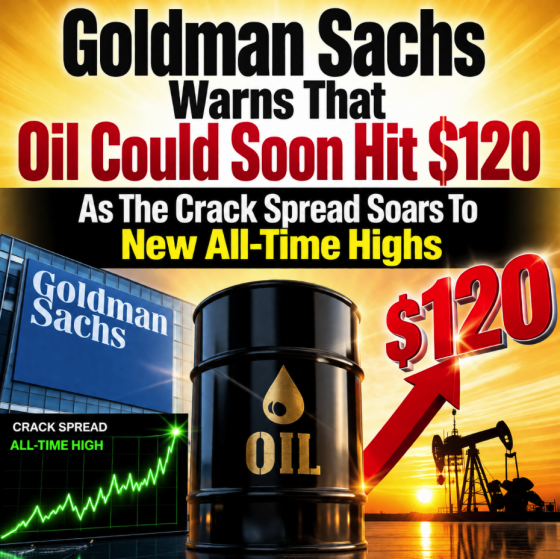
Pilkington also discussed the implications of something called the “crack spread,” the industry term for the difference between the price of crude oil and that of the refined petroleum products extracted from it. He provided a chart showing that the official value of the crack spread was currently at absolutely unprecedented levels.

One possibility was that refineries worldwide were currently enjoying profit margins far greater than they had ever previously achieved. But Pilkington believed it was much more likely that the price they were actually paying for barrels of crude was considerably higher than the figure widely quoted in the public markets, perhaps around $110 a barrel rather than $75 or $80. This would confirm the statements made earlier by the Saudi Finance Minister and others.
A seemingly knowledgeable commodities expert named Chris Martenson made very similar arguments regarding obvious market manipulation about a week later when he was interviewed by Lt. Col. Daniel Davis.
Video Link
Although oil inventories were as low as they had ever been, we were simultaneously seeing the largest volume of oil short contracts in history. Such a combination made absolutely no logical sense, and strongly suggested a massive attempt at market manipulation.
A few weeks after the Iran War began, there had naturally been a very high ratio of long positions on oil to short ones since there were widespread expectations that the price would rise as the Strait remained closed. But by late June, this had completely reversed, and the ratio of short to long positions on Brent oil was the absolute highest that it had ever been during the last fifteen years. Perhaps everyone had suddenly become absolutely certain that oil prices would fall, but more likely this represented market manipulation.
Martenson also devoted considerable coverage to the complexities of our Strategic Petroleum Reserve, and the difficulties of our current drawdowns. He noted that some of our older storage sites probably could not be refilled for geological reasons and that using their oil merely to keep global prices low would be remarkably irresponsible.
One interesting aspect of these SPR releases was that in the past we had always simply auctioned off that petroleum, but this time we were essentially loaning it out, requiring the buyer to return 120% of the same amount within the next couple of years or so. But since oil future prices were apparently so much lower than current values, these buyers could lock in large arbitrage profits by buying futures contracts, taking delivery, and then returning that oil to the SPR. However, if these oil futures were being manipulated and actual supplies might be much tighter than expected at that point, there could be a horrendous short squeeze with the sellers of the futures contracts desperately trying to locate physical oil barrels that weren’t easily found.
The notion that oil markets might be subject to manipulation and their prices totally divorced from reality may be deeply disturbing to many individuals. What might be called “market fundamentalism” is a powerful tenet of our overwhelmingly financialized economic system.
But whether or not this applies to recent oil prices, it seemed undeniable that it has sometimes been the case in the past.
During the Tech Bubble of the late 1990s, the stock prices of companies that had never turned a profit and seemed unlikely to ever do so were absurdly inflated, and this fact was as apparent before the bubble burst as it was afterward. Little had changed during that juncture, but the shift in market sentiment was brutal. A WSJ column last month provided a sobering anecdote from that era:
This same degree of market unreality appeared in the years leading up to the even more massive Financial Crisis of 2008. During that period, questionable mortgage securities were traded back and forth for large profits even as many analysts recognized that they might not have the actual value that the markets placed upon them. When the market values suddenly became more realistic, the entire world financial system tottered and nearly collapsed.
At that point, Citicorp was one of the world’s largest financial institutions, and shortly before the crisis hit, CEO Chuck Prince notoriously explained why his bank had to match the dangerously loose lending standards of all its competitors:
The result was that Citicorp’s market capitalization dropped by 98%. This prompted the largest of all government bailouts, totaling more than $350 billion in loan guarantees and investments.
Last month I discussed how some astute observers believe that today’s AI boom is exactly that same sort of bubble, doomed to explode with trillions of dollars in financial losses, possibly taking down some of our largest corporations during such a collapse.
But perhaps the most striking illustration of a total disconnect between financial market values and underlying economic reality came in the Meme Stock craze of a few years ago.
Trapped at home by the Covid lockdowns that began in 2020, large numbers of bored, underemployed individuals congregated on Reddit and other social media platforms to commiserate about the financial unfairness of our society. Apparently on a lark, they took advantage of the new Robinhood trading platform and grouped together to plow their limited personal funds into the stocks of dying companies such as GameStop, deliberately challenging the professional investment managers who had shorted those stocks on sound economic grounds. The resulting “short squeeze” propelled those stock prices to ridiculous heights, sometimes destroying the multi-billion-dollar hedge funds that were on the other side of the trade.
Other companies that were spiraling into economic collapse such as AMC and Koss were also sometimes rescued and revived by similar waves of stock manipulation by those irrational buyers.
But perhaps the most absurd example of all may have been the stock of Hertz, the large car rental company. After its business totally disappeared during the Covid pandemic, Hertz unsurprisingly was forced to declare bankruptcy. The common stock of a bankrupt company is obviously almost worthless, but the meme stock traders decided otherwise, and regardless of the market fundamentals, they began buying that worthless stock and carried the day.
With the market price for Hertz stock rapidly rising for no logical reason, the company was eventually recapitalized by new investors with billions of dollars of equity. So those who bought the stock at the right point would have increased the value of their illogical investment by an astonishing 16,000%, vastly outperforming the early investors in Google, Facebook, or Amazon.
This amusing story was summarized a few years ago in a Substack column appropriately entitled “The Inefficient Market Hypothesis.”
According to the famous adage widely attributed to economist John Maynard Keynes: “The market can stay irrational longer than you can stay solvent.” A few weeks ago, I noticed that a wit had updated it with regard to the meme stock craze in which ignorant dilettantes had bankrupted top hedge fund managers: “We can stay retarded longer than you can stay solvent.”
Consider that bands of resentful twenty-somethings discovered that they could manipulate the stock prices of famous corporations in such easy fashion. Is it really so implausible that determined supporters of the Iran War such as the American government and the billionaire partisans of Israel could do the same with regard to the paper prices of oil traded on the commodity exchanges?
Tweet
Continue reading...
[ H/T The Burning Platform ]
Our Iran War has fully resumed and last week I published an article on that subject.
After many weeks of negotiations, President Donald Trump finally signed a “Memorandum of Understanding” with Iran on June 17th. This was intended to set the stage for 60 days of additional peace talks aimed at permanently ending the conflict.
Unfortunately, that preliminary agreement remained on life-support during its entire existence. Many of its provisions were ignored or violated from almost the very first day, and within three weeks the plug was pulled, restarting the war. The end finally came on Monday when the Iranians declared that they had once again closed the Strait of Hormuz to oil tankers and other cargo traffic.
- The Resumption of the Iran War and Oil Supplies
Ron Unz • The Unz Review • July 13, 2026 • 3,700 Words
Aside from briefly recapitulating the current state of the conflict and its origins, my article also discussed the impact upon global oil supplies. Near the end I included a chart showing the trajectory of oil futures prices during 2026.
After months of rising and falling, on July 10th the widely quoted price for a barrel of WTI oil stood at around $71, almost exactly the same as its $67 price on February 27th, the day before the war originally began.
Thus, more than four months of war and blockade had left oil prices virtually unchanged. Some 1.3 billion barrels of oil had been lost and global stockpiles had reached their lowest levels in many decades, but prices had returned to their prewar levels, an extremely strange development that had important political consequences.
This complete stability must have surely helped convince Trump that he held a very strong hand on that issue and there would be few adverse consequences in the oil markets to his full resumption of the war. Indeed, just after he began bombing and blockading Iran once again, he declared at a press conference that he expected oil prices to fall because the world had “an oil glut.”
Back in April, Trump had ridiculed those who had warned him that oil prices would skyrocket if he attacked Iran, saying that they had been proven completely wrong. So with oil prices having now fully returned to peacetime levels, he may have been emboldened to attack Iran a second time.
For these reasons, global oil prices and the markets that set them have been a central element of our war with Iran, and I regularly discussed these matters in my articles.
The Iranians had threatened for decades that if they were attacked, they would close the Strait of Hormuz to oil shipments and other cargo traffic, and the conventional wisdom had been that the resulting loss of supply would quickly cause a huge spike in global prices.
I had fully accepted that argument and repeated it in my own recent articles, citing all the many experts who predicted that prices would soon rise to very high levels. But for four and a half months prices never did so, proving me wrong over and over and over again, a source of considerable personal embarrassment.
With the war now fully resumed and the Strait once again closed, oil prices are coming under renewed pressure. So it is worth exploring why prices have generally remained so surprisingly low and whether this situation will continue.
Widespread Expectations of a Huge Rise in Oil Prices
Most of us possess small islands of solid knowledge scattered amidst a vast sea of ignorance, and that is certainly true in my own case.
Until a few months ago, I’d never paid any attention to oil markets. So when the war began I relied upon media outlets and industry analysts who seemed to have the greatest expertise in that subject. These uniformly agreed that oil prices would rise dramatically as a global shortage developed.
That hardly surprised me. I’ve always been quite skeptical of many of the more complex and arcane aspects of modern economic theory. But the Law of Supply and Demand always seemed rock-solid. So if much of the supply of a vital commodity such as oil were suddenly removed, demand would force prices to sharply rise as users bid up the barrels that remained available.
The Strait normally carried 20% of global oil supplies, so once the Iranians closed it and blocked those shipments, there was a widespread belief that prices would soon skyrocket to $150 per barrel or even higher, an expectation that I fully accepted.
This certainly seemed supported by recent history. For example, after Russia invaded Ukraine in February 2022, Western countries banned the import of Russian oil, and as a result Brent oil prices soon almost touched $140 per barrel. But Russian oil only accounted for about 10% of the global supply, and Russia merely sold its banned oil to India, which refined the crude and then resold it to Europe, so none of the Russian oil had actually been taken off the market.
If the temporary rerouting of 10 million barrels a day of Russian crude had caused such an extremely large price shock, it seemed obvious that the actual loss of most Persian Gulf oil would have a far greater impact on market prices.
The Trump Administration certainly feared that this would happen. Trump had originally assumed that his surprise attack would successfully overthrow the Iranian government within a few days, so the Strait would quickly be reopened. But when his optimism proved unwarranted, his administration did everything it could to cushion the expected impact upon world oil markets.
Iran still exported its own oil and the Saudis were able to use a pipeline to redirect most of their crude to a port on the Red Sea. But the Iranian closure still took around 10 million barrels of oil per day off the world market, representing roughly 10% of total global consumption, resulting in an enormous shock to the system. Numerous experts claimed that if this loss of supply continued for any extended period of time, huge price hikes would inevitably result, producing a severe global recession or even a worldwide depression.
The International Energy Agency (IEA) declared that the Iran War was causing “the largest supply disruption in the history of oil markets.” Brent oil prices quickly approached $95 per barrel, with expectations that they would go far, far higher if the Iranians kept the Strait closed for any length of time.
In response, Trump officials urgently announced that the 32 nations in the IEA were releasing 400 million barrels of oil and refined products from their reserves, which included 172 million barrels from our own Strategic Petroleum Reserve (SPR).
During 2022 the Biden Administration had already drawn down our SPR to unusually low levels, perhaps in order to keep gasoline prices low for consumers prior to the midterm elections of that year. So Trump’s additional release would reduce our strategic reserve to the lowest level since 1983.
Despite these large announced releases, Brent oil prices still continued rising, easily passing $100 per barrel.
Faced with an economic disaster, the Trump Administration removed all existing sanctions on Russian oil, thereby allowing countries to easily purchase it. This included the 200 million barrels that Russia had already exported but that had been sitting at sea without buyers.
That huge injection of additional oil supplies only slowed the rise in global prices. So even more remarkably, a week later the desperate American government removed all sanctions on Iranian oil. This allowed the country we were seeking to defeat and destroy to freely market the 140 million or more barrels of crude they had already shipped but been unable to sell. This financial windfall amounted to around $15 billion, almost twice Iran’s annual military spending. I had never previously heard of any country during wartime deliberately boosting the government finances of the enemy it was facing in the field.
Thus, within three weeks of the Strait being closed, the Trump Administration had grown so desperate to halt the relentless rise in oil prices that it unilaterally lifted all the sanctions on Iranian oil even as it was massively bombing that same country. Trump officials certainly seemed to accept the reality of supply and demand at that point.
With so many hundreds of millions of extra barrels of oil now placed on the global markets, there was suddenly a great abundance of that commodity available for sale. The daily shortfall of Persian Gulf crude was temporarily mitigated, allowing supplies to remain stable for the next month or two until that large surplus was exhausted.
But it seemed obvious to me that perspicacious traders would look past these temporary ameliatory measures and recognize the severe oil shortages that loomed just beyond, so the futures prices they quoted would reflect that reality. And indeed, that was exactly what happened, with Brent oil futures soon rising about $25 per barrel and reaching $112 within the next couple of weeks.
At that point, Trump grew so extremely desperate that he famously posted his profanity-laced Easter Sunday warning that he would destroy Iran unless it reopened the Strait, followed a couple of days later by an even wilder, genocidal threat. These statements outraged some of his strongest erstwhile supporters such as Marjorie Taylor Greene and Carrie Prejean Boller.
When Trump declared that “A whole civilization will die tonight, never to be brought back again” many reasonably interpreted that phrase as the threat to use nuclear weapons to annihilate Iran and its 93 million people.
But the Iranians remained absolutely steadfast against these outrageous threats. From the beginning, they had emphasized that they would retaliate to such blows to their civilian infrastructure by inflicting similar damage upon America’s Gulf Arab allies who were enabling all these attacks against their country, and they had always followed through on those threats. They even released a couple of their popular LEGO animations dramatizing these horrific scenarios that might permanently eliminate Persian Gulf oil.
So it was Trump who blinked first. Instead of launching a nuclear strike against Iran, our president declared that he accepted as “a workable basis” for peace negotiations the ten-point proposal that the Iranians had previously offered. By bowing to the Iranian demands, he obtained a two week cease-fire, providing time for all the details to be worked out and an agreement signed. Peace was apparently at hand and the Strait would soon be reopened.
The markets were hugely relieved at these prospects for peace and a resumption of the regular flow of oil. Therefore, on April 7th the futures price of WTI crude fell by more than $35 a barrel, one of the largest single-day drops in the last twenty-five years.
The Strange, Unexpected Decline in Oil Prices
Unfortunately, the actual peace talks turned out to be a total bust.
A seventy member Iranian delegation, heavy on diplomats and technical experts, arrived in Islamabad, Pakistan only to discover that the peace proposal offered by JD Vance, Jared Kushner, and Steve Witkoff was entirely different than what Trump had suggested, merely amounting to the original, totally unacceptable set of American demands.
Whether it had been planned all along or was simply a product of Trump’s erratic behavior, the Iranians had been the victims of a bait-and-switch offer, so the talks broke up after less than 24 hours. Their plane returned to Iran, escorted by Pakistani fighter jets due to reports that the Israelis had planned to shoot it down, killing all the negotiators.
But although the peace effort was stillborn and the Strait remained closed, oil prices only recovered a fraction of the huge amount that they dropped a few days earlier. This may have had important consequences.
During previous weeks, the Trump Administration had put hundreds of millions of additional barrels of oil on the market, and prices had naturally fallen at those points. But Trump’s mere announcement that peace with Iran was at hand and the Strait was about to be reopened had produced a drop almost three times larger, and prices stayed down even after his statement turned out to be erroneous. So perhaps Trump officials took that important lesson to heart and began to regularly exploit it.
Prior to this incident, movements in oil prices had generally been understandable and based upon considerations of supply and demand. But during the next couple of months, they often seemed driven instead by Trump’s loud public announcements that the Iranians were about to reopen the Strait even though all of those statements were false.
On several occasions, quoted oil prices dropped to levels only somewhat above what they had been before the war began, when the Strait had been open and before any damage had been done to the oil facilities of either Iran or the Gulf Arabs. This pricing development made no sense to me.
Furthermore, a very puzzling gap had also appeared between the widely quoted futures prices and the actual prices charged for physical barrels of oil.
These extremely strange developments were covered by major articles in the New York Times and the Wall Street Journal, quoting top oil industry experts.
A few days later, an article in the Wall Street Journal told the same story of the strange, massive gap that had suddenly appeared between “fictional” and physical oil prices:
A CNBC article quoted similar dire warnings:
By this point in April, South Korea and some European countries had already begun rationing their gasoline and some large airlines had cut tens of thousands of their flights. Nothing like this had happened during the previous 2022 oil-shock following the Russian invasion of Ukraine, so the current one was obviously much worse. But no one would have ever suspected any of this from the oil prices that were so widely quoted everywhere.
I considered myself a total ignoramus on the oil markets, but I saw that top figures in the industry were expressing their bewilderment. On May 1st, the Exxon-Mobil CEO warned that public oil prices still did not reflect anything like the true impact of the ongoing market disruptions.
Subscribe to New Columns
Later that month, a major article in the Wall Street Journal emphasized that the existing oil stockpiles that had been cushioning our current shortfall were rapidly being exhausted:
The Unreality of Oil Market Prices
Being very naive about such things, I’d always vaguely assumed that buyers of oil generally paid something close to the prices widely quoted in the media. But I gradually discovered that was not at all the case, at least according to seemingly knowledgeable individuals.
For example, the Saudi Finance Minister said that those quoted prices had no relationship to the actual prices at which physical barrels of oil were changing hands.
A top energy expert who had held a senior role in the Biden Administration was interviewed on Bloomberg TV and he said much the same thing, declaring that physical barrels of oil were actually selling at $150 or $170.
Video Link
Bloomberg was one of our top business channels, probably watched by large numbers of the global oil brokers who know the reality of those physical prices. So if Bloomberg and the influential guest it promoted were talking total nonsense about something as extremely important as world oil prices, surely someone would have gotten fired.
Numerous other individuals interviewed on various podcasts made these same claims that the market prices quoted for oil were essentially fictional, being wildly different from what people were actually being forced to pay for physical barrels.
But at the time, I still wondered whether it were really possible that the actual price for oil had already passed $150 per barrel without almost anyone becoming aware of that fact.
Then at the beginning of July, a Financial Times article said exactly that. The writer made a huge distinction between “physical oil” and “paper oil,” saying that the price paid for physical barrels of oil was dramatically higher than the quoted figure:
So “physical oil” may have indeed been selling for $180 or $200 per barrel a couple of months ago just as those individuals had claimed at the time. I found it difficult to believe that the FT would publish total nonsense on such an important business/financial matter.
I think that further evidence for the total unreality of quoted oil prices appeared in the first half of June, just before Trump signed the preliminary agreement with Iran that temporarily reopened the Strait.
During that two week period, WTI oil prices generally hovered around $80 per barrel, only somewhat above what they had been prior to the beginning of the war, with Brent being a few dollars higher. These prices certainly failed to suggest any alarming shortage of oil.
But during that same period, oil company executives became frantic that global supplies were approaching complete exhaustion and heavily pressed Trump to make a deal.
The document Trump signed a few days later was extremely one-sided, widely characterized as an American capitulation to Iran. He justified doing so by declaring that America would exhaust its oil reserves in about four weeks, saying he was fearful of going down in history as the second Herbert Hoover, responsible for a new global Great Depression.
On the 14th of June, the lead story in the WSJ announced that the agreement had been reached. But that same day, a different front-page story recounted some of the factors that had driven America into making those huge political concessions:
The statements by top oil executives and other experts were alarming:
Although some of the quoted statements of these top figures in the oil industry were sometimes contradictory, they generally described what they considered the severe shortages of global oil supplies and their great puzzlement why this was not reflected in the prices of that commodity.
The Return of Oil Prices to Prewar Levels
Furthermore, as the WSJ soon reported, this seemingly strange behavior of quoted oil prices continued even after Trump signed the preliminary agreement on June 17th and the Iranians reopened the Strait.
With quoted oil prices now returned to prewar levels and no economic disaster having happened, one of the leading Cassandras threw in the towel and published a remarkable mea culpa.
The Economist is the world’s most influential newsweekly, especially strong in business and finance, and for months it had published articles warning of a looming economic catastrophe.
The editors noted that the continued closure of the Strait and the resulting shortfall of global oil supplies was impossible to reconcile with the low apparent price of oil. They even ran a cover story declaring that the oil markets were lost in “La La Land.”
TRADERS OF OIL futures are a sunny bunch. On April 17th, after Iran’s foreign minister declared the Strait of Hormuz “completely open”, the price of Brent crude fell by 10%, to $90 a barrel. Within hours Iran reversed course and attacked an Indian tanker. The next trading day the global benchmark rose by just 5%. It remains around $20 below its high in late March, even though an American blockade on Iranian oil means even more oil is trapped in the Gulf…
This comforting picture is deeply misleading. By April 20th the last few oil tankers to cross Hormuz before the war began reached their destinations, in Malaysia and California. There is no buffer left to protect the world from the supply shock, at a time of the year when demand from holiday drivers starts to pick up…
Futures markets have a different view of things. Yet even if Hormuz reopened today, it would take months for Gulf crude output, shipping and refinery production to resume in full. Saad Rahim of Trafigura, a trader, reckons a cumulative loss of 1.5bn Gulf barrels, or 5% of annual global output, is almost unavoidable. If the strait does not reopen, it could easily reach double that. The last time oil demand fell by 10% in short order was during the covid-19 lockdowns of 2020, a shock that also brought about a fall in world GDP of more than 3%. The time to avoid a similar tumble is running out.

But weeks went by, oil prices stayed low, and the predicted catastrophe never arrived. So after the Iranians reopened the Strait to cargo traffic and prices further collapsed, the editors issued a heartfelt mea culpa at the beginning of July, admitting that they had been entirely wrong in all their predications about the oil market.
Indeed, the Economist was so embarrassed by its mistaken analysis that its staff used AI to analyze and evaluate the accuracy of some 7,000 of its previous leaders of the last quarter-century, noting that although many of its other political, economic, and financial predictions had been pretty good, its track-record on predicting oil prices had often been abysmal.
I can’t remember the last time that the Economist had issued such a lengthy and detailed editorial apology. I doubt that had even happened after its strong support for the Iraq War based upon Saddam’s fictional WMDs turned out to be so disastrously wrong. Indeed, the Economist had shoved that colossal blunder so far down the memory-hole that around the twentieth anniversary it published a column condemning all the elite consensus behind that geopolitical calamity without even acknowledging that it itself had played a starring role at the time.
I can easily understand why the editors of a business magazine such as the Economist capitulated to the oil markets, and the reasons they gave for their erroneous predictions hardly reflected that badly upon them.
They had never expected that Trump would sign a document in which he surrendered to all the Iranian demands, thereby getting the Strait reopened.
They also never expected that China would reduce its oil imports by a colossal 5 million barrels per day, a figure large enough that it cut the entire global oil shortfall nearly in half.
Everyone knew that China possessed colossal strategic oil reserves estimated at 1.4 billion barrels, a total far greater than those of the rest of the world combined and many times larger than our own. But neither the Economist nor any other analyst had ever expected the Chinese to expend those reserves in order to save the world economy from the folly of America’s Iran War.
The exact reasons for this unexpected Chinese decision were unclear. Some speculated that China feared skyrocketing oil prices would produce a global recession that impoverished all their customers worldwide. Others suspected that Trump had worked out some deal with the Chinese, perhaps offering them major concessions on Taiwan. But for whatever reason, the partial release of China’s enormous stockpiles had obviously had a major effect on world prices.
Has the Law of Supply and Demand Been Repealed for Oil?
The Economist editors did their best to explain why their earlier predictions of a catastrophic oil shortage had been so severely mistaken.
But although they cited important factors, I believed that these completely failed to explain why oil market prices had not risen much higher, let alone why prices had actually fallen back to low prewar levels.
According to the IEA, during the period that the Strait had been closed, well over a billion barrels of oil production had been lost, and existing global stockpiles had been severely depleted to partially mitigate the impact of that shortfall.
The hundreds of millions of barrels of sanctioned Russian and Iranian oil parked at sea had been desanctioned, sold, and used. Hundreds of millions of barrels of oil in Western stockpiles had been depleted, reducing those reserves to some of their lowest levels in decades, and China’s reserves had also been drawn down by hundreds of millions of barrels.
The use of those different oil buffer stocks not only eliminated their potential future role as shock absorbers, but the Western and Chinese reserves would now have to be replenished, greatly adding to demands on the current market for oil. The Chinese were notoriously cautious, and they would surely want to rebuild their stockpiles as quickly as possible, absorbing hundreds of millions of barrels of new production.
In May, experienced oil analysts such as Jeff Currie and Ari Berman had estimated that unless the Strait of Hormuz were reopened, global oil stockpiles would be reaching “tank bottom” some time in July.
A lengthy research study by the Brookings Institution entitled “The Timing of the Impending Crude Crisis” came to similar conclusions, with their findings conveniently summarized in a simple chart.
In mid-June, Trump seemed to confirm these estimates by declaring that if he hadn’t signed the deal and reopened the Strait, oil reserves would have been exhausted within about four weeks.
Let us now reconsider that chart showing the history of WTI oil prices:
During the months of April and May and into June, the Strait remained closed and global stockpiles of oil steadily declined as the world moved closer and closer to “tank bottom.” But instead of rapidly rising, oil prices moved up and down, barely touching $100 per barrel before they began sharply dropping in mid-May, falling by more than 25% over the next four weeks.
So with oil stockpiles sharply declining and with a terrible supply crisis looming nearer and nearer, the market price for oil steadily dropped. This seems to represent a total violation of the fundamental laws of economics. Unless the markets were somehow being manipulated, I cannot see how this could have happened.
The oil commodity markets are among the largest in the world and the Economist is a publication fervently committed to the validity of markets. So I can easily understand why its editors averted their eyes from these obvious signs of manipulation, but the rest of us should not operate under such ideological restrictions.
By mid-June, Trump dodged that oil supply catastrophe by capitulating to the Iranians and persuading them to reopen the Strait and allow the hundreds of trapped tankers to depart, carrying their oil into the world markets. But according to the Gemini AI:
So the oil in that large one-time release only amounted to a few weeks of the continuing shortfall of Persian Gulf oil, and even much of that was Iranian oil on its way to China.
The preliminary agreement that Trump signed with Iran was extremely fragile and even before it collapsed, average oil tanker traffic never returned to more than a small fraction of what it had previously been. Disputes over control of the Strait flared up within a couple of weeks and the Iranians began firing at tankers that violated their orders, while threatening once again to close the waterway to cargo traffic.
With global buffer stocks of oil now almost completely exhausted, a renewed loss of supply would have far greater and more immediate impact than had been the case in March. But the markets remained blissfully insouciant about this risk and oil market prices remained low.
By July 10th the war was on the verge of resuming, with the Iranians about to close the Strait to traffic. But on that same day, market prices for oil dropped to their low, prewar levels. There seems no logical explanation for this.
Subscribe to New Columns
The totally inexplicable behavior of the oil markets was further compounded by other geopolitical developments.
Russia has long been the world’s second largest oil exporter, just behind Saudi Arabia. But during June and into July, Ukrainian drones had begun successfully hitting Russian refineries, putting them out of commission. As a result, Russia experienced very serious local shortages of gasoline and instead of exporting petroleum products was forced to urgently begin importing them instead. Russia’s oil refining volumes have dropped to their lowest levels in more than two decades, with 58% of its total capacity hit by drones.
Even if the Middle East had been entirely at peace, major attacks that crippled the capacity of a leading world oil exporter should have caused a large spike in prices, but nothing like that occurred. Russia’s largest refinery deep in Siberia was attacked and seriously damaged on July 7th yet global oil prices took no significant notice of that very serious incident.
The Manipulation of Our Oil Markets?
When financial markets begin violating every rational pricing principle and seem to ignore the basic law of supply and demand, sensible observers must grow very suspicious, and over the last few months I began wondering about these matters.
During this period Trump had regularly—and erroneously—declared that he was on the very verge of signing a peace agreement with the Iranians that would reopen the Strait. Although completely false, these brash statements often had powerful market-moving impact, driving down oil prices long after no sensible individuals would have taken Trump’s words seriously.
Anderson Cooper of CNN eventually totaled up some 39 such separate instances of those public statements, and in many of these cases prices would sharply drop and then only somewhat recover after Trump turned out to have been “fibbing.”
I found it extremely difficult to believe that even the most gullibly optimistic trader would continue to take our president’s blatant prevarications at face value after the tenth or twelfth time, let alone that there were enough such traders to move the markets in dramatic fashion.
But a shrewd observer suggested that the solution to this mystery was that these major market movements were actually due to trading by AI systems, which made their decisions mostly based upon how they expected all the other AI trading systems would react to Trump’s statements.
I also began considering the professional background of Treasury Secretary Scott Bessent.
Unlike many of his predecessors, Bessent lacked any serious expertise in economics, but as a highly successful former hedge-fund manager for George Soros, he must surely be intimately familiar with the financial markets and how they can be manipulated. Indeed, just two weeks before we attacked Iran, Bessent publicly boasted at the World Economic Forum that he had successfully employed various financial strategies to crush the value of the Iranian currency, leading to the huge public protests that were intended to destabilize the regime and assist in its overthrow:
If he had successfully manipulated the financial markets to lower the dollar price of the Iranian Rial, wasn’t it quite plausible that he would have tried to do the same thing with the price of oil?
I’d originally begun speculating about possible oil market manipulations back in April and immediately encountered fierce push-back from market fundamentalists and others, who dismissed that notion as ridiculous.
Given my total lack of expertise in the commodities markets, I could hardly dispute the matter. But I still felt that I might be correct and recent presentations by far more knowledgeable individuals have strongly substantiated my suspicions.
In early July, an economist and investment strategist named Philip Pilkington gave a pair of consecutive interviews in which he sketched out the alleged manipulation of our oil markets, and I’d strongly recommend them to those interested in the topic.
Video Link
Video Link
According to Pilkington, the AI trading systems used by hedge funds heavily relied upon the analysis of text-based media coverage and gave great weight to the keywords they found. So if the dramatic pronouncements of an American president such as Trump were widely reported in the most influential media outlets, they could have a large impact.
Thus, when Trump declared that peace was at hand with Iran and the Strait would soon be reopened, his mere statements could influence those mindless trading systems and directly shift the oil markets. Although no rational human trader would have taken them at face value, the AI systems did, so Trump’s statements almost amounted to a magic incantation in which the words themselves possessed the power to transform financial reality.
This continued to apply after the Strait had been reopened, and when Trump declared that there was “an oil glut,” the financial markets sometimes reacted as if that were the case. Since the AI trading systems failed to properly distinguish between true statements and false ones, flooding the media zone with these spurious statements had the desired result.
Human traders who were also in the market would recognize that these statements were obvious nonsense. But Pilkington argued that they were invariably trading on margin and they painfully discovered that they would be crushed financially if they opposed the erroneous views of the AI systems, so they stopped doing so. In effect, those who believed in the reality of higher oil prices—the traders who were long on oil—could be squeezed out of the market by the far greater quantity of capital controlled by the trading systems on the other side.
And just as I had speculated, Pilkington noted that Treasury Secretary Scott Bessent was himself a former hedge-fund manager who probably recognized this possibility not long after the Iran War began and started exploiting it to keep oil market prices low.
Another means of manipulating the markets was to place huge short positions on oil at the very beginning of a week because these were accorded a great deal of weight by the AI trading algorithms. These oil shorts often made no logical sense given economic and geopolitical considerations, but they moved the financial markets in the intended direction.
Pilkington also discussed the implications of something called the “crack spread,” the industry term for the difference between the price of crude oil and that of the refined petroleum products extracted from it. He provided a chart showing that the official value of the crack spread was currently at absolutely unprecedented levels.
One possibility was that refineries worldwide were currently enjoying profit margins far greater than they had ever previously achieved. But Pilkington believed it was much more likely that the price they were actually paying for barrels of crude was considerably higher than the figure widely quoted in the public markets, perhaps around $110 a barrel rather than $75 or $80. This would confirm the statements made earlier by the Saudi Finance Minister and others.
A seemingly knowledgeable commodities expert named Chris Martenson made very similar arguments regarding obvious market manipulation about a week later when he was interviewed by Lt. Col. Daniel Davis.
Video Link
Although oil inventories were as low as they had ever been, we were simultaneously seeing the largest volume of oil short contracts in history. Such a combination made absolutely no logical sense, and strongly suggested a massive attempt at market manipulation.
A few weeks after the Iran War began, there had naturally been a very high ratio of long positions on oil to short ones since there were widespread expectations that the price would rise as the Strait remained closed. But by late June, this had completely reversed, and the ratio of short to long positions on Brent oil was the absolute highest that it had ever been during the last fifteen years. Perhaps everyone had suddenly become absolutely certain that oil prices would fall, but more likely this represented market manipulation.
Martenson also devoted considerable coverage to the complexities of our Strategic Petroleum Reserve, and the difficulties of our current drawdowns. He noted that some of our older storage sites probably could not be refilled for geological reasons and that using their oil merely to keep global prices low would be remarkably irresponsible.
One interesting aspect of these SPR releases was that in the past we had always simply auctioned off that petroleum, but this time we were essentially loaning it out, requiring the buyer to return 120% of the same amount within the next couple of years or so. But since oil future prices were apparently so much lower than current values, these buyers could lock in large arbitrage profits by buying futures contracts, taking delivery, and then returning that oil to the SPR. However, if these oil futures were being manipulated and actual supplies might be much tighter than expected at that point, there could be a horrendous short squeeze with the sellers of the futures contracts desperately trying to locate physical oil barrels that weren’t easily found.
Bubbles, Meme Stocks, and the Unreality of Financial Markets
The notion that oil markets might be subject to manipulation and their prices totally divorced from reality may be deeply disturbing to many individuals. What might be called “market fundamentalism” is a powerful tenet of our overwhelmingly financialized economic system.
But whether or not this applies to recent oil prices, it seemed undeniable that it has sometimes been the case in the past.
During the Tech Bubble of the late 1990s, the stock prices of companies that had never turned a profit and seemed unlikely to ever do so were absurdly inflated, and this fact was as apparent before the bubble burst as it was afterward. Little had changed during that juncture, but the shift in market sentiment was brutal. A WSJ column last month provided a sobering anecdote from that era:
This same degree of market unreality appeared in the years leading up to the even more massive Financial Crisis of 2008. During that period, questionable mortgage securities were traded back and forth for large profits even as many analysts recognized that they might not have the actual value that the markets placed upon them. When the market values suddenly became more realistic, the entire world financial system tottered and nearly collapsed.
At that point, Citicorp was one of the world’s largest financial institutions, and shortly before the crisis hit, CEO Chuck Prince notoriously explained why his bank had to match the dangerously loose lending standards of all its competitors:
The result was that Citicorp’s market capitalization dropped by 98%. This prompted the largest of all government bailouts, totaling more than $350 billion in loan guarantees and investments.
Last month I discussed how some astute observers believe that today’s AI boom is exactly that same sort of bubble, doomed to explode with trillions of dollars in financial losses, possibly taking down some of our largest corporations during such a collapse.
But perhaps the most striking illustration of a total disconnect between financial market values and underlying economic reality came in the Meme Stock craze of a few years ago.
Trapped at home by the Covid lockdowns that began in 2020, large numbers of bored, underemployed individuals congregated on Reddit and other social media platforms to commiserate about the financial unfairness of our society. Apparently on a lark, they took advantage of the new Robinhood trading platform and grouped together to plow their limited personal funds into the stocks of dying companies such as GameStop, deliberately challenging the professional investment managers who had shorted those stocks on sound economic grounds. The resulting “short squeeze” propelled those stock prices to ridiculous heights, sometimes destroying the multi-billion-dollar hedge funds that were on the other side of the trade.
Other companies that were spiraling into economic collapse such as AMC and Koss were also sometimes rescued and revived by similar waves of stock manipulation by those irrational buyers.
But perhaps the most absurd example of all may have been the stock of Hertz, the large car rental company. After its business totally disappeared during the Covid pandemic, Hertz unsurprisingly was forced to declare bankruptcy. The common stock of a bankrupt company is obviously almost worthless, but the meme stock traders decided otherwise, and regardless of the market fundamentals, they began buying that worthless stock and carried the day.
With the market price for Hertz stock rapidly rising for no logical reason, the company was eventually recapitalized by new investors with billions of dollars of equity. So those who bought the stock at the right point would have increased the value of their illogical investment by an astonishing 16,000%, vastly outperforming the early investors in Google, Facebook, or Amazon.
This amusing story was summarized a few years ago in a Substack column appropriately entitled “The Inefficient Market Hypothesis.”
According to the famous adage widely attributed to economist John Maynard Keynes: “The market can stay irrational longer than you can stay solvent.” A few weeks ago, I noticed that a wit had updated it with regard to the meme stock craze in which ignorant dilettantes had bankrupted top hedge fund managers: “We can stay retarded longer than you can stay solvent.”
Consider that bands of resentful twenty-somethings discovered that they could manipulate the stock prices of famous corporations in such easy fashion. Is it really so implausible that determined supporters of the Iran War such as the American government and the billionaire partisans of Israel could do the same with regard to the paper prices of oil traded on the commodity exchanges?
Tweet
Continue reading...
[ H/T The Burning Platform ]