






The Great Rare Earth Disconnect: Prices Up 23%, Miners Down 28%
Here is a question that should be harder to answer than it is: China still controls the rare earth spigot, the latest Trump-Xi summit did nothing to loosen its grip, Japan is about to run out of yttrium, Washington has put a $110/kg floor under NdPr, and Western buyers are paying anywhere from 5x to 346x the Chinese price for heavy rare earths.
So why are rare earth stocks down on the year?
That is the question Canaccord's critical minerals team led by Reg Spencer asks in an overnight note titled "Rare Earths: Equity disconnect from strong market fundamentals", and the answer is blunt:
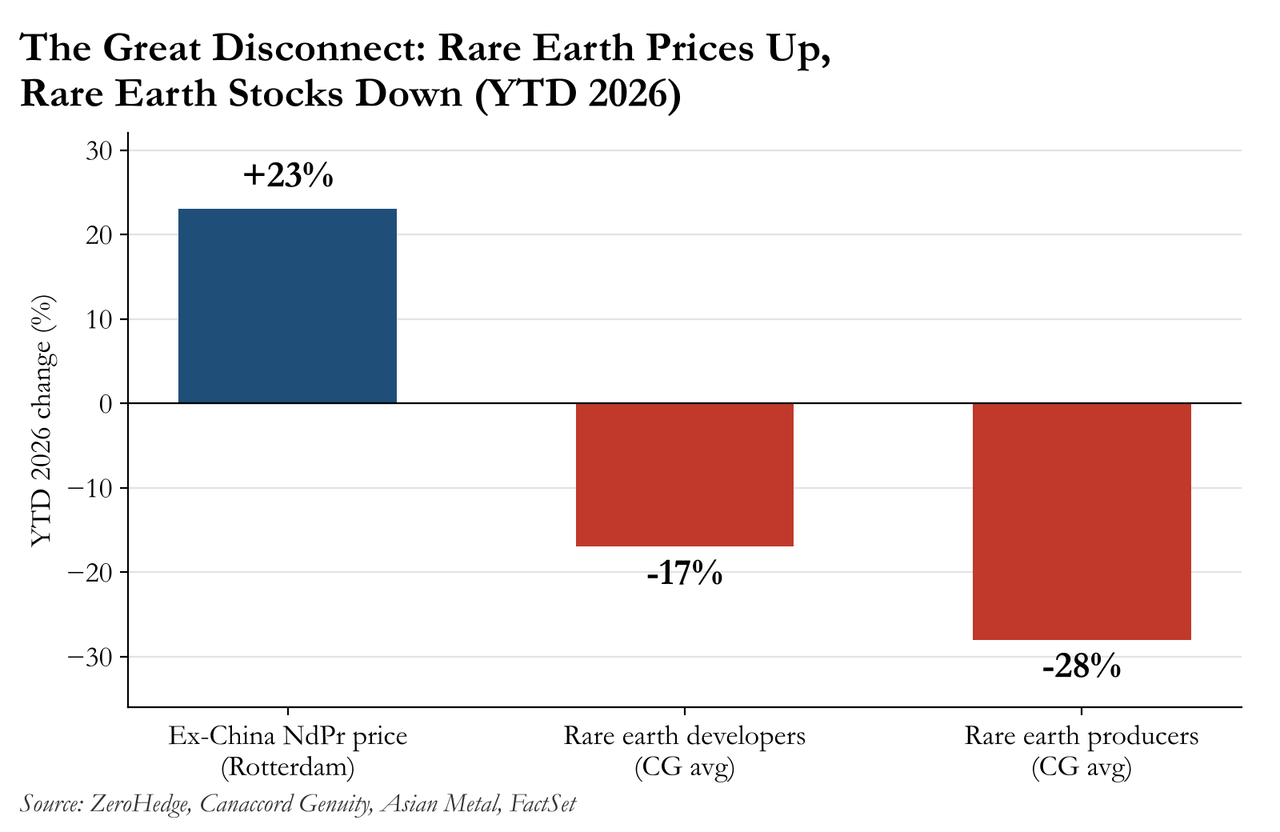
In other words, the commodity is acting like a strategic asset and the stocks are trading like a risk-off casualty. The numbers are stark: year to date, the ex-China NdPr price is up 23%, while Canaccord's rare earth developers are down 17% on average and its producers are down 28%.
We have been tracking the rare earth theme since long before China started rationing exports to the West in late 2024, and back in July 2025 we laid out "The Coming Rare Earth Revolution And How To Profit", flagging MP Materials as the stock best positioned to benefit. A few hours later the Pentagon announced its MP deal, and well we allowed ourselves a modest victory lap:
Fifteen months later, MP trades at $40.17, about half of Canaccord's $82 target. So what happened?
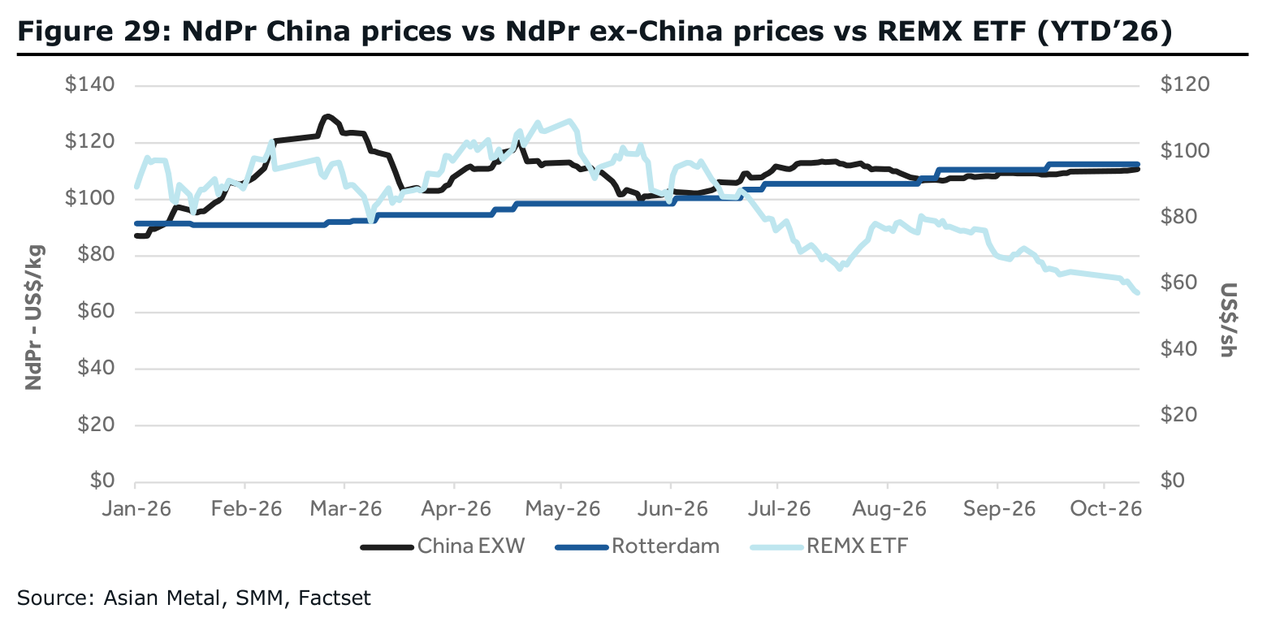
Canaccord's chart below shows the problem in one picture. Chinese NdPr (black) and Rotterdam NdPr (dark blue) have converged and climbed steadily all year, with the Western price now above $110/kg. Meanwhile the REMX ETF (light blue) peaked in May and has since slid from above $100 to the high-$50s.
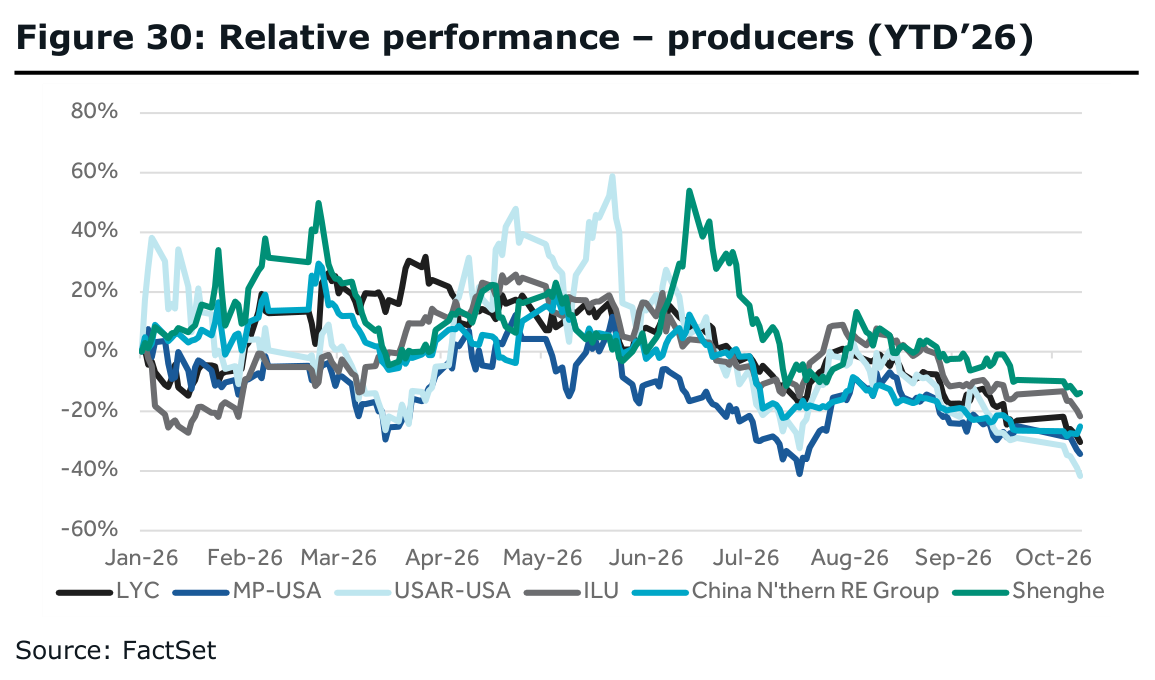
The carnage is broad. On the producer side, Lynas, MP, USA Rare Earth and Iluka are all deep in the red, and even China Northern Rare Earth and Shenghe are lower on the year. Diversification at its finest.
Developers did a bit better on average, mostly thanks to Viridis (VMM), which is still up well over 50% on the year. Strip that out and the picture is grim: Hastings is down roughly two-thirds, St George about half, and Arafura and Brazilian Rare Earths 35-50%.
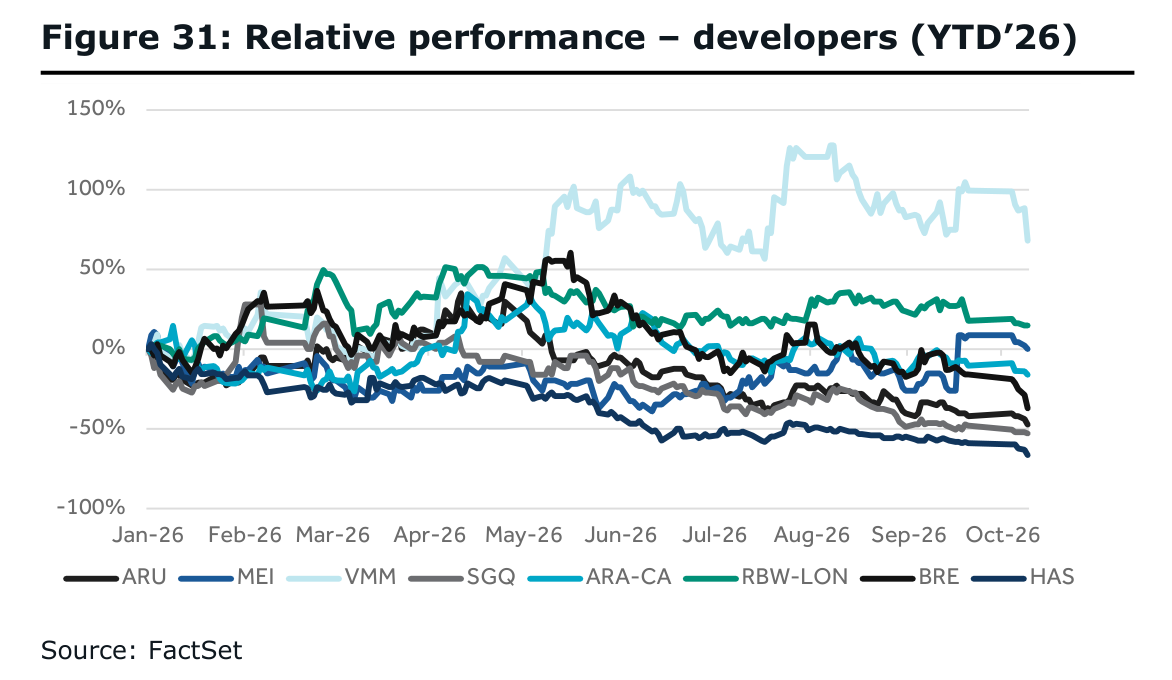
Canaccord's verdict: "We question how equities have performed so poorly YTD despite strong underlying market fundamentals." Those fundamentals include recent sector M&A, direct government support, a scarcity of Western supply and "ex-China NdPr pricing up 23% YTD."
Start with the most important structural change of the past year. As we reported when the Department of Defense set a price floor last August, Washington has moved from financing Western supply to underwriting its economics. Canaccord tallies the floors: US$110/kg NdPr for MP (DoD), Lynas (Japan, US, plus upside sharing) and USA Rare Earth, which also gets US$575/kg for dysprosium and US$2,050/kg for terbium.
And the floor has done something nobody expected: it has tamed the Chinese price too. For years Beijing used export quotas, policy changes and, more recently, export controls to whipsaw NdPr from about $175/kg down to around $50 and back again. Over the past 10 months, Canaccord notes, Chinese pricing has "begun to normalise around the US$110/kg floor price level."
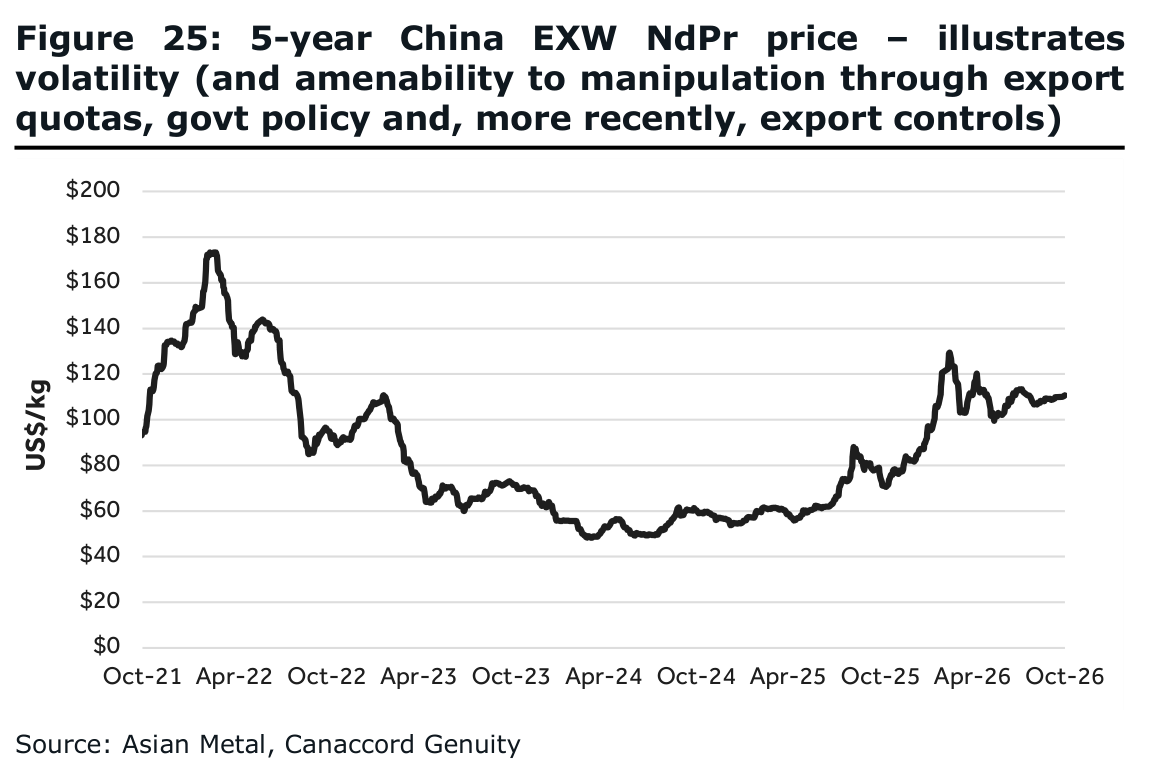
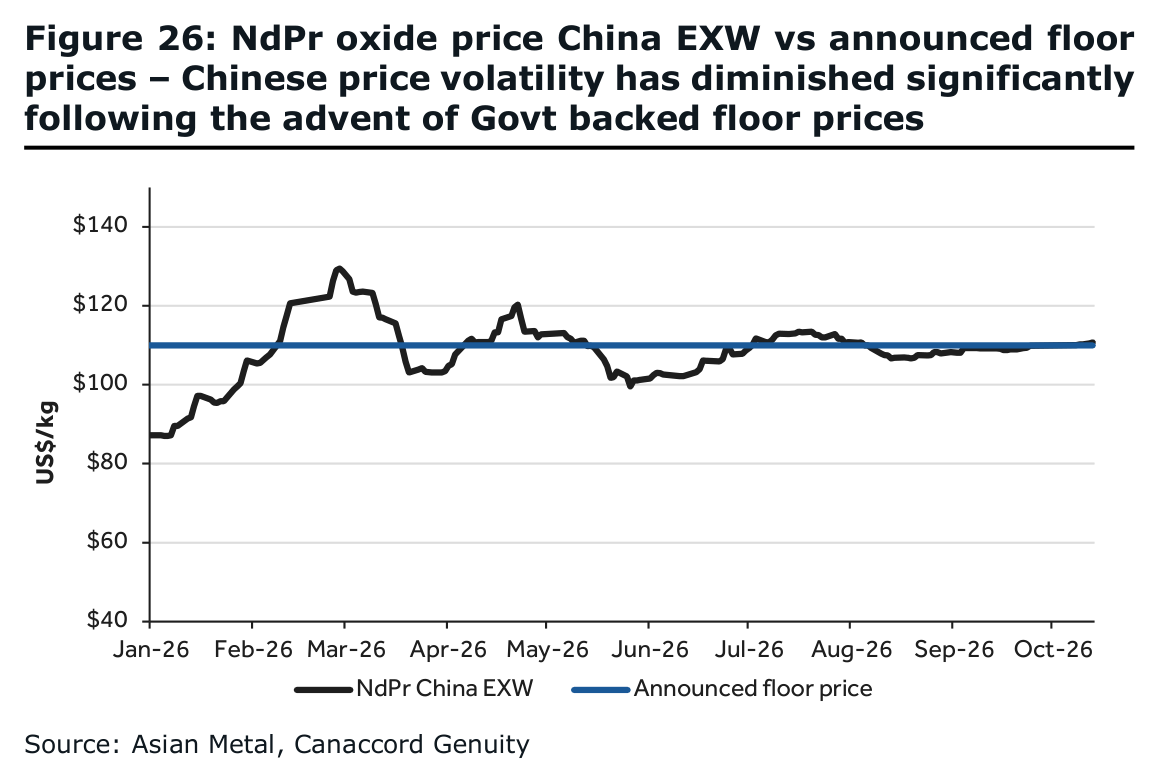
Put differently, the volatility that made rare earth projects unbankable has largely vanished, and yet investors are paying less for those projects than they did in January.
NdPr is now a one-price market, more or less. Everything heavier is a different story. Since Beijing started rationing heavies, the West has developed its own (thin, opaque) price for anything China won't ship, and the gaps are absurd. Rotterdam dysprosium sits around $1,074/kg vs $227 in China, and terbium at $4,594 vs $983.
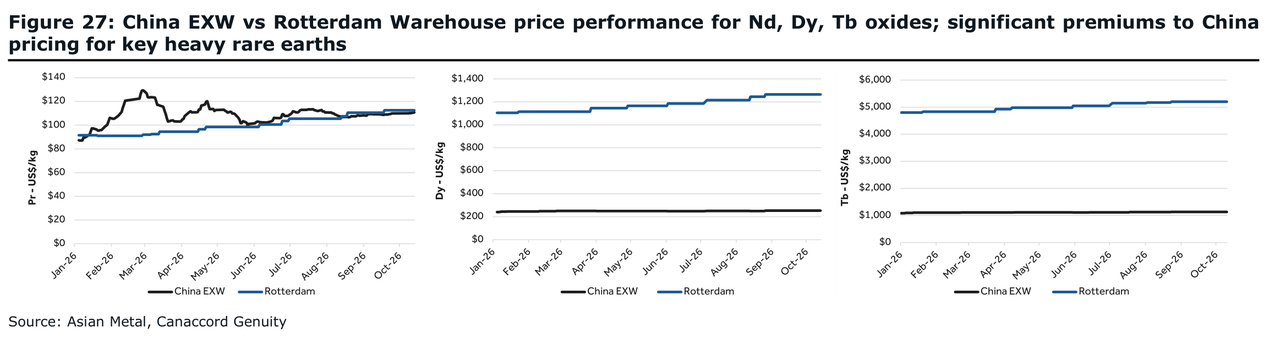
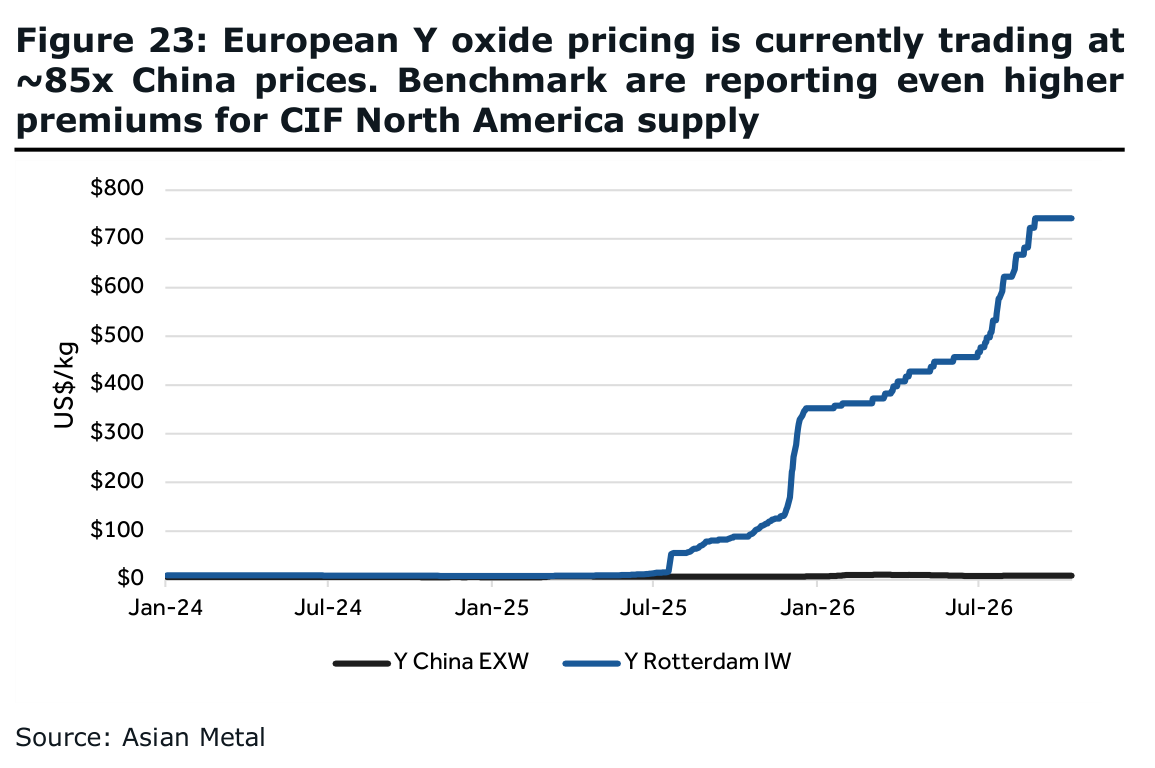
But Dy and Tb are the tame ones. Canaccord now forecasts yttrium, gadolinium and samarium for the first time, and the Western premiums there are almost comical. Chinese yttrium oxide has averaged about $8/kg over the past five years, while European spot is "~US$740/kg", a premium of 85x, and "some price reporting agencies have quoted US prices of up to US$1,750/kg." Gadolinium trades about 10x China in Baltimore, with US CIF quotes as high as $3,100/kg.
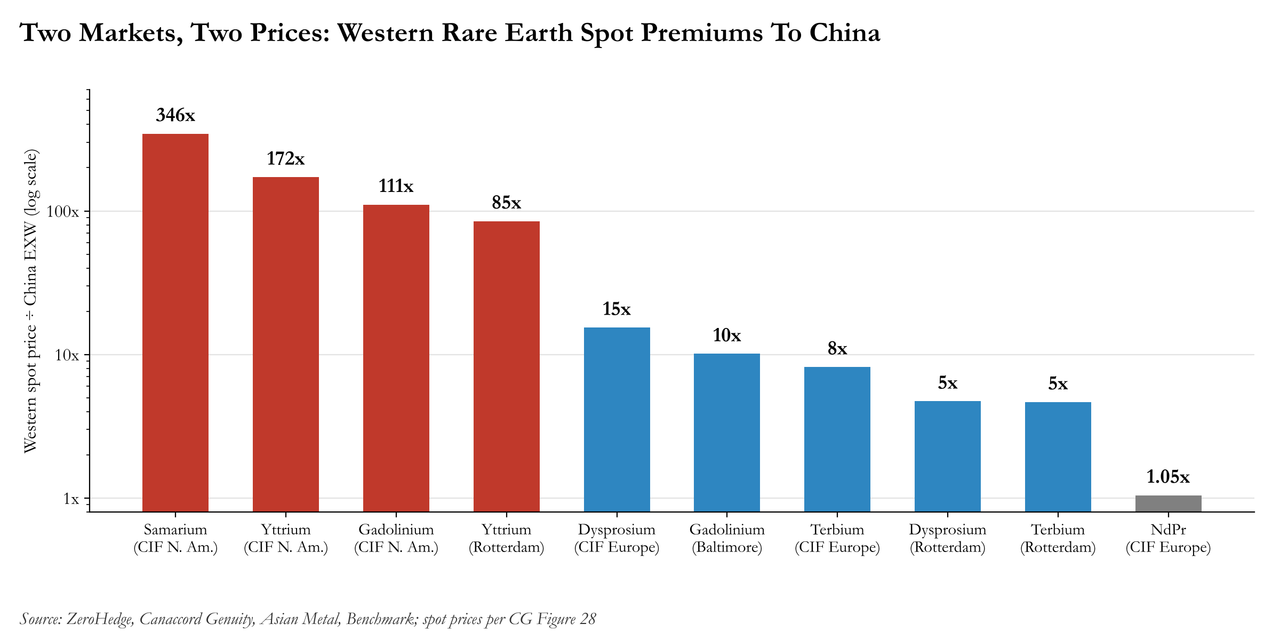
We ran Canaccord's own spot price table through the calculator, and here is what the "dual market" looks like element by element. CIF North America samarium, used in the SmCo magnets that go into missiles, fighter jets and radar, trades at 346 TIMES THE CHINESE PRICE!
And the squeeze is very real. Just this morning the FT reported that Japan has made an urgent request to Washington and global companies to help resolve its yttrium crisis, warning of a severe shortage by year-end. "Inventories are plummeting," one official said. Per Argus, yttrium oxide costs about $9/kg in China and roughly $1,150/kg outside it, a 179-fold jump in two years. A senior US official added that China is shipping the US just two-thirds of the rare earths it promised under last October's truce, and Japan "only the bare minimum." That followed last month's Trump-Xi summit, where China pledged to buy US coal but fell short on rare earths, and the two sides settled for a two-month truce that markets promptly faded.
To be fair, Canaccord is careful here. It notes the ex-China DyTb market was just 151 tonnes in 2025, and China's was 22x larger. It warns that Western premiums "should be viewed cautiously" and that "we question whether pricing is sustainable at these levels," with some magnet makers already pivoting to lower-cost ferrite magnets. Its own price deck has ex-China yttrium falling from $740/kg this year to $100 by 2030. Still, even the bank's haircut numbers leave Western producers with integrated separation (it names Lynas and MP) earning premiums nobody would have modeled two years ago.
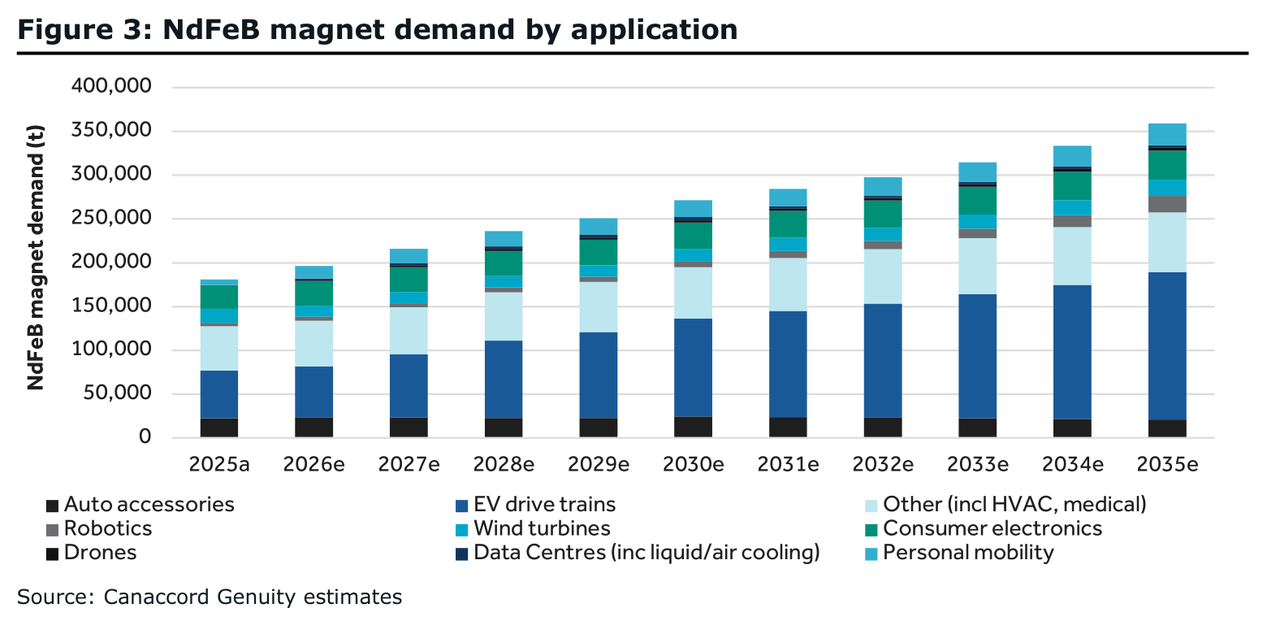
Meanwhile the demand side keeps getting revised higher. Canaccord now sees NdFeB magnet demand growing at a 7.3% CAGR to ~365,000 tonnes by 2035, 15% above its prior update. EVs remain the anchor (52 million units by 2035 vs 23.5 million in 2026), but the bank has added data centers (motors for cooling), e-bikes and scooters, and drones. Drones are only ~1% of forecast demand, but the bank notes that Ukrainian and Russian military drone production alone was estimated at ~9 million units, so "our model forecasts may prove conservative."
Then there are the robots. Canaccord models humanoid deliveries growing at a 45% CAGR to 2.5 million units by 2035, and points out that Tesla is reportedly preparing an Optimus line designed for 1 million robots a year. For comparison, global EV sales rose more than 4,600% from 2014 to 2024. Maybe the robot curve won't look like that... but if it does, the magnet math gets very ugly very quickly.
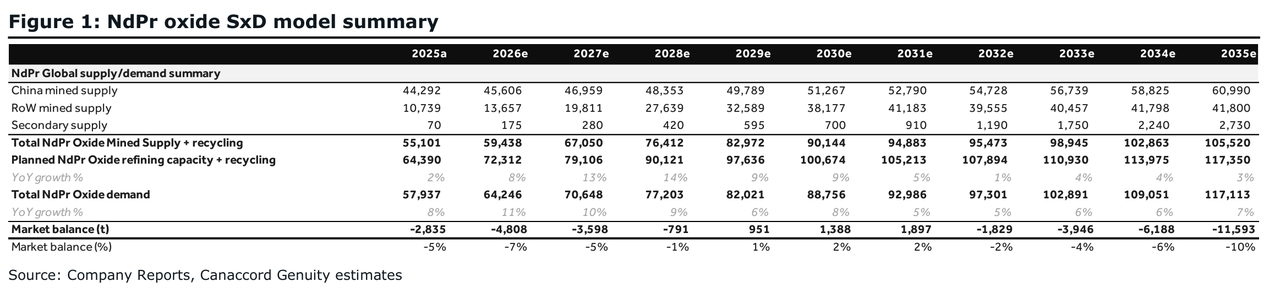
Netting it all out, Canaccord sees the global NdPr market in deficit through 2028 (about 7% short this year), roughly balanced in 2029-31 as Eneabba, Kangankunde, Caldeira, White Mesa and the Lynas expansions come online, and then sliding back into a deeper deficit: -10% by 2035. Dy+Tb follows the same shape, ending at a 12% deficit.
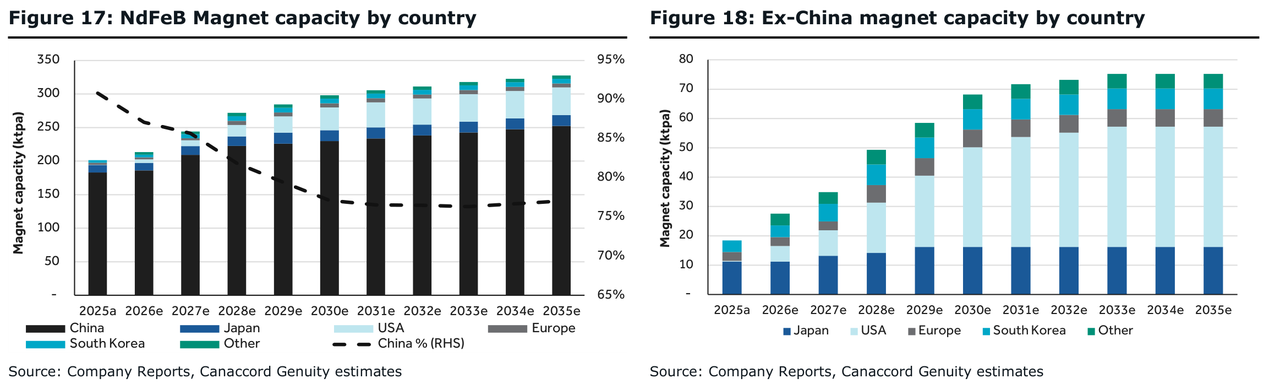
The bulls' case gets even stronger once you look past the mines. Canaccord forecasts ex-China NdFeB magnet capacity rising more than 300% by 2030 to about 70,000 tonnes, which sounds impressive until you realize it would still be only 23% of global capacity, with China at ~77%.
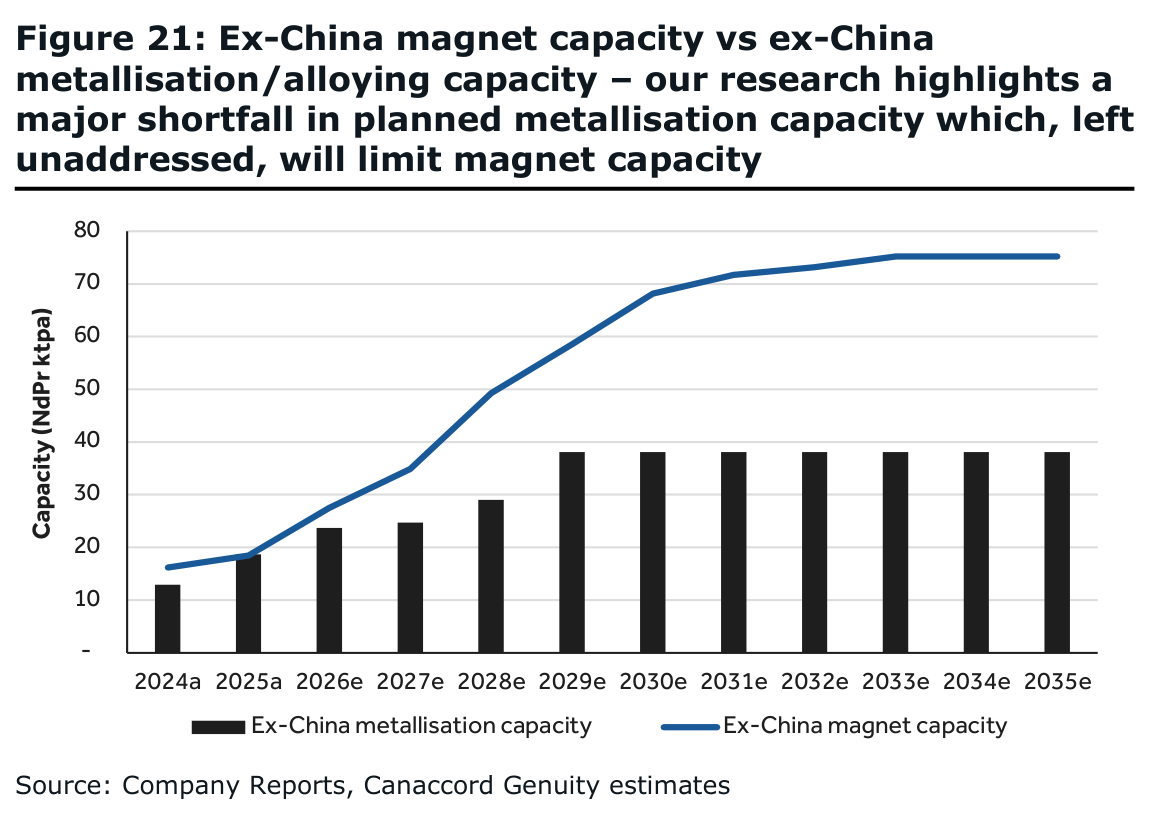
And the West may not even get there, because it is missing a step. Global NdFeB metallisation and alloying capacity is about 210,000 tonnes in 2026, and more than 90% of it is Chinese controlled. Ex-China capacity is set to roughly double to 38,000 tonnes by 2030, which falls well short of planned Western magnet capacity. Canaccord calls metallisation "a major blind spot in western supply chain development", and its channel checks found lead times of up to two years for strip casters, "with sourcing from China impossible under current export controls."
This echoes ING's warning, which we covered two weeks ago, that China's rare earth chokehold may outlast this decade because the bottleneck is "industrial rather than geological." Canaccord's conclusion is just as stark: "our research points to China maintaining market dominance, with shortfalls in Western supply (and likelihood of ongoing Chinese export controls) supporting bifurcated markets and pricing premiums."
Translation: the scarcity premium for anything mined, separated or metallised outside China is a structural feature that will be around for years, and the companies capturing it are trading as if it will be gone by next quarter.
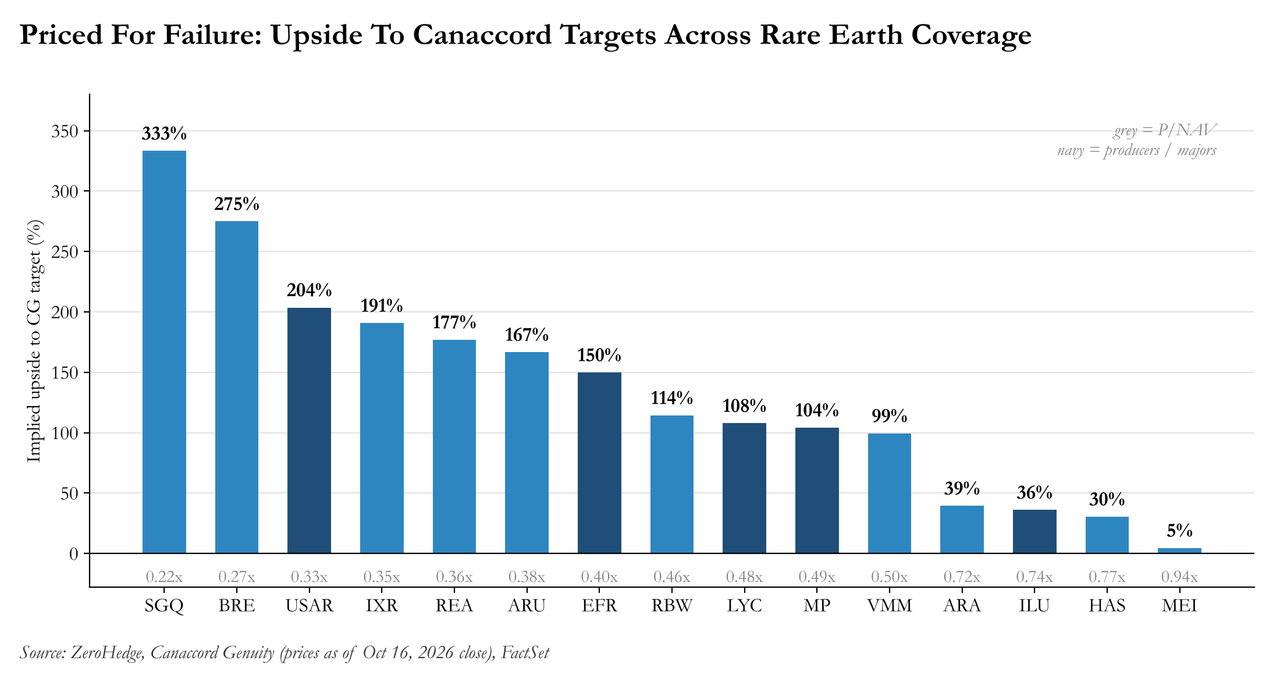
Which brings us to valuation. Canaccord's producer coverage trades at an average 0.57x P/NAV and its developers at 0.47x. On the bank's targets, MP has 104% upside, Lynas 108% (target raised to A$23), USA Rare Earth 204% and Energy Fuels 150%, even after Canaccord cut its EFR target to C$30 on project delays.
The rating changes: Meteoric (MEI) goes to Hold from Spec Buy, since its value is now tied to Lynas' all-scrip takeover at 0.0207 LYC shares per MEI share. (Lynas shares fell almost 8% the day that deal was announced, another reminder that this market keeps punishing consolidation.) Hastings (HAS) goes to Spec Buy from Hold "on valuation", even though its target was cut to A$0.30 from A$0.55, which tells you just how far the stock has fallen.
Of course, price targets have a habit of following prices rather than leading them, and at least some of the selloff has a perfectly sensible explanation: these are long-duration, capex-heavy projects at a time when the 10Y is above 5%, tech is wobbling and the bid for anything speculative has evaporated. Canaccord concedes as much, blaming "global macroeconomic pressures."
Tungsten isn't a rare earth, but it is a critical material with the same chokepoint (China controls roughly 80% of supply, per Jefferies), and it shows the exact same disconnect, only worse. Take Almonty Industries (ALM), the most prominent Western tungsten miner and a name we have covered extensively in recent weeks.
When Goldman's Nick Cash initiated coverage last month, he put Almonty "at the center of the Western tungsten investment narrative," with tungsten prices up 8x since the start of 2025. He was also the Street's skeptic, expecting prices to normalize and Sangdong's ramp to run slower than the market hoped, with a $13 target vs a $24.73 consensus. The stock was $12.74 that morning. Today it is below $9, down 62% from its April peak and back where it started the year, after dropping another 10% on the day of yesterday's Investor Day. So even Goldman's cautious target now implies about 45% upside.
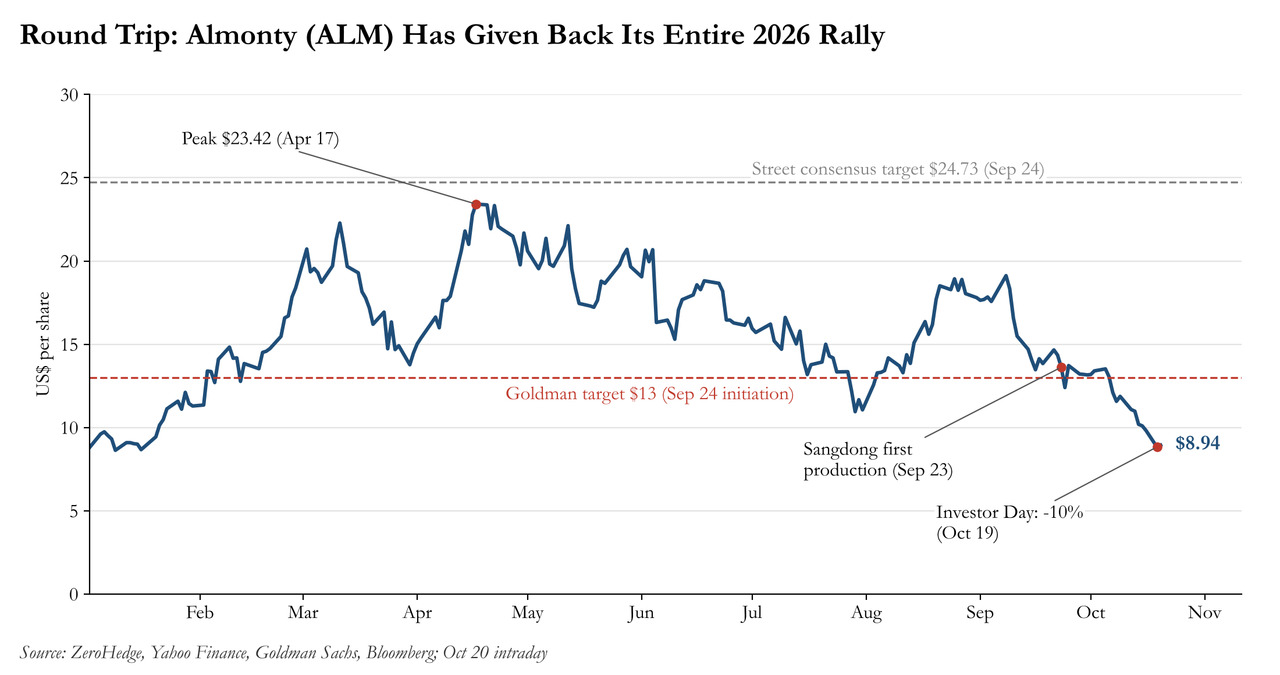
Meanwhile the operations are going the right way. Sangdong in South Korea started production in September and is moving toward 24/7 operations, with its first concentrate shipment due later this month, and Cantor's Matthew O'Keefe models output jumping from 126,287 MTU this year to 444,400 MTU in 2027, with all-in sustaining costs falling from $905 to $319 per MTU. Oppenheimer's Ian Zaffino puts the shares at just 5.7x/4.2x FY27/FY28 EBITDA, with roughly $290 million in net cash.
So what spooked the market? Spot prices. Western APT has slipped from $3,140 to about $2,700/MTU, and Chinese prices have retreated even more sharply. But Zaffino explains why that is a misleading signal: Western APT and oxide plants are running at capacity under long-term contracts and can't absorb more concentrate, so "concentrate prices have softened, even as availability of finished APT/oxide in the West remains constrained." And the demand wave hasn't even started. On January 1, 2027, US defense procurement rules extend to tungsten mining, refining and separation, so Chinese or Russian ore processed in a third country no longer qualifies. Stifel says the US strategic tungsten stockpile is nearly depleted, and Bernstein sees the Western rearmament order boom running from 2027 through 2030. The cherry on top: on Monday, CME announced plans to launch tungsten futures by early Q1 2027 at the latest (subject to regulatory review), which tells you how seriously the market's plumbing is taking a metal that equity investors are currently dumping.
In other words, spot is pricing today's bottleneck in Western processing, and the stock is pricing spot, while the 2027 demand cliff is priced almost nowhere. Sound familiar?
Goldman, for its part, thinks the debate has already shifted. Its third Global Metals & Mining Conference kicks off in London today during LME Week, bringing together the world's largest "diversified, copper, aluminium, rare earth and lithium producers." In their conference preview, Goldman's Matt Greene and the bank's mining team write that "the conversation has increasingly shifted to supply," with governments "becoming more active participants in the mining sector through faster permitting, shared infrastructure, strategic funding, price floors and direct offtake agreements, reflecting the growing importance of resource security." The question the bank poses is the right one: "whether the industry can deliver the supply that markets are increasingly pricing in."
For rare earths, the honest answer seems to be: not anytime soon, and not without China. Which is exactly why the sector's stocks probably shouldn't be trading at half of NAV.
We have seen this movie before. Back in March we reported that the US reportedly had just two months of rare earths left, and in July that China's "killer chokepoint" was reshaping the global economy. Each time the physical market tightened, and when Washington finally stepped in (see last July's MP deal), the equities caught up violently.
Today we have a two-month trade truce that expires January 10, a Japanese government begging for yttrium, the West's flagship tungsten miner trading below even Goldman's skeptical target ten weeks before the Pentagon's sourcing rules kick in,a floor price that has turned NdPr into a one-way bet with a safety net, and an equity market that is valuing the West's only scalable non-Chinese suppliers at roughly half of what they're worth on conservative assumptions.
Canaccord's closing line sums it up: "We expect demand to remain strong, as the West looks to secure ex-China supply and build its independence within the global magnet supply chain."
Our take: the disconnect will probably close the same way it did last summer, with a headline out of Beijing or the Pentagon, and the investors waiting for macro to give them the all-clear will be buying it 50% higher. After all, nothing cures a 0.5x P/NAV like a 346x price premium.
More in the full Canaccord note "Rare Earths: Equity disconnect from strong market fundamentals", available to pro subs.
Tyler Durden Tue, 10/20/2026 - 17:40
Continue reading...
[ H/T ZeroHedge ]
Here is a question that should be harder to answer than it is: China still controls the rare earth spigot, the latest Trump-Xi summit did nothing to loosen its grip, Japan is about to run out of yttrium, Washington has put a $110/kg floor under NdPr, and Western buyers are paying anywhere from 5x to 346x the Chinese price for heavy rare earths.
So why are rare earth stocks down on the year?
That is the question Canaccord's critical minerals team led by Reg Spencer asks in an overnight note titled "Rare Earths: Equity disconnect from strong market fundamentals", and the answer is blunt:
In other words, the commodity is acting like a strategic asset and the stocks are trading like a risk-off casualty. The numbers are stark: year to date, the ex-China NdPr price is up 23%, while Canaccord's rare earth developers are down 17% on average and its producers are down 28%.
We have been tracking the rare earth theme since long before China started rationing exports to the West in late 2024, and back in July 2025 we laid out "The Coming Rare Earth Revolution And How To Profit", flagging MP Materials as the stock best positioned to benefit. A few hours later the Pentagon announced its MP deal, and well we allowed ourselves a modest victory lap:
Fifteen months later, MP trades at $40.17, about half of Canaccord's $82 target. So what happened?
The Chart That Says It All
Canaccord's chart below shows the problem in one picture. Chinese NdPr (black) and Rotterdam NdPr (dark blue) have converged and climbed steadily all year, with the Western price now above $110/kg. Meanwhile the REMX ETF (light blue) peaked in May and has since slid from above $100 to the high-$50s.
The carnage is broad. On the producer side, Lynas, MP, USA Rare Earth and Iluka are all deep in the red, and even China Northern Rare Earth and Shenghe are lower on the year. Diversification at its finest.
Developers did a bit better on average, mostly thanks to Viridis (VMM), which is still up well over 50% on the year. Strip that out and the picture is grim: Hastings is down roughly two-thirds, St George about half, and Arafura and Brazilian Rare Earths 35-50%.
Canaccord's verdict: "We question how equities have performed so poorly YTD despite strong underlying market fundamentals." Those fundamentals include recent sector M&A, direct government support, a scarcity of Western supply and "ex-China NdPr pricing up 23% YTD."
The Floor Works... Just Ask China
Start with the most important structural change of the past year. As we reported when the Department of Defense set a price floor last August, Washington has moved from financing Western supply to underwriting its economics. Canaccord tallies the floors: US$110/kg NdPr for MP (DoD), Lynas (Japan, US, plus upside sharing) and USA Rare Earth, which also gets US$575/kg for dysprosium and US$2,050/kg for terbium.
And the floor has done something nobody expected: it has tamed the Chinese price too. For years Beijing used export quotas, policy changes and, more recently, export controls to whipsaw NdPr from about $175/kg down to around $50 and back again. Over the past 10 months, Canaccord notes, Chinese pricing has "begun to normalise around the US$110/kg floor price level."
Put differently, the volatility that made rare earth projects unbankable has largely vanished, and yet investors are paying less for those projects than they did in January.
Two Markets, Two Prices
NdPr is now a one-price market, more or less. Everything heavier is a different story. Since Beijing started rationing heavies, the West has developed its own (thin, opaque) price for anything China won't ship, and the gaps are absurd. Rotterdam dysprosium sits around $1,074/kg vs $227 in China, and terbium at $4,594 vs $983.
But Dy and Tb are the tame ones. Canaccord now forecasts yttrium, gadolinium and samarium for the first time, and the Western premiums there are almost comical. Chinese yttrium oxide has averaged about $8/kg over the past five years, while European spot is "~US$740/kg", a premium of 85x, and "some price reporting agencies have quoted US prices of up to US$1,750/kg." Gadolinium trades about 10x China in Baltimore, with US CIF quotes as high as $3,100/kg.
We ran Canaccord's own spot price table through the calculator, and here is what the "dual market" looks like element by element. CIF North America samarium, used in the SmCo magnets that go into missiles, fighter jets and radar, trades at 346 TIMES THE CHINESE PRICE!
And the squeeze is very real. Just this morning the FT reported that Japan has made an urgent request to Washington and global companies to help resolve its yttrium crisis, warning of a severe shortage by year-end. "Inventories are plummeting," one official said. Per Argus, yttrium oxide costs about $9/kg in China and roughly $1,150/kg outside it, a 179-fold jump in two years. A senior US official added that China is shipping the US just two-thirds of the rare earths it promised under last October's truce, and Japan "only the bare minimum." That followed last month's Trump-Xi summit, where China pledged to buy US coal but fell short on rare earths, and the two sides settled for a two-month truce that markets promptly faded.
To be fair, Canaccord is careful here. It notes the ex-China DyTb market was just 151 tonnes in 2025, and China's was 22x larger. It warns that Western premiums "should be viewed cautiously" and that "we question whether pricing is sustainable at these levels," with some magnet makers already pivoting to lower-cost ferrite magnets. Its own price deck has ex-China yttrium falling from $740/kg this year to $100 by 2030. Still, even the bank's haircut numbers leave Western producers with integrated separation (it names Lynas and MP) earning premiums nobody would have modeled two years ago.
Demand Goes Up, Again
Meanwhile the demand side keeps getting revised higher. Canaccord now sees NdFeB magnet demand growing at a 7.3% CAGR to ~365,000 tonnes by 2035, 15% above its prior update. EVs remain the anchor (52 million units by 2035 vs 23.5 million in 2026), but the bank has added data centers (motors for cooling), e-bikes and scooters, and drones. Drones are only ~1% of forecast demand, but the bank notes that Ukrainian and Russian military drone production alone was estimated at ~9 million units, so "our model forecasts may prove conservative."
Then there are the robots. Canaccord models humanoid deliveries growing at a 45% CAGR to 2.5 million units by 2035, and points out that Tesla is reportedly preparing an Optimus line designed for 1 million robots a year. For comparison, global EV sales rose more than 4,600% from 2014 to 2024. Maybe the robot curve won't look like that... but if it does, the magnet math gets very ugly very quickly.
Netting it all out, Canaccord sees the global NdPr market in deficit through 2028 (about 7% short this year), roughly balanced in 2029-31 as Eneabba, Kangankunde, Caldeira, White Mesa and the Lynas expansions come online, and then sliding back into a deeper deficit: -10% by 2035. Dy+Tb follows the same shape, ending at a 12% deficit.
The West's Blind Spot
The bulls' case gets even stronger once you look past the mines. Canaccord forecasts ex-China NdFeB magnet capacity rising more than 300% by 2030 to about 70,000 tonnes, which sounds impressive until you realize it would still be only 23% of global capacity, with China at ~77%.
And the West may not even get there, because it is missing a step. Global NdFeB metallisation and alloying capacity is about 210,000 tonnes in 2026, and more than 90% of it is Chinese controlled. Ex-China capacity is set to roughly double to 38,000 tonnes by 2030, which falls well short of planned Western magnet capacity. Canaccord calls metallisation "a major blind spot in western supply chain development", and its channel checks found lead times of up to two years for strip casters, "with sourcing from China impossible under current export controls."
This echoes ING's warning, which we covered two weeks ago, that China's rare earth chokehold may outlast this decade because the bottleneck is "industrial rather than geological." Canaccord's conclusion is just as stark: "our research points to China maintaining market dominance, with shortfalls in Western supply (and likelihood of ongoing Chinese export controls) supporting bifurcated markets and pricing premiums."
Translation: the scarcity premium for anything mined, separated or metallised outside China is a structural feature that will be around for years, and the companies capturing it are trading as if it will be gone by next quarter.
Wall Street Is Paying 50 Cents On The Dollar
Which brings us to valuation. Canaccord's producer coverage trades at an average 0.57x P/NAV and its developers at 0.47x. On the bank's targets, MP has 104% upside, Lynas 108% (target raised to A$23), USA Rare Earth 204% and Energy Fuels 150%, even after Canaccord cut its EFR target to C$30 on project delays.
The rating changes: Meteoric (MEI) goes to Hold from Spec Buy, since its value is now tied to Lynas' all-scrip takeover at 0.0207 LYC shares per MEI share. (Lynas shares fell almost 8% the day that deal was announced, another reminder that this market keeps punishing consolidation.) Hastings (HAS) goes to Spec Buy from Hold "on valuation", even though its target was cut to A$0.30 from A$0.55, which tells you just how far the stock has fallen.
Of course, price targets have a habit of following prices rather than leading them, and at least some of the selloff has a perfectly sensible explanation: these are long-duration, capex-heavy projects at a time when the 10Y is above 5%, tech is wobbling and the bid for anything speculative has evaporated. Canaccord concedes as much, blaming "global macroeconomic pressures."
Same Disconnect, Different Metal
Tungsten isn't a rare earth, but it is a critical material with the same chokepoint (China controls roughly 80% of supply, per Jefferies), and it shows the exact same disconnect, only worse. Take Almonty Industries (ALM), the most prominent Western tungsten miner and a name we have covered extensively in recent weeks.
When Goldman's Nick Cash initiated coverage last month, he put Almonty "at the center of the Western tungsten investment narrative," with tungsten prices up 8x since the start of 2025. He was also the Street's skeptic, expecting prices to normalize and Sangdong's ramp to run slower than the market hoped, with a $13 target vs a $24.73 consensus. The stock was $12.74 that morning. Today it is below $9, down 62% from its April peak and back where it started the year, after dropping another 10% on the day of yesterday's Investor Day. So even Goldman's cautious target now implies about 45% upside.
Meanwhile the operations are going the right way. Sangdong in South Korea started production in September and is moving toward 24/7 operations, with its first concentrate shipment due later this month, and Cantor's Matthew O'Keefe models output jumping from 126,287 MTU this year to 444,400 MTU in 2027, with all-in sustaining costs falling from $905 to $319 per MTU. Oppenheimer's Ian Zaffino puts the shares at just 5.7x/4.2x FY27/FY28 EBITDA, with roughly $290 million in net cash.
So what spooked the market? Spot prices. Western APT has slipped from $3,140 to about $2,700/MTU, and Chinese prices have retreated even more sharply. But Zaffino explains why that is a misleading signal: Western APT and oxide plants are running at capacity under long-term contracts and can't absorb more concentrate, so "concentrate prices have softened, even as availability of finished APT/oxide in the West remains constrained." And the demand wave hasn't even started. On January 1, 2027, US defense procurement rules extend to tungsten mining, refining and separation, so Chinese or Russian ore processed in a third country no longer qualifies. Stifel says the US strategic tungsten stockpile is nearly depleted, and Bernstein sees the Western rearmament order boom running from 2027 through 2030. The cherry on top: on Monday, CME announced plans to launch tungsten futures by early Q1 2027 at the latest (subject to regulatory review), which tells you how seriously the market's plumbing is taking a metal that equity investors are currently dumping.
In other words, spot is pricing today's bottleneck in Western processing, and the stock is pricing spot, while the 2027 demand cliff is priced almost nowhere. Sound familiar?
Supply Security Gets The Stage In London
Goldman, for its part, thinks the debate has already shifted. Its third Global Metals & Mining Conference kicks off in London today during LME Week, bringing together the world's largest "diversified, copper, aluminium, rare earth and lithium producers." In their conference preview, Goldman's Matt Greene and the bank's mining team write that "the conversation has increasingly shifted to supply," with governments "becoming more active participants in the mining sector through faster permitting, shared infrastructure, strategic funding, price floors and direct offtake agreements, reflecting the growing importance of resource security." The question the bank poses is the right one: "whether the industry can deliver the supply that markets are increasingly pricing in."
For rare earths, the honest answer seems to be: not anytime soon, and not without China. Which is exactly why the sector's stocks probably shouldn't be trading at half of NAV.
When Macro Lets Go
We have seen this movie before. Back in March we reported that the US reportedly had just two months of rare earths left, and in July that China's "killer chokepoint" was reshaping the global economy. Each time the physical market tightened, and when Washington finally stepped in (see last July's MP deal), the equities caught up violently.
Today we have a two-month trade truce that expires January 10, a Japanese government begging for yttrium, the West's flagship tungsten miner trading below even Goldman's skeptical target ten weeks before the Pentagon's sourcing rules kick in,a floor price that has turned NdPr into a one-way bet with a safety net, and an equity market that is valuing the West's only scalable non-Chinese suppliers at roughly half of what they're worth on conservative assumptions.
Canaccord's closing line sums it up: "We expect demand to remain strong, as the West looks to secure ex-China supply and build its independence within the global magnet supply chain."
Our take: the disconnect will probably close the same way it did last summer, with a headline out of Beijing or the Pentagon, and the investors waiting for macro to give them the all-clear will be buying it 50% higher. After all, nothing cures a 0.5x P/NAV like a 346x price premium.
More in the full Canaccord note "Rare Earths: Equity disconnect from strong market fundamentals", available to pro subs.
Tyler Durden Tue, 10/20/2026 - 17:40
Continue reading...
[ H/T ZeroHedge ]