


October 2026 saw the suspension of the silent 5th Generation WW3 which began with Covid in 2020 and which I call an Interregnum. We now move to a new phase; warfare or negotiated peace?
Protect & SurviveThe Financial Jigsaw Part 3, Episode (1): Opens with a note about the historic, anticipated, and hopeful Trilateral Meeting in Shenzen, China. The question I always ask is: “Why now?” Karl Sanchez writes: “What made the anticipated and hopeful Trilateral Meeting between Presidents Putin, Xi and Trump at the APEC Summit in Shenzen a marker instead of a turning point happened prior to their meeting—the NATO/EU Reich attack on the Kerch Bridge. It signalled President Trump’s lack of agency and control over the CIA/Deep State nexus that organised and executed the attack. All Trump could do was muster a weak condemnation of Zelensky.” Which leads me on to address the problem of who or what actually rules our world today.
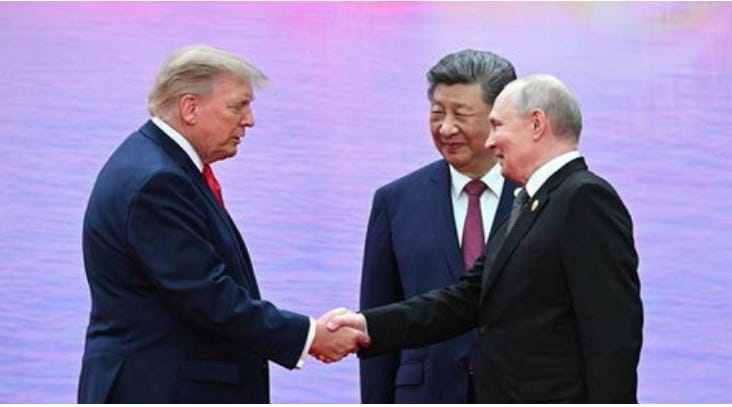
The leaders of Russia, America, and China held their first ever trilateral talks over two days this week on the sidelines of the Asia-Pacific Economic Cooperation (APEC) Summit. Global security, trade, and international cooperation were among the key issues on the agenda in Shenzhen, China. This marks the start of a new era in global geopolitics with many conflicts left to be settled through either outright war or peaceful negotiation. The two regional wars, Ukraine and Iran, remain unresolved together with many other conflicts around the world, emphasising the extreme risks to world peace to be faced as we approach the New Year.
The 33rd APEC Economic Leaders’ Meeting, which opened on Wednesday, brings together 21 Asia-Pacific economies accounting for more than 60% of global GDP and around half of world trade. Held under the theme ‘Building an Asia-Pacific Community to Prosper Together’, the two-day gathering also focused on innovation, digital technologies, and closer regional integration.
Austrian’s Newsletter is a reader-supported publication. To receive new posts and support my work, consider becoming a free or paid subscriber.
This summit is exceptionally important, and its main outcome and contribution to the world order will be agreement among the world’s three leading powers on the need to maintain normal, manageable relations between them and to prevent war. The summit is a vivid illustration of the current global balance of power. It underscores that the three leading powers in the world are indeed the United States, China, and Russia. They really do play the leading role in world politics and international security. Sources
- An absolutely unprecedented event’: Experts react to Putin-Trump-Xi meeting https://rt-english.com/news/648991-absolutely-unprecedented-event-russian-experts/
- No1 Substack reported Friday: Shenzhen result was a four-point “Declaration toward Peace” naming neither Ukraine nor Iran:
- Shenzhen’s Diplomatic Tightrope: Why a Swift Close to the Trilateral Serves the Interests of APEC by Einar Tangen https://asianarratives.substack.com/p/shenzhens-diplomatic-tightrope?
- Scott Ritter: Shenzhen was the first step away from WW3 https://rt-english.com/news/649154-shenzhen-world-war-iii/
- What made the anticipated and hopeful Trilateral Meeting in Shenzen a marker instead of a turning point happened prior to their meeting—the NATO/EU Reich attack on the Kerch Bridge

EXCEPT, in the Final Analysis; They are still Taking their Orders from the Usual Suspects

The concentration of financial and corporate power raises fundamental questions about who ultimately controls the global economy. While commercial banks create money through lending, the ownership and influence of major banks, investment institutions, and transnational corporations represent another important dimension of the modern economic system. A recent article explains, The Boom-Bust-Bailout System: How Private Banking Losses Become Public Debt, the debt/money banking system, the boom-bust-bailout/in cycle, and the contrasting responses of Ireland and Iceland to the 2008 banking crisis.
The relationship between monetary power, corporate ownership, and financial influence, in landmark research identifies a highly interconnected network or super-entity of 147 corporations, and the substantial voting authority exercised by major asset management companies such as BlackRock. These subjects, including the Swiss research, were also examined in February 2025, Who Owns the World? The Boom-Bust Bailout Process that Placed Nations in Debt.

The power to create money ex nihilo gives control and manipulation over asset prices, media and politics regardless of which system is used, be it capitalism, socialism, communism, or variations thereof. Thus most of our lives are in reality controlled by unelected ‘Masters of the Financial Universe’ – in essence the bankers. A short clip from long ago describes its nature: (Hat Tip Reader James) Sorry, the video didn’t run, too old I guess!
A hierarchy of control creates the lowest level for the vast mass of humanity who are managed by governments, which create nothing, but hold a monopoly to force taxation and control of a population. In a ‘representative democracy’ the illusion of ‘Power to the People’ exists but ‘The Establishment of Permanent Bureaucracy’ decides all policy regardless of the people’s consent or which colour of government is elected.
But who controls The Establishment? Under a fiat money system governments are free to borrow money from the bankers as needed by issuing bonds (debts with a promise to repay at a given date). It is not the people of the nations that control governments, and it became so obvious during the GFC in 2008, when governments simply complied with the wishes of the transnational private banking cartel.
At a higher level of the pyramid of control are the global corporations financed, by the private global central banking system, and with the Bank for International Settlements (BIS) as the central bankers’ central bank. Over the centuries, these corporations, having acquired ‘personhood’ through the laws of Limited Liability, have gained ownership of the world’s resources and exercise control over global markets. https://austrianpeter.substack.com/p/the-financial-jigsaw-part-2-83-limited?
“Whoever controls the volume of money in any country is absolute master of all industry and commerce.. when you realise that the entire system is very easily controlled, one way or another, by a few powerful men at the top, you will not have to be told how periods of inflation and depression originate.“ [James Garfield (20th President of the United States of America (assassinated 1881).]
In addition, Congressman Charles McFadden, Chairman, House Banking and Currency Committee, June 10, 1932 said: “Some people think the Federal Reserve Banks are U.S. governments institutions. They are not… they are private credit monopolies which prey upon the people of the U.S. for the benefit of themselves and their foreign and domestic swindlers, and rich and predatory money lenders… These twelve private credit monopolies were deceitfully foisted upon this Country by the bankers who came here from Europe and repaid us our hospitality by undermining our American Institutions… The sack of the United States by the FED is the greatest crime in history. Every effort has been made by the FED to conceal its powers, but the truth is the FED has usurped the government. It controls everything here and it controls all foreign relations. It makes and breaks governments at will.” [Congressman Charles McFadden, 1032]. Demonic Economics and the Tricks of the Bankers.
The concentration of ownership and financial influence within the global banking and corporate system raises fundamental questions about economic power, corporate governance and democratic accountability. Major commercial banks, investment institutions and asset management companies are connected through extensive networks of shareholdings, finance arrangements and investment relationships. Among the largest global financial institutions are BlackRock, Vanguard, State Street, JPMorgan Chase, and Goldman Sachs.
Large asset management companies generally manage investments on behalf of clients, pension funds, institutions, and individual investors. Voting authority is delegated to these institutions and they exercise considerable influence over corporate governance, board appointments and shareholder resolutions. In effect, the Limited Liability corporation can implement significant control whilst remaining a minority shareholder of the company with a vast network of subsidiaries and opaque financial vehicles.
This network of control is described so well in the series, The Wizard of Oz in 1900. Readers were instantly won over by Dorothy’s pluck and the fully realised Land of Oz. “The Wonderful Wizard of Oz” is often interpreted as an allegory for various political, economic, and social issues in America during the 1890s, including themes of populism and feminism. Scholars have explored its meanings through different adaptations, highlighting its ability to reflect diverse American fantasies and struggles.” [ Wikipedia]
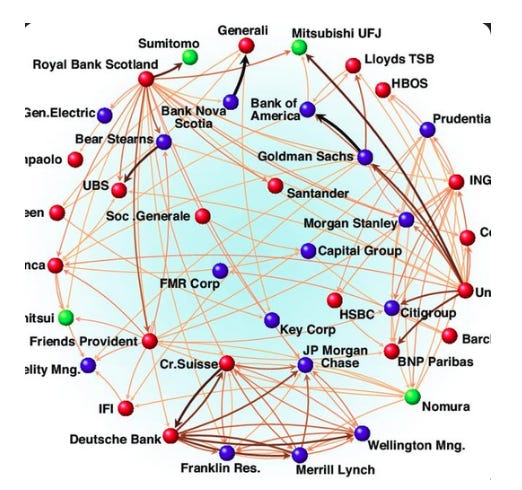
The structure of the control network of transnational corporations affects global market competition and financial stability. So far, only small national samples were studied and there was no appropriate methodology to assess control globally. Presented, is the first investigation of the architecture of the international ownership network, along with the computation of the control held by each global player. We find that transnational corporations form a giant ‘bow-tie’ structure and that a large portion of control flows to a small, tightly-knit core of financial institutions. This core can be seen as an economic ‘‘super-entity’’ (PDF) The Network of Global Corporate Control: https://www.researchgate.net/publication/51761051_The_Network_of_Global_Corporate_Control
“Certainly, it is intuitive that every large transnational corporation (TNC) has a pyramid of subsidiaries below and a number of shareholders above. However, economic theory does not offer models that predict how TNCs globally connect to each other. Three alternative hypotheses can be formulated. TNCs may remain isolated, cluster in separated coalitions, or form a giant connected component, possibly with a core-periphery structure. So far, this issue has remained unaddressed, notwithstanding its important implications for policy making. Indeed, mutual ownership relations among firms within the same sector can, in some cases, jeopardize market competition [13,14].”
“Moreover, linkages among financial institutions have been recognized to have ambiguous effects on their financial fragility [15,16]. Verifying to what extent these implications hold true in the global economy is per se an unexplored field of research and is beyond the scope of this article. However, a precondition to such investigations is to uncover the worldwide structure of corporate control.”
“A second question concerns what share of total control each component of the bow-tie holds. We find that, despite its small size, the core holds collectively a large fraction of the total network control. In detail, nearly 4/10ths of the control over the economic value of TNCs in the world is held, via a complicated web of ownership relations, by a group of 147 TNCs in the core, which has almost full control over itself. The top holders within the core can thus be thought of as an economic ‘‘super-entity’’ in the global network of corporations. A relevant additional fact at this point is that three quarters of the core are financial intermediaries. The figure above shows a small subset of well-known financial players and their links, providing the level of entanglement of the entire core.”
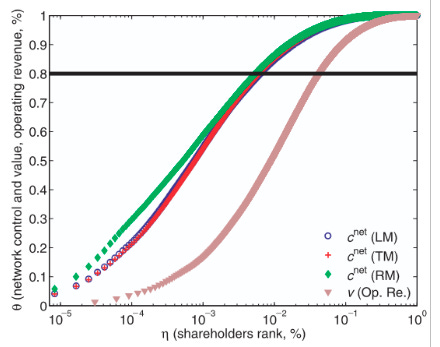
Figure above: “Concentration of network control and operating revenue. Economic actors (TNCs and shareholders) are sorted by descending importance, as given by cnet. A data-point located at (g,h) corresponds to a fraction g of top economic actors cumulatively holding the fraction h of network control, value or operating revenue. The different curves refer to network control computed with three models (LM, TM, RM), see Appendix S1, Section 3.1, and operating revenue. The horizontal line denotes a value of h equal to 80%. The level of concentration is determined by the g-value of the intersection between each curve and the horizontal line. The scale is semi-log. [doi:10.1371/journal.pone.0025995.g003]”
In essence, this is a worldwide privately-owned, self-reinforcing entity under the tentacles of many financial corporations. Significantly, around 3/4ths of this tightly interconnected core consisted of financial intermediaries including Barclays Bank, JPMorgan Chase & Co, and The Goldman Sachs Group. According to James B. Glattfelder, one of the authors of the study: “In effect, less than 1% of the companies were able to control 40% of the entire network.” Author Dean Henderson writes:
“The Four Horsemen of Banking (Bank of America, JP Morgan Chase, Citigroup and Wells Fargo)… According to company 10K filings to the SEC, the Four Horsemen of Banking are among the top ten stock holders of virtually every Fortune 500 corporation… One important repository for the wealth of the global oligarchy that owns these bank holding companies is US Trust Corporation – founded in 1853 and now owned by Bank of America. A recent US Trust Corporate Director and Honorary Trustee was Walter Rothschild…”
Furthermore, according to Ellen Brown, chairperson of the Public Banking Institute in the U.S. asset management companies, such as BlackRock, literally own much of the U.S. and the world. She states:
“BlackRock has a controlling interest in all the major corporations in the S&P 500, it professes not to “own” the funds. It just acts as a kind of “custodian” for its investors — or so it claims. But BlackRock and the other Big 3 ETFs (Exchange Traded Funds) vote the corporations’ shares; so from the point of view of management, they are the owners. And as observed in a 2017 article from the University of Amsterdam titled These Three Firms Own Corporate America they vote 90% of the time in favor of management.”
In a 2018 review titled “BlackRock – The Company That Owns the World”, a multinational research group called ‘Investigate Europe’ concluded that BlackRock “undermines competition through owning shares in competing companies”. The major shareholders of BlackRock are all transnational banks and financial corporations, such as Bank of America, JPMorgan Chase, Citi Group, Wells Fargo and Co, Morgan Stanley, and various other banks. Thus, privately owned commercial banks own BlackRock and the other major asset management companies that own most of the world. The figures describe the ownership network examined at that time and should not be interpreted as a direct measurement of corporate control in 2026.
Author Karen Hudes, who worked in the legal department of the World Bank for more than 20 years, has cited the above study during an interview with the New American. According to Hudes: “What is really going on is that the world’s resources are being dominated by this group,” and that “corrupt power grabbers” have managed to dominate the media and control the finances of virtually every nation in the world. These organisations include The World Bank, the IMF, the BIS, and central banks, such as the Federal Reserve, all of which are unelected and unaccountable.
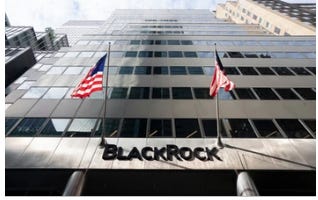
The activities of major investment management companies provide a contemporary illustration of the relationship between asset management and corporate influence. According to BlackRock’s 2025 annual report the company managed approximately $14tn in assets at the end of December 2025. These assets are mainly managed on behalf of clients rather than being owned outright by BlackRock itself. Nevertheless, the management of such extensive investment portfolios can confer substantial influence through shareholder voting, corporate engagement and investment stewardship.
BlackRock acknowledges that its investment stewardship teams engage with corporate management and exercise shareholder voting rights on behalf of clients who authorise them to do so. The company has also expanded arrangements allowing eligible clients to select their own voting policies through its ‘BlackRock Voting Choice’ programme. This illustrates both the substantial voting responsibilities exercised by investment managers and the distinction between delegated voting authority and ultimate beneficial ownership.
The broader question is therefore, not simply who legally owns the shares in the world’s largest corporations, but who exercises the voting rights associated with those shares, how that authority is distributed, and what mechanisms exist to ensure accountability.
The significance of this research lies not merely in identifying concentrated corporate ownership, but in demonstrating how interconnected financial institutions can occupy central positions within the wider global economy. This raises further questions, to be explored, about how the concentration of financial influence interacts with the debt-based monetary system, and what happens when the risks generated within that system are ultimately transferred to taxpayers by government bailout/in, institutions, and what institutional safeguards are necessary to ensure transparency and protect the public interest. [To be continued] Sources
- Who Owns the World? The Concentration of Corporate and Financial Power https://www.globalresearch.ca/who-owns-world-concentration-corporate-financial-power/5945724
- In early 2020, the Global Elite launched its long-planned “depopulation agenda.” A primary intended outcome of this agenda was to enable the Elite to own and completely control use of the Earth’s remaining resources. https://www.globalresearch.ca/terri...-embracing-global-elite-technotyranny/5783361
AFTERWORD: IRAN: “The Shenzhen trilateral did not include Iran in the first ever meeting between sitting US, Russian and Chinese presidents (KobeissiLetter), and the Kremlin allotted one hour (zerohedge). Putin opened with “our three states are the victors in World War 2” (Osint613).”
NATO is formally changing its strategic planning to prioritise fighting Russia over conducting wars of aggression against much weaker opponents, source https://www.globalresearch.ca/nato-...-over-usual-neo-colonial-racketeering/5945779
POSTSCRIPT (Friday, November 20): “Russia answered the Crimean Bridge strikes overnight with 117 missile barrage that hit Kyiv’s Dnieper bridges and the western grid, and put a Kh-101 down inside Poland. At the same time Iran massed tankers to run the US blockade, and Trump pushed any strike decision past January 1. Anthropic’s record IPO popped 39% and then faded into a sixth straight S&P loss and an Asian rout, while gold and silver flushed to fresh cycle lows overnight even as retail bullion sold out.” [Hat Tip No1 Substack]
REFERENCES
- “The Financial Jigsaw Part 1” https://www.researchgate.net/publication/358117070_THE_FINANCIAL_JIGSAW_-_PART_1_-_4th_Edition_2020 including regular updates.
- Austrian Newsletter Archive https://www.theburningplatform.com/author/austrian-peter/
- BOOM Finance and Economics | Designed for Critical Thinkers
Tweet
Continue reading...
[ H/T The Burning Platform ]