


The Fall Of Europe
Authored by Milton Madriz Cedeño via The Daily Sceptic,
Europe is falling because it has confused the management of inherited wealth with the ability to create new wealth. Part of its political leadership turned public spending, proliferating rules, excessive regulation and presumed moral superiority into sufficient credentials to govern. Productivity, solvency and social cohesion were pushed aside. Today they have returned to collect a bill that no amount of rhetoric can cancel.
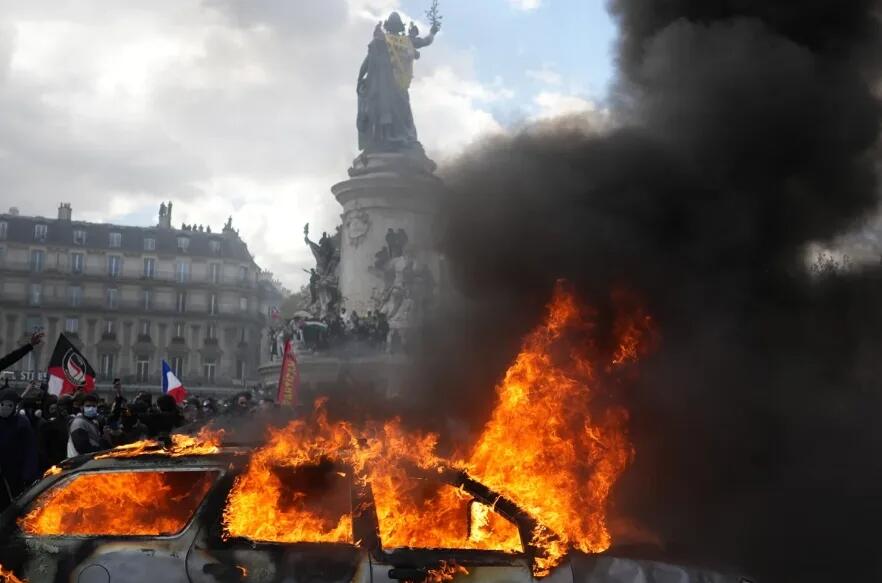
On October 24th, France recorded 410,000 demonstrators and 1,314 arrests, according to the Interior Ministry's provisional tally. After the previous weekend's protests, the trade minister estimated that at least 3,000 businesses had been affected, and historic buildings were destroyed. The authorities pointed to the involvement of radical far-Left groups in the attacks. In Milan, looting and destruction on October 17th and 18th caused damage to businesses that Confcommercio estimated at close to €1 million. Similar events took place in Rome. In Barcelona, on October 24th, 23 businesses were looted or vandalized, and firefighters were called out 33 times to fires in public streets.
Behind those figures lie livelihoods destroyed, business owners intimidated and public property attacked. People who keep a business running are expected to pay their taxes on time. The security they finance deserves the same promptness. Peaceful protest must be protected and vandalism punished with the utmost firmness. No cause turns someone else's business into legitimate spoils.
Fritz Scharpf explained that legitimacy also depends on the ability to solve problems. That is the corrosive contradiction of governments that collect vast sums yet struggle to guarantee services, opportunities and security. When the protection they promise deteriorates, their institutional rhetoric loses credibility.
Europe's postwar Left deserves unsparing scrutiny for defending spending and debt commitments without securing a sufficient productive base, turning regulations into displays of virtue and treating too many demands for integration as suspect and impractical. Responsibility also extends to the center-Right that preserved those policies or postponed reform. Since 2004, the European Commission has been led by figures from the center-Right European People's Party. Changing the letterhead does not erase the bill.
Mancur Olson studied how organized interests accumulate privileges and block adjustments that would benefit society as a whole. His warning sheds light on a Europe in which every protection finds defenders and every reform rallies opponents. Citizens pay for bargains they never negotiated. Acknowledging problems while systematically postponing their solution amounts to managing decline with impeccable manners.
In the second quarter of 2026, gross public debt amounted to 139.9% of GDP in Italy, 119.1% in France, 110.2% in Belgium and 101.4% in Spain, according to Eurostat. The United Kingdom recorded 100.5%, according to the ONS using a comparable measure. Spain's ratio had fallen year on year. The trajectories differ, but the fiscal constraints facing several major countries are plain to see.
France's public spending amounted to 57.3% of GDP in 2025, and it ended the year with a deficit of 5.1%. The size of the state does not guarantee balanced finances. High debt commits future resources and leaves less room to respond to crises. Its sustainability depends on growth, interest rates and budgetary discipline.
For a single person with no children earning the average wage, the OECD calculated a tax wedge of 52.5% of total labor costs in Belgium and 47.2% in France in 2025, compared with an OECD average of 35.1%. This includes taxes and contributions paid by employees and employers. Such a burden demands results, not indulgence.
Buchanan and Wagner analyzed the political incentive to grant benefits now and defer their costs. The officeholder receives the applause; a later budget receives the bill. A Left that proclaims itself the defender of the welfare state must explain how it will preserve it when its promises grow faster than the capacity to finance them and the difference is added to the debt.
Protecting pensions and essential services requires priorities and effectiveness. Shielding every budget line as a 'social achievement' can jeopardize the achievements that truly matter. The welfare state loses its foundation when its obligations rest on an economy that finds it increasingly difficult to renew itself.
The European Union's fertility rate fell to 1.34 children per woman in 2024; Spain recorded 1.10. At the beginning of 2025, 22% of the EU's population was aged 65 or older. Pension expenditure amounted to 12.3% of EU GDP in 2023. Living longer is an achievement; financing longer retirements requires productivity, employment and foresight.
Net immigration has offset the natural population decline, but increasing the number of residents and increasing the number of productive taxpayers are different processes. Formal employment and integration are essential. A serious family policy must also reduce the obstacles posed by housing, work and balancing employment with family life for those who want children. No population pyramid can be repaired with cheap speeches from the same old politicians.
The European Commission's January 2026 competitiveness report put the EU's hourly productivity, adjusted for purchasing power, at 78.5% of the US level in 2024. Venture capital represented just 0.06% of GDP, one tenth of the U.S. share. That weakness makes it harder to turn knowledge into businesses capable of growth.
A Joint Research Centre study published in 2022, using data through mid-2021, identified 40 relocations of headquarters abroad among 147 unicorn companies originating in the EU; 32 moved to the United States. The Draghi report reiterated that warning. Moving a headquarters does not mean closing all European operations, but it reveals the difficulty of retaining companies with substantial potential.
Switzerland and Sweden still lead WIPO's 2026 innovation index. Europe retains extraordinary capabilities. That makes it all the more serious that its leaders maintain obstacles to putting those capabilities to use. Talent and capital seek places where they can grow; they are under no obligation to finance any government's nostalgia.
According to the IEA, electricity for the EU's energy-intensive industries cost more than twice as much as in the United States in 2025. Germany completed its nuclear phaseout in 2023, following decisions by Social Democrats, Greens, and Merkel's center-Right. Retiring firm generating capacity with low emissions while promoting electrification demands answers about costs and alternatives. The promise of a cheap and straightforward transformation must answer for results that have yet to materialize.
The environmentalist Left must be held accountable for emissions, supply and the final price. Invoking the planet grants no immunity from bad industrial policy. Imports of electric vehicles manufactured in China also require scrutiny of the footprint of their factories and batteries. Social and environmental responsibility does not stop at the customs border.
In 2025, 45.3% of adults living in the EU who held non-EU citizenship were at risk of poverty or social exclusion, compared with 18.2% of nationals. Integration must be measured by employment, economic independence and civic participation. Solemn declarations of intent do not heal a fractured society.
In 2024-25, the United Kingdom spent around £4 billion supporting asylum seekers, including £2.1 billion on hotels. Receiving asylum seekers entails costs that must be acknowledged and financed. Concealing them harms both existing residents and newcomers.
Democratic authorities must exercise rigorous control over their borders, decide applications for protection and demand compliance with the law. Integration requires language skills, work and shared duties. A Left that discredits those requirements weakens the rules of coexistence it is obliged to defend, beginning with its own people.
Islamism that seeks to subordinate civil law to religious authority is wholly incompatible with Western freedoms. Equality for women and freedom of conscience are nonnegotiable. Muslim citizens share the same rights and obligations, including protection against those who would impose religious orthodoxy on them. Defending the Christian, humanist and liberal heritage requires institutions capable of protecting it, for this is the legacy of Western forebears who gave their lives for the freedoms and rights enjoyed today.
That is why I speak of a fall. The pretense of guaranteeing welfare through obligations without sufficient backing, securing competitiveness by multiplying obstacles and preserving coexistence without requiring duties has collapsed. The strengths Europe retains make its leadership more culpable. Western Rome, whose fall is dated to 476, left a warning that a heritage can outlive those who lose the ability to sustain it.
An economy that makes production more expensive and innovation harder loses ground to those offering better conditions. Competition for investment and knowledge thus opens an opportunity for the whole of the Americas. The continuity of the West will depend on societies capable of turning their freedoms into prosperity. That is the transfer of leadership the Americas must prepare to undertake.
Talent is nurtured in universities, technical institutes and research centers throughout the Americas. It is found in Canada and the United States, in Mexico, Central America and the Caribbean, in Colombia, Brazil, Argentina, Chile, Uruguay and the rest of South America. Differences in funding and scale call for cooperation. No country in the Americas should resign itself to exporting brains and buying back the products of their intelligence.
Brazilian engineering at Embraer, Argentine nuclear technology at INVAP and the antivenoms developed by the University of Costa Rica's Clodomiro Picado Institute demonstrate a homegrown ability to research, design and compete. They show that the Americas already produce knowledge and solutions for the world. Their universities and businesses can expand that role if they find the financing and conditions to grow.
Costa Rica, where I am based, exported $10.927 billion in medical devices in 2025, accounting for 48% of its goods exports. Panama connects oceans. The IEA identifies opportunities in Latin America to process minerals that currently leave for other regions. We have the resources and capabilities to put more knowledge into what we produce and retain more value within the Americas.
Our ambition must be to develop our own technologies, patents and businesses. Connecting markets, research and capital would allow us to combine energy, food and minerals more effectively with the scientific and industrial capabilities of the Americas. Every country must be able to expand its role in design, manufacturing and specialized services. Natural wealth takes on another dimension when its owners also master the knowledge that transforms it.
That project requires legal certainty, rigorous education, protection for investment and governments capable of controlling crime and delivering infrastructure without letting permits drag on forever. Someone else's decline does not create our prosperity. The Americas would squander their opportunity if they copied the fiscal and bureaucratic complacency that has weakened a declining Europe.
Our task is to build that leadership with the intelligence of the whole of the Americas and with the freedom of their citizens to create. The Western legacy needs societies capable of sustaining, enriching and carrying it forward. Europe's leaders must answer for having mortgaged their promise. It falls to the Americas to show that a civilization can also renew its greatness by shifting the center of its dynamism.
Europe may go on charging admission to its past. The Americas have what it takes to build the West's future.
Milton Madriz Cedeño is a Costa Rican political scientist and expert in public administration and governance. This is an edited English translation of an article that first appeared in DiarioDigitalRD.
Tyler Durden Thu, 10/29/2026 - 02:00
Continue reading...
[ H/T ZeroHedge ]
Authored by Milton Madriz Cedeño via The Daily Sceptic,
Europe is falling because it has confused the management of inherited wealth with the ability to create new wealth. Part of its political leadership turned public spending, proliferating rules, excessive regulation and presumed moral superiority into sufficient credentials to govern. Productivity, solvency and social cohesion were pushed aside. Today they have returned to collect a bill that no amount of rhetoric can cancel.
On October 24th, France recorded 410,000 demonstrators and 1,314 arrests, according to the Interior Ministry's provisional tally. After the previous weekend's protests, the trade minister estimated that at least 3,000 businesses had been affected, and historic buildings were destroyed. The authorities pointed to the involvement of radical far-Left groups in the attacks. In Milan, looting and destruction on October 17th and 18th caused damage to businesses that Confcommercio estimated at close to €1 million. Similar events took place in Rome. In Barcelona, on October 24th, 23 businesses were looted or vandalized, and firefighters were called out 33 times to fires in public streets.
Behind those figures lie livelihoods destroyed, business owners intimidated and public property attacked. People who keep a business running are expected to pay their taxes on time. The security they finance deserves the same promptness. Peaceful protest must be protected and vandalism punished with the utmost firmness. No cause turns someone else's business into legitimate spoils.
Fritz Scharpf explained that legitimacy also depends on the ability to solve problems. That is the corrosive contradiction of governments that collect vast sums yet struggle to guarantee services, opportunities and security. When the protection they promise deteriorates, their institutional rhetoric loses credibility.
Responsibility lies with identifiable leaders and decisions
Europe's postwar Left deserves unsparing scrutiny for defending spending and debt commitments without securing a sufficient productive base, turning regulations into displays of virtue and treating too many demands for integration as suspect and impractical. Responsibility also extends to the center-Right that preserved those policies or postponed reform. Since 2004, the European Commission has been led by figures from the center-Right European People's Party. Changing the letterhead does not erase the bill.
Mancur Olson studied how organized interests accumulate privileges and block adjustments that would benefit society as a whole. His warning sheds light on a Europe in which every protection finds defenders and every reform rallies opponents. Citizens pay for bargains they never negotiated. Acknowledging problems while systematically postponing their solution amounts to managing decline with impeccable manners.
The welfare state needs balanced books
In the second quarter of 2026, gross public debt amounted to 139.9% of GDP in Italy, 119.1% in France, 110.2% in Belgium and 101.4% in Spain, according to Eurostat. The United Kingdom recorded 100.5%, according to the ONS using a comparable measure. Spain's ratio had fallen year on year. The trajectories differ, but the fiscal constraints facing several major countries are plain to see.
France's public spending amounted to 57.3% of GDP in 2025, and it ended the year with a deficit of 5.1%. The size of the state does not guarantee balanced finances. High debt commits future resources and leaves less room to respond to crises. Its sustainability depends on growth, interest rates and budgetary discipline.
For a single person with no children earning the average wage, the OECD calculated a tax wedge of 52.5% of total labor costs in Belgium and 47.2% in France in 2025, compared with an OECD average of 35.1%. This includes taxes and contributions paid by employees and employers. Such a burden demands results, not indulgence.
Buchanan and Wagner analyzed the political incentive to grant benefits now and defer their costs. The officeholder receives the applause; a later budget receives the bill. A Left that proclaims itself the defender of the welfare state must explain how it will preserve it when its promises grow faster than the capacity to finance them and the difference is added to the debt.
Protecting pensions and essential services requires priorities and effectiveness. Shielding every budget line as a 'social achievement' can jeopardize the achievements that truly matter. The welfare state loses its foundation when its obligations rest on an economy that finds it increasingly difficult to renew itself.
Demography also presents its bill
The European Union's fertility rate fell to 1.34 children per woman in 2024; Spain recorded 1.10. At the beginning of 2025, 22% of the EU's population was aged 65 or older. Pension expenditure amounted to 12.3% of EU GDP in 2023. Living longer is an achievement; financing longer retirements requires productivity, employment and foresight.
Net immigration has offset the natural population decline, but increasing the number of residents and increasing the number of productive taxpayers are different processes. Formal employment and integration are essential. A serious family policy must also reduce the obstacles posed by housing, work and balancing employment with family life for those who want children. No population pyramid can be repaired with cheap speeches from the same old politicians.
Talent is moving elsewhere
The European Commission's January 2026 competitiveness report put the EU's hourly productivity, adjusted for purchasing power, at 78.5% of the US level in 2024. Venture capital represented just 0.06% of GDP, one tenth of the U.S. share. That weakness makes it harder to turn knowledge into businesses capable of growth.
A Joint Research Centre study published in 2022, using data through mid-2021, identified 40 relocations of headquarters abroad among 147 unicorn companies originating in the EU; 32 moved to the United States. The Draghi report reiterated that warning. Moving a headquarters does not mean closing all European operations, but it reveals the difficulty of retaining companies with substantial potential.
Switzerland and Sweden still lead WIPO's 2026 innovation index. Europe retains extraordinary capabilities. That makes it all the more serious that its leaders maintain obstacles to putting those capabilities to use. Talent and capital seek places where they can grow; they are under no obligation to finance any government's nostalgia.
The green transition must answer for its results
According to the IEA, electricity for the EU's energy-intensive industries cost more than twice as much as in the United States in 2025. Germany completed its nuclear phaseout in 2023, following decisions by Social Democrats, Greens, and Merkel's center-Right. Retiring firm generating capacity with low emissions while promoting electrification demands answers about costs and alternatives. The promise of a cheap and straightforward transformation must answer for results that have yet to materialize.
The environmentalist Left must be held accountable for emissions, supply and the final price. Invoking the planet grants no immunity from bad industrial policy. Imports of electric vehicles manufactured in China also require scrutiny of the footprint of their factories and batteries. Social and environmental responsibility does not stop at the customs border.
Integration requires governance
In 2025, 45.3% of adults living in the EU who held non-EU citizenship were at risk of poverty or social exclusion, compared with 18.2% of nationals. Integration must be measured by employment, economic independence and civic participation. Solemn declarations of intent do not heal a fractured society.
In 2024-25, the United Kingdom spent around £4 billion supporting asylum seekers, including £2.1 billion on hotels. Receiving asylum seekers entails costs that must be acknowledged and financed. Concealing them harms both existing residents and newcomers.
Democratic authorities must exercise rigorous control over their borders, decide applications for protection and demand compliance with the law. Integration requires language skills, work and shared duties. A Left that discredits those requirements weakens the rules of coexistence it is obliged to defend, beginning with its own people.
Islamism that seeks to subordinate civil law to religious authority is wholly incompatible with Western freedoms. Equality for women and freedom of conscience are nonnegotiable. Muslim citizens share the same rights and obligations, including protection against those who would impose religious orthodoxy on them. Defending the Christian, humanist and liberal heritage requires institutions capable of protecting it, for this is the legacy of Western forebears who gave their lives for the freedoms and rights enjoyed today.
Europe's promise is crumbling
That is why I speak of a fall. The pretense of guaranteeing welfare through obligations without sufficient backing, securing competitiveness by multiplying obstacles and preserving coexistence without requiring duties has collapsed. The strengths Europe retains make its leadership more culpable. Western Rome, whose fall is dated to 476, left a warning that a heritage can outlive those who lose the ability to sustain it.
An economy that makes production more expensive and innovation harder loses ground to those offering better conditions. Competition for investment and knowledge thus opens an opportunity for the whole of the Americas. The continuity of the West will depend on societies capable of turning their freedoms into prosperity. That is the transfer of leadership the Americas must prepare to undertake.
The Americas as the West's new center of gravity
Talent is nurtured in universities, technical institutes and research centers throughout the Americas. It is found in Canada and the United States, in Mexico, Central America and the Caribbean, in Colombia, Brazil, Argentina, Chile, Uruguay and the rest of South America. Differences in funding and scale call for cooperation. No country in the Americas should resign itself to exporting brains and buying back the products of their intelligence.
Brazilian engineering at Embraer, Argentine nuclear technology at INVAP and the antivenoms developed by the University of Costa Rica's Clodomiro Picado Institute demonstrate a homegrown ability to research, design and compete. They show that the Americas already produce knowledge and solutions for the world. Their universities and businesses can expand that role if they find the financing and conditions to grow.
Costa Rica, where I am based, exported $10.927 billion in medical devices in 2025, accounting for 48% of its goods exports. Panama connects oceans. The IEA identifies opportunities in Latin America to process minerals that currently leave for other regions. We have the resources and capabilities to put more knowledge into what we produce and retain more value within the Americas.
Our ambition must be to develop our own technologies, patents and businesses. Connecting markets, research and capital would allow us to combine energy, food and minerals more effectively with the scientific and industrial capabilities of the Americas. Every country must be able to expand its role in design, manufacturing and specialized services. Natural wealth takes on another dimension when its owners also master the knowledge that transforms it.
That project requires legal certainty, rigorous education, protection for investment and governments capable of controlling crime and delivering infrastructure without letting permits drag on forever. Someone else's decline does not create our prosperity. The Americas would squander their opportunity if they copied the fiscal and bureaucratic complacency that has weakened a declining Europe.
Our task is to build that leadership with the intelligence of the whole of the Americas and with the freedom of their citizens to create. The Western legacy needs societies capable of sustaining, enriching and carrying it forward. Europe's leaders must answer for having mortgaged their promise. It falls to the Americas to show that a civilization can also renew its greatness by shifting the center of its dynamism.
Europe may go on charging admission to its past. The Americas have what it takes to build the West's future.
Milton Madriz Cedeño is a Costa Rican political scientist and expert in public administration and governance. This is an edited English translation of an article that first appeared in DiarioDigitalRD.
Tyler Durden Thu, 10/29/2026 - 02:00
Continue reading...
[ H/T ZeroHedge ]