





The Electoral College May Be The Next Victim Of The 2026 Midterms
On Tuesday, Democrats won full control of state government in Pennsylvania, Michigan, Arizona, Wisconsin and Nevada, a shift that could let states effectively bypass the Electoral College before the 2028 presidential election without amending the Constitution.
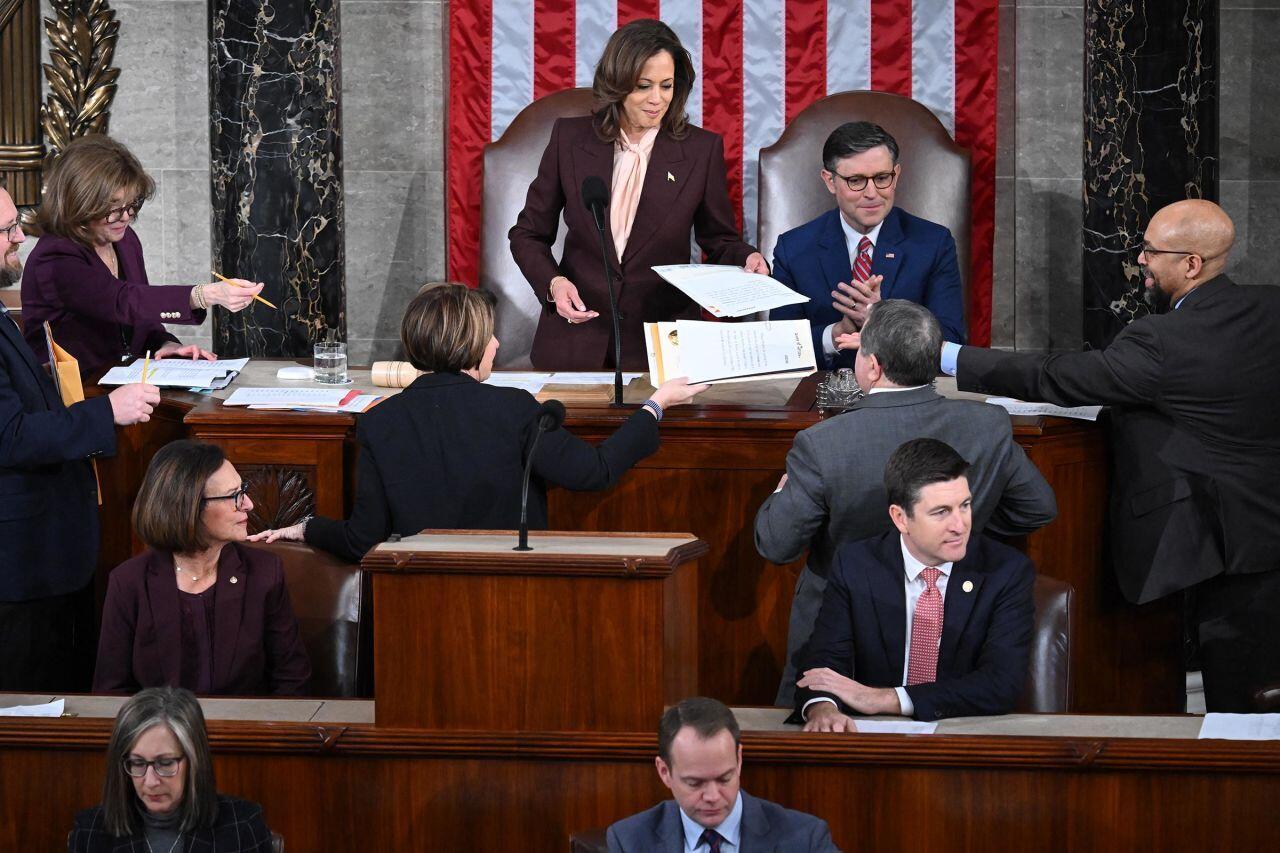
Congress certifying President Trump's 2024 victory (Getty Images)
Those states hold a combined 61 electoral votes. If all five enact the National Popular Vote Interstate Compact, the agreement would grow from 222 electoral votes to 283, clearing the 270 it needs to take effect. According to a report from Axios, the Democrats' victories "opened a path to effectively replacing the Electoral College with a national popular vote in time for the 2028 presidential election."
The compact binds member states to award all of their electoral votes to the candidate who wins the national popular vote. That obligation applies even when a member state's own voters choose a different candidate. Once states controlling 270 electoral votes sign on, the agreement would end the possibility of a candidate winning the White House while losing the national popular vote.
Americans vote for slates of electors, and those electors choose the president. Nearly every state gives its entire slate to the candidate who carries the state. Maine and Nebraska also award electors by congressional district. The compact keeps the electors in place and changes only the standard member states use to select them, with the switch activating only after membership reaches the 270-vote threshold.
Eighteen states and Washington, D.C. have enacted the compact since organizers launched it in 2006. The member states are California, Colorado, Connecticut, Delaware, Hawaii, Illinois, Maine, Maryland, Massachusetts, Minnesota, New Jersey, New Mexico, New York, Oregon, Rhode Island, Vermont, Virginia and Washington.
Kamala Harris carried every one of those states, along with the District, in the 2024 presidential election. President Trump won the national popular vote that year. Had the compact been in force in 2024, its members would have awarded their electoral votes to Trump.
Ironically, Harris said this summer that Democrats should revisit the Electoral College, among a list of changes she floated that included expanding the Supreme Court and making D.C. and Puerto Rico states.
The compact's supporters rely on Article II, Section 1 of the Constitution, which gives each state's legislature authority to appoint presidential electors "in such Manner as the Legislature thereof may direct." Because that power belongs to the states, backers say they can change how electors are chosen through ordinary state legislation rather than through a constitutional amendment requiring support from two-thirds of both chambers of Congress as well as the high bar of ratification by three-quarters of the states.
Supporters argue that the provision gives states broad discretion over their electors, including the authority to award the state's Electoral College votes to the winner of the national popular vote.
Critics dispute that interpretation, arguing that the Constitution's framers deliberately rejected the idea of electing presidents through a nationwide popular vote. Patrick Valencia, Iowa's deputy solicitor general, argued to NPR that the compact attempts to "usurp the constitutionally required electoral procedures" by keeping the Electoral College technically intact while fundamentally changing how electoral votes are assigned. Critics contend that such a sweeping change to the presidential election system should require a constitutional amendment.
A separate constitutional objection is raised under Article I, Section 10 with respect to interstate compacts and agreements. Opponents of the NPVIC insist it requires congressional approval as it is an agreement which binds the states that are a part of it to a common electoral arrangement which in turn will affect the political power of the states not in the compact. Congress has not approved the agreement.
The central legal issue is whether a state can exercise its constitutional power to appoint electors to effectively convert the Electoral College into a national popular vote system. No court has ever squarely faced that question, and therefore the constitutionality of the compact is still very much in doubt. If it does get to 270 electoral votes and goes into effect, it would be certain to trigger a major constitutional dispute.
Tyler Durden Sat, 11/07/2026 - 12:50
Continue reading...
[ H/T ZeroHedge ]
On Tuesday, Democrats won full control of state government in Pennsylvania, Michigan, Arizona, Wisconsin and Nevada, a shift that could let states effectively bypass the Electoral College before the 2028 presidential election without amending the Constitution.
Congress certifying President Trump's 2024 victory (Getty Images)
Those states hold a combined 61 electoral votes. If all five enact the National Popular Vote Interstate Compact, the agreement would grow from 222 electoral votes to 283, clearing the 270 it needs to take effect. According to a report from Axios, the Democrats' victories "opened a path to effectively replacing the Electoral College with a national popular vote in time for the 2028 presidential election."
The compact binds member states to award all of their electoral votes to the candidate who wins the national popular vote. That obligation applies even when a member state's own voters choose a different candidate. Once states controlling 270 electoral votes sign on, the agreement would end the possibility of a candidate winning the White House while losing the national popular vote.
Americans vote for slates of electors, and those electors choose the president. Nearly every state gives its entire slate to the candidate who carries the state. Maine and Nebraska also award electors by congressional district. The compact keeps the electors in place and changes only the standard member states use to select them, with the switch activating only after membership reaches the 270-vote threshold.
Eighteen states and Washington, D.C. have enacted the compact since organizers launched it in 2006. The member states are California, Colorado, Connecticut, Delaware, Hawaii, Illinois, Maine, Maryland, Massachusetts, Minnesota, New Jersey, New Mexico, New York, Oregon, Rhode Island, Vermont, Virginia and Washington.
Kamala Harris carried every one of those states, along with the District, in the 2024 presidential election. President Trump won the national popular vote that year. Had the compact been in force in 2024, its members would have awarded their electoral votes to Trump.
Ironically, Harris said this summer that Democrats should revisit the Electoral College, among a list of changes she floated that included expanding the Supreme Court and making D.C. and Puerto Rico states.
The compact's supporters rely on Article II, Section 1 of the Constitution, which gives each state's legislature authority to appoint presidential electors "in such Manner as the Legislature thereof may direct." Because that power belongs to the states, backers say they can change how electors are chosen through ordinary state legislation rather than through a constitutional amendment requiring support from two-thirds of both chambers of Congress as well as the high bar of ratification by three-quarters of the states.
Supporters argue that the provision gives states broad discretion over their electors, including the authority to award the state's Electoral College votes to the winner of the national popular vote.
Critics dispute that interpretation, arguing that the Constitution's framers deliberately rejected the idea of electing presidents through a nationwide popular vote. Patrick Valencia, Iowa's deputy solicitor general, argued to NPR that the compact attempts to "usurp the constitutionally required electoral procedures" by keeping the Electoral College technically intact while fundamentally changing how electoral votes are assigned. Critics contend that such a sweeping change to the presidential election system should require a constitutional amendment.
A separate constitutional objection is raised under Article I, Section 10 with respect to interstate compacts and agreements. Opponents of the NPVIC insist it requires congressional approval as it is an agreement which binds the states that are a part of it to a common electoral arrangement which in turn will affect the political power of the states not in the compact. Congress has not approved the agreement.
The central legal issue is whether a state can exercise its constitutional power to appoint electors to effectively convert the Electoral College into a national popular vote system. No court has ever squarely faced that question, and therefore the constitutionality of the compact is still very much in doubt. If it does get to 270 electoral votes and goes into effect, it would be certain to trigger a major constitutional dispute.
Tyler Durden Sat, 11/07/2026 - 12:50
Continue reading...
[ H/T ZeroHedge ]