





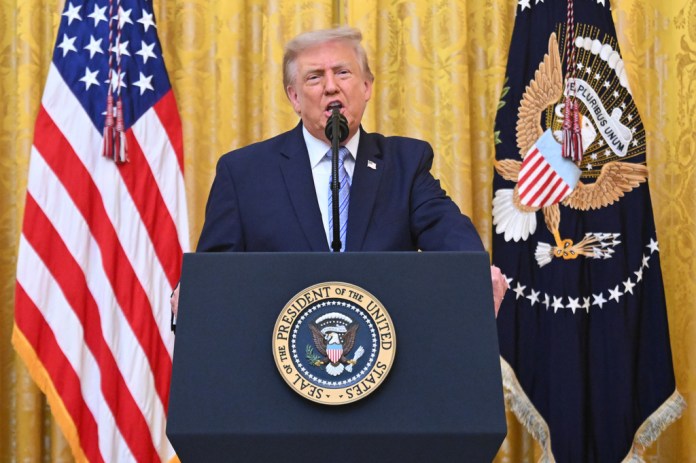
Last Thursday night, President Donald Trump used a primetime address to announce the declassification of records concerning American elections. Most of the commentary since has focused on whether the material proves what he says it proves. That argument will take months, as it should. Meanwhile, the question that matters most to the people responsible for keeping this country safe is going unasked.
The question is: What happens to a free society when a large share of its citizens stop believing that the institutions responsible for telling them the truth are telling them the truth? Erosion of that belief is not a cultural complaint. It is a security condition, and our adversaries read it far more carefully than we do.
Trust is infrastructure
We harden substations, segment networks, and build redundancy into water systems. What we underinvest in is the least tangible asset in the inventory: the public’s willingness to believe official information when it arrives.
That willingness does real work. It is what allows an evacuation order to move a city, a public health advisory to change behavior, and an election result to be accepted by the side that lost. Strip it out, and the pipes still carry water, and the servers still route traffic, but the instruction set stops running, because nobody trusts the instruction.
Foreign intelligence services understand this. One of the cheapest ways to attack a free society is not to break its systems. It is to convince the population that its systems are already broken, and then to let the population do the rest of the work.
What was alleged, and what it costs either way
The president alleged that China illicitly acquired roughly 220 million American voter files, assigned a dedicated data exploitation unit to the project, and that intelligence officials failed to elevate what they knew to him or disclose it publicly. The supporting material was posted publicly, though much of it is heavily redacted, mixing finished assessments with raw reporting and witness allegations of varying evidentiary weight. Those allegations warrant investigation. They are not findings, and nobody should treat them as findings.
The counterweight is on the record as well. An unclassified 2021 intelligence community assessment found no indication that any foreign actor altered any technical aspect of the 2020 vote, and one of the newly released documents states that tabulation systems would be difficult to manipulate at the scale needed to compromise a result. Reuters, citing two people familiar with the matter, reported that the files China obtained were not confidential and could not be manipulated. Voter files of that kind are routinely purchased by political consultants. The president offered no evidence that any vote was altered.
Notice what happens either way. If the allegations hold, then intelligence officials withheld material information from an elected president about what a foreign adversary had done near the machinery of American self-government. If they collapse, then a president used primetime to tell the country something about its elections that did not survive contact with the evidence. Public confidence takes an immediate hit in both cases. A credible inquiry may repair some of it later, but it begins from a deeper deficit than the country carried on Wednesday.
That asymmetry is the point. Whatever the investigations establish, foreign adversaries can exploit the surrounding uncertainty. They need not manufacture every institutional failure themselves. They need only find the fractures, widen them, and ensure no resolution is accepted as legitimate.
Mediation carries a cost, too
The coverage decisions were not a blackout, and calling them one gets the problem wrong. ABC and NBC declined to interrupt their broadcast schedules, carrying the address only on their streaming services. CNN did not carry it live on its main channel, instead offering analysis and fact-checking while making a live feed available online. CBS carried part of it inside a segment framed by disclaimers, and Fox News ran it in full before noting on air that it had not seen the underlying evidence.
Set aside whether those judgments were defensible and consider their effect on the threat picture. Whatever the decisions were intended to prevent, they risked reinforcing a suspicion already widespread in this country that important information is filtered before citizens may weigh it themselves. You cannot inoculate a public against foreign disinformation by demonstrating in primetime that domestic information is curated first. That teaches the wrong lesson to exactly the audience an adversary most wants to reach.
Access is not accountability
The remedy is not to believe what was released, and not to dismiss it either, because dismissal is one of the reflexes that helped build the credibility gap. Publishing the raw material is a start, but a document release delivers access rather than accountability. Accountability requires three further things: a public accounting of what each document does and does not establish, congressional oversight with testimony from intelligence and election security officials, and correction of any claim the evidence fails to support, whoever made it.
OPINION: HOW TRUMP’S IRAN WAR JUST MADE US-CHINA PEACE MORE LIKELY
When institutions unnecessarily restrict direct access to information of obvious public importance, they risk weakening the information environment on which national security depends. Our adversaries do not need to create every fracture themselves. They need only exploit the ones we refuse to repair.
Colton Overcash is the founder of Vertex Strategies, a Charlotte, North Carolina-based government relations and strategic advisory firm with a presence in Washington, D.C. He previously served in a presidential appointment at the U.S. Department of Homeland Security during the Trump administration and is a former staffer in the offices of U.S. Sen. Thom Tillis (R-NC) and U.S. Rep. Virginia Foxx (R-NC).
Continue reading...
[ H/T Washington Examiner ]