



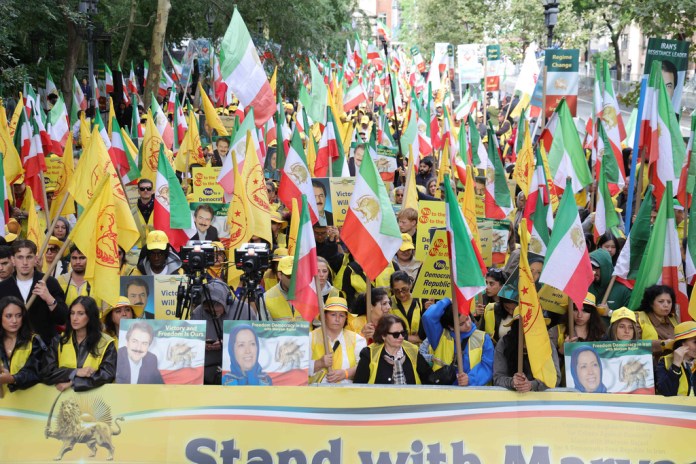
The ruling theocracy in Iran has survived decades of sanctions and diplomacy, as well as two major wars in the past 15 months. The question facing Washington is no longer simply how much additional pressure can be applied to Tehran — it is whether external pressure alone can produce political change. Or is there an Iranian element, a ground game capable of turning public discontent into sustained political action?
The question is more imperative as it looks like the Iran conflict is on the cusp of turning into a new phase.
First, let’s review what has happened in the past eight months. The U.S. military and economic actions have imposed substantial economic and military costs on the regime. But they have not, by themselves, changed Iran’s political system. And more importantly, they will not.
BLOOD ON THE UN PODIUM: IRAN’S PRESIDENT JUST DEFENDED GENOCIDE TO AN EMPTY ROOM
That distinction matters.
Military force can destroy infrastructure. Sanctions can constrain resources. Diplomacy can influence government policy. None of these tools, even combined, automatically creates a political alternative capable of replacing a ruthless authoritarian state.
Iran’s recent experience illustrates the point. The nationwide protests that erupted in late 2025 spread across all 31 provinces and more than 300 towns and cities. The regime responded with massive lethal force, mass arrests, and communications blackout restrictions, preventing the protests from developing into a sustained nationwide mobilization.
Popular anger is no substitute for organized resistance.
Millions of Iranians may oppose the government, yet opposition alone does not produce political change. Demonstrations can be dispersed, communications disrupted, and organizers arrested. The latest uprising demonstrated how quickly a nationwide protest movement can be subjected to repression before it develops the capacity to sustain itself.
Iran’s own history offers an important distinction. The fall of the monarchy in 1979 followed months of increasingly large demonstrations, strikes, political mobilization, and growing fractures within the state apparatus. Even during the final days of the shah’s reign, as fragile as the rule was, it took a popular armed revolt to overwhelm the last vestiges of the shah’s army.
The reality is that the Islamic Republic has spent decades learning from that experience. It has built an extensive system of surveillance, detention, and coercion designed to prevent popular discontent from developing into sustained nationwide mobilization.
That makes organization critical. What changes the equation is the existence of networks capable of organizing, communicating, and sustaining action despite repression.
The regime’s current security posture illustrates the validity of this observation and how seriously the regime takes that possibility. On Friday, the National Council of Resistance of Iran, the coalition of Iranian opposition groups, reported that the Islamic Revolutionary Guard Corps, paramilitary Basij, army, and state security forces had been placed on heightened alert, with security forces deployed in Tehran and other cities. The NCRI also reported increased patrols, phone checks, and preparations for arrests. These steps fit a broader pattern documented by international rights organizations.
This explains why the regime treats organized opposition differently from spontaneous public anger. A population protesting with little coordination can be suppressed city by city. An organized movement capable of connecting those protests across the country presents a different challenge.
A weakened regime does not automatically produce a political transition. It creates conditions in which internal political forces become more important.
The key question is whether organized political forces exist that can help convert spontaneous unrest into sustained political pressure.
Among the established opposition forces is the NCRI, whose president-elect, Maryam Rajavi, has articulated a 10-point plan for the future of Iran after the end of the ruling theocracy. Its main member organization, the People’s Mojahedin Organization of Iran, has maintained organizational structures and networks over decades. PMOI-affiliated resistance units continue operating inside Iran. These resistance units have grown in scope of operations, frequency, and geographical presence. They reportedly operate in all 31 provinces throughout Iran.
The organized resistance can not only organize and lead any future uprising but also protect it in the face of the onslaught of the regime’s security forces, a very plausible prospect at the time of a future uprising.
And here is a distinction with Reza Pahlavi, the son of the last monarch of Iran, who was overthrown by a mass uprising in 1979. He relies on visibility, interviews, and social media campaigns outside of Iran, with no organization inside or even outside of Iran. And unlike the organized resistance, there is no sign of activists in Iran who are willing to put up a fight against the Guard and other repressive apparatus.
For Washington, this distinction should reshape the debate.
The West cannot engineer a democratic transition in Iran from the outside. Nor does it need to choose Iran’s future leadership. But policymakers should recognize that weakening the Islamic Republic and replacing it are two different political challenges.
A durable transition would require sustained public resistance, functioning opposition networks, fractures within the regime’s coercive apparatus, and a political process capable of preventing a power vacuum from producing another form of authoritarian rule.
The missing variable is inside Iran itself: the ability of organized resistance to connect widespread public dissatisfaction with sustained action.
TRUMP HESITATED AND LOST THE IRANIAN STREET — BUT THE REVOLUTION DOESN’T NEED HIM
While the Islamic Republic has repeatedly survived pressure from abroad, it is facing a growing frustrated and outraged population, and, at its heart, a growing organized resistance.
It is the combination of these two forces that could be the game-changer in the Iranian enigma.
Nasser Razii is an Iranian-born independent analyst and writer based in London. Over the years, he has worked extensively with British and European parliamentarians on issues relating to Iran, human rights, and democratic governance. He is also associated with the democratic Iranian opposition and has been actively engaged in advocating a democratic, secular, and nonnuclear future for Iran.
Continue reading...
[ H/T Washington Examiner ]