


There is perhaps no more well-known Aesop’s fable than The Ant and the Grasshopper. The ant works hard and saves during the summer, while the grasshopper spends his time singing and dancing. When winter arrives, the grasshopper approaches the ant and asks for help. In the traditional version, the ant teaches the grasshopper a lesson by refusing to help.
The moral is to work hard today to provide security and a more comfortable existence tomorrow. It is a wise lesson, for sure, but perhaps we should take a closer look.
The lifespan of ants varies enormously. Some worker ants live only a few weeks, others several years, while queens of certain species can live for decades. Grasshoppers, by contrast, generally live only a season, with adults typically surviving two to three months. It might be said that each lived the life it was destined to live, rather than anthropomorphizing a story that may, in fact, mislead us. What appears to be foresight in one and folly in the other may simply reflect the different horizons within which each life unfolds.
Nations, however, do not have the luxury of living for a season. Their governments must prepare for winters their citizens may never have imagined. That said, over the last six months, at least five European countries have undertaken significant civil-preparedness initiatives involving public warnings, operational measures, and changes to preparedness arrangements. Denmark and Lithuania have been particularly notable in their responses to military and hybrid threats. They are joined by Ireland, Belgium, and the United Kingdom, which have expanded public emergency preparedness efforts.
The seeming end goal is to increase the civilian population’s ability to endure prolonged periods without electricity, running water, or access to internet-dependent services such as banking and communications. Preparedness for cyber threats, sabotage, and kinetic terrorist attacks appears increasingly prominent.
On Sept. 24, Denmark’s Defense Intelligence Service warned that Russia was likely to intensify its hybrid warfare against NATO and the West in the coming months. The assessment included the possibility of destructive cyberattacks, sabotage, and attacks against critical infrastructure. Danish intelligence also identified a low but growing risk of a limited Russian military attack against one or more NATO countries bordering Russia.
This was not a general warning about severe weather, flooding, or an occasional power outage. It was an assessment of hostile state activity and the possible consequences for European security.
Between Sept. 25 and Oct. 3, Lithuania conducted a national mobilization exercise involving 14 ministries, all 60 municipalities, and approximately 150 participating institutions. The exercise tested civilian evacuation, emergency communications, protection of critical infrastructure, transportation, continuity of financial and energy services, and the reception of allied military forces. Among the scenarios considered were disruptions to communications and energy infrastructure, limited resources, and the practical difficulties of moving civilian populations during a national security emergency.
These were not abstract academic exercises. They were practical tests of whether a modern nation could continue to function when the systems upon which its citizens depend begin to fail. But did these exercises include scenarios in which portions of the population refuse to comply with emergency directives or contribute to the disruption through looting, vandalism, or civil unrest?
Ireland, Belgium, and the U.K. have also expanded public emergency-preparedness communications, emphasizing the importance of household supplies, emergency planning, and the ability to function independently during interruptions to essential services. The European Union has encouraged households to maintain enough basic supplies to remain self-sufficient for at least 72 hours. Even Sky News has a Defence Insider Application it’s promoting now.
Can you imagine France, Belgium, and the U.K., in their current political and economic conditions, losing nationwide power and internet access for three days or more?
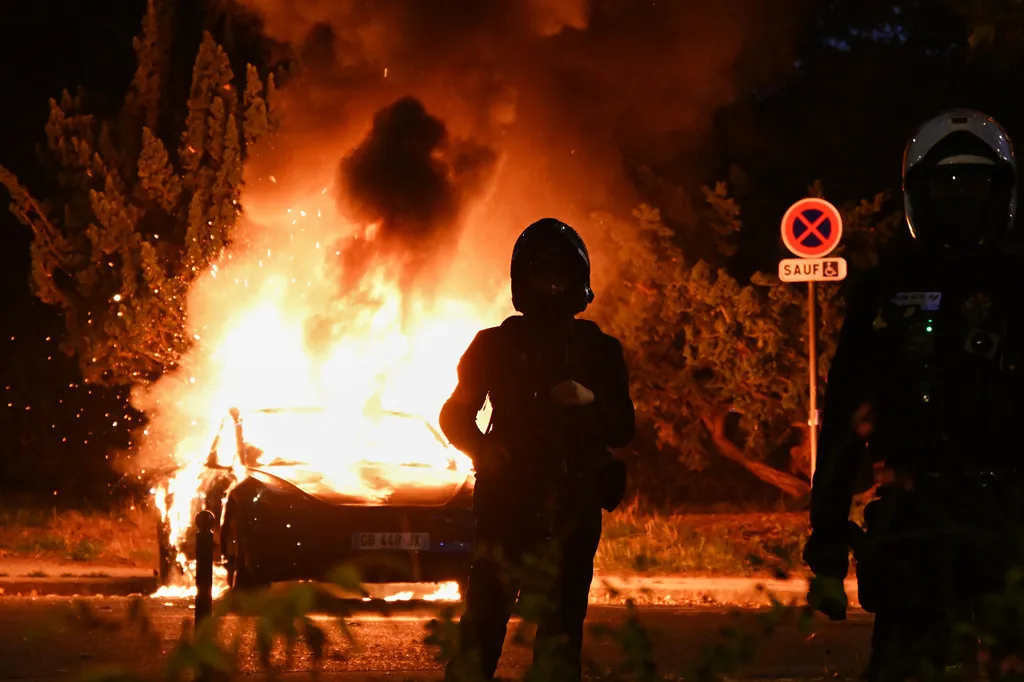
Imagine London, Paris, or Brussels entering a third day without reliable electricity. Banks cannot process transactions, fuel becomes difficult to obtain, and communications are unreliable. But the more consequential failure may be the government’s diminishing ability to communicate with, reassure, and ultimately govern its population. What begins as an interruption of essential services could become a test of political authority.
The immediate consequences of such a disruption would be obvious enough. But the secondary consequences might be more difficult to manage. Economic activity would likely slow or stop, access to cash and essential goods could become increasingly difficult, and public frustration would mount. Governments already confronting fiscal pressures, political divisions, and social unrest would be required to maintain public confidence while struggling to restore the services upon which that confidence depends. Curfews, emergency restrictions, and perhaps even martial law might be imposed. But would the public comply, particularly in European societies already experiencing episodes of civil unrest?
A modern society may possess extraordinary wealth, sophisticated technology, and formidable military capabilities, yet remain remarkably vulnerable to the interruption of a few essential systems.
Gather ye rosebuds while ye may. And winter is coming.
In the United States, meanwhile, an Oct. 25 Fox News report described the Pentagon’s FORTRESS initiative, which reportedly includes a proposed requirement for major military installations to sustain essential operations for at least 90 days without outside support. While Europe’s civilian preparedness recommendations emphasize a minimum of 72 hours of household self-sufficiency, American military planners are reportedly contemplating disruptions lasting three months. The requirements are different, but both reflect concern about the vulnerability of essential infrastructure.
None of this establishes that a European war is imminent. Governments have an obligation to prepare for contingencies that may never occur. Military exercises, emergency supplies, and civil-defense planning are not declarations of war.
Yet it would be equally foolish to dismiss these developments as unrelated bureaucratic exercises. Denmark’s intelligence assessment, Lithuania’s mobilization preparations, the expansion of European household-readiness campaigns, and the American military’s emphasis on prolonged operational independence all point toward a growing concern about the vulnerability of essential infrastructure.
FRANCE DOESN’T HAVE A RIOT. IT HAS A COALITION OF INSTABILITY
There may also be a political dimension to these preparations. By drawing public attention to the vulnerability of essential services, governments may be cultivating greater awareness of the threats posed by Russia. Such awareness could strengthen public support for continued assistance to Ukraine, increased defense expenditures, and a more resolute posture toward Moscow. Whether this is an intended objective or simply a consequence of greater public awareness is difficult to determine. Yet the political implications are difficult to ignore. A population that understands what it stands to lose may be more willing to support the measures necessary to defend it.
The ant prepared for winter because winter was certain to come. Europe’s governments are preparing for something considerably less certain, but potentially far more destructive.
Andrew Moore is a small-business owner and author of the Primus Aeternus series.
Continue reading...
[ H/T Washington Examiner ]