





Guest Post by Unshadowed
UPDATE: A video walkthrough of this report is available here.

A month ago, Elizabeth Sherwood-Randall laid out a scenario in Foreign Affairs. She is not a science fiction author. She was White House Homeland Security Adviser from 2021 to 2025. She coordinated the response to the 2024 H5N1 (Bird Flu) outbreak in US dairy.
She wrote:
That same day, the Belfer report she co-authored, Deterrence by Resilience, made policy recommendations responding to this, including restricting unlicensed models (AI) and unscreened print shops (biomanufacturing).
The scenario may not be that imaginative.
On 10 September 2026, Anthropic published Detecting and Countering Misuse of AI, documenting cases of people using Claude to help with questionable purposes, from assembling weaponized drones to performing gain-of-function work on H5:
They were careful to add a caveat—in the preamble, no less:
Sherwood-Randall is not the first to imagine such a crisis:
The scenarios differed slightly across these exercises, but the policy recommendations mirrored those in the Belfer report: limit access to the technology that can design (AI) and print (biomanufacturing) a pathogen, and create biosurveillance to flag an outbreak as engineered.
Companies like Twist Bioscience and Integrated DNA Technologies, among others, accept a customer’s description of a gene sequence and synthesize it. Both claim to screen the customer and the sequence before shipping an order of DNA, checking each gene against a database of pathogens.
There are also benchtop DNA synthesizers available for a mere $300,000 that can print short DNA without going through a screened vendor.
That DNA can then be submitted to a cloud lab like Emerald Cloud Lab which will build and test a working sample.
Once tested, that sample can be sent to a biomanufacturing facility to be created at scale.
This is both why Sherwood-Randall’s catastrophic dairy/beef/poultry shock is plausible, and how it would set the stage for regulation of both compute and these bio-manufacturing capabilities.
The surveillance layer for an H5 shock in US livestock is already built — and well-funded:
I have reported before that a novel H5 outbreak has been both repeatedly predicted and positioned to advance the goals of bio-surveillance. The more recent scenarios from Sherwood-Randall and the tabletops sharpen this view. The crisis would play out through a sequence of events:
There has been a lot of speculation, given the new massive fear campaign around AI, about an AI-enhanced attack on the financial system or on water and wastewater systems.
Those remain possible (Jamie Dimon is, after all, saying a cyberattack is looming that could cause a massive liquidity event). But they are not what former National Security Council members are warning about: an H5 shock in livestock, attributed to an unlicensed model and print shop/cloud lab, used to lock animals and compute/synthesis in the same motion. Our Right to Compute and our chickens would be lost in one fell swoop.
This aligns with many of the stated goals of policymakers. The Absolute Zero decarbonization plan phases out beef and lamb. In Food Chain Reaction Game, a tabletop exercise involving a food crisis, participants reached for carbon credits and a meat tax. Gates has called for countries to move to synthetic beef. And defense agencies have been funding synthetic proteins, precision fermentation, and bio-surveillance. This is an open agenda. An H5 attack attributed to AI would achieve all this much more quickly than a meat tax — and can be passed as “public safety.”
It was also Bill Gates, who said of the next pandemic “this time people will pay attention,” that funded research by Yoshihiro Kawaoka at the University of Wisconsin–Madison, who worked on H5 mammalian adaptation. (I happen to report on this the very same day that fmr CDC Director Robert Redfield explicitly said that Bird Flu will be the next pandemic).
I’d prefer this remains a fictitious scenario for thinktanks and tabletop exercises. But the milk tests are running, the screen for genetic engineering exists, and the policy memo that speaks to an AI-enhanced H5 hit on poultry, beef and dairy is already written by a former high-ranking Homeland Security official.
People with that job title don’t publish fiction. They prepare us for the future they are staffed and funded to manage.
Tweet
Continue reading...
[ H/T The Burning Platform ]
UPDATE: A video walkthrough of this report is available here.
A month ago, Elizabeth Sherwood-Randall laid out a scenario in Foreign Affairs. She is not a science fiction author. She was White House Homeland Security Adviser from 2021 to 2025. She coordinated the response to the 2024 H5N1 (Bird Flu) outbreak in US dairy.
She wrote:
That same day, the Belfer report she co-authored, Deterrence by Resilience, made policy recommendations responding to this, including restricting unlicensed models (AI) and unscreened print shops (biomanufacturing).
The scenario may not be that imaginative.
On 10 September 2026, Anthropic published Detecting and Countering Misuse of AI, documenting cases of people using Claude to help with questionable purposes, from assembling weaponized drones to performing gain-of-function work on H5:
They were careful to add a caveat—in the preamble, no less:
Sherwood-Randall is not the first to imagine such a crisis:
- February 2024 (Munich Security Conference): CEPI hosts a tabletop exercise entitled “Fighting ‘Smart’ Pandemics” wherein a group of senior people from health, security, and tech were presented with a scenario wherein a pathogen that appears zoonotic spreads rapidly around the world. An anarchist cell then claims they made it with AI.
- February 2025 (Munich Security Conference): NTI hosts a tabletop exercise entitled “Safeguarding Against Global Catastrophe”. The panel is presented with “A global pandemic that eventually results in more than 850 million cases and 60 million deaths begins, sparked by a novel enterovirus strain that was intentionally engineered by an extremist group using artificial intelligence–enabled capabilities to engineer living systems (referred to as AIxBio capabilities)”
- April 2026: RAND hosts a tabletop exercise 10 times, in which participants faced “a global pandemic triggered by students’ accidental release of an AI-engineered virus.”
The scenarios differed slightly across these exercises, but the policy recommendations mirrored those in the Belfer report: limit access to the technology that can design (AI) and print (biomanufacturing) a pathogen, and create biosurveillance to flag an outbreak as engineered.
Companies like Twist Bioscience and Integrated DNA Technologies, among others, accept a customer’s description of a gene sequence and synthesize it. Both claim to screen the customer and the sequence before shipping an order of DNA, checking each gene against a database of pathogens.
There are also benchtop DNA synthesizers available for a mere $300,000 that can print short DNA without going through a screened vendor.
That DNA can then be submitted to a cloud lab like Emerald Cloud Lab which will build and test a working sample.
Once tested, that sample can be sent to a biomanufacturing facility to be created at scale.
This is both why Sherwood-Randall’s catastrophic dairy/beef/poultry shock is plausible, and how it would set the stage for regulation of both compute and these bio-manufacturing capabilities.
The surveillance layer for an H5 shock in US livestock is already built — and well-funded:
- The USDA National Milk Testing Strategy (NMTS) includes using PCR tests for H5 on milk from US dairies.
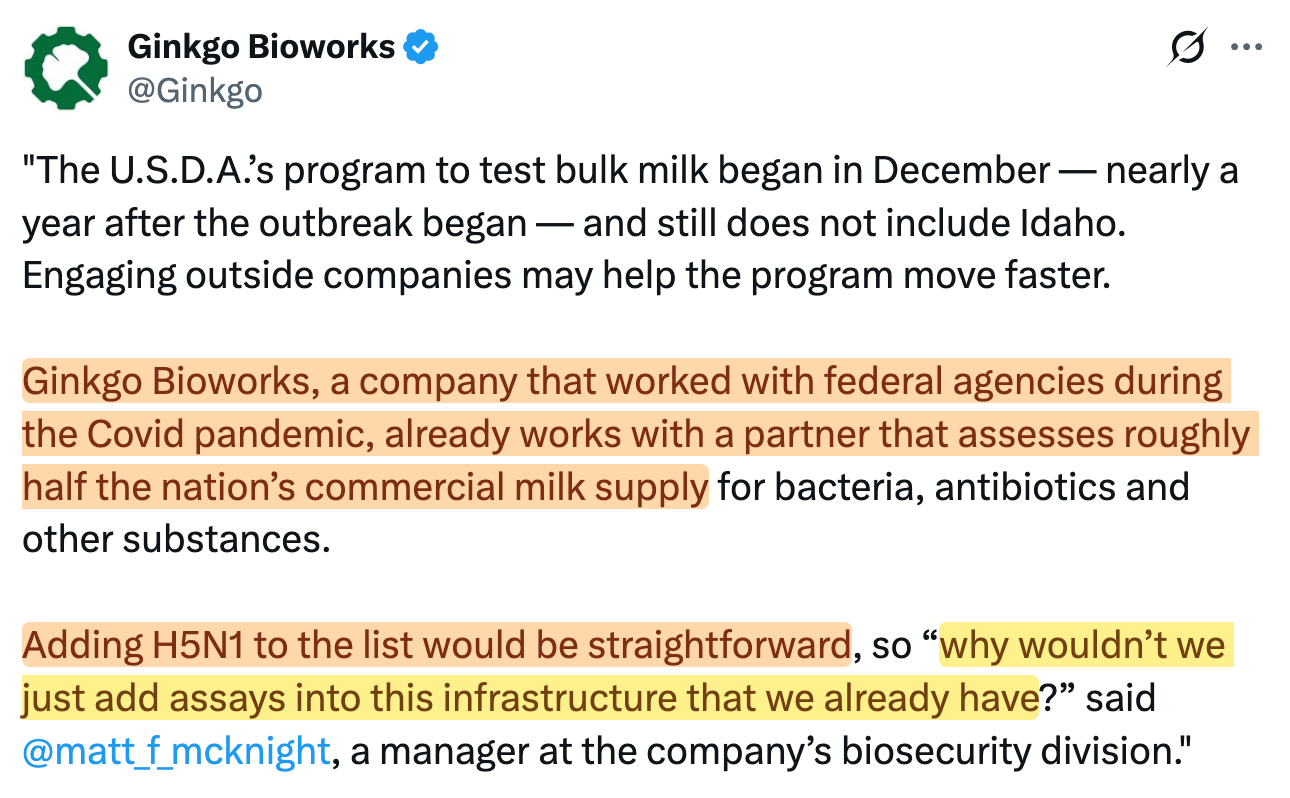
Ginkgo Bioworks (whose board was until recently chaired by Palantir’s CTO) proposed including H5 tests in the existing tests for commercial milk:
- Ginkgo separately developed a gene analysis product, ENDAR, which detects markers of genetic engineering. The product was created specifically for IARPA’s FELIX program, and has since been spun off with Ginkgo’s biosecurity arm to a new company, Perimeter.
I have reported before that a novel H5 outbreak has been both repeatedly predicted and positioned to advance the goals of bio-surveillance. The more recent scenarios from Sherwood-Randall and the tabletops sharpen this view. The crisis would play out through a sequence of events:
- A spike in H5 detections in dairy would throw officials into alarm. This PCR-based H5 testing is already running under the National Milk Testing Strategy.
- A sequence would be pulled off the positive samples and run through genetic engineering screen. This is the job ENDAR was created for, now sitting at Perimeter.
- Officials reveal an origin story: a jailbroken AI model designed it, it was printed, tested in a cloud lab, scaled, and put into farm air systems.
- Poultry, beef and dairy are hit first. Massive culls of commercial poultry and backyard flocks take place, movement restrictions for livestock.
- When it makes the jump to humans, the Belfer policy recommendations are taken down from the shelf: access is limited to biomanufacturing capabilities and to any AI models sufficiently powerful to design a pathogen.
There has been a lot of speculation, given the new massive fear campaign around AI, about an AI-enhanced attack on the financial system or on water and wastewater systems.
Those remain possible (Jamie Dimon is, after all, saying a cyberattack is looming that could cause a massive liquidity event). But they are not what former National Security Council members are warning about: an H5 shock in livestock, attributed to an unlicensed model and print shop/cloud lab, used to lock animals and compute/synthesis in the same motion. Our Right to Compute and our chickens would be lost in one fell swoop.
This aligns with many of the stated goals of policymakers. The Absolute Zero decarbonization plan phases out beef and lamb. In Food Chain Reaction Game, a tabletop exercise involving a food crisis, participants reached for carbon credits and a meat tax. Gates has called for countries to move to synthetic beef. And defense agencies have been funding synthetic proteins, precision fermentation, and bio-surveillance. This is an open agenda. An H5 attack attributed to AI would achieve all this much more quickly than a meat tax — and can be passed as “public safety.”
It was also Bill Gates, who said of the next pandemic “this time people will pay attention,” that funded research by Yoshihiro Kawaoka at the University of Wisconsin–Madison, who worked on H5 mammalian adaptation. (I happen to report on this the very same day that fmr CDC Director Robert Redfield explicitly said that Bird Flu will be the next pandemic).
I’d prefer this remains a fictitious scenario for thinktanks and tabletop exercises. But the milk tests are running, the screen for genetic engineering exists, and the policy memo that speaks to an AI-enhanced H5 hit on poultry, beef and dairy is already written by a former high-ranking Homeland Security official.
People with that job title don’t publish fiction. They prepare us for the future they are staffed and funded to manage.
Tweet
Continue reading...
[ H/T The Burning Platform ]