

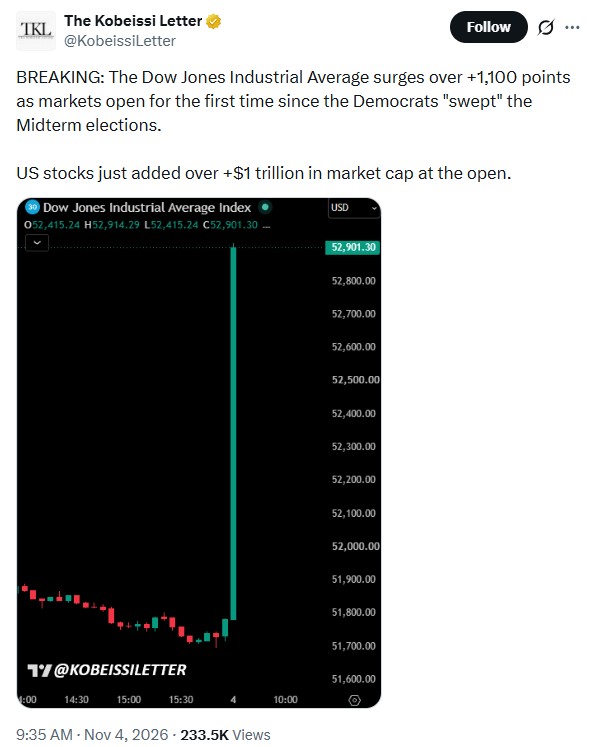
Wall Street came roaring back Wednesday morning, with the Dow Jones Industrial Average surging more than 1,000 points after Democrats captured control of Congress in Tuesday’s midterm elections.
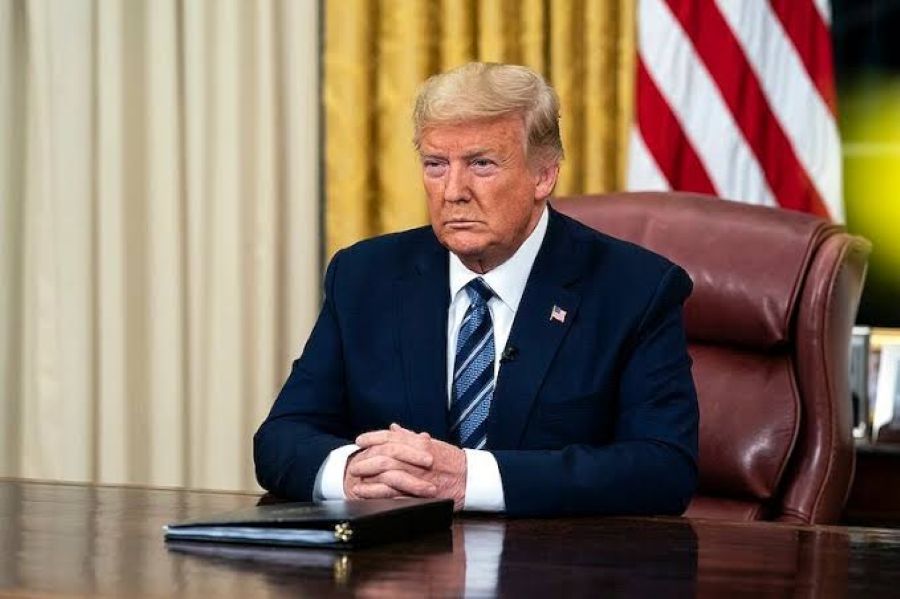
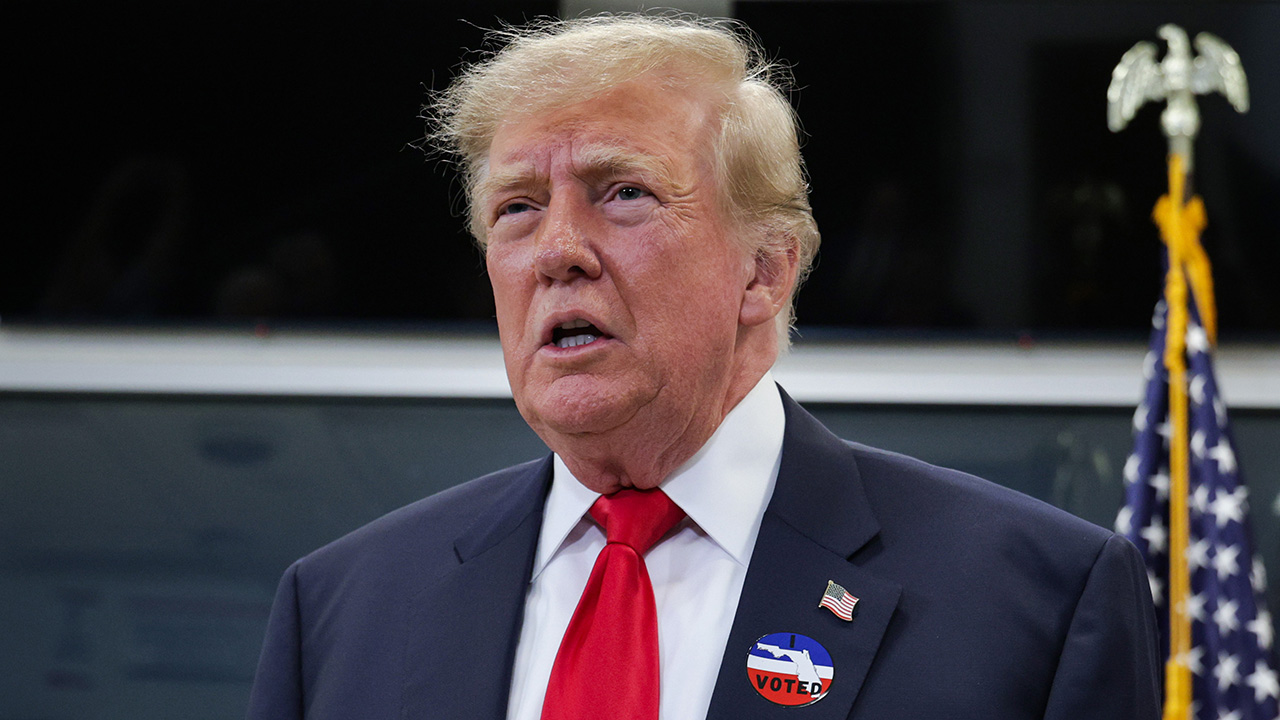
The sharp rally came as investors reacted to President Donald Trump’s acceptance of the results and the prospect of a divided Washington, where neither party will have complete control over federal policymaking.
The Dow jumped 1,024 points, or approximately 2%, during Wednesday’s trading session, according to CNBC.
The S&P 500 climbed 1.5%, while the technology-heavy Nasdaq Composite surged 2%, delivering broad gains across major U.S. stock indexes.
The market’s response followed a bruising election night for Republicans, who lost their majorities in both the House and Senate. Democrats also captured several governorships, including a victory in Texas.
Despite the GOP’s political setbacks, investors appeared encouraged by signs that Washington could avoid a prolonged confrontation over the election results.
Trump told The New York Times he was “absolutely willing” to accept the outcome and separately indicated to The Wall Street Journal that Republicans would work with Democrats.
Jay Woods, chief market strategist at Freedom Capital Markets, attributed part of Wednesday’s rally to the president’s response.
Screenshot-X
The rebound “was in part due to the president’s initial tone and reaction to the results,” Woods said.
“Still more uncertainty looms, but one thing is certain, there will be gridlock and historically this is good for the market.”
The development presents an unusual political contrast: Democrats celebrated their election victories while investors rallied around the prospect that their congressional majorities could face significant resistance from the Republican president.
Donald Trump retains his veto power, meaning Democrats cannot automatically enact their legislative priorities despite controlling both chambers of Congress.
That divided government could make sweeping policy changes more difficult, potentially offering businesses greater predictability.
Andrew Slimmon of Morgan Stanley Investment Management explained the appeal during an appearance on CNBC’s Squawk Box Europe.
Markets “like gridlock — they don’t like a party with too much power.”
Several major companies benefited from Wednesday’s rally.
RELATED: NEW: Staggering Shift In Oil Prices Rocks Stock Market
Walmart shares advanced approximately 3%, while Bank of America gained 2.5% as investors moved into companies closely tied to the broader economy.
Health care stocks also climbed as traders assessed how Democratic control of Congress could influence federal health policy.
Molina Healthcare jumped 5%, while Centene and HCA Healthcare each gained approximately 7%.
Renewable energy companies experienced an even larger boost, with the Invesco Solar ETF surging 8% amid expectations that Democrats could pursue policies more favorable to the industry.
However, not every sector benefited from the election results.
Companies associated with artificial intelligence infrastructure faced pressure over concerns that Democratic lawmakers could impose tougher restrictions on data centers.
Those worries intensified following Democrat Gina Hinojosa’s gubernatorial victory in Texas, where she has proposed an immediate moratorium on new data center development.
Shares of CoreWeave declined Wednesday, while Elon Musk’s SpaceX also traded lower.
Energy markets provided another source of encouragement for investors.
U.S. West Texas Intermediate crude futures fell approximately 2%, trading near $94 per barrel as attention turned toward the possibility of progress in negotiations to end the war with Iran.
Oil prices have remained a major economic concern throughout the conflict, contributing to inflationary pressures and complicating the Federal Reserve’s efforts to manage interest rates.
Slimmon suggested that a diplomatic breakthrough could help ease those pressures.
“That’s been an issue for the Fed, and inflation, and part of the reason that rates are higher.”
For Trump, Wednesday’s rally offered an economic development amid an otherwise difficult political week.
The president has championed tax cuts, deregulation and domestic energy production as central components of his economic agenda, although his tariff policies and the conflict with Iran have also introduced uncertainty for businesses and consumers.
Democratic control of Congress could complicate efforts to advance additional Republican legislation, but it does not eliminate the president’s existing executive authority.
Nor does Wednesday’s rally establish that investors favor one political party over another. Market strategists pointed instead to reduced election uncertainty, expectations of legislative gridlock and falling oil prices.
As Washington prepares for two years of divided government, the immediate reaction on Wall Street has been unmistakable.
POLL: Is Melania Trump One Of The Best First Ladies In American History?
Continue reading...
[ H/T Trending Politics ]