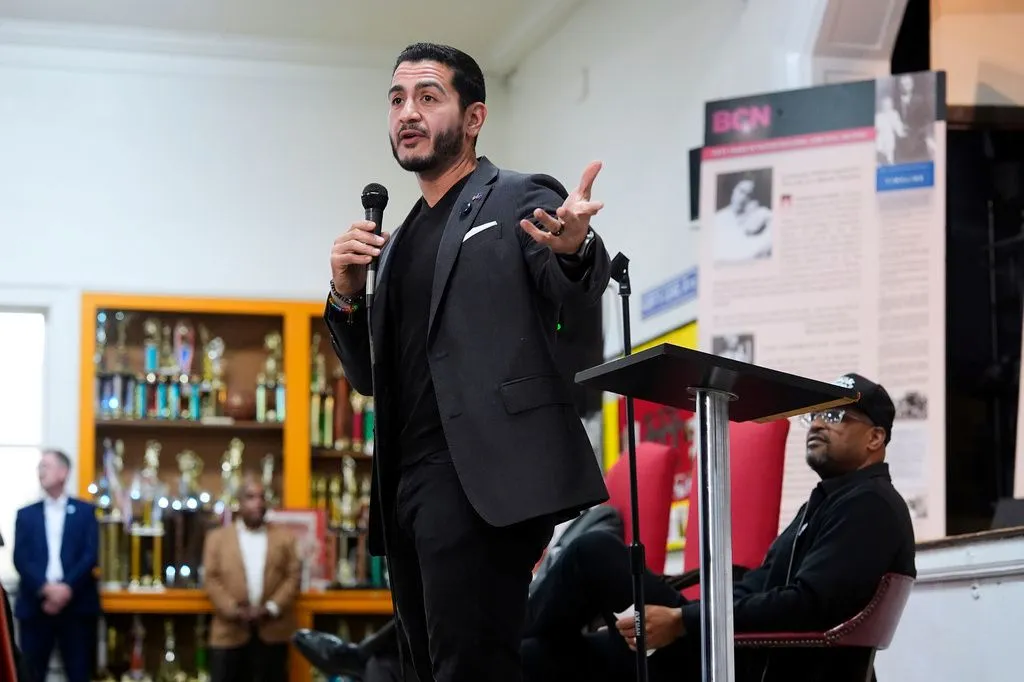
SLICK ABDUL. Over the weekend, a video featuring Michigan Democratic Senate candidate Abdul el Sayed went viral on social media. In it, a young man who attended an el Sayed town hall in Caro, Michigan, asked if the candidate disavowed the Muslim Brotherhood.
It was a reasonable question. In recent weeks, el Sayed’s Republican opponent, Mike Rogers, had accused el Sayed of having ties to the Muslim Brotherhood, of which several branches have been designated terrorist organizations by the U.S. government, including the branch in Egypt, where el Sayed’s family came from. In an Oct. 11 appearance on NBC News’s Meet the Press, moderator Kristen Welker said to el Sayed: “For Michigan voters, who are hearing those attacks against you, who are looking to separate fact from fiction, can you set the record straight about whether you or your family have any ties to the Muslim Brotherhood?”
“No, but let’s talk about this,” el Sayed responded. In context, what el Sayed meant by “no” was unclear, so Welker asked, “No, you don’t have any ties?” El Sayed responded: “No.” Then Welker asked, “And your family doesn’t?” El Sayed responded, “No. Let me ask you, though, why this is even a subject of debate? Because [Rogers’s] only strategy is to point to me and my name and my faith and to say that we’re different. And that you should suspect people simply because they are different than you in how they pray.”
The interview moved on to other topics. But later that Sunday, the Washington Free Beacon published a story based on social media posts by el Sayed’s half sister in 2012 and 2013. Back then, the Washington Free Beacon reported, “Eman Abdelhadi, [now] an assistant professor at the University of Chicago, wrote openly about her family’s ties to the Muslim Brotherhood.”
The Washington Free Beacon offered examples: “‘My family has long been MB,’ Abdelhadi wrote on June 24, 2012, days after Egypt elected Muslim Brother leader Mohamed Morsi as president. ‘I have had family jailed for being part of it,’ she wrote on July 3, 2013. ‘Praying for all my family that supports that #MB in Egypt. Lie low, stay safe,’ she said.”
That certainly cast a different light on el Sayed’s interview on Meet the Press. A few days later, NBC questioned el Sayed about the posts from Abdelhadi reported in the Washington Free Beacon, plus one more that said, “Had an amazing talk with my mom about her activism in the Muslim Brotherhood during the early ’70s while she was in college. Hashtag respect.” During the new NBC interview, el Sayed tried to tell reporter Tom Llamas that it was all nothing.
“Yeah, Tom, it’s funny to me,” he said. “I was born in 1984, down the street in Rochester Hills. I was raised here in Michigan, went to the University of Michigan, rebuilt the health department in the city, led the health department in this county. And you want to ask me about what’s happening in Egypt in 1970? Are you serious?”
“I get it, but you were asked a question, and you gave an answer,” said Llamas. El Sayed responded, “This is kind of like the same — yeah, I’m telling you, I have no ties. We have no ties.”
“So your mother had no ties?” Llamas asked. El Sayed answered: “I have never had these conversations with my mother. I wasn’t raised by my mother.” Then Llamas pressed: “So you’re unaware?”
El Sayed did not answer. Instead, he said, “But I’m just telling you that you’re using hearsay evidence from a tweet. This is not serious. It’s not serious.”
“Correct,” Llamas said. “But you’ve also gone after the president for truthfulness. You’ve also gone after the president for truthfulness. So when people ask you a question, they all do expect the truth.”
“And do you think, are you insinuating that somehow I was lying?” el Sayed asked. “I don’t know — that’s why I’m asking,” said Llamas. “And I’m telling you, I was not,” el Sayed said.
So what is the truth? A reasonable conclusion would be that it is hard to say. But that is where things stood on Saturday when el Sayed arrived at his town hall in Caro. There, a young man named Tommy — later identified as Thomas Teepell, a former staffer for Sen. Josh Hawley (R-MO) — yelled out, “Abdul! Will you disavow the Muslim Brotherhood?”
“What’s your name?” el Sayed responded. Teepell said, “It’s a simple question.” The two went back and forth for a while as el Sayed refused to answer until Tommy identified himself. “You give me your name, I’ll answer the question,” el Sayed said. “OK, Tommy,” Teepell said.
After a quick how-are-you, el Sayed moved on to misdirection. “Do you know what the Constitution of the United States is?” he asked Teepell. Young Tommy did not bite. “I have one simple question,” he said. “Will you disavow the Muslim Brotherhood?”
“Sure, yeah, absolutely, but I want to ask to the question that you’re asking,” el Sayed said. “Why are you asking the question?” “Well, because they’re a terrorist group,” Teepell answered. El Sayed responded, “OK, no, no, but what are you implying? Do you assume that I wouldn’t?”
“Yes,” said Teepell. “Why not?” asked el Sayed. “Because I have not heard you disavow them yet,” Teepell answered.
At that point the exchange had reached a place where el Sayed might have said something clear — something like, “OK, I disavow the Muslim Brotherhood” — or moved on to play games. He moved on to play games. “Have you disavowed them?” he asked Teepell. “I haven’t heard you disavow them yet.”
Teepell played along. “I disavow them,” he said. “Do you? Great,” said el Sayed. “But here’s the thing about it. You’re asking the question because implicitly you assume that I’ll have dual loyalties, right? You assume that somehow I wouldn’t disavow, or that I’ll have some higher order allegiance than to the Constitution. Correct? Tommy, is that what you imply? Why would you think that about me?”
With that el Sayed had turned the question away from himself — did he disavow the Muslim Brotherhood? — and onto the previously unknown audience member Thomas Teepell. It appears that el Sayed considered his quick “Sure, yeah, absolutely, but I want to ask to the question that you’re asking” as a clear, ringing disavowal of the Muslim terrorist group. After that, he was just going after Teepell.
Teepell tried to keep his question on track, trying to repeat again that he had not heard el Sayed disavow the Muslim Brotherhood. And indeed, before the two were standing there in Caro, el Sayed had never before disavowed the Muslim Brotherhood. But there would be no more talk about that. El Sayed’s mission — and he seemed to have a supportive crowd in doing it — was to portray Teepell as Islamophobic.
El Sayed asked if Teepell had “asked everybody in your life” if they disavowed the Muslim Brotherhood. Teepell erred by taking el Sayed’s nonsense question seriously, answering, “I have not.” “So why are you asking me?” el Sayed said. “Because I have not heard you—” Teepell began, starting to repeat his original question. El Sayed stopped him. “No, no, no — answer the question, Tommy. Everybody knows the answer to it. Answer the question.”
The crowd began to make noise. Abdul was putting this Islamophobe in his place! El Sayed went on to lecture Teepell about how his question really concerned the Constitution and the meaning of the religion clauses of the First Amendment — as if any constitutional question was raised by a town hall attendee asking a candidate whether he disavowed the Muslim Brotherhood. El Sayed then went on to deliver a sermon about John F. Kennedy’s statements on Catholicism during the 1960 presidential campaign — as if there were any equivalence between the Catholic Church and a U.S. government-designated terrorist organization.
By the end, el Sayed had the crowd cheering and Tommy heading out the door. Just for the record, before el Sayed began his misdirection routine, when he asked Teepell why he asked the disavowal question, Teepell, had he been older and perhaps had some experience in confrontations, might have said something like: One, because one of your family members — your half sister — has said your family “has long been MB” and said that your mother, specifically, was involved with the Muslim Brotherhood. Two, you have been evasive in your answers to questions about your family’s relationship with the Muslim Brotherhood. Three, you attempt to attack and distract people who ask you the question. So given all that, just to remove any doubt, could you simply say the words, “I disavow the Muslim Brotherhood”?
That, of course, did not happen. Instead, el Sayed took another step forward in his campaign to portray valid questions about his background and his associations as Islamophobia.
Continue reading...
[ H/T Washington Examiner ]