


Selling Gas Twice: Venture Global Courts Qatar While Plotting A $160 Billion AI Power Empire
Seven months ago, Qatar was the world's biggest LNG seller. Now it's a buyer.
According to a Reuters scoop late Thursday, QatarEnergy is in advanced talks with Venture Global (VG) on a long-term supply deal for at least 3 million tons of LNG a year, sourced from VG's CP2 plant, which is still under construction in Louisiana. The report landed just hours after QatarEnergy signed a separate deal with Cheniere (LNG) for up to 4 million tons a year through 2054. VG shares jumped more than 6% on Friday, and they have now roughly doubled this year. Then again, they're still trading about 45% below their $25 IPO price.
Venture Global's other headline this month is that it wants to get into AI data centers... in a very big way. Goldman thinks both stories come back to the same molecule. Below we summarize what Goldman's LNG team has been telling clients about each (available to pro subs), and why we think the Qatar trade is the one that pays first.
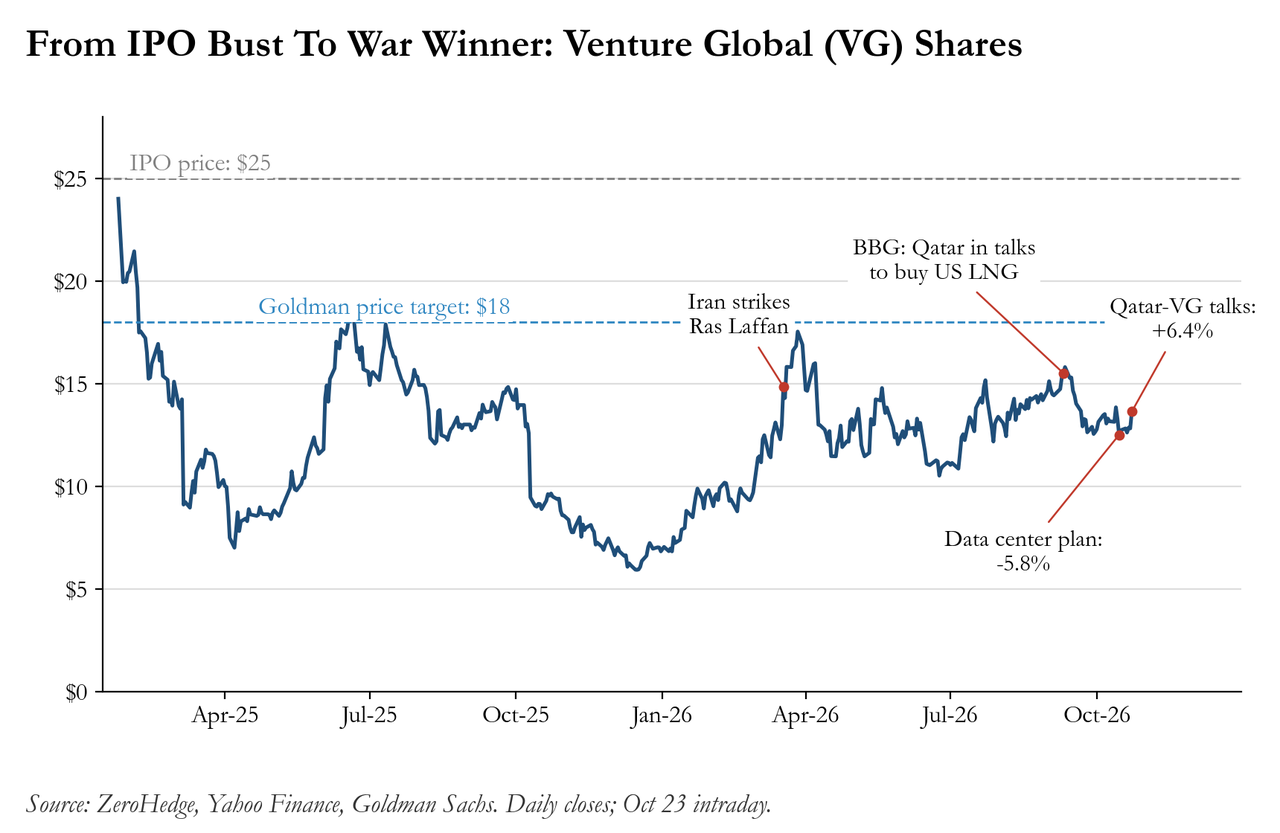
Regular readers know how Qatar got here. In March, Iranian missiles hit Ras Laffan, the world's largest LNG complex. We wrote at the time that the attack itself was "bad" and the math behind the global LNG fleet "far worse", and a day later we concluded that Qatar had been dethroned as "LNG King", with the US taking the crown. The strikes damaged two of Qatar's 14 trains, taking out 12.8 million tons a year, or about 17% of export capacity. QatarEnergy CEO Saad al-Kaabi said repairs would take three to five years and cost roughly $20 billion a year in lost revenue.
The bill has been coming due. Last week we reported that Qatar's government revenue plunged 42% in the first half: LNG exports were just 1.6 million tons in September, less than a quarter of the prewar average, and Kpler sees October falling to 0.6 million tons. QatarEnergy has also been renewing its force majeure notices every month, most recently through November.
Meanwhile, Doha still has customers to serve. So it has been buying spot cargoes, many of them from Venture Global, and is now trying to lock in long-term supply. As one source told Reuters back in September, "They will have to buy whatever they can get their hands on." We flagged where this was headed the moment Bloomberg first reported the talks:
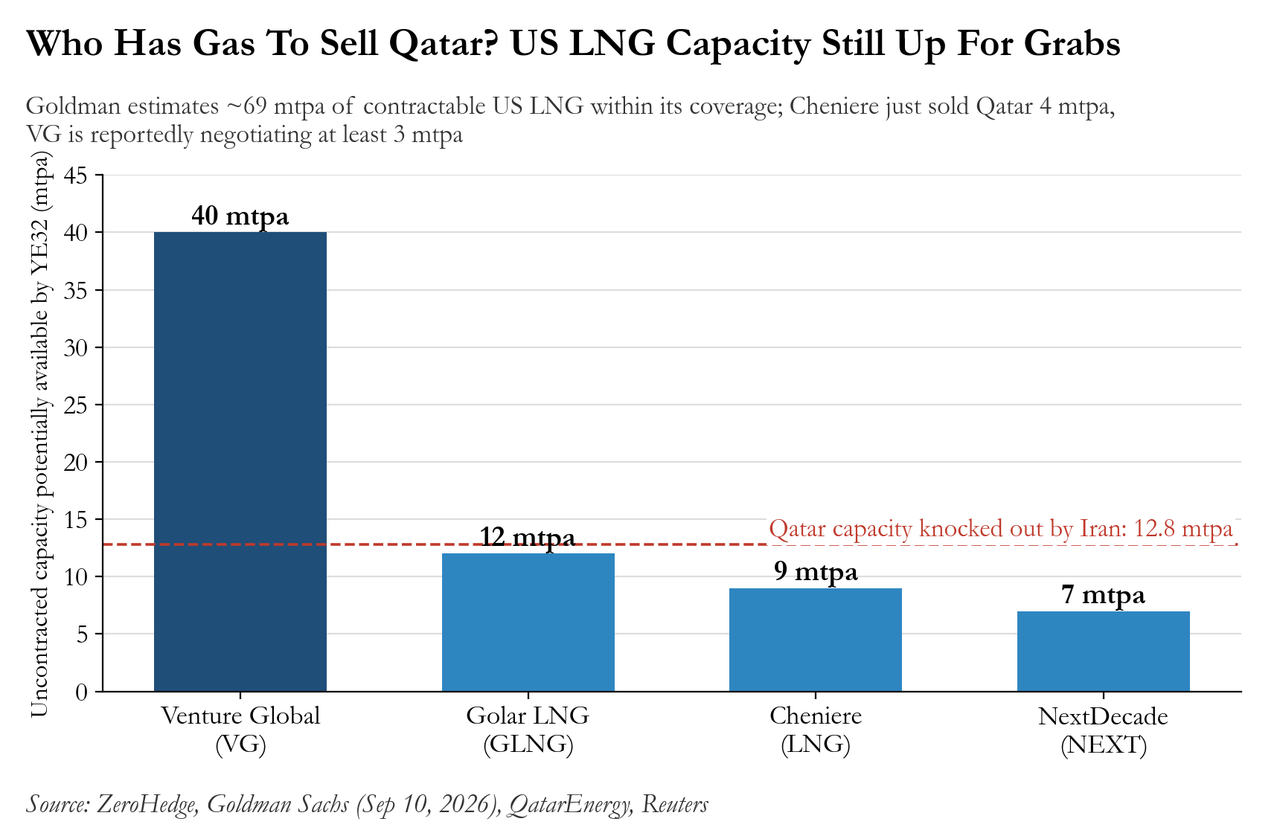
Goldman's Americas Pipelines & MLPs analyst John Mackay ran the numbers that same day in "Outlining Contractable Capacity for Our LNG Coverage Following Media Reports of QatarEnergy Interest". Mackay notes that Qatar is "the largest single LNG exporter in the world," sits behind the Strait of Hormuz, and "is planning the largest LNG capacity additions through the medium-term." Goldman says it takes no view on whether a deal happens, but it points out who would be on the other side if one does:
Put differently, VG alone has about three times as much uncontracted capacity as Qatar lost at Ras Laffan. Rapidan's count of capacity under construction is more modest, but VG still leads it at 10 mtpa, ahead of Cheniere and Woodside (6 mtpa each) and Sempra's Port Arthur (3 mtpa). So when Qatar goes shopping in the US, Venture Global probably can't be avoided.
Mackay brought Qatar up again in his 3Q26 preview on Oct 8. He trimmed his 3Q EBITDA estimate to $2.52 billion, below the $2.61 billion consensus, but kept FY26 at $9.03 billion, "still at the top-end of guidance." He also wrote that "any Qatar contracting, on top of their ongoing spot deals, would be meaningful." That was two weeks before the Reuters scoop. Goldman also counts recent additions such as ConocoPhillips' 20-year deal (Oct 1) and China Gas as "high-quality," while dismissing the adverse Galp arbitration ruling on CP1, where damages are capped at $170 million, as "manageable." Goldman's price target stays at $18, about 32% above Friday's price.
Two caveats. Nothing has been signed yet: Reuters "could not immediately learn the timeline of any agreement... or how long a contract could run," and neither company commented. And Cheniere's deal doesn't start until 2031, which says a lot about how long Doha expects to be without those trains.
The Qatar news is relatively straightforward. The data center plan is a far bigger swing.
On Oct 15, VG signed frame agreements with GE Vernova (GEV) and Baker Hughes (BKR) for up to 16 combined-cycle "power island" units of 720 MW each, plus transformers and switchgear. VG says the units could support up to 10 GW of compute by the end of 2034. The plants would run behind the meter, without drawing on the grid or local water utilities, around VG's existing Louisiana LNG sites. VG plans to place its first power island order by year-end and was set to file its first permit applications that week. It already runs 4.5 GW of gas-fired generation in island mode to power its LNG plants.
Goldman's first take, called it "on its face, a major diversification away from VG's core LNG export focus," but listed five ways it could fit with the LNG business. The fifth is the most interesting:
In other words, VG would own an option on which use pays more for a molecule of Louisiana gas: a Qatari utility or a hyperscaler. That's the "sell gas twice" pitch.
The market wasn't convinced. VG was up 1.5% in the premarket, according to Goldman's Industrials & Natural Resources desk, which called it a "big diversification for VG." The stock then closed down 5.8%. Investors seem to be asking the same thing as Mackay: whether VG can fund the rest of its LNG buildout to ~85-100 mtpa before taking on a second capital-intensive business. Goldman also notes that "strip pricing would add ~$20b to our EBITDA estimates, all else equal, by YE30." That's a good reminder that the LNG business is the one generating the cash.
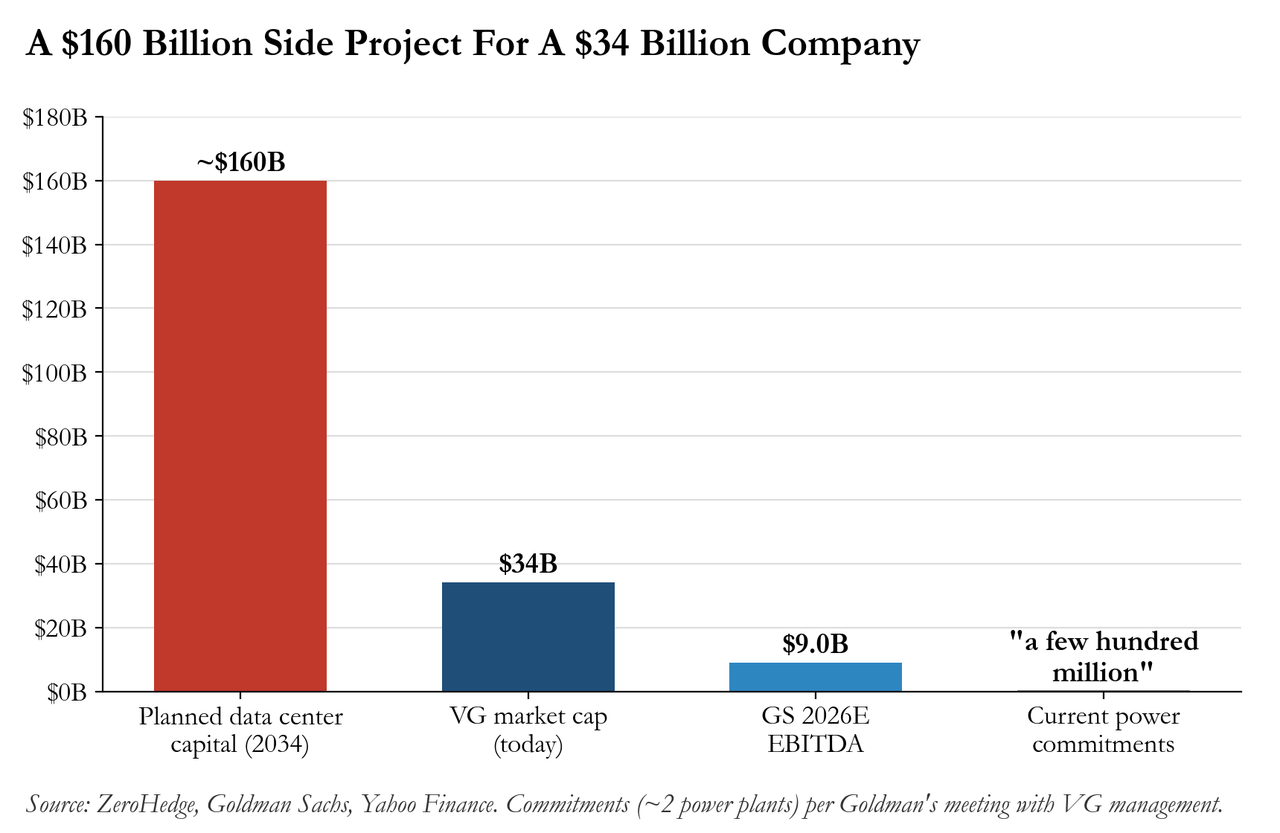
Goldman hosted CEO Mike Sabel and CFO Jack Thayer for a virtual roadshow the next day. The Oct 19 takeaways note, "Significant Potential Power Scope, but Limited Spend Ahead of Customer Deals" is where the numbers got big:
Some math: $160 billion for 10 GW works out to about $16 million per MW, roughly ten times the cost of a typical behind-the-meter project, because VG would supply the land and buildings as well as the power (everything except the chips). About two-thirds of that capex isn't power-related, and VG says it won't commit to that part without signed tenants. For the power portion, management is targeting ~75% investment-grade debt financing. If the power piece is the remaining third, or about $53 billion, that's somewhere around $40 billion of new debt on top of a balance sheet that already carries a debt-to-equity ratio of about 3.5x.
Goldman, which rates VG Buy, ends up more constructive than the tape:
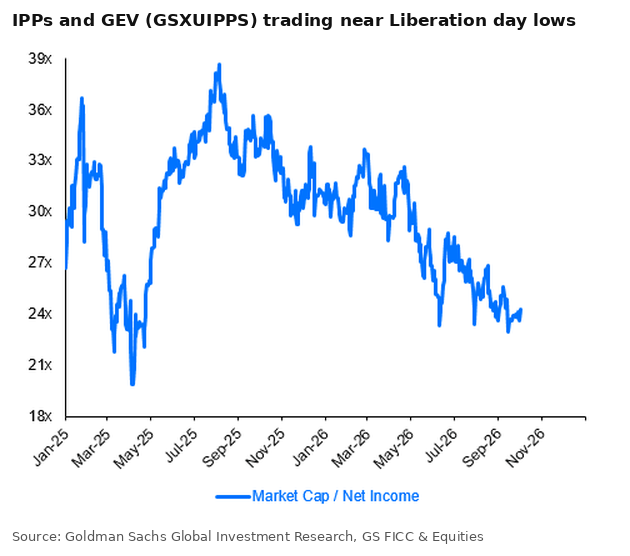
Wells Fargo, which had been sitting at Equal Weight, apparently agrees: it upgraded VG to Overweight on Tuesday and raised its target from $15 to $21. The "choppy" part is easy to see: as Goldman's desk showed a couple of weeks ago, IPPs and GE Vernova were trading near their "Liberation Day" lows on a P/E basis.
We've been pounding the table on on-site generation for almost a year. Since last November, we have argued that every data center should have its own "behind the meter" power so that households don't pay for the AI buildout through their electric bills. A month later we put it more simply:
Wall Street has since come around. Goldman now expects behind-the-meter generation to power a quarter of all US data centers by 2030. So VG's idea is sound. The problem is timing, and it comes down to which technology VG picked. Combined-cycle gas turbines (CCGTs) are the cheapest behind-the-meter option and also the slowest. Bernstein's machinery team spelled out that trade-off last month in "Powering AI: The modular advantage" (also available to pro subs): CCGT power costs about $48/MWh, but it takes 4-5 years to deliver, versus months for fuel cells at almost twice the price.
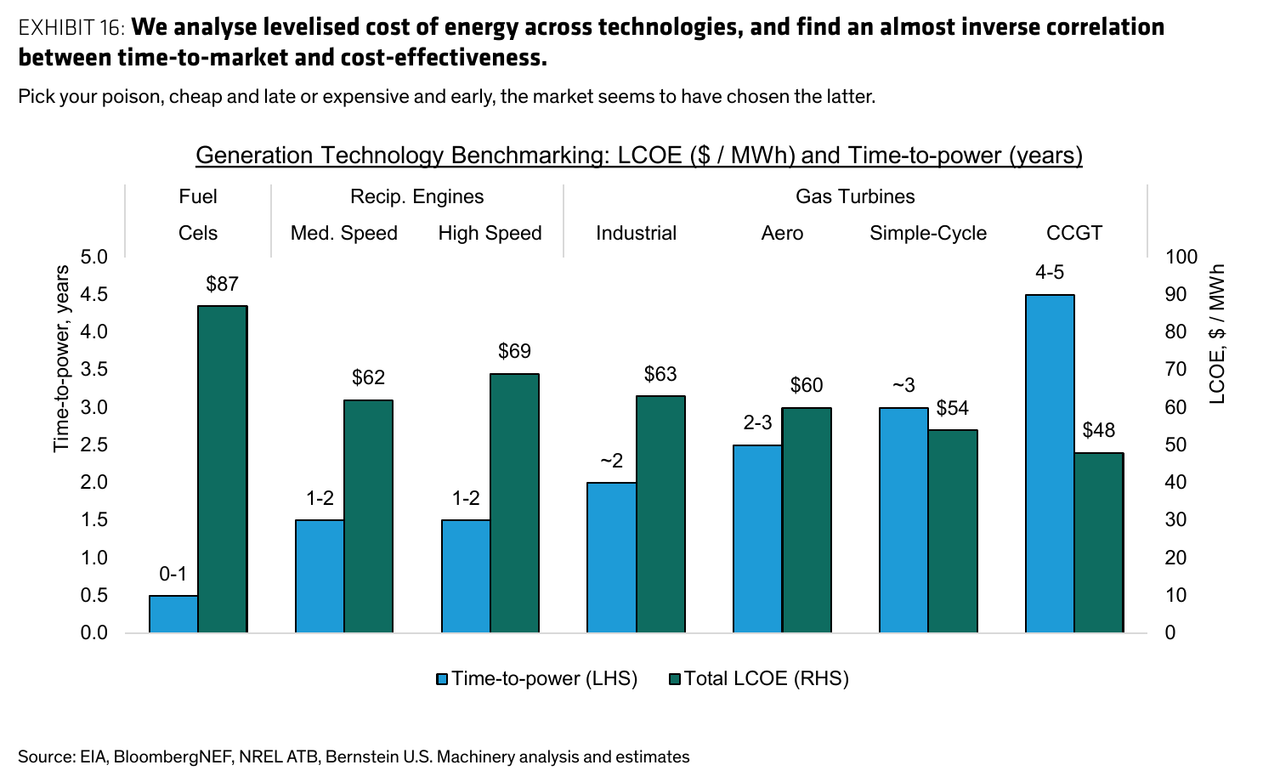
That lines up with Goldman's timeline: first deployments in late 2028 at the earliest, and only about half of the capacity ramped by 2031. By then, VG will be competing for tenants with everyone who signed up two years earlier. Goldman flags this too, asking about "their go-to-market strategy for signing customers as a relatively later entrant vs. other competitors in the space."
Equipment is the other constraint. Back in September we noted that the gas turbine shortage was sending AI developers back to boilers and steam. VG's GE Vernova and Baker Hughes order secures a big block of a very scarce resource, and as Goldman notes, VG is already one of those suppliers' largest customers. There's a twist here, too. As Bloomberg's Stephen Stapczynski pointed out in March, Qatar's two damaged trains need new gas turbines for their refrigeration compressors, with delivery expected to take 2-4 years. So the same turbine backlog that keeps Qatar's capacity offline is the one VG has just reserved a large chunk of.
VG now has two possible new markets for its gas. One is a state-backed buyer that has lost a sixth of its capacity for years and needs cargoes now. The other is a data center business that doesn't yet have a single tenant and can't deliver power before 2028. Goldman's view is that the power plan is a cheap option and the LNG business keeps generating the cash in the meantime:
We agree with the first half. The Qatar deal is close to signing, the counterparty is about as motivated as a buyer can be, and every month Ras Laffan stays damaged makes 20-year American LNG look more valuable. The $160 billion data center plan is a different matter: until VG names a tenant, it is mostly equipment reservations and press releases. To its credit, VG knows this, which is why it built in "firm off-ramps." The bigger risk may be the timing. If Hormuz reopens properly and Qatar's trains come back sooner than expected, the spot cargoes, and maybe the urgency to sign long-term deals, could fade just as the power build starts requiring real money.
For now, the market is rewarding the Qatar story and punishing the AI one: shares jumped over 6% on a Reuters report of talks and fell 5.8% on 10 GW of compute. We'll know more on Nov 10, when VG reports third-quarter results.
Much more in the full Goldman notes (here, here and here) all available to pro subs.
Tyler Durden Fri, 10/23/2026 - 19:40
Continue reading...
[ H/T ZeroHedge ]
Seven months ago, Qatar was the world's biggest LNG seller. Now it's a buyer.
According to a Reuters scoop late Thursday, QatarEnergy is in advanced talks with Venture Global (VG) on a long-term supply deal for at least 3 million tons of LNG a year, sourced from VG's CP2 plant, which is still under construction in Louisiana. The report landed just hours after QatarEnergy signed a separate deal with Cheniere (LNG) for up to 4 million tons a year through 2054. VG shares jumped more than 6% on Friday, and they have now roughly doubled this year. Then again, they're still trading about 45% below their $25 IPO price.
Venture Global's other headline this month is that it wants to get into AI data centers... in a very big way. Goldman thinks both stories come back to the same molecule. Below we summarize what Goldman's LNG team has been telling clients about each (available to pro subs), and why we think the Qatar trade is the one that pays first.
The Customer Who Used To Be The Competition
Regular readers know how Qatar got here. In March, Iranian missiles hit Ras Laffan, the world's largest LNG complex. We wrote at the time that the attack itself was "bad" and the math behind the global LNG fleet "far worse", and a day later we concluded that Qatar had been dethroned as "LNG King", with the US taking the crown. The strikes damaged two of Qatar's 14 trains, taking out 12.8 million tons a year, or about 17% of export capacity. QatarEnergy CEO Saad al-Kaabi said repairs would take three to five years and cost roughly $20 billion a year in lost revenue.
The bill has been coming due. Last week we reported that Qatar's government revenue plunged 42% in the first half: LNG exports were just 1.6 million tons in September, less than a quarter of the prewar average, and Kpler sees October falling to 0.6 million tons. QatarEnergy has also been renewing its force majeure notices every month, most recently through November.
Meanwhile, Doha still has customers to serve. So it has been buying spot cargoes, many of them from Venture Global, and is now trying to lock in long-term supply. As one source told Reuters back in September, "They will have to buy whatever they can get their hands on." We flagged where this was headed the moment Bloomberg first reported the talks:
Goldman's Americas Pipelines & MLPs analyst John Mackay ran the numbers that same day in "Outlining Contractable Capacity for Our LNG Coverage Following Media Reports of QatarEnergy Interest". Mackay notes that Qatar is "the largest single LNG exporter in the world," sits behind the Strait of Hormuz, and "is planning the largest LNG capacity additions through the medium-term." Goldman says it takes no view on whether a deal happens, but it points out who would be on the other side if one does:
Put differently, VG alone has about three times as much uncontracted capacity as Qatar lost at Ras Laffan. Rapidan's count of capacity under construction is more modest, but VG still leads it at 10 mtpa, ahead of Cheniere and Woodside (6 mtpa each) and Sempra's Port Arthur (3 mtpa). So when Qatar goes shopping in the US, Venture Global probably can't be avoided.
Mackay brought Qatar up again in his 3Q26 preview on Oct 8. He trimmed his 3Q EBITDA estimate to $2.52 billion, below the $2.61 billion consensus, but kept FY26 at $9.03 billion, "still at the top-end of guidance." He also wrote that "any Qatar contracting, on top of their ongoing spot deals, would be meaningful." That was two weeks before the Reuters scoop. Goldman also counts recent additions such as ConocoPhillips' 20-year deal (Oct 1) and China Gas as "high-quality," while dismissing the adverse Galp arbitration ruling on CP1, where damages are capped at $170 million, as "manageable." Goldman's price target stays at $18, about 32% above Friday's price.
Two caveats. Nothing has been signed yet: Reuters "could not immediately learn the timeline of any agreement... or how long a contract could run," and neither company commented. And Cheniere's deal doesn't start until 2031, which says a lot about how long Doha expects to be without those trains.
Plan B: Burn It For AI
The Qatar news is relatively straightforward. The data center plan is a far bigger swing.
On Oct 15, VG signed frame agreements with GE Vernova (GEV) and Baker Hughes (BKR) for up to 16 combined-cycle "power island" units of 720 MW each, plus transformers and switchgear. VG says the units could support up to 10 GW of compute by the end of 2034. The plants would run behind the meter, without drawing on the grid or local water utilities, around VG's existing Louisiana LNG sites. VG plans to place its first power island order by year-end and was set to file its first permit applications that week. It already runs 4.5 GW of gas-fired generation in island mode to power its LNG plants.
Goldman's first take, called it "on its face, a major diversification away from VG's core LNG export focus," but listed five ways it could fit with the LNG business. The fifth is the most interesting:
In other words, VG would own an option on which use pays more for a molecule of Louisiana gas: a Qatari utility or a hyperscaler. That's the "sell gas twice" pitch.
The market wasn't convinced. VG was up 1.5% in the premarket, according to Goldman's Industrials & Natural Resources desk, which called it a "big diversification for VG." The stock then closed down 5.8%. Investors seem to be asking the same thing as Mackay: whether VG can fund the rest of its LNG buildout to ~85-100 mtpa before taking on a second capital-intensive business. Goldman also notes that "strip pricing would add ~$20b to our EBITDA estimates, all else equal, by YE30." That's a good reminder that the LNG business is the one generating the cash.
"A Relatively Low-Cost Call Option"
Goldman hosted CEO Mike Sabel and CFO Jack Thayer for a virtual roadshow the next day. The Oct 19 takeaways note, "Significant Potential Power Scope, but Limited Spend Ahead of Customer Deals" is where the numbers got big:
Some math: $160 billion for 10 GW works out to about $16 million per MW, roughly ten times the cost of a typical behind-the-meter project, because VG would supply the land and buildings as well as the power (everything except the chips). About two-thirds of that capex isn't power-related, and VG says it won't commit to that part without signed tenants. For the power portion, management is targeting ~75% investment-grade debt financing. If the power piece is the remaining third, or about $53 billion, that's somewhere around $40 billion of new debt on top of a balance sheet that already carries a debt-to-equity ratio of about 3.5x.
Goldman, which rates VG Buy, ends up more constructive than the tape:
Wells Fargo, which had been sitting at Equal Weight, apparently agrees: it upgraded VG to Overweight on Tuesday and raised its target from $15 to $21. The "choppy" part is easy to see: as Goldman's desk showed a couple of weeks ago, IPPs and GE Vernova were trading near their "Liberation Day" lows on a P/E basis.
Cheap Power, Slow Power
We've been pounding the table on on-site generation for almost a year. Since last November, we have argued that every data center should have its own "behind the meter" power so that households don't pay for the AI buildout through their electric bills. A month later we put it more simply:
Wall Street has since come around. Goldman now expects behind-the-meter generation to power a quarter of all US data centers by 2030. So VG's idea is sound. The problem is timing, and it comes down to which technology VG picked. Combined-cycle gas turbines (CCGTs) are the cheapest behind-the-meter option and also the slowest. Bernstein's machinery team spelled out that trade-off last month in "Powering AI: The modular advantage" (also available to pro subs): CCGT power costs about $48/MWh, but it takes 4-5 years to deliver, versus months for fuel cells at almost twice the price.
That lines up with Goldman's timeline: first deployments in late 2028 at the earliest, and only about half of the capacity ramped by 2031. By then, VG will be competing for tenants with everyone who signed up two years earlier. Goldman flags this too, asking about "their go-to-market strategy for signing customers as a relatively later entrant vs. other competitors in the space."
Equipment is the other constraint. Back in September we noted that the gas turbine shortage was sending AI developers back to boilers and steam. VG's GE Vernova and Baker Hughes order secures a big block of a very scarce resource, and as Goldman notes, VG is already one of those suppliers' largest customers. There's a twist here, too. As Bloomberg's Stephen Stapczynski pointed out in March, Qatar's two damaged trains need new gas turbines for their refrigeration compressors, with delivery expected to take 2-4 years. So the same turbine backlog that keeps Qatar's capacity offline is the one VG has just reserved a large chunk of.
One Molecule, Two Bidders
VG now has two possible new markets for its gas. One is a state-backed buyer that has lost a sixth of its capacity for years and needs cargoes now. The other is a data center business that doesn't yet have a single tenant and can't deliver power before 2028. Goldman's view is that the power plan is a cheap option and the LNG business keeps generating the cash in the meantime:
We agree with the first half. The Qatar deal is close to signing, the counterparty is about as motivated as a buyer can be, and every month Ras Laffan stays damaged makes 20-year American LNG look more valuable. The $160 billion data center plan is a different matter: until VG names a tenant, it is mostly equipment reservations and press releases. To its credit, VG knows this, which is why it built in "firm off-ramps." The bigger risk may be the timing. If Hormuz reopens properly and Qatar's trains come back sooner than expected, the spot cargoes, and maybe the urgency to sign long-term deals, could fade just as the power build starts requiring real money.
For now, the market is rewarding the Qatar story and punishing the AI one: shares jumped over 6% on a Reuters report of talks and fell 5.8% on 10 GW of compute. We'll know more on Nov 10, when VG reports third-quarter results.
Much more in the full Goldman notes (here, here and here) all available to pro subs.
Tyler Durden Fri, 10/23/2026 - 19:40
Continue reading...
[ H/T ZeroHedge ]