






Eleven years after Donald Trump’s rise, the Republican Party still has not broken with the business interests that depend on cheap, abundant migrant labor. A handful of conservatives want to shut off the employment spigot and reduce both illegal and legal immigration. But too much of the party remains willing to protect longtime illegal workers in agriculture, expand guest-worker programs, or legalize workers already here when employers insist they cannot operate without them.
That’s the real fault line. Almost every Republican says border chaos is bad. The harder test comes when immigration enforcement raises labor costs for industries dependent upon a large foreign workforce.
When a party’s voters and its governing class want fundamentally different things on a defining issue, eventually the contradiction must break somewhere.
For years, Republicans have talked about focusing deportations on criminal aliens while treating workers in agriculture, hospitality, and other favored industries differently. That approach leaves the cheap labor pipeline largely intact. If employers can continue hiring illegal labor with little consequence, the incentive to come and remain does not disappear.
Republicans simply won’t protect our nation’s sovereignty. Instead, they build up a false dichotomy that points to one solution: amnesty.
Senator Jim Justice (R-W.Va.) made the tension explicit last month. He told Politico that ICE can get “carried away” and questioned “dragging people away that have lived on your street corner for 15 years.” He later issued a statement saying he supports Trump’s immigration strategy “full stop,” while emphasizing the removal of dangerous criminals.
Justice serves one of the most anti-illegal alien states. He did not endorse blanket amnesty outright. He didn’t need to. His comments reveal how quickly the politics change once enforcement reaches local industries and communities that have become addicted to illegal labor.
The same pressure surfaced in southwest Kansas after ICE operations disrupted meatpacking towns. Sen. Roger Marshall (R-Kan.) complained that local law enforcement had not received adequate notice and said the operations caused “mass disruptions to local communities and businesses.” Enforcement, he said, should be done “in a responsible and secure manner.” Sen. Jerry Moran (R-Kan.) likewise urged coordination with local police and said DHS told him the operation targeted people with criminal warrants.
Their complaint was about tactics and coordination, not ICE’s legal authority to remove illegal aliens. Still, the episode underscores the problem: Enforcement remains popular in the abstract until it collides with an employer’s workforce. Clearly, the problem is worse than we thought.
Rep. María Elvira Salazar (R) of Florida has gone further. In a campaign ad, she told Trump that some enforcement efforts had “gone too far” and said Hispanic voters who backed him in 2024 “feel betrayed.” Salazar explicitly said she was not proposing amnesty. But she has long favored a “legal-status framework” for many illegal immigrants already living and working here. In other words, amnesty.
RELATED: Kansas Republicans muddy the waters on ICE enforcement

The guest-worker side of the equation is even clearer.
House Agriculture Committee Chairman Glenn Thompson (R-Penn.) introduced the Securing Agriculture’s Workforce Act with 50 co-sponsors. The bill would allow H-2A labor certifications lasting up to three years, make it easier to transfer guest workers between employers, and let certain illegal farmworkers who were already here and had worked in agriculture apply for H-2A status. That is not citizenship, but it is a legalization mechanism tied directly to agricultural employment.
The administration has moved in the same direction on temporary labor. For fiscal year 2026, DHS and the Labor Department authorized up to 64,716 additional H-2B visas on top of the statutory cap for seasonal non-agricultural workers.
H-2A has no numerical cap. In October 2025, the Labor Department changed the methodology used to set the program’s minimum wage. The department itself estimated the rule would produce $2.46 billion in annualized wage transfers from H-2A workers to employers. A federal judge ruled the methodology unlawful in August but did not vacate the rule, leaving the wage rates in place while the litigation continues.
Whatever one thinks of the legal dispute, the economic direction is obvious: Washington is making foreign farm labor cheaper and easier to use.
In July, Rep. Dan Newhouse (R-Wash.) led a bipartisan letter — joined by six Republican senators and a number of House Republicans endorsed by Trump — asking the administration to reduce processing delays and structural barriers in the H-2A program. The letter did not ask Congress to raise a visa cap, because H-2A has none. It asked the executive branch to make the existing pipeline work more smoothly.
Sadly, this is not a fringe position inside the GOP. The cheap-labor lobby remains deeply embedded in the party’s agricultural and business wings.
Consider Nebraska. Gov. Jim Pillen (R) has embraced Trump’s immigration-enforcement agenda, yet a New York Times and Flatwater Free Press investigation found that Pillen Family Farms had employed undocumented workers at at least 20 hog farms. Court records showed at least a dozen workers charged with using fake or stolen IDs between 2015 and 2024. Pillen and the company say they never knowingly hired illegal workers and that the business now uses E-Verify. Still, it’s worth noting that Pillen’s farms have never been raided by ICE.
RELATED: The promise was mass deportation. The policy is carve-outs.
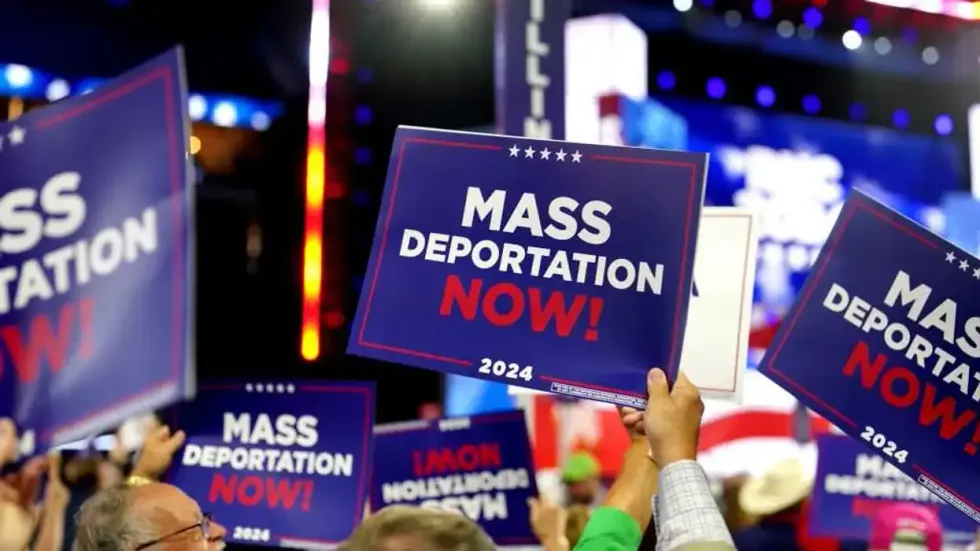
Republicans often treat illegal farm labor as the least objectionable form of illegal immigration. In reality, it may be among the most transformative.
Over the past few decades, large agricultural employers have reshaped rural communities across the Great Plains by relying heavily on immigrant labor. In Schuyler, Nebraska, roughly three-quarters of the population is Hispanic, while 27% of students in the Central Nebraska school district are foreign-born — figures more commonly associated with major metropolitan areas like New York and San Francisco.
The political divide is less about whether mass immigration transforms communities than about where that transformation occurs. Democratic interests tend to favor it in large cities; Republican-aligned agricultural interests have helped bring it to rural America.
When a party’s voters and its governing class want fundamentally different things on a defining issue, eventually the contradiction must break somewhere. The Republican Party itself was born in 1854 when the old party system fractured over the expansion of slavery into the territories.
If Republicans cannot choose between an immigration policy built around American workers and one built around employers’ demand for ever more labor, voters may eventually make the choice for them — and let this party go the way of the Whigs.
Continue reading...
[H/T Blaze Media]