









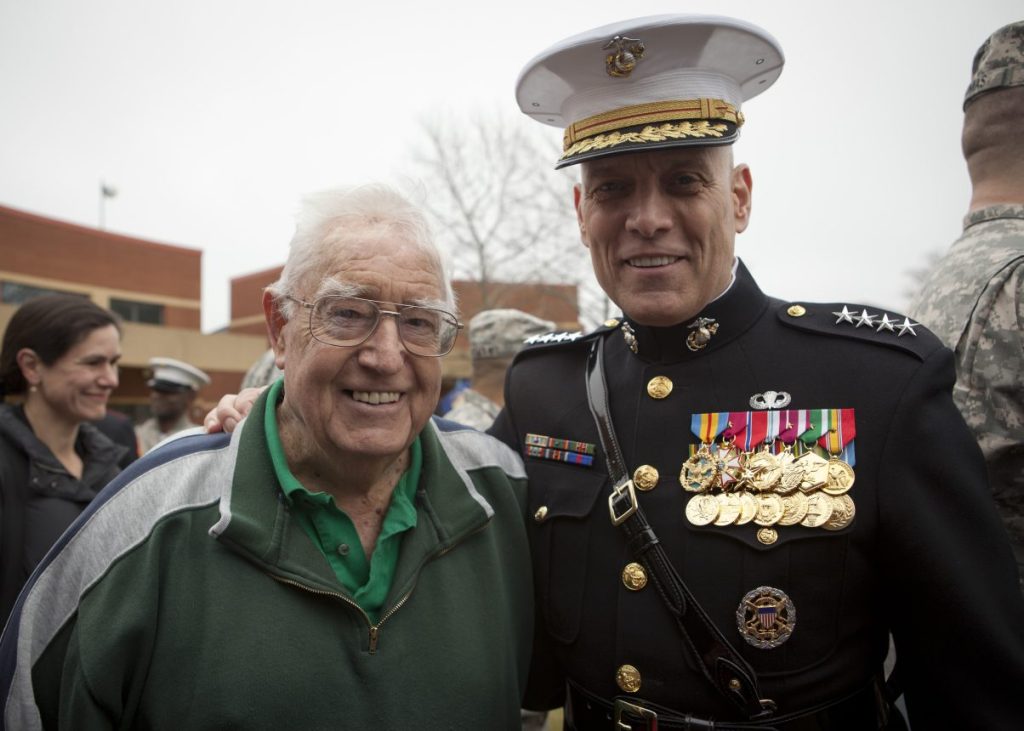
On a troop transport ship shortly before the invasion of Okinawa, a 19-year-old U.S. Marine, James “Jim” Rogan, was interviewed by a radio reporter from back home. He explained that he had met his brother, Peter, a Marine serving with another division. And that they would both go on the operation together. Jim added. “And I want to wish my mother a very happy Mother’s Day. And I hope that everything at home is OK.” The reporter responded, “Well, good luck to you, Jimmy.”
Jim, who had joined the Marines at age 17, had good luck.
A radio lineman, Jim would survive the Battle of Okinawa. Albeit not without some close calls. Jim remembered a sniper’s bullet hissing past his head, “a sound I’ll never forget.” He recalled being knocked off his feet and stunned by a nearby mortar shell impact. He said that “the nights were the longest.” He described once being ordered to clear a cave in which it was believed Japanese soldiers might be hiding. Instead of throwing in grenades, he carefully listened for voices. Hearing what he thought were women and children, he lightly called to them to come out. Women and children were indeed inside, and they were ushered to safety.
Many Americans were not so lucky. There were 12,520 killed in the hard battle for that still-strategically critical island. Jim’s unit, the 2nd Battalion, 22nd Marine Regiment, suffered very high casualties (as shown in the chart below).
Chart
" data-large-file="https://www.washingtonexaminer.com/wp-content/uploads/2026/11/image.png?w=681" src="https://www.washingtonexaminer.com/wp-content/uploads/2026/11/image.png" alt="Chart showing WWII losses." class="wp-image-4789894" style="width:400px;height:auto" srcset="https://www.washingtonexaminer.com/wp-content/uploads/2026/11/image.png 681w, https://www.washingtonexaminer.com/wp-content/uploads/2026/11/image.png?resize=300,267 300w" sizes="(max-width: 681px) 100vw, 681px">
Prior to the assault on Okinawa, Jim had fought in the Marshall Islands campaign and at the Battle of Guam. At that latter battle, he narrowly avoided another untimely demise.
During the beach assault, an understandably nervous Marine behind him tripped and accidentally fired his shotgun. It blasted Jim’s helmet off his head. Fortunately, he was only dazed. He also remembers a rat “the size of a cat” sitting on his feet during a short stint in hospital following the battle. Again, however, he was lucky. Jim’s friend and platoon buddy Ernest Kernen was killed clearing a cave during the battle. In a short moment of respite, another friend went off looking for souvenirs. He was later found staked into the ground after Japanese forces captured and killed him.
Immediately after the war, Jim would serve with the Marines deployed to northern China. He liked to remind me that he didn’t like the food. He then joined the Army, later receiving a commission. His Army career would see Jim guard high-ranking Nazi prisoners at Spandau prison, deploy to peacetime Korea and Japan, and serve in the 7th Cavalry Regiment and 82nd Airborne Division. He would retire as a Major. Jim then worked at a bank in Connecticut before retiring with his wife, Marian, to Florida. Marian passed in 2002, with Jim then relocating to be closer to a son and daughter in the Washington, D.C., area. He celebrated a wonderful 90th birthday at a Washington Capitals hockey game, moved by the audience’s cheers. He was also touched on a later birthday when former Defense Secretary and retired Marine general Jim Mattis called to wish him well.
Jim died at age 101 on Saturday, Oct. 31, surrounded by family. Twenty-four years later, he has finally been reunited with Marian.
Jim was my grandfather, and I was very close to him. A medical condition precluded me from joining the military, but I held him in very high regard for his many years of courageous national service. Until his mobility declined in later years, I would often go with him to the Washington, D.C., Fort Myer/Henderson Hall military base for coffee and a chat. He was on a first-name basis with the staff, whom he would tip extraordinarily well (perhaps compensation for the sometimes original nicknames he gave them). Jim had four children, eight grandchildren, and four great-grandchildren.
Three final points stand out for me.
CAN EUROPE STOP RUSSIAN SUBMARINES FROM EXPLOITING BROKEN UK NAVY
First, Jim’s life offers testimony to that great American intersection of true patriotism, courage, and family. Second, it was a life well lived. Jim fought young and, moving past some turbulent middle years, died old after many happy years at peace. He was well cared for by his family. He gave many much benefit and joy, myself as much as anyone (even if he didn’t always appreciate my sense of humor).
Jim’s life proves that the American dream is always, however hard the circumstances in any one moment, worth pursuing.
Continue reading...
[ H/T Washington Examiner ]