



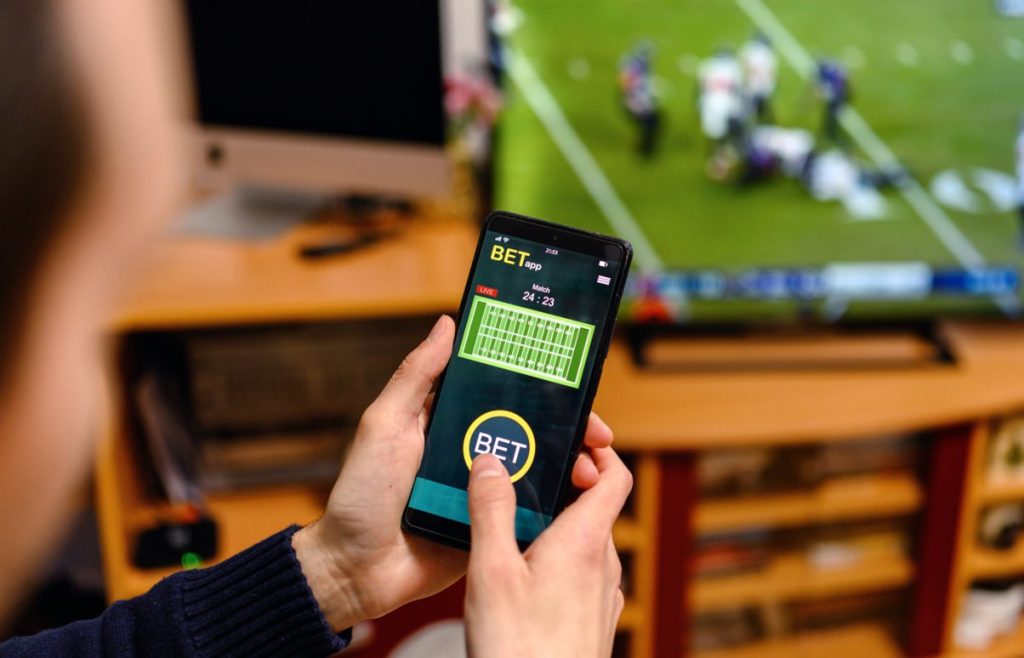
We are now a nation of gamblers. Sports betting was once relegated to casinos and local bookmakers. Today, apps have put a 24-hour sportsbook directly into the pockets of Americans.
This shift carries acute risks for service members and veterans.
A month after 9/11, one of us, David Yeager, deployed to a U.S. base in South Korea, leaving behind a wife and two young children. Looking to unwind from deployment stress, he walked into an on-base hotel, was met by a room of slot machines, and played a couple hundred dollars. He won.
That momentary rush planted a seed that spiraled over the next six years into severe addiction. David wiped out his savings, went through a divorce, lost contact with his children for two years, and survived four suicide attempts. While David is now in recovery, his story captures the central vulnerability across the ranks: A high-stress environment, steady pay, and an easy escape that quickly spirals out of control.
As the other of us, Patrick J. Murphy, saw while serving with the 82nd Airborne Division in Iraq and later helping run the Army as Undersecretary, David’s story is far from isolated. Troops have long gambled deployment pay in barracks card games or on overseas base slots.
But now it’s even easier to access on mobile apps that never close.
Since the Supreme Court opened the door in 2018, most states have legalized sports betting, most of them through mobile apps, including the states that are home to some of the largest military bases in the country.
Researchers at West Point’s Lab for Economic Security estimate close to 100,000 active-duty soldiers could have a betting account — that’s 20% of our active troops. Gambling is common in the ranks. According to the Defense Department’s 2022 Health-Related Behaviors Survey, 1.6% of active-duty servicemembers reported problem gambling. Yet in fiscal 2024, only 185 active-duty servicemembers received a gambling-related diagnosis. But the National Council on Problem Gambling estimates as many as 56,000 active-duty members meet the criteria for gambling disorder. Veterans’ rates of gambling problems run more than twice those of the general public.
A soldier can place a bet in the motor pool, at the range, or before morning PT.
Part of the problem is that the military is full of people who are especially susceptible to gambling because we’re willing to take risks, including potentially giving up our lives in combat or jumping out of perfectly fine airplanes with our weapons at hand. West Point researchers note that soldiers have greater risk tolerance than civilians, and 71% of enlisted soldiers are between 18 and 30 — the age group most heavily targeted by sports-betting companies. Put that soldier in a barracks room with a steady paycheck, a lot of empty evenings, and a sportsbook on his phone, and you can see where it goes.
The gambling industry knows exactly who it’s marketing to. Every December, sportsbooks promote betting offers around the Army-Navy game. Major casino operators like MGM, Caesars, PENN Entertainment, and Hard Rock offer service members special loyalty perks, giving them rewards status that other customers have to earn through spending or gambling. The companies present these perks as a way to thank service members, but there’s an obvious business incentive too. For a population already at greater risk of addiction, encouraging gambling is a perverse way of showing gratitude.
The problem is going unseen. Congress required gambling screening in the annual health assessment in 2018, but that screening isn’t anonymous, and financial counselors told GAO that troops worry a gambling problem could cost them their security clearance. The confidential survey meant to fill the gap got a 4.7% response rate in 2024.
When it does surface, it rarely shows up alone. Among service members diagnosed between 2019 and 2024, more than half also had depression and about half had anxiety. A lot of veterans we know went looking for something that felt like the adrenaline of a deployment, or something to quiet what came back with them. For some, that was gambling.
And when a soldier does ask for help, GAO found the military has no specialized treatment program for gambling disorder the way it does for drugs and alcohol. In January 2025, the Pentagon formally expanded its addiction policies to include gambling disorder. But eight months later, the Government Accountability Office (GAO) found that the Defense Health Agency still hadn’t issued the guidance needed to put those policies into practice, including who would be responsible for training personnel to diagnose and treat the condition. The agency was supposed to address those gaps by June 2026.
THE HOUSE ALWAYS WINS — AND IT’S COMING FOR YOURS
At least lawmakers are beginning to pay attention. Republicans and Democrats in Congress have introduced legislation to expand gambling-addiction treatment and prevention. In our home state of Pennsylvania, legislators from both parties recently formed a problem gambling caucus. These are welcome developments, although neither substitutes for action by the Pentagon itself.
Military and VA medical providers need the resources to screen for gambling disorders confidentially, without destroying careers. Most urgently, the Pentagon must build dedicated clinical care pathways, enforce its own directives, and finally shut down its overseas slot machines.
Patrick J. Murphy served as the 32nd Undersecretary of the Army and represented Pennsylvania’s 8th Congressional District. David Yeager is an Army veteran, behavioral health counselor, and author of “Fall In: A Veteran with a Gambling Addiction.” If you or someone you know needs help, call 1-800-GAMBLER.
Continue reading...
[ H/T Washington Examiner ]