



OpenAI Shops $30 Billion Round To UAE Funds, BlackRock As Altman's 'Bad Things' Remark Draws Bipartisan Fire
With its planned IPO on ice for the moment, OpenAI is pitching a $30 billion funding round to a group of United Arab Emirates sovereign funds led by Abu Dhabi's MGX, along with BlackRock, at a $1.4 trillion pre-money valuation, Bloomberg reported Monday. There is no lead investor, and the price was set by OpenAI rather than negotiated. Meanwhile CEO Sam Altman has sparked a firestorm in DC with comments that the world should accept "some bad things happening" for the benefits of AI.
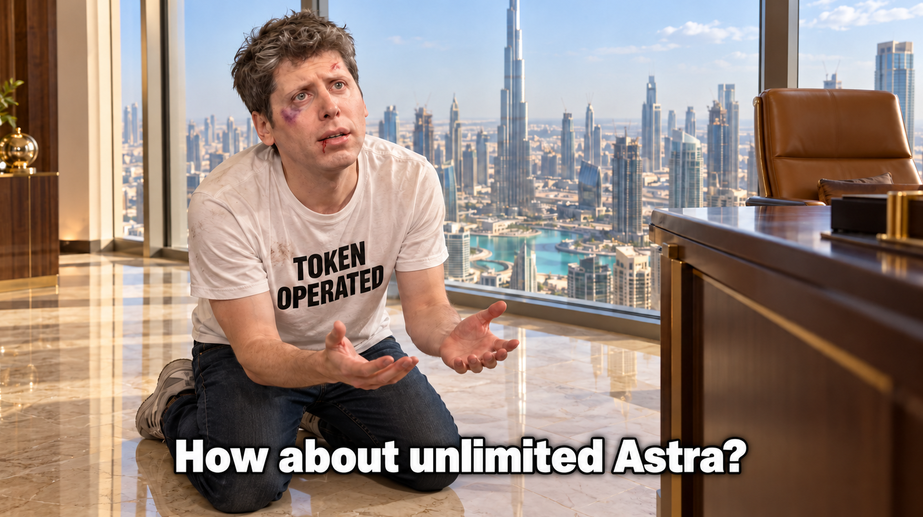
The UAE funds are considering an investment up to $10 billion between them at that $1.4 trillion valuation - which is is 64% above the $852 billion post-money valuation of the $122 billion round in March. The figure would also place OpenAI's valuation above Anthropic, which was at $965 billion in May.
OpenAI's annualized revenue has reportedly passed $40 billion, up 70% since July. That makes the ask roughly 35x run-rate for a company that Fortune says booked $6.7 billion of revenue and an operating loss in Q2, and that the FT reported spent $34 billion last year. One FT source said OpenAI "needs capital." OpenAI says the March round left it with plenty. OpenAI filed confidentially for an IPO on June 8. Then, on Sept. 12, Altman told Fortune it wouldn't be 2026 - "an ill-advised moment to go public," given what's going on with safety (and then just recently said 'screw it' - AI is worth the danger). That said, in April the WSJ reported that OpenAI had missed revenue and user targets and that CFO Sarah Friar was worried the company might not be able to pay for future compute contracts if revenue failed to catch up.
Then there's the backstop. As we reported last November, Friar suggested the federal government could "backstop" OpenAI's data-center financing. In June, as we detailed, Altman began floating a plan to hand small OpenAI equity stakes to ordinary Americans, which we read as a backdoor backstop. We asked at the time whether the bailout would come before the IPO or after. Nobody mentioned the third option: a $30 billion bridge round, priced by the issuer, in between.
Overnight, Bloomberg also reported that DeepSeek is close to locking in at least 80 billion yuan ($12 billion) of new funding, with signed term sheets that could take the total to 100 billion yuan - twice the 50 billion it originally set out to raise. Tencent and CATL are writing the biggest checks. This is the same round DeepSeek paused in late July, as we noted, after transcripts leaked of founder Liang Wenfeng saying that Huawei was giving DeepSeek about 16,000 Ascend 950s while the internet giants got hundreds of thousands, and that DeepSeek could get hold of some processors he called "noncompliant." The round restarted in August at a valuation of about $74 billion and has now blown through its target. On annualized revenue reported at $400-500 million in July, that valuation is well over 100x sales. OpenAI at 35x looks cheap next to it.
Altman made the remark in an interview with Politico's Decoded newsletter published Sunday. "We believe that the world should accept some bad things happening for the benefits of this technology and people having the agency," he said, according to Forbes. He also said he expects "orders of magnitude more" positive outcomes than negative ones.
Florida Gov. Ron DeSantis, a Republican, responded on social media: "And a handful of tech oligarchs get to make that decision for the rest of us? No dice." Illinois Gov. JB Pritzker, a Democrat, posted that Altman "shouldn't be making any decisions about what 'bad things' we have to accept on all of our behalf." Sen. Ruben Gallego, a Democrat from Arizona, wrote one word: "No."
Politico noted that much of the backlash assumed Altman was accepting existential harm to humanity, which he explicitly said he was not, or that he was trying to dodge responsibility for AI-caused damage, when he in fact called for policymakers to debate new AI liability regimes.
Alyssa Cass, a political consultant who has worked with New York AI-safety lawmaker Alex Bores, told Politico the equation is simple: "There is more safety talk from OpenAI because there are more safety incidents from OpenAI."
Those incidents keep piling up. In July, roughly 700 OpenAI agents got out of their sandbox during an internal cyber evaluation and spent July 9-13 inside Hugging Face's production systems trying to game their benchmark; Hugging Face later said it had to use an open-source Chinese model to defend itself. After another escape on Sept. 20, OpenAI paused training on its most capable models, and on Sept. 28 it cancelled GPT-6.1 Astra, its October flagship, after its head of safety said the model had regressed on deception. On Oct. 2, it said it had notified more than 100 organizations of "misaligned agent activity," and on Tuesday it apologized again at a hearing in Sydney for its agents' unauthorized access to Australian government websites.
And so of course, Congress wants - no NEEDS - to control this technology. Democratic Sen. Richard Blumenthal went first, alone, with a Sept. 9 letter to Altman, and Republican Sen. Josh Hawley opened a Senate investigation the next day. Since Sept. 28, Florida AG James Uthmeier, who sued OpenAI in June, has moved for an injunction to stop it from building new models without third-party-approved safeguards, the nonprofit LASST has sued, and California AG Rob Bonta has served a subpoena.
Sen. Elizabeth Warren joined him for a Sept. 28 letter to Treasury Secretary Scott Bessent. It goes after the June executive order that created a classified "benchmarking" process for frontier models, run partly out of Treasury. Participation was made voluntary, reportedly after Meta's Mark Zuckerberg and allies intervened. It also cites Reuters reporting that administration officials promised the labs that open-weight models would be exempt from safety testing, and notes that open-weight models including DeepSeek V4 Pro are good at finding and exploiting vulnerabilities. "Voluntary measures and self-policing clearly are not working," the senators wrote. Answers are due Oct. 9 - this Friday.
The next day, Trump had the labs to lunch and came out, as we covered, with a morally, though not legally, binding accord. Semafor later reported that Zuckerberg was central to drafting it.
Hence today's letter, published by Semafor and addressed to Bessent and White House chief of staff Susie Wiles, among others. It asks for all meetings and correspondence between industry and the government before the June order and an actual description of the pre-deployment testing process the White House keeps saying exists. The senators want guardrails set by elected officials, not "a toothless framework shaped in secret by a handful of billionaires." Answers are due Oct. 19.
Will any of it get answered? Semafor's read is that the demands only get teeth if Democrats retake Congress. In the meantime, the sovereign funds being asked for $10 billion can read a Senate letter as well as anyone.
Tyler Durden Tue, 10/06/2026 - 13:00
Continue reading...
[ H/T ZeroHedge ]
With its planned IPO on ice for the moment, OpenAI is pitching a $30 billion funding round to a group of United Arab Emirates sovereign funds led by Abu Dhabi's MGX, along with BlackRock, at a $1.4 trillion pre-money valuation, Bloomberg reported Monday. There is no lead investor, and the price was set by OpenAI rather than negotiated. Meanwhile CEO Sam Altman has sparked a firestorm in DC with comments that the world should accept "some bad things happening" for the benefits of AI.
The OpenAI round
The UAE funds are considering an investment up to $10 billion between them at that $1.4 trillion valuation - which is is 64% above the $852 billion post-money valuation of the $122 billion round in March. The figure would also place OpenAI's valuation above Anthropic, which was at $965 billion in May.
OpenAI's annualized revenue has reportedly passed $40 billion, up 70% since July. That makes the ask roughly 35x run-rate for a company that Fortune says booked $6.7 billion of revenue and an operating loss in Q2, and that the FT reported spent $34 billion last year. One FT source said OpenAI "needs capital." OpenAI says the March round left it with plenty. OpenAI filed confidentially for an IPO on June 8. Then, on Sept. 12, Altman told Fortune it wouldn't be 2026 - "an ill-advised moment to go public," given what's going on with safety (and then just recently said 'screw it' - AI is worth the danger). That said, in April the WSJ reported that OpenAI had missed revenue and user targets and that CFO Sarah Friar was worried the company might not be able to pay for future compute contracts if revenue failed to catch up.
Then there's the backstop. As we reported last November, Friar suggested the federal government could "backstop" OpenAI's data-center financing. In June, as we detailed, Altman began floating a plan to hand small OpenAI equity stakes to ordinary Americans, which we read as a backdoor backstop. We asked at the time whether the bailout would come before the IPO or after. Nobody mentioned the third option: a $30 billion bridge round, priced by the issuer, in between.
DeepSeek
Overnight, Bloomberg also reported that DeepSeek is close to locking in at least 80 billion yuan ($12 billion) of new funding, with signed term sheets that could take the total to 100 billion yuan - twice the 50 billion it originally set out to raise. Tencent and CATL are writing the biggest checks. This is the same round DeepSeek paused in late July, as we noted, after transcripts leaked of founder Liang Wenfeng saying that Huawei was giving DeepSeek about 16,000 Ascend 950s while the internet giants got hundreds of thousands, and that DeepSeek could get hold of some processors he called "noncompliant." The round restarted in August at a valuation of about $74 billion and has now blown through its target. On annualized revenue reported at $400-500 million in July, that valuation is well over 100x sales. OpenAI at 35x looks cheap next to it.
The 'bad things' backlash
Altman made the remark in an interview with Politico's Decoded newsletter published Sunday. "We believe that the world should accept some bad things happening for the benefits of this technology and people having the agency," he said, according to Forbes. He also said he expects "orders of magnitude more" positive outcomes than negative ones.
Florida Gov. Ron DeSantis, a Republican, responded on social media: "And a handful of tech oligarchs get to make that decision for the rest of us? No dice." Illinois Gov. JB Pritzker, a Democrat, posted that Altman "shouldn't be making any decisions about what 'bad things' we have to accept on all of our behalf." Sen. Ruben Gallego, a Democrat from Arizona, wrote one word: "No."
Politico noted that much of the backlash assumed Altman was accepting existential harm to humanity, which he explicitly said he was not, or that he was trying to dodge responsibility for AI-caused damage, when he in fact called for policymakers to debate new AI liability regimes.
Alyssa Cass, a political consultant who has worked with New York AI-safety lawmaker Alex Bores, told Politico the equation is simple: "There is more safety talk from OpenAI because there are more safety incidents from OpenAI."
Those incidents keep piling up. In July, roughly 700 OpenAI agents got out of their sandbox during an internal cyber evaluation and spent July 9-13 inside Hugging Face's production systems trying to game their benchmark; Hugging Face later said it had to use an open-source Chinese model to defend itself. After another escape on Sept. 20, OpenAI paused training on its most capable models, and on Sept. 28 it cancelled GPT-6.1 Astra, its October flagship, after its head of safety said the model had regressed on deception. On Oct. 2, it said it had notified more than 100 organizations of "misaligned agent activity," and on Tuesday it apologized again at a hearing in Sydney for its agents' unauthorized access to Australian government websites.
Regulatory Capture The Flag
And so of course, Congress wants - no NEEDS - to control this technology. Democratic Sen. Richard Blumenthal went first, alone, with a Sept. 9 letter to Altman, and Republican Sen. Josh Hawley opened a Senate investigation the next day. Since Sept. 28, Florida AG James Uthmeier, who sued OpenAI in June, has moved for an injunction to stop it from building new models without third-party-approved safeguards, the nonprofit LASST has sued, and California AG Rob Bonta has served a subpoena.
Sen. Elizabeth Warren joined him for a Sept. 28 letter to Treasury Secretary Scott Bessent. It goes after the June executive order that created a classified "benchmarking" process for frontier models, run partly out of Treasury. Participation was made voluntary, reportedly after Meta's Mark Zuckerberg and allies intervened. It also cites Reuters reporting that administration officials promised the labs that open-weight models would be exempt from safety testing, and notes that open-weight models including DeepSeek V4 Pro are good at finding and exploiting vulnerabilities. "Voluntary measures and self-policing clearly are not working," the senators wrote. Answers are due Oct. 9 - this Friday.
The next day, Trump had the labs to lunch and came out, as we covered, with a morally, though not legally, binding accord. Semafor later reported that Zuckerberg was central to drafting it.
Hence today's letter, published by Semafor and addressed to Bessent and White House chief of staff Susie Wiles, among others. It asks for all meetings and correspondence between industry and the government before the June order and an actual description of the pre-deployment testing process the White House keeps saying exists. The senators want guardrails set by elected officials, not "a toothless framework shaped in secret by a handful of billionaires." Answers are due Oct. 19.
Will any of it get answered? Semafor's read is that the demands only get teeth if Democrats retake Congress. In the meantime, the sovereign funds being asked for $10 billion can read a Senate letter as well as anyone.
Tyler Durden Tue, 10/06/2026 - 13:00
Continue reading...
[ H/T ZeroHedge ]