






Explaining ‘off-grid finance’ working in South Africa: The ‘Stokvel’ which is a community-based economic system (Ubuntu) free from any central control by government, banks, or any other authority.
Protect & SurviveMy “Letter from South Africa” (part 2) describes how off-grid finance uniquely works in South Africa (SA) by implementing the traditional cultural concept of ‘UBUNTU’. This is an African philosophy that expresses the idea of humanity being interconnected. It is often summarised by the phrase: “I am because we are.” or more descriptively: “A person is a person through other people.” Ubuntu has particular significance in South Africa, where it became an important moral principle during the transition from apartheid to democracy in 1994. Ubuntu is more than simply being kind or helpful. It challenges the idea that individual success, wealth, or power comes at the expense of others and in SA is expressed practically by the functions of Stokvels.
We covered some local economic networks in Part 1, but in South Africa (SA), we have a special one – something more than just a random network; read on for a glimpse into the future of localisation in action. It seems obvious, at least to me, that a local network of essential supply chains is not only empowering for its members, but is resilient to external forces determined to centralise and dictate to others how they should live and prosper, like governments and central banks act in the Collective West.
South Africa is a leading example of how democracy should work as intended. In the recent local elections, the ANC (the original leaders for years), lost dramatically. However, instead of the angst and conflicts seen in the West, the ANC demonstrated humility. This is part of how the ANC reacted: Responding to the election outcome, ANC Secretary-General Fikile Mbalula said “the party accepted the outcome with humility:” “The people of South Africa have spoken”.
Austrian’s Newsletter is a reader-supported publication. To receive new posts and support my work, consider becoming a free or paid subscriber.
“As the ANC, we have heard [the] people. We recognise that many South Africans who once placed their confidence in the ANC have chosen to support other parties,” he said. “Others have withdrawn from electoral participation altogether. We recognise their concerns; we will not question their judgement or explain away their decisions.” Mbalula said, “the ANC will approach the election’s outcome with introspection”.
“We will confront the reasons why people who once regarded the ANC as their natural political home have become disillusioned with our movement,” he said. Source: https://businesstech.co.za/news/government/883205/final-2026-election-results-announced/?

However, I have to ask “why do Western leaders so want to dominate others by commanding and ruling their people; what are they afraid of? If you have immense wealth, then a primary concern must be that others will notice, want you have too, and often choose to get it by any means available. As the general population in America are heavily armed and trained, I’m not surprised that the ‘Epstein Class’ are nervous, I certainly would be.
This situation inevitably leads to the fear of losing what you have because “them over there – the 99%” – are many, and we rich bastards are few” thus leading to a stupid conclusion, which is called ‘defence’. But these prospective and current leaders are bright, well educated, and know their history. They know what happens if they lose control; they would be lucky to get away with their heads intact. So, I ask again: “Why do such intelligent people become so stupid?”
German theologian, Dietrich Bonhoeffer discovered the answer in 1942 while imprisoned by the Nazis, and it’s more terrifying than you might realise. This video below breaks down Bonhoeffer’s theory of stupidity: why smart people surrender their thinking, how power creates mass stupidity, and why you can’t convince someone once they’ve crossed that line. This isn’t about low IQ or bad education; it’s about the psychological surrender that makes even brilliant minds vulnerable to manipulation.
9/11 did that to USA as “Mass Formation Psychosis.” What is mass formation psychosis? What does the research literature say about this disorder? [Read, https://www.nepsy.com/articles/lead...is-is-it-like-mass-hysteria-or-mass-delusion/]
This pattern has played out a number of times over the past century. It’s happening again today in the Collective West.

There is a type of psychology that explains why your loved one cannot allow themselves to see the truth:
Leo’s Newsletter: Lame duck? Why Trump is more dangerous now than ever and likely to turn on conservatives https://leohohmann.substack.com/p/lame-duck-why-trump-is-more-dangerous?
Furthermore, Leo says, “I also encourage you to reread my article from earlier this year titled “Beware the isms” because it is directly relevant to today’s topic. An “ism” is an ideology based on a belief system that’s so powerful it competes for our loyalties with religious fervour. Ideologies can cross over at some point and become a false religion, at which point they operate like a cult.” [I explained how Covid became a cult very early in its existence; https://austrianpeter.substack.com/p/the-covidian-cult-is-global-453]
An ideological cult demands everything in its quest for total allegiance. We must give up our independence, or critical thinking skills, and swear allegiance to a false belief system. And that’s why any Christian should recognise an ideology in all its forms. It’s a trap laid for the hearts and minds of men. Even the smartest men and women are vulnerable to its snares.
You have to be able to recognise an ideology upfront as a danger zone and refuse to enter. Once you’re inside, it’s almost impossible to get out. In times like these, our loyalty must be reserved exclusively for our Creator in Heaven and His Son, Jesus Christ. The minute you relegate Him to the sidelines, you have succumbed to the cult and its leader. We also must recognise that even a cult has some truth mixed in with its toxic lies.
However, in South Africa, due to our history, we are able to see the truth and act upon it, which is why Stokvels were not only created decades ago with the full force of government and law behind them, but could also offer a model for prosperity in the Collective West. This is how the Global South will not only survive the coming conflagration, but actually prosper through it. What follows is how it works today.
What is a Stokvel? An Introductory Guide: A Stokvel is a traditional South African savings club where a group of people pool their money together on a regular basis. The concept has been part of South African culture for over a century, originating from the rotating credit associations (aka Credit Unions) brought by communities during the industrialisation era.
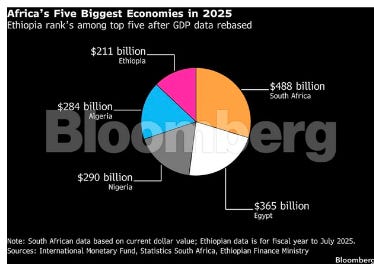
Today, over 11 million South Africans are members of approximately 810,000 Stokvel groups, collectively saving an estimated R50 billion per year. That’s more than the GDP of some African countries. A Stokvel is built on trust, community, and the principle of Ubuntu (”I am because we are.”)
The basic principle is simple: A group of people (typically 5-30) agree to contribute a fixed amount at regular intervals (weekly, fortnightly, or monthly). The pooled money is then distributed according to the group’s agreed rules. A treasurer manages the finances, tracks contributions, and handles payouts. The group operates under a set of agreed rules, often documented in a Constitution. There are various types of Stokvels in South Africa:
- Rotation Stokvel (Round Robin): This is the most common type. Members contribute a fixed amount each month, and the entire pool goes to one member per cycle. Everyone takes a turn. For example, if 10 members each contribute R500/month, one member receives R5,000 each month. After 10 months, everyone has received their payout.
- Savings Stokvel (Lump Sum): Members save throughout the year, and the total pool is divided equally at the end of the cycle, usually during December holidays. This is popular for Christmas savings.
- Burial Society: Members contribute to a fund specifically for funeral costs. When a member or their family member passes away, the fund covers burial expenses.
- Investment Stokvel: The pooled money is invested in stocks, property, or local business ventures for collective growth and growing prosperity by trading locally.
- Grocery Stokvel: Members save throughout the year and buy groceries in bulk at a discount, typically before December.

Why Are Stokvels So Popular? A networked group provides responsibility and accountability, making it easier to save consistently. No bank account or credit score is needed, cash and barter provide the basic financial connections. The supportive networked community strengthens social bonds and mutual support. Members can access larger sums than they could save alone. These ‘Ubuntu’ traditions are deeply rooted in South African tradition and culture.
Managing a Stokvel can be challenging due to the need to track contributions manually with notebooks or local spreadsheets. There will always be reluctant members who need encouragement to continue their contributions. As in all normal business transactions, the need to chase defaulting members, or reconciling disputes about payments, requires a degree of local management skills.
There can be a lack of transparency, when members are not allowed see the books, or if they do, maybe they don’t recognise the entries. Formal record-keeping can be inadequate for audit purposes, and of course, the obvious opportunity for petty theft or crude frauds can arise. This is why the ‘StokvelClub’ arose, offering a digital platform that handles management and records automatically. It can track contributions, send reminders, schedule payouts, and give every member full transparency, all from their smartphone.
The ‘StokvelClub’ is just one of many organisations supporting this type of informal economy. Stokvels in South Africa do not have legal personality and are generally treated as partnerships under common law. There is no statutory registration required to form a Stokvel and they can operate informally.
Under the Banks Act 94 of 1990, Stokvels are exempt from banking regulations only if they register with a self-regulatory body approved by the Registrar of Banks. The designated body is the National Stokvel Association of South Africa (NASASA).
- Mandatory if the Stokvel holds member contributions exceeding R100,000 in aggregate at any time
- Not required if total contributions stay below R100,000
- Additional conditions: fewer than 36 members and total deposits not exceeding R9.99 million (exceeding this triggers mutual bank registration)
While not legally mandatory for small Stokvels, a written constitution is strongly advisable and is required for NASASA registration. It should cover:
- Name, aims, and objectives
- Membership criteria and admission process
- Contribution amounts and schedules
- Payout/distribution arrangements
- Executive committee structure (chairperson, secretary, treasurer)
- Dispute resolution procedures
Under the Financial Intelligence Centre Act (FICA), Stokvels opening a bank account must comply with identity verification requirements:
- Valid South African ID or permanent resident permit for each member
- Proof of residence (not older than 3 months)
- At least 3 to a maximum of 5 signatories, all over 18
- The Stokvel’s constitution or founding document
National Credit Act (NCA)
- Loans between the Stokvel and its own members following the Stokvel’s rules are exempt from the NCA
- If the Stokvel lends to non-members and charges interest, it must register as a credit provider with the National Credit Regulator (NCR)
- Interest rates must fall within legal limits, and proper loan agreements must be provided
Tax Obligations (SARS)
- Each member must declare their share of interest earned in their annual tax return
- Annual interest exemption: R23,800 (under 65) / R34,500 (65+)
- Stokvels with annual contributions below R150,000 are generally treated as informal savings clubs, not businesses
For most small, informal Stokvels, the practical steps are: draft a constitution, open a joint bank account in the Stokvel’s name, and ensure FICA compliance. Once the group crosses R100,000 in pooled funds, NASASA registration becomes a legal requirement to maintain the Banks Act exemption.
Stokvels open dedicated Stokvel accounts (group savings accounts), not standard business current accounts. Since Stokvels are not registered businesses, banks treat them as group savings schemes rather than commercial entities. What banks offer:
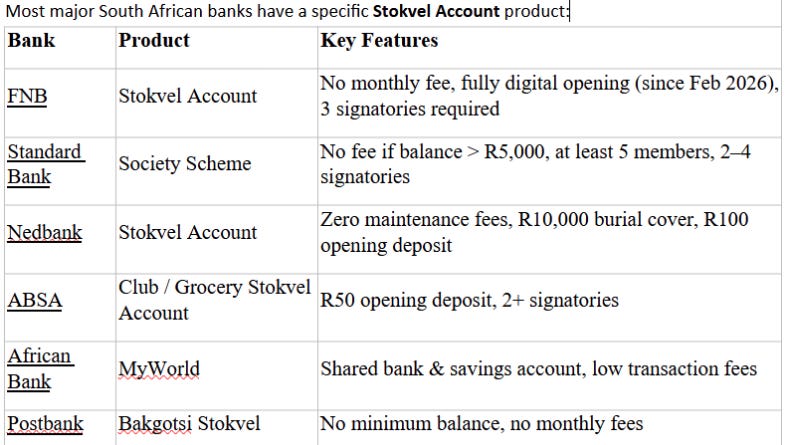
Typical requirements
- Constitution of the Stokvel
- 3 to 5 signatories (all over 18), each with a valid SA ID or passport + permanent residence permit
- Proof of residence (not older than 3 months) for each signatory
- List of members (some banks require at least 5)
- Minutes of the meeting where the decision to open the account was made (some banks)
What you can’t do
- Stokvel accounts are savings-oriented, not transactional business accounts. They generally don’t support:
- Business credit cards
- Merchant/POS services
- Business overdrafts
- VAT registration or company-level banking features
If a Stokvel is running a separate business (e.g., a Stokvel that also operates a catering service), that business entity would need to register separately and open its own business bank account under its own registration.
As of February 2026, FNB allows Stokvels to open accounts entirely through its app: each of the three signatories completes registration independently on their own device, removing the need to visit a branch together. Other banks like Nedbank also offer app-based application routes.
NOT ALL LOCAL ECONOMIES ARE EQUAL
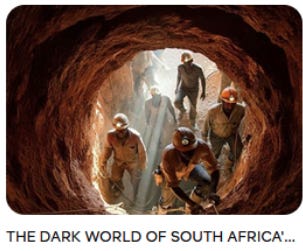
The downside of localisation is the opportunity for exploitation of weak and powerless people like little children working in mines. SA is doing all it can to normalise this tragedy but it will take time. South Africa’s Treasury once again has reason to be grateful to the mining industry, but this time round it’s the zama zamas who deserve a round of applause. Meaning ‘take a chance’ in IsiZulu, these are illegal mining groups operating in abandoned mine shafts across South Africa scavenging for leftover minerals. Sources
- Loaded for Bear: SA’s GDP and fiscal numbers get a lift from zama zamas https://www.dailymaverick.co.za/art...nd-fiscal-numbers-get-a-lift-from-zama-zamas/?
- The scale of South Africa’s informal economy is difficult to pin down due to its ‘off the books’ nature. Previous estimates of the scale from groups such as Standard Bank had pegged it at around R1 trillion https://businesstech.co.za/news/fin...onomy-that-doesnt-pay-tax-is-facing-a-crisis/?
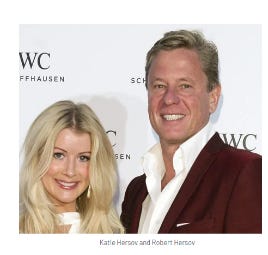
However, billionaire Rob Hersov has a message for young people who want to leave South Africa. He shared his views on people leaving South Africa during a discussion with Jan Hugo on The Relocated South African podcast. After spending 31 years abroad, Hersov returned to South Africa. He said that he loves the country, and that Cape Town is the best place to live in the world.
After his return, Hersov became known as a political activist advocating for the ANC’s removal from government and business-friendly policies. Although he can live anywhere in the world, Hersov said that South Africa is so special that it is worth fighting for. Sources
- Rob Hersov returns to South Africa and his advice for young people https://dailyinvestor.com/south-afr...-young-people-who-want-to-leave-south-africa/?
- South Africa is close to having 4 provinces where more people are unemployed than working https://businesstech.co.za/news/lif...here-more-people-are-unemployed-than-working/?
- The young of the world are solving their way out of the joblessness crisis https://www.dailymaverick.co.za/art...ving-their-way-out-of-the-joblessness-crisis/?
- Heads or Tails, Wall Street Wins: Saving Our Pensions From The Casino https://www.globalresearch.ca/heads-tails-wall-street-wins-saving-pensions-casino/5945395
AFTERWORD – [HatTip Franklin O’Kanu]
Who is working for whom? Please take the time to watch this 2-minute clip. It’s about when clothes washers and refrigerators were first introduced: https://unorthodoxy.substack.com/i/...es-it-results-in-nothing-but-your-destruction
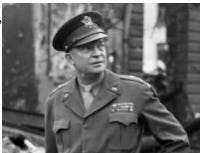
Armistice: Day. “November 10th, marked the eve of the armistice that finally stilled the guns on the Western Front of World War I in 1918. President Eisenhower avowed that he hated war in all its waste and brutality. We hate war because it gives free rein to humanity’s worst passions and deadliest sins. It must always be resisted by people of probity, reserved as a last resort to stop those who elevate force and killing above all else.”

OTHER REFERENCES OF INTEREST
- The sword and the shield https://swordandshield26.substack.com/p/were-all-witnessing-the-final-stages?
- 2026 Medium-Term Budget in a nutshell – what you need to know https://businesstech.co.za/news/bud...m-budget-in-a-nutshell-what-you-need-to-know/?
- How microinsurance can sustain small businesses in Africa https://www.brookings.edu/articles/how-microinsurance-can-sustain-small-businesses-in-africa/?
- What now? Experts weigh in after Trump boots SA from Agoa https://www.dailymaverick.co.za/art...erts-weigh-in-after-trump-boots-sa-from-agoa/?
Tweet
Continue reading...
[ H/T The Burning Platform ]