




Now that the dust has settled on yet another controversy over American education, it’s time to re-learn what our forebears knew: Money doesn’t buy results. Diversity doesn’t guarantee success.
Last month, Nikole Hannah-Jones’ piece in the New York Times Magazine provoked a heated response on what seemed like every op-ed page and podcast in the country. Some commentators were outraged at her selfishness; others, including intellectual adversaries, respected Hannah-Jones for living by her principles.
My reaction was one of empathy. It took tremendous courage and vulnerability to concede that she and her husband had chosen the wrong schools for her daughter, and any parent who has let a child down despite the best intentions can’t help but feel her pain.
But whatever hard lessons Hannah-Jones has learned personally, her policy diagnosis hasn’t changed. Racism is still the disease, and more funding and integration are the cure. The reason these schools fail, she argues, is because they do not have enough resources and lack “diversity.”
But let’s check the numbers. P.S. 307 Brooklyn, where Hannah-Jones sent her daughter, receives about $44,000 per student from New York City — double, even triple, of what higher-performing schools in the city are allotted. It might be failing, but it’s not broke. And schools with far fewer resources have produced high-achieving black graduates for generations.
That history is just one reason I can never accept her assumptions that black achievement requires black children to be seated next to wealthier or demographically “privileged” peers — as in, white or Asian — or that public schools cannot enforce robust community norms that inculcate the habits of achievement. What they need are the kinds of schools generations of black Americans once built for themselves, even when desegregation was a distant dream, and money was scarce.
Over a century ago, reformer Booker T. Washington and philanthropist Julius Rosenwald launched a partnership that built nearly 5,000 schools across the rural South. Rosenwald’s fund paid only part of the cost. Black families, many of them sharecroppers, raised money and donated land and labor to cover much of the rest, and those schools reflected their shared values. The schoolhouses themselves were models of ingenuity, with tall windows to maximize light in classrooms that often lacked electricity, layouts that helped circulate air in the heat of summer, and movable partitions that allowed classrooms to adapt to different sizes and subjects. Smart design, not lavish spending, made the difference.
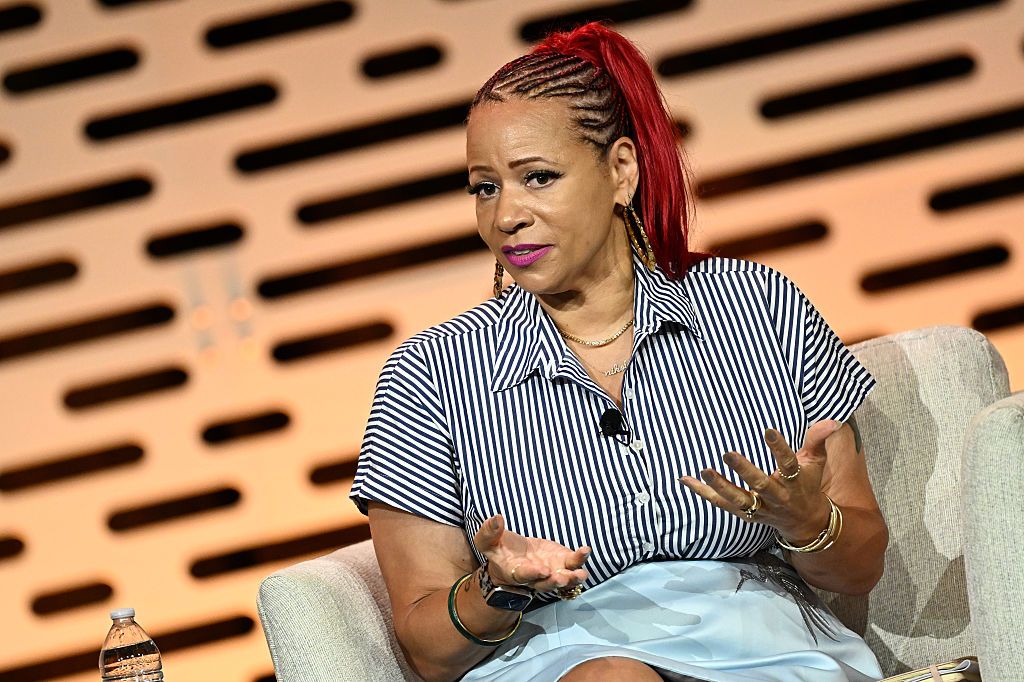
Nikole Hannah-Jones speaks onstage during “The New Power Structure: Black Politics in the Age of Resistance” panel during the 2026 National Association Of Black Journalists Convention at Atlanta Marriott Marquis on August 13, 2026 in Atlanta, Georgia. (Photo by Paras Griffin/Getty Images)
" data-large-file="https://www.washingtonexaminer.com/wp-content/uploads/2026/09/GettyImages-2291010089.jpg?w=1024" src="https://www.washingtonexaminer.com/wp-content/uploads/2026/09/GettyImages-2291010089.jpg?w=1024" alt="Nikole Hannah-Jones speaks onstage during "The New Power Structure: Black Politics in the Age of Resistance" panel during the 2026 National Association Of Black Journalists Convention at Atlanta Marriott Marquis on August 13, 2026 in Atlanta, Georgia. (Photo by Paras Griffin/Getty Images)" class="wp-image-4742465" srcset="https://www.washingtonexaminer.com/wp-content/uploads/2026/09/GettyImages-2291010089.jpg 1024w, https://www.washingtonexaminer.com/.../09/GettyImages-2291010089.jpg?resize=300,200 300w, https://www.washingtonexaminer.com/.../09/GettyImages-2291010089.jpg?resize=768,512 768w" sizes="(max-width: 1024px) 100vw, 1024px">
Nikole Hannah-Jones speaks onstage during “The New Power Structure: Black Politics in the Age of Resistance” panel during the 2026 National Association Of Black Journalists Convention at Atlanta Marriott Marquis on August 13, 2026 in Atlanta, Georgia. (Photo by Paras Griffin/Getty Images)
By the late 1920s, roughly a third of the South’s rural black children attended a Rosenwald school. These schools always had less funding than their white counterparts, but later studies show that Rosenwald graduates nearly closed the black-white achievement gap in the decades that followed.
The same spirit outlived Jim Crow. In 1965, a Philadelphia social worker named Liller Green couldn’t find a preschool that would teach her 3-year-old to read, so she started one with her husband, William, and 17 children. By 1986, the Ivy Leaf School had 750 students and a long waiting list. The New York Times counted it among some 220 independent black schools nationwide, most founded in the 1960s and 1970s. Mrs. Green called the movement “a ripple that’s turned into a tidal wave.”
Of course, just as resources don’t guarantee success, high ideals alone can’t sustain even the best schools. The Rosenwald schools were eclipsed by integration efforts and gradually shut down, though surviving schoolhouses still honor the project’s legacy as civic centers and museums. The Ivy Leaf School closed in 2008, citing competition with charter schools and other fiscal challenges, and Green died in 2024.
Other schools were undermined by misplaced priorities. Hannah-Jones’s hometown of Waterloo, Iowa, is a case in point.
In 1972, Robert Harvey, a black dentist on the school board, asked for more black teachers and administrators, textbooks that reflected his community, and better training for staff. But the board decided instead to bus black children across town, and black leaders protested that this put the whole burden of desegregation on their kids. A 1977 federal review found that while racial tensions in Waterloo had relaxed somewhat since integration, the quality of education had not measurably improved.
Across the country, the same pattern played out on a larger scale: Black schools closed, and tens of thousands of black teachers and principals lost their jobs. Good intentions and political convenience took precedence over black children’s learning.
My predecessor, Bob Woodson, often warned against the elite belief that “all black is all bad.” Our history shows that nothing could be further from the truth. There are social benefits to crossing or even breaking down racial and cultural barriers in many cases, but that work should not come at the expense of the community values that have enabled Americans of all races to achieve against the odds. Diverse classrooms don’t magically raise test scores, much less save our poorest children from lives of despair.
Nothing proves this better than the school I know best, as both its president and a former student.
The Piney Woods School was founded in Mississippi in 1909 by Laurence C. Jones, a black northerner and graduate of the University of Iowa, where his white peers voted him class president. When Jones came south in the worst days of Jim Crow, he encountered a radically different world — the only one his students and their family members had ever known. But Jones never looked down on the poor blacks he sought to educate or expected less of them. Piney Woods was built with the help of former slaves, along with their children and grandchildren, who refused to wait for permission to educate the next generation.
Piney Woods has been in continuous operation ever since. Our students today are not racially diverse or wealthy, and they excel anyway. Over 95% of graduates go on to a four-year university or the military. They arrive knowing hardship and poverty, but graduate with discipline and purpose. In fact, white applicants to Piney Woods compete to get into the school and learn alongside their black peers.
Students receive modest scholarships, but nothing like the tens of thousands of dollars per student that are common in large school districts with middling results. The key to our students’ success is a culture of hard work and high standards. These are what too many schools in our communities have abandoned. Hannah-Jones’s own reporting makes this point: A principal she admires told her that lowering expectations in the name of anti-racism is just racism in another form.
But we know what works. A nurturing community, shaped by discipline, led by teachers and administrators who expect nothing less from their students than good character and academic excellence. Economist Glenn Loury, one of the first scholars to popularize the term “social capital,” argued that what young people inherit from their families and neighbors shapes their opportunities far more than money. What’s true at home is true at school, too. Piney Woods has proven that for over 100 years.
I applaud Hannah-Jones for listening to her daughter, and I admire her daughter for speaking up. We should celebrate every child who encounters hardship and chooses excellence anyway.
HEAD START QUALITY SUFFERED UNDER OBAMA RULES, HHS REPORT FINDS
It is time for all of us to choose excellence, no matter who we are or where we come from. And it is time for us to accept that we hold within ourselves and within our own communities the capacity for real, transformative change.
Instead of searching for the next idea to save black America, we should honor the legacy of those innovators who came before us and invest in the institutions that are already working.
Will Crossley is president of The Woodson Center.
Continue reading...
[ H/T Washington Examiner ]