






NASA Warns Scientists Understating Worst-Case Solar-Storm Scenario
As if the growing risk of a global economic disaster springing from the US-Israeli war on Iran weren't enough to worry about, researchers at NASA's Goddard Space Flight Center are warning that miscalculations and false assumptions may have resulted in an enormous underestimation of the worst-case effects of a solar storm.
Solar storms are events in which the sun experiences a massive explosion of energy, charged particles and magnetic fields. From solar flares to coronal mass ejections (CMEs), these explosions pose a danger to all kinds of electronics, from your cell phone, computer and car to gas pumps, airplanes, power stations and everything in between.
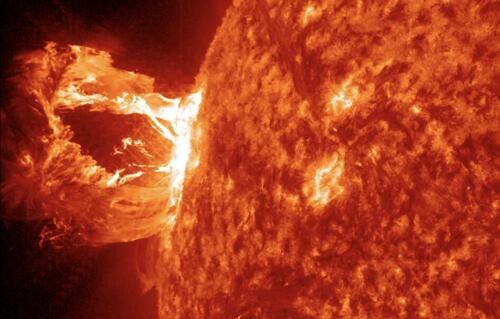
The worst such event in recorded history was the Carrington Event of 1859. Estimated to have been as powerful as 10 billion atomic bombs, it caused telegraphs to fail across Europe. A far more modest event in 2003 disrupted the FAA's navigation computers for more than 24 hours, and the FAA was prompted to warn that high-altitude flights might receive dangerous doses of radiation.
Critically, the prevailing theory about "solar weather" posits that there's a limit to just how much energy can be injected into Earth's polar ionosphere. Alarmingly, NASA scientists are now saying there may be no such limit to the destructive energy that could rain down on the world. They derive that suspicion from more than a million data points where solar wind was gauged by NASA craft in Earth orbit. These measurements show a direct correlation between the potency of the solar wind and upper-atmosphere currents -- rather than a declining correlation as more powerful forces confronted the theorized upper limit. “There is currently no statistical evidence to suggest an upper limit to the energy transferred from the solar wind to the polar ionosphere,” the NASA researchers concluded.
VIDEO -- the sun's activity from July 10 to 16, as captured by NASA's Solar Dynamics Observatory:
Here's what a co-author of the new study, Lancaster University's Dr. Maria Walach, had to say:
Putting aside the worst-case scenario, a major disaster would surely result from another event on the scale of the Carrington Event. A 2014 study by Lloyds of London in concert with Lexington, Mass-based Atmospheric and Environmental Research called it "almost inevitable," and concluded 20 to 40 million people could endure blackouts lasting anywhere from 16 days up to two years.
Organizations like the Foundation for Resilient Societies have long been urging the implementation of measures to harden America's power infrastructure against solar events, warning that unshielded transformers and transmission systems -- which in turn fail to shield supply chains, medical services and societal order -- threaten the survival of a significant portion of the population.
Tyler Durden Mon, 07/20/2026 - 18:00
Continue reading...
[ H/T ZeroHedge ]
As if the growing risk of a global economic disaster springing from the US-Israeli war on Iran weren't enough to worry about, researchers at NASA's Goddard Space Flight Center are warning that miscalculations and false assumptions may have resulted in an enormous underestimation of the worst-case effects of a solar storm.
Solar storms are events in which the sun experiences a massive explosion of energy, charged particles and magnetic fields. From solar flares to coronal mass ejections (CMEs), these explosions pose a danger to all kinds of electronics, from your cell phone, computer and car to gas pumps, airplanes, power stations and everything in between.
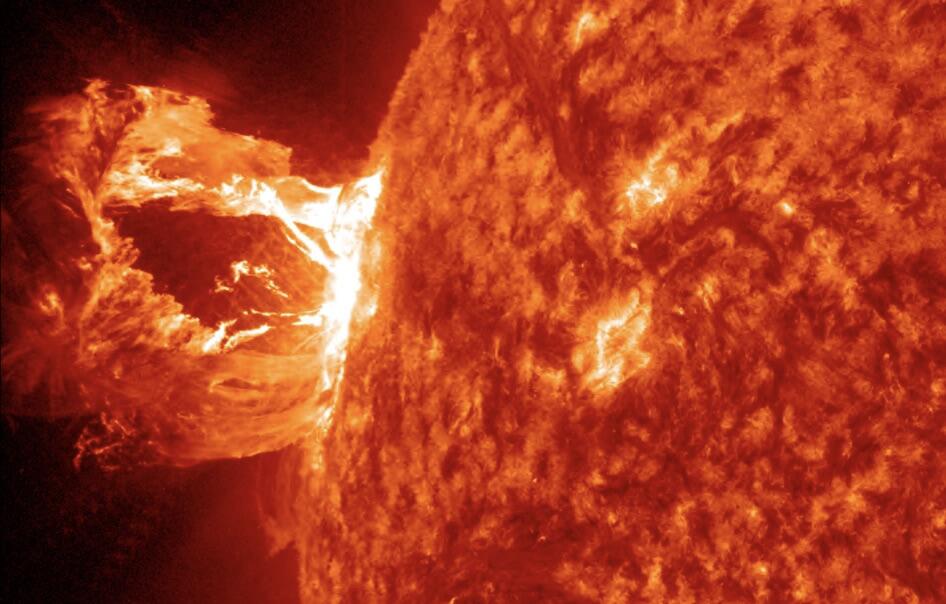
The worst such event in recorded history was the Carrington Event of 1859. Estimated to have been as powerful as 10 billion atomic bombs, it caused telegraphs to fail across Europe. A far more modest event in 2003 disrupted the FAA's navigation computers for more than 24 hours, and the FAA was prompted to warn that high-altitude flights might receive dangerous doses of radiation.
Critically, the prevailing theory about "solar weather" posits that there's a limit to just how much energy can be injected into Earth's polar ionosphere. Alarmingly, NASA scientists are now saying there may be no such limit to the destructive energy that could rain down on the world. They derive that suspicion from more than a million data points where solar wind was gauged by NASA craft in Earth orbit. These measurements show a direct correlation between the potency of the solar wind and upper-atmosphere currents -- rather than a declining correlation as more powerful forces confronted the theorized upper limit. “There is currently no statistical evidence to suggest an upper limit to the energy transferred from the solar wind to the polar ionosphere,” the NASA researchers concluded.
VIDEO -- the sun's activity from July 10 to 16, as captured by NASA's Solar Dynamics Observatory:
Here's what a co-author of the new study, Lancaster University's Dr. Maria Walach, had to say:
Putting aside the worst-case scenario, a major disaster would surely result from another event on the scale of the Carrington Event. A 2014 study by Lloyds of London in concert with Lexington, Mass-based Atmospheric and Environmental Research called it "almost inevitable," and concluded 20 to 40 million people could endure blackouts lasting anywhere from 16 days up to two years.
Organizations like the Foundation for Resilient Societies have long been urging the implementation of measures to harden America's power infrastructure against solar events, warning that unshielded transformers and transmission systems -- which in turn fail to shield supply chains, medical services and societal order -- threaten the survival of a significant portion of the population.
Tyler Durden Mon, 07/20/2026 - 18:00
Continue reading...
[ H/T ZeroHedge ]