







[Newsletter ad — view on SCOTUSblog]
Today is the 25th anniversary of 9/11. Justice Brett Kavanaugh, who was a White House attorney in 2001 and has described 9/11 as “the most memorable, searing, important day” of his life, will speak at a Notre Dame event commemorating the anniversary. The event is scheduled to begin at 3:30 p.m. EDT and will be livestreamed on YouTube.
On a separate note, readers in the Washington, D.C., area may be interested in attending Catholic University Law School’s Sept. 18 event on the state of the Supreme Court and what to watch for in the upcoming term. Amy Howe and Sarah Isgur are among the speakers.
At the Court
On Thursday, the Supreme Court granted a request to prevent Missouri from using a new congressional map favoring Republicans in November’s elections. For more on the decision, see the On Site section below.
Also on Thursday, the court denied a request for a stay of execution from Daniel Conahan, Jr., who was sentenced to death for the 1996 murder of Richard Allen Montgomery. Hours later, Conahan was executed in Florida.
On Tuesday, the Trump administration filed a petition for review on the process it has used to appoint acting U.S. attorneys. Find Amy’s coverage of the petition in the On Site section.
On Sunday, the Trump administration again appealed a dispute over President Donald Trump’s executive order on mail-in voting to the Supreme Court. On Wednesday, the states and civic groups challenging implementation of the order filed responses to that request. The dispute is now fully briefed, and the court’s decision could come at any time.
The Trump administration has asked the Supreme Court to clear the way for it to use the Department of Homeland Security’s Systematic Alien Verification for Entitlements database to identify noncitizens on state voter rolls. A response to the administration’s request is due next Tuesday by 4 p.m. EDT.
Morning Reads
US appeals court rejects Trump mail-in ballot restrictions as Supreme Court considers rule
Nate Raymond, Reuters (paywalled)
On Thursday, the U.S. Court of Appeals for the 1st Circuit “declined to allow President Donald Trump’s administration to implement a new U.S. Postal Service rule that would tighten mail-in voting requirements before November’s congressional elections,” according to Reuters. The 1st Circuit explained that “it saw no error in [the district court’s] conclusion that allowing the rule to take effect ‘will likely result in the disenfranchisement of millions of voters across the country while providing minimal – if any – gains in combating voter fraud.’” Nevertheless, “[t]he fate of that rule will be decided” by the Supreme Court because the administration did not “wait for the 1st Circuit to issue a decision before asking the high court to lift” the district court’s injunction preventing the rule’s implementation.
Appeals court rejects ICE detention policy, setting stage for SCOTUS
Kyle Cheney, Politico
On Thursday, the U.S. Court of Appeals for the 4th Circuit “rejected ICE’s effort to detain millions of people without bond, comparing it to the ‘historical stain’ of Japanese internment during World War II,” according to Politico. The decision was “the ninth loss in a row for ICE at federal appeals courts, all of which have now ruled on the” agency’s policy of subjecting noncitizens “residing in the interior of the country” “to mandatory detention while their immigration proceedings” unfold. The nine appellate courts “agreed that the Trump administration’s approach relies on a misreading of the 1996 immigration reform law that established current deportation and detention policies.” Politico noted that “[t]he Supreme Court is all but certain to take up the issue in its next term.”
Only 31% of Americans approve of the Supreme Court
David Montgomery, YouGov
The latest Economist/YouGov survey showed “[a]bout one-third (31%) of Americans strongly or somewhat approve of how the U.S. Supreme Court is handling its job, ... while 53% disapprove.” And like other surveys, it identified a partisan gap: 63% of Republicans approve of the Supreme Court’s job handling, compared to just 12% of Democrats. Researchers also found that “[f]ew Americans (11%) say the Supreme Court is biased against Trump, while 40% say it’s biased in his favor and 24% say the court treats Trump fairly.”
Defying Precedent in Ten Commandments Case
Adam Liptak, The New York Times (paywalled)
In his newsletter for The New York Times, Adam Liptak explored the dispute over Ten Commandments displays in public school classrooms, an issue the Supreme Court may take up during the 2026-27 term. He highlighted the U.S. Court of Appeals for the 5th Circuit’s decision upholding a Ten Commandments law in Texas, describing the ruling as “a bold move.” That’s because, as Liptak noted, it appeared to be directly at odds with the Supreme Court’s 1980 decision in Stone v. Graham to strike down “a very similar Kentucky law.” According to Liptak, “the Supreme Court has been adamant that only it – not a lower court – can overrule its decisions, however powerful the evidence that it may someday do so.”
On Site
Court News
Supreme Court grants request to prevent Missouri from using congressional map expected to aid Republicans
The Supreme Court on Thursday paused a ruling by a federal judge in Missouri that would have allowed the state to use a new congressional map intended to give Republicans an additional seat in the U.S. House of Representatives in the upcoming elections. In a brief, unsigned order, the court granted a request by the organizers of a referendum on the new map to put the ruling on hold while litigation in the dispute moves forward.
Court News
Trump administration asks justices to decide on its appointments of acting U.S. attorneys
Arguing that a ruling by the U.S. Court of Appeals for the 9th Circuit “threatens to inject mass confusion into five U.S. Attorney’s Offices in the Ninth Circuit that collectively handle over 8000 civil and criminal cases annually,” the Trump administration on Tuesday asked the Supreme Court to weigh in on the legality of President Donald Trump’s appointment of an acting U.S. attorney in Nevada.
Contributor Corner
A quick update on the Missouri congressional districting case
In their Brothers in Law column, Akhil and Vikram Amar explored the Supreme Court’s decision to prevent Missouri from using a new congressional map favoring Republicans in November’s elections and why they predicted the case would come out this way.
Contributor Corner
The minoritarian difficulty
In her Cases and Controversies column, Carolyn Shapiro reflected on the current debate over court reform, explaining why she believes “it is a mistake to think about the work of the court as so removed from politics that reforms are inherently inappropriate.”
Contributor Corner
The architecture of persuasion: United States v. Hemani
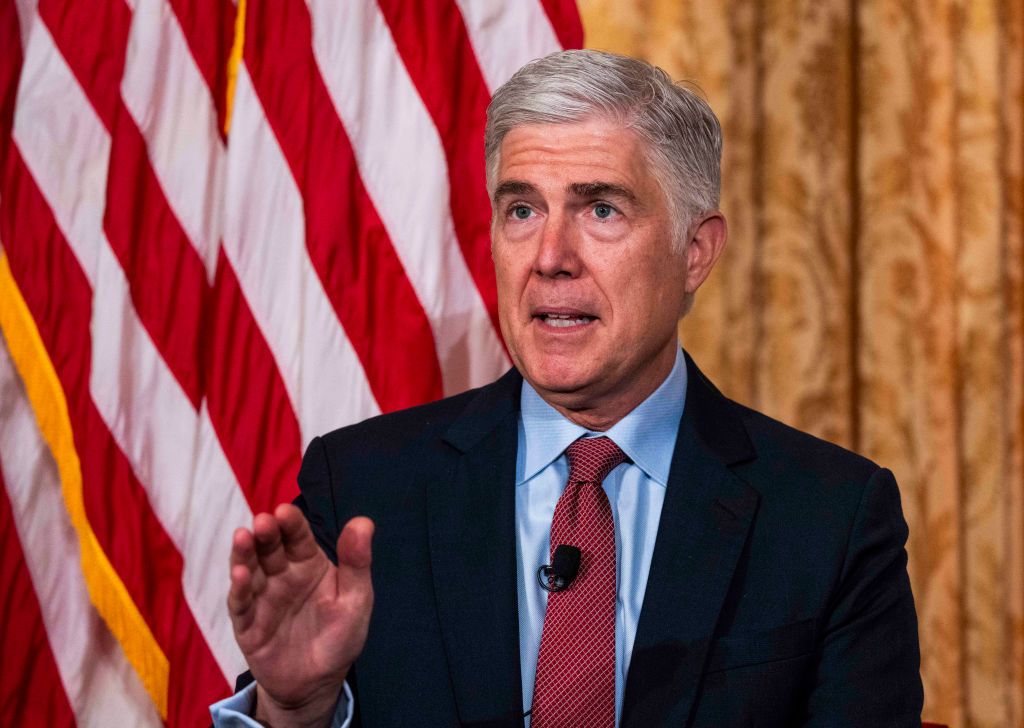
In his High Style column, Kendall Gray revisited Justice Neil Gorsuch’s majority opinion in United States v. Hemani, noting that Gorsuch was “not engaged in legal writing so much as strong English style.”
Podcasts
Advisory Opinions
Insular Cases | Interview: Chief Judge Jeff Sutton and Neil Weare
Sarah Isgur and David French discuss updates on two cases: preferred advertising rates for political committees and congressional redistricting in Missouri. Then, Judge Jeff Sutton, chief judge of the U.S. Court of Appeals for the 6th Circuit, and Neil Weare, co-director of Right to Democracy, join to discuss the Insular Cases and where birthright citizenship stands now.
Amarica's Constitution
More Statesmanship, and State Constitutions - Special Guests Steven B. Smith and Vikram D. Amar
Akhil Amar and Andy Lipka speak with Steven B. Smith about his new book, On Statesmanship, and Vikram Amar about the dispute over Missouri redistricting.
Divided Argument
Shoe of Damocles
Will Baude and Dan Epps discuss the per curiam standing rulings in the White House ballroom case and in the first interim docket case on President Donald Trump’s executive order on mail-in voting.
A Closer Look
Justice Gabriel Duvall
In an earlier Closer Look, we noted that Justice Thomas Todd often takes the title of “most insignificant justice.” He is rivaled, however, by the subject of today’s closer look: Justice Gabriel Duvall. Indeed, a 1936 history of the court proclaimed Duvall the winner (or loser?), and in 1983, two law professors revisited the question. Professor David Currie ruled for Duvall, “praising” him for “an enviable standard of insignificance against which all other Justices must be measured.” Professor (and later Judge) Frank Easterbrook called the contest between Duvall and Thomas Todd “almost a dead heat” between “the Tweedledee and Tweedledum of sloth” – before handing the title to Todd. We’ll let you decide who emerges victorious.
Duvall, a direct descendant of Mareen Duvall, a Huguenot who fled France for Maryland in 1655, was born in December 1752 in Prince George’s County. (Genealogists have determined that both President Barack Obama and Vice President Dick Cheney are distant relatives of Mareen Duvall.) Admitted to the bar in 1778, Duvall spent the first years of the American Revolution as a clerk for the Maryland State Convention (Maryland’s revolutionary convention that created the state government) while serving in the state militia. He also represented enslaved Marylanders suing for their freedom: In 1791, Duvall filed petitions against a slaveholding Jesuit priest on behalf of two individuals. At the same time, Duvall himself owned at least eight enslaved people as of 1783; at one point, Francis Scott Key (who also represented enslaved persons) successfully sued Duvall to free a family held by Duvall.
Duvall resigned from the Executive Council of Maryland in 1786 because he believed a new law expanding the governor’s (and the council’s) powers was “repugnant to the Constitution and Form of Government of this State.” Maryland subsequently named him a delegate to the 1787 Constitutional Convention, although Duvall never attended – Oyez attributes the absence to his wedding, which fell during the proceedings.
Duvall won a seat in the U.S. House in 1794 as a Democratic-Republican, where he met then-House member James Madison. Duvall resigned in March 1796 to become chief judge of the General Court of Maryland, taking the seat that Samuel Chase had held before he joined the Supreme Court. In 1800 Duvall publicly defended Thomas Jefferson as “the Friend of the People” in response to allegations that Jefferson had absconded from Richmond before the British arrived. Duvall served as a Jefferson presidential elector that year. Jefferson returned the favor in 1802, naming Duvall the comptroller of the treasury, the treasury secretary’s legal adviser. Duvall reportedly earned such a “reputation for accuracy and honesty” that both sides of congressional debates trusted his figures.
Madison’s first choice for Chase’s seat was John Quincy Adams, who opted to remain a diplomat in Russia. Madison nominated Duvall on Nov. 15, 1811, the same day he nominated Joseph Story; the arrival of the two Democratic-Republicans flipped the court’s Federalist majority. Duvall took his seat on Nov. 23 at age 58, and he and Story first took the bench together the same day in February 1812 – after which their reputations “diverged widely.”
Unlike Story, by most accounts Duvall did very little. He generally voted with Chief Justice John Marshall and favored a nationalist reading of the Constitution. Currie wrote that Duvall’s entire output on a constitutional case in his 25 years on the court was a single three-word dissent in the Dartmouth College case – “DUVALL, Justice, dissented” – approximately 0.0008 pages per year. Easterbrook’s reply counted 18 opinions across all fields, 15 of them for the court, although he described them as “graceless and plodding, saved only by their brevity.” In fairness, Duvall sat during the era with the lowest rate of separate opinions in the court’s history, at 7%. And not everyone has been so harsh: Prince George’s County court notes that Marshall drew on Duvall’s commercial expertise and assigned him opinions on public finance. Justice Bushrod Washington’s correspondence shows Duvall as strict on procedure – in 1822, he objected to a motion made after three members of the majority had already gone home.
Duvall’s most enduring work likely came in two slavery cases. In Mima Queen and Child v. Hepburn, argued for the petitioners by Francis Scott Key, he dissented alone from Marshall’s opinion excluding hearsay evidence of free ancestry, arguing that because freedom was at issue the customary rules of evidence should yield. Duvall wrote that “the right to freedom is more important than the right of property” and warned that the majority’s rule “cuts up by the root all claims of this kind.” Sixteen years later, in Le Grand v. Darnall, Duvall wrote for a unanimous court that a slave owner’s bequest of property to a person he had enslaved freed that individual by necessary implication. (Easterbrook concluded that these opinions cost Duvall the “most insignificant” title.)
Deafness eventually ended Duvall’s time on the bench. He reportedly held onto his seat to block someone he felt was “too much of a politician” to serve on the court and left only upon learning Roger Taney would be nominated. Duvall resigned in January 1835 as the court’s “first conventional retiree” – that is, the first justice to leave voluntarily after a long career (previous justices had either died on the court or left for another job after a brief tenure). Marshall’s farewell letter noted “the purity of his public life,” although the letter went unpublished until 2006 and the court did not note his departure at all for several weeks.
Duvall died at Marietta, the Duvall family home, in March 1844 at age 91, leaving a law library of 528 volumes. Despite his record on the court, Duvall never personally denounced slavery, and his estate at his death included 36 enslaved people. More than a century later, Prince George’s County inducted him into its Hall of Fame and named a wing of its courthouse for him.
SCOTUS Quote
Continue reading...
[ H/T SCOTUSblog ]