

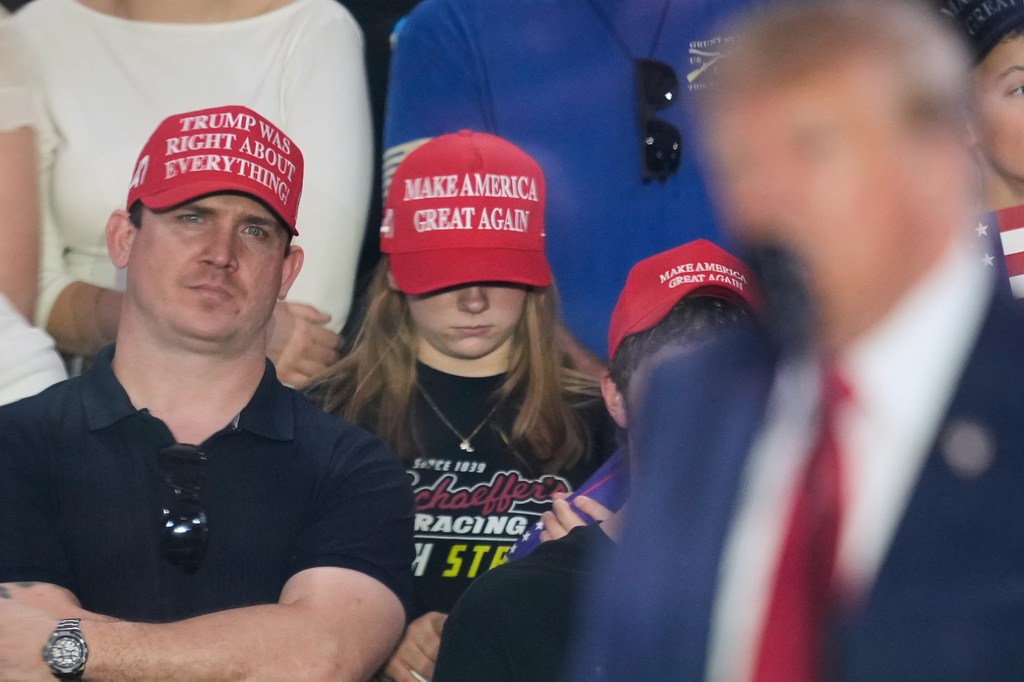
In his recent breakdown of the Republican Party’s internal mechanics, the Washington Examiner’s chief political correspondent Byron York highlighted a stark operational reality: President Donald Trump holds a 95% approval rating among self-described MAGA Republicans. While conventional political coverage filters this data through a lens of partisan triumph or panic, an objective institutional analysis reveals a more volatile structural problem. MAGA is no longer just a faction within the GOP. From a purely administrative standpoint, it has become the party’s entire engine.
When a system relies on a single, hyperconcentrated driver for nearly all of its enthusiasm and voter turnout, that system ceases to be a diversified coalition. It becomes a political monoculture. In infrastructure, relying on a single, un-replicable component creates a distinct vulnerability known as a single point of failure. Remove that component, and the surrounding structure does not simply adapt; it collapses under its own weight. MAGA has become the central pillar holding up the modern Right, meaning its exit would pull down the entire architecture.
Analyzing data over a multiyear trajectory reveals a striking paradox: the MAGA segment is growing larger inside the Republican Party, but weaker within the national electorate. According to historical polling data compiled by Statista, self-identified MAGA voters made up roughly 38% of the Republican electorate in late 2022. Today, that figure sits between 50% and 70%. On paper, this internal consolidation looks like an expansion of strength. It gives the movement absolute veto power over the party’s infrastructure, guarantees primary victories, and aligns the platform tightly with the base.
However, this internal capture masks a severe external erosion. The movement is capturing a dominant share of a steadily narrowing national coalition. While Trump maintains his 95% wall among MAGA loyalists, York’s column details how his approval among non-MAGA Republicans drops precipitously to just 47%. This profound divergence illustrates that the traditional, establishment wing of the party lacks the density and emotional capital required to sustain a national competitive footprint. If the MAGA engine stalls or dissolves, the remaining architecture of the GOP is structurally incapable of winning national elections against a highly disciplined progressive apparatus. The consequence is not just a few lost election cycles; it is the functional dissolution of the center-right as a viable governing force.
This brings us to the broader institutional question that defines the modern political landscape: If the movement collapses, is the country itself lost?
Rather than engaging in apocalyptic predictions, a pragmatic assessment requires looking at the systemic functions the movement performs. The base is fundamentally driven by tangible, everyday strains: persistent inflation, fractured local infrastructure, and an acute distrust of federal institutions. With the national job approval rating hovering around 36% to 38.8% in late October 2026, the administration is facing an operational disconnect. Independent voter support has bottomed out, driven by macroeconomic realities such as 3.7% inflation and energy cost spikes tied to escalating conflicts with Iran.
The administration’s core political mistake has been an echo-chamber effect, frequently conflating base intensity with national popularity. By tailoring policy and rhetoric almost exclusively to the 95% approval base, the executive branch has alienated the “Pragmatic Right” and independent voters who supported the ticket out of economic utility rather than movement loyalty.
THE PRESIDENT STILL THINKS HE’S ON REALITY TV
Yet, in the current electoral landscape, MAGA acts as the primary institutional counterweight to a specific vision of progressive globalization and administrative expansion. The American two-party framework relies on a predictable friction between opposing forces to maintain equilibrium. If the center-right party fractures irreversibly, the balance collapses. A society cannot maintain long-term stability without a cohesive, functional opposition party to stress test policies and represent structural alternatives.
The risk of a post-MAGA vacuum is not a dramatic, sudden end to the nation, but rather a profound, unchecked systemic imbalance where institutional guardrails vanish, local realities are ignored by a centralized apparatus, and a vast portion of the electorate is left permanently disenfranchised. The challenge for the modern Right is to recognize that building a sustainable political ecosystem requires more than a single engine. MAGA is currently suffering from a structural supply-chain crisis: it has built a highly efficient mechanism for turning out its core, but the product itself is failing to attract new consumers. In a two-party system, a movement that grows more pure internally while alienating external swing segments eventually hits a wall of demographic math. The threat to the party is not that the base will abandon it, but that the base will be left holding the keys to an electoral fortress that no longer commands the surrounding territory.
Eric Wargotz, M.D., is a practicing physician, geopolitical analyst, and multi-sector policy writer whose commentary has appeared in the Washington Examiner, the Baltimore Sun, and the Jerusalem Post. He currently serves as a judge and the 178th president of MedChi, the Maryland State Medical Society, following a career that includes serving as a U.S. Senate nominee and elected county commission president. A clinical professor emeritus at George Washington University, his views are his own and do not represent his affiliates.
Continue reading...
[ H/T Washington Examiner ]