







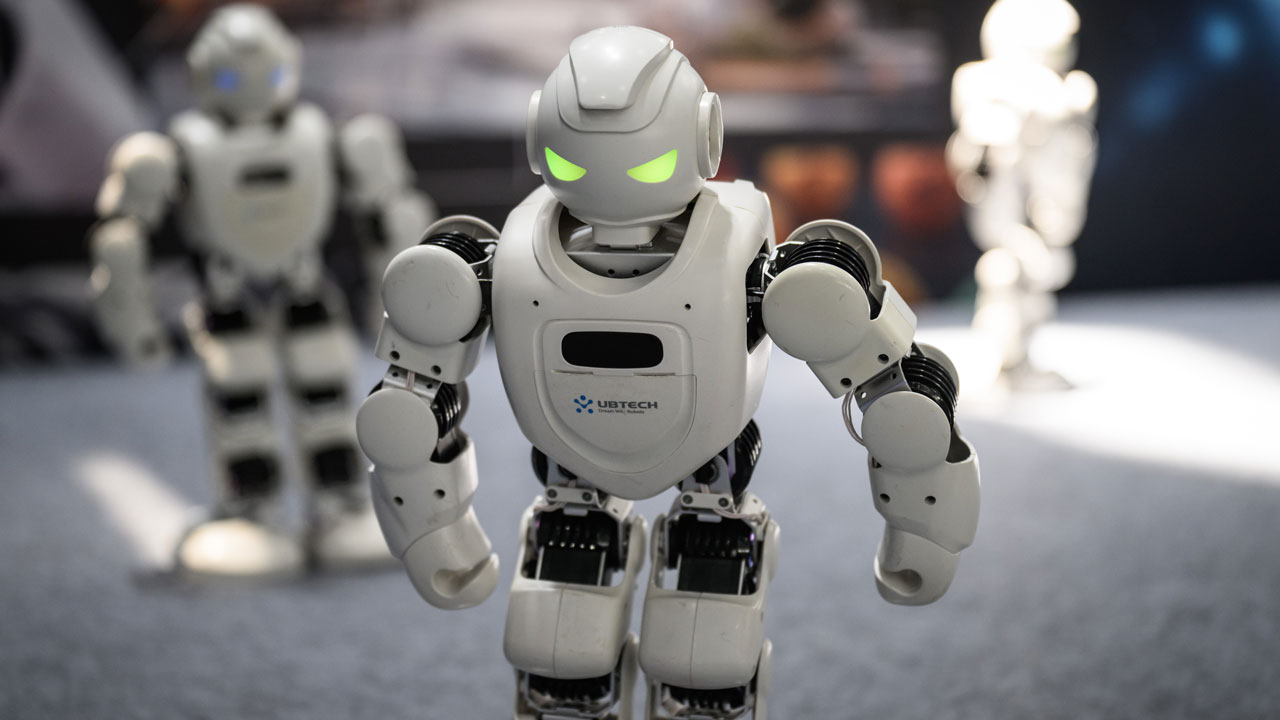
The United States is about to import the next generation of surveillance technology–not in the form of apps or routers but embodied in humanoid robots built by Chinese companies.
These machines could become the next frontier of CCP surveillance, and Washington shouldn’t let them flood the U.S. market.
Humanoid robots are programmed to mimic human movements using machine learning to make real-time “decisions.”
They learn by using pattern recognition to predict what happens next through imitating human users, studying their environment, and engaging in trial and error. To do so effectively, they rely on machine learning systems that continuously collect and process data from their surroundings.
Cameras, sensors, and onboard systems capture detailed information about physical spaces, human behavior, and operational workflows. That data is often transmitted back to developers to improve performance and refine future models.
For Chinese humanoids, that means all the data is stored in servers overseas. And since Chinese law requires all companies to comply with party interests, all the harvested information is directly accessible to the Chinese government.
These machines are no longer just science fiction, and they are getting cheap fast. Most humanoids cost nearly $50,000, but certain Chinese models sell for as low as $13,500––cheaper than your average used car.
That low price tag reflects both China’s lower labor and manufacturing costs and the over $20 billion the Chinese government has poured into subsidizing its domestic robotics industry. The result is a wave of low-cost machines poised to scale quickly in global markets.
This combination of data access and lower costs creates risks similar to those the U.S. has seen with TikTok or Chinese routers.
Like past Chinese technologies, humanoid robots collect sensitive information except now sensors are embedded in physical environments.
Concerns are already emerging.
Unitree, a major Chinese robotics firm, has drawn scrutiny from the House Select Committee on the Chinese Communist Party. Its systems have reportedly been used in military contexts. These machines are gathering potentially critical intelligence about our national defense infrastructure and storing it in foreign hard drives. Unitree’s quadruped humanoids have even been utilized by the Marines for select operations.
Preventing Chinese surveillance is always in America’s national interest.
Recent legislation reflects this, such as the National Defense Authorization Act for Fiscal Year 2026.
The NDAA included amendments by Rep. John Moolenaar, R-Mich., to assess just how much of our military infrastructure depends on hardware from dangerous foreign entities.
Soon thereafter, the FCC added Chinese routers to their Covered List, banning them from U.S. markets.
The FCC maintains a “Covered List” of communications equipment and services deemed an unacceptable risk to national security. Once listed, equipment cannot receive the FCC authorization required for sale in the United States, effectively shutting it out of the American market.
Last December, the FCC added select foreign drones to their Covered List, including the Chinese manufacturer DJI, which dominated 75% of the U.S market at the time.
Protecting Americans from humanoid technology looks no different.
According to current statutes, any national security agency with relevant expertise, such as the Department of War or Department of Homeland Security, can simply update FCC’s Covered List to include dangerous humanoid technology, thus ending further Chinese surveillance.
Better yet, the brilliance of such a ban is that it also allows American manufacturers to flourish.
It’s not as though we’re solely dependent on foreign-made machines, like we were with DJI and the drone market.
Some of the biggest names in humanoid manufacturing come from the United States, including Elon Musk’s Tesla, Amazon’s Fauna Robotics, and Boston Dynamics.
Domestically, an outright ban of Chinese humanoids allows these American companies to focus on developing quality products, not just beating China in the latest tech race.
As it stands, foreign manufacturers, like China’s Unitree, threaten American developers.
When it comes to sheer numbers, China could soon control the American market. Not surprising since they produce more robots and they cost less than American-made alternatives.
Comparatively, while American humanoids largely remain in testing, Unitree produced an alleged 5,500 humanoids last year. They set the lofty goal of 20,000 more machines for 2026.
Tesla, on the other hand, has manufactured roughly 1,000 Optimus humanoids to date.
Cost-effective American humanoids are within reach, but the domestic industry needs room to mature, and it won’t get that chance if China is allowed to corner the market first.
Keeping Chinese manufacturers from swallowing the market now is what buys American developers the time to compete on both price and security later.
If left unregulated, Chinese humanoids have the potential to become one of the most dangerous threats facing the United States. But by the time these machines fully enter U.S. markets, it may just be too late.
Decoupling from the Chinese robotics industry will become significantly riskier after we’ve already allowed them to devour the U.S. market share. Pivoting to American companies now ensures the market share rests in American hands, furthering economic independence and technological innovation.
We must take steps to protect our industries, treating this threat like any other national security risk.
Update the FCC Covered List like we did for dangerous routers, servers, and drones. Prevent literal Chinese robots from spying on American citizens. In doing so, American manufacturers and start-ups can grow, unencumbered by Chinese competition. When it comes to our national interest, the best humanoid technology should be made in America.
Continue reading...
[ H/T The Daily Signal ]